Published
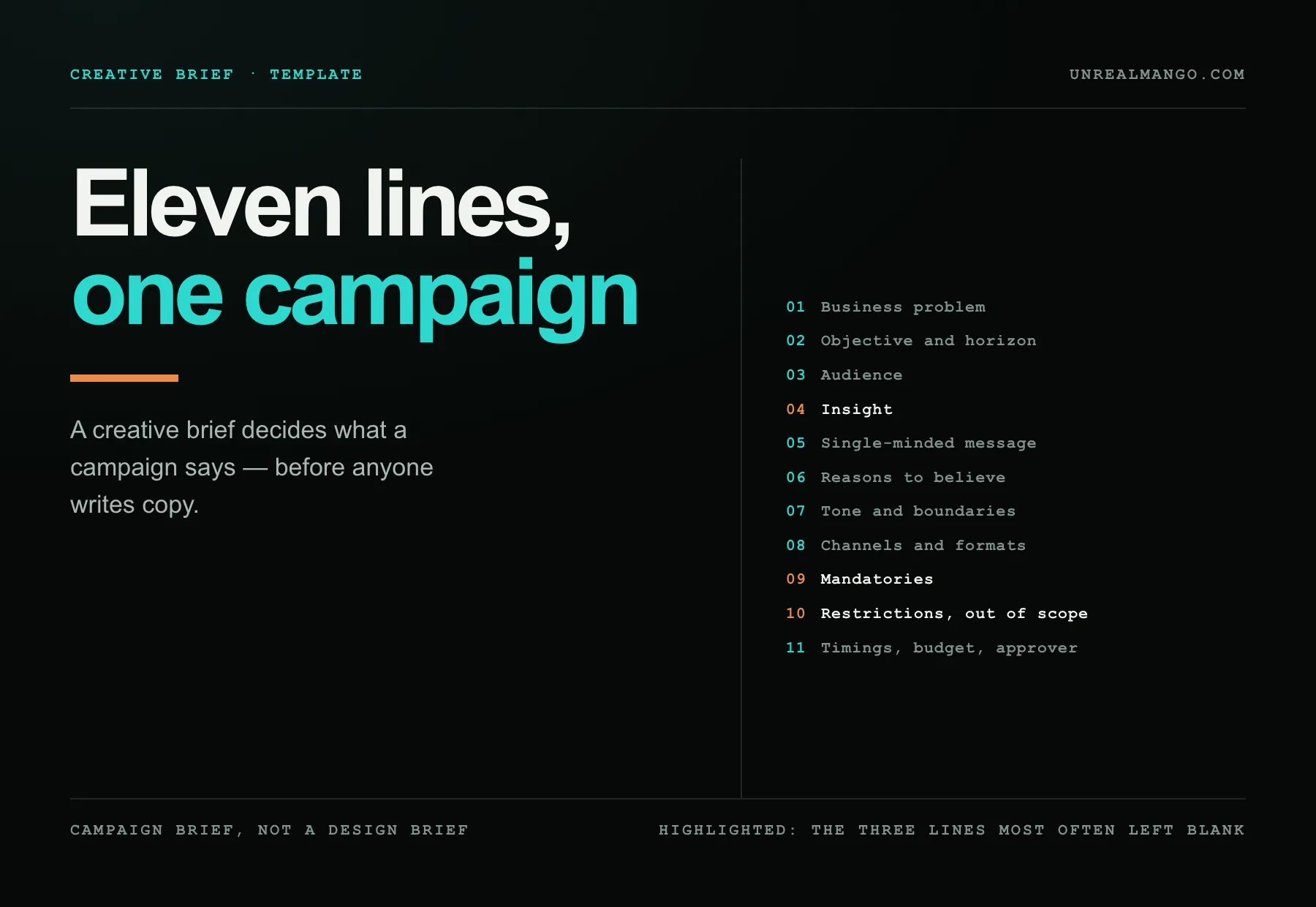
A creative brief is a one-page document that tells a creative team what a campaign has to say, to whom, and under what constraints. It records eleven decisions — problem, objective, audience, insight, message, reasons to believe, tone, channels, mandatories, restrictions, approver — before anyone writes a line of copy.
It is not the same document as a design brief, which specifies a single artefact and its files. That difference is worth two minutes if you are unsure which one your project needs; the rest of this article assumes you need the campaign one and gets on with filling it in.
What the search results actually contain. On 25 August 2026 we pulled the United States results for “creative brief template”: nine organic results, an image pack of 33 thumbnails sitting above all of them, and no AI Overview. Four of the nine are template giveaways, three are guides with a template inside, one is a YouTube walkthrough, and one is a Reddit thread in an advertising forum asking what format people actually use. Five of the nine describe the brief in campaign language — audience, messaging, campaign goals — and the one that narrows, StudioBinder’s video-agency template, still runs on campaign objectives and only splits its dates into pre-production, production and post. One result, Asana’s, works a hypothetical launch through its own nine fields, from title to distribution. Not one of the pages we could open fills in the mandatories, the restrictions or the approver — the three lines that reach the media plan, and the three this article fills in. Rankings inside that set move week to week; what has held across re-checks is the shape — nine organic results, an image pack above all of them, no AI Overview, a Reddit thread in second place, and campaign framing dominant.
Eleven decisions a creative brief has to record
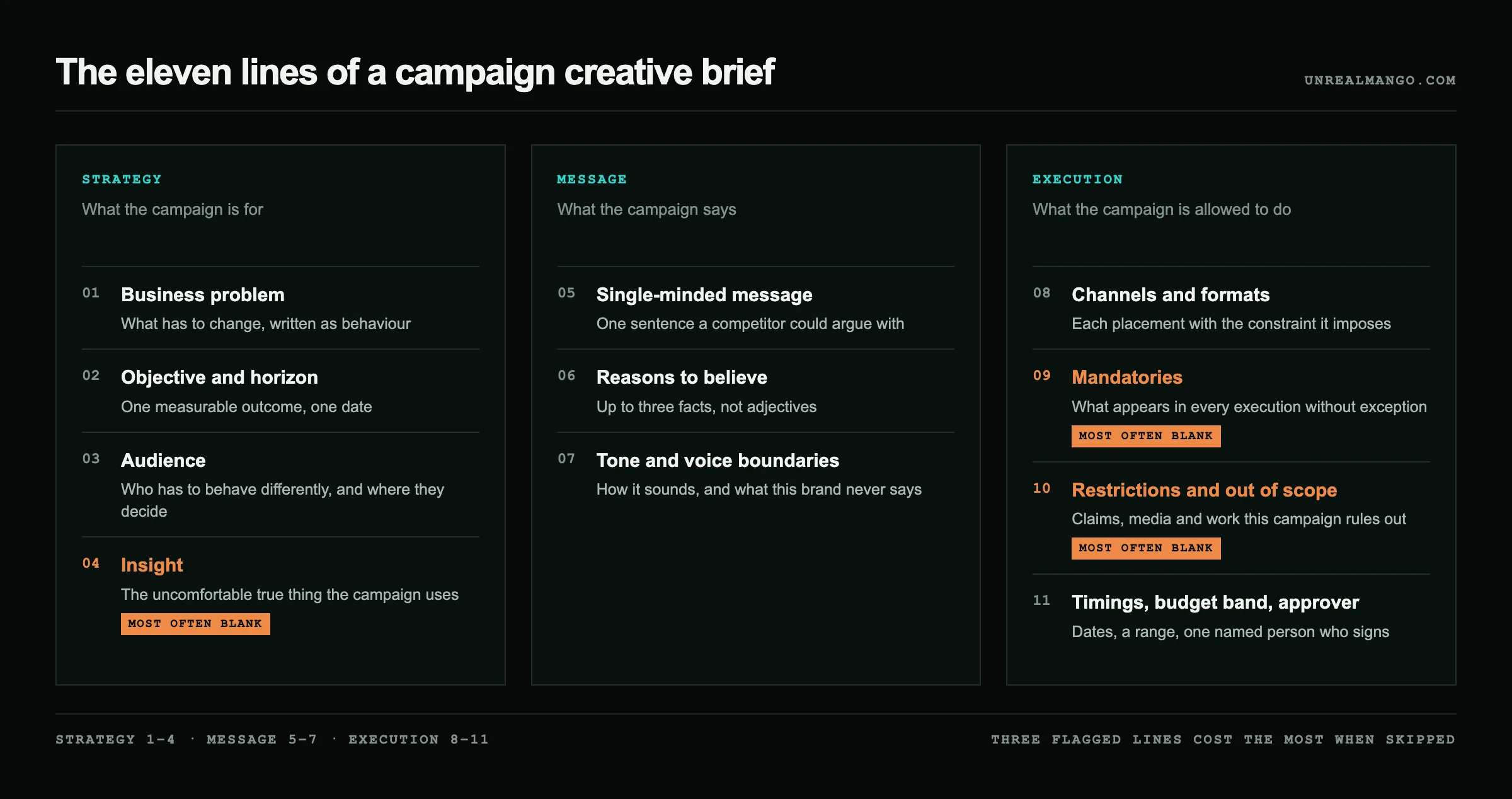
Every line below exists because something goes wrong when it is missing. That is the only test a field has to pass to earn its place: name the failure it prevents, or cut it.
| Line | The decision it records | What happens when it is blank |
|---|---|---|
| 1. Business problem | What has to change in the market, written as behaviour rather than as an adjective | The campaign gets judged at the end on whatever number happens to be available |
| 2. Objective and horizon | One measurable outcome and the date it is measured on | Every result can be described as a success |
| 3. Audience | The people whose behaviour has to change, described by what they do, not by an age bracket alone | The work is aimed at everyone and lands on nobody |
| 4. Insight | The uncomfortable true thing about those people that the campaign uses | The idea starts from product features and stays there |
| 5. Single-minded message | The one sentence the campaign has to leave behind | The team writes three campaigns at once and picks none |
| 6. Reasons to believe | Up to three facts that make the message credible | The message gets asserted louder instead of supported |
| 7. Tone and voice boundaries | How it sounds, plus the words this brand never uses | Every review round turns into an argument about taste |
| 8. Channels and formats | Where it runs, and the constraint each placement imposes | The idea is written for a format that cannot hold it |
| 9. Mandatories | The elements that must appear in every execution without exception | Legal and brand come back after the edit is locked |
| 10. Restrictions and out of scope | Claims that cannot be made, media that cannot be bought, work this campaign is not doing | Scope grows quietly and nobody can point at when |
| 11. Timings, budget band, approver | The dates, the range, and one named person who signs | The brief is approved by a committee, which means by nobody |
The layout is the least interesting decision here. Eleven headings with a sentence or two under each fits on a page, and a page is enough — the difficulty was never the layout, it was deciding what goes on the lines. The three that come back blank most often in briefs we are sent are the insight, the mandatories and the out-of-scope line, and those are precisely the three that cost money later.
A worked creative brief: the Fenmoor spritz launch, all eleven lines
The brief below is a composite, assembled from the shape of launches we work on rather than lifted from one client’s file, so the names and the numbers are stand-ins and the structure is not. A small distillery is putting a canned spritz into supermarkets for the first time.
| Line | What was written |
|---|---|
| 1. Business problem | “Fenmoor sells 70% of its volume through bars in two cities. The canned spritz enters 600 supermarket stores in March. Outside those two cities nobody has heard of us, and the can sits beside four national brands at the same shelf price. What has to change: someone reaching into a chiller for a ready-to-drink can has to have a reason to take ours.” |
| 2. Objective and horizon | “Trial, not awareness. Target: 60% of stocked stores placing a reorder within 90 days of launch, read from the distributor’s reorder report on 1 June.” |
| 3. Audience | “25–39, buys ready-to-drink for other people — the person who brings something to a table of six. Buys in the same trip as the food, decides in front of the chiller.” |
| 4. Insight | “The fear is not that the drink tastes bad. It is being the person who brought the boring thing.” |
| 5. Single-minded message | “The one you bring on purpose.” |
| 6. Reasons to believe | “Bittered with the same infusion as the aperitivo we only pour in bars; one can is a full bar serve, not a half; distilled and canned in our own building.” |
| 7. Tone and voice boundaries | “Dry, specific, adult. Never ‘crafted’, never ‘perfect for summer’, no cocktail puns, no sunset photography.” |
| 8. Channels and formats | “Six-second YouTube bumpers on mobile; banners in the grocery chain’s app; thirty-sheet posters in four cities; shelf talkers in store.” |
| 9. Mandatories | “Can visible in every execution; ABV and volume legible; the responsible-drinking line; the retailer’s approval mark on anything in store.” |
| 10. Restrictions and out of scope | “No taste comparison against a named competitor. No media buy that misses the spirits industry’s 73.8% adult-audience standard. No influencer work this phase. Bar activation is a separate brief and a separate budget.” |
| 11. Timings, budget band, approver | “Assets locked 10 February, flight 3 March to 14 April. Production band $60–80k; the media budget sits in the media plan. One approver: the commercial director, Ines Faber.” |
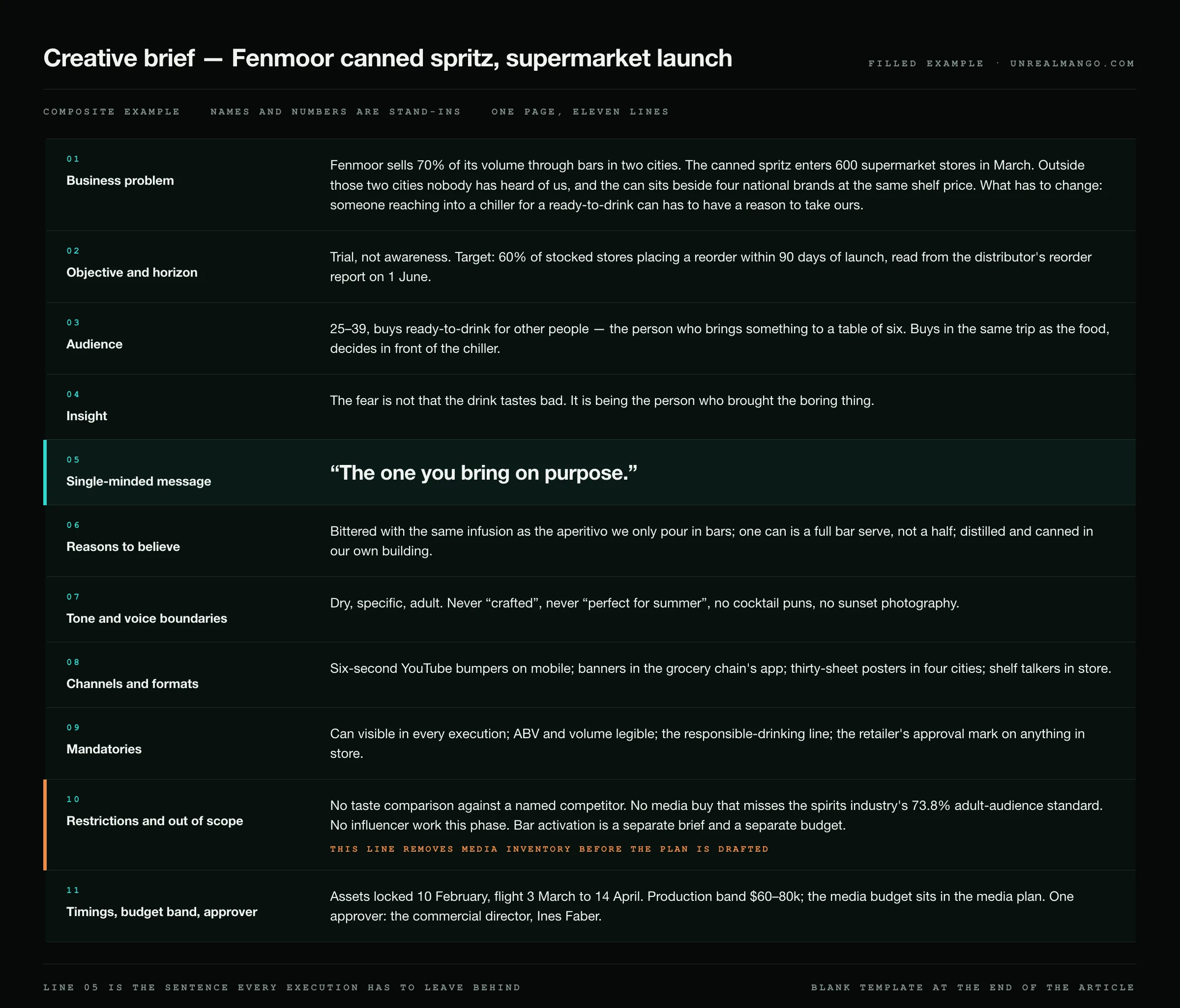
Line 4 did the most work. “The fear is being the person who brought the boring thing” is an insight because it is about the buyer and it is slightly unflattering. Compare it with what usually appears on that line — “consumers want premium quality at an accessible price” — which is true of every product ever sold and therefore rules nothing out. An insight that rules nothing out has not been written yet.
Line 5 took the longest. “The one you bring on purpose” survived because it is a sentence a competitor could argue with. It also survived a harder test: it can be executed in a six-second video, on a poster and on a shelf talker without becoming a different idea in each.
Line 10 is where the media plan gets saved. A restriction written on line 10 removes inventory before a plan is drafted, not after a buy — on launches we have worked on, this line has taken placements out at brief stage. That is the single highest-value line in this document, and it is one of the three most often left empty.
The single-minded message, and the two tests it has to pass
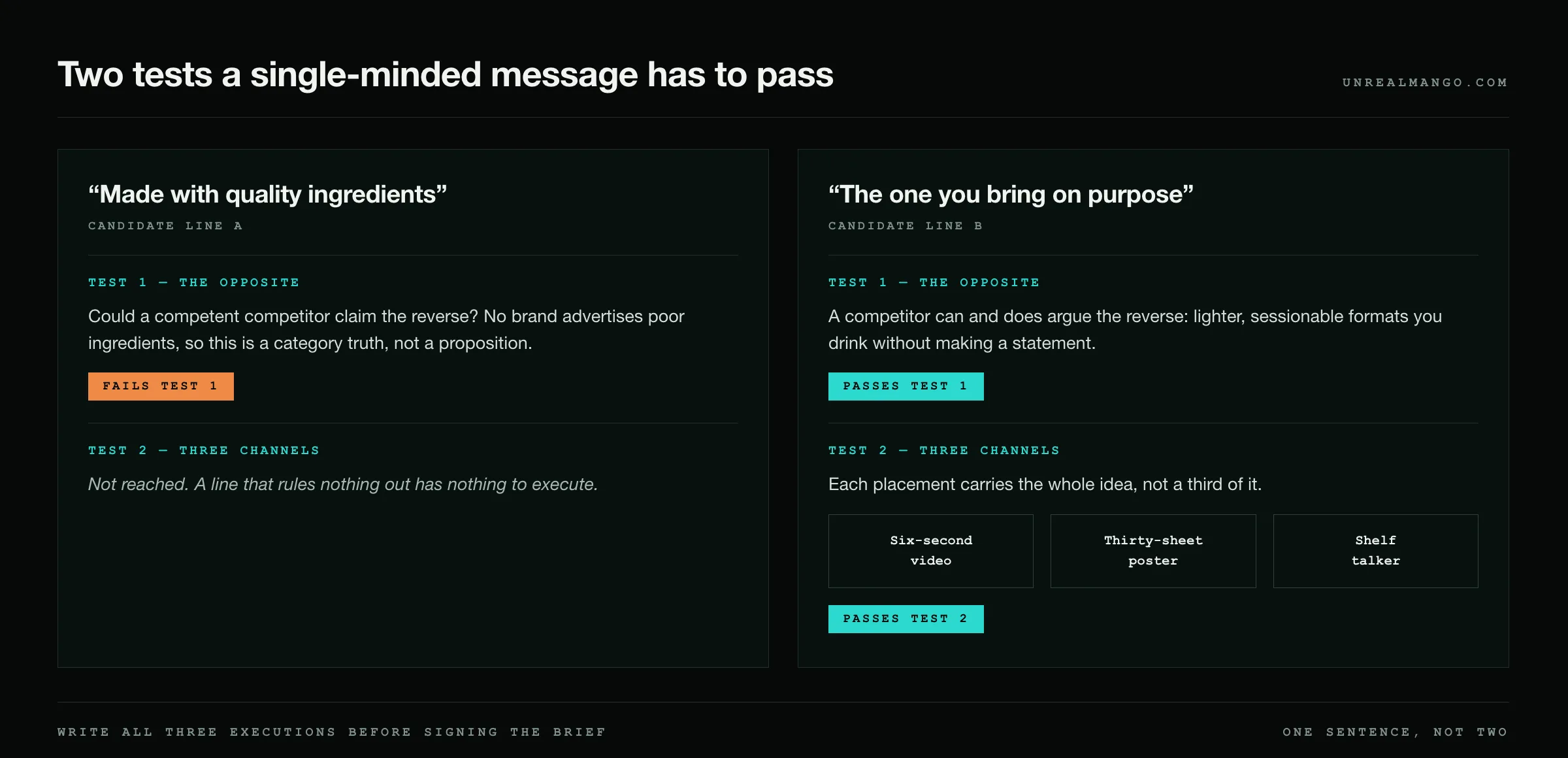
A single-minded message is one sentence, and the discipline is in the adjective. Two messages is not a compromise, it is two campaigns sharing a budget: the audience receives whichever one the media weight happened to favour, and the post-campaign debrief argues about which was tested.
Test one: can a competent competitor claim the opposite? If nobody sane would advertise the reverse, the sentence is a category truth rather than a proposition. “Made with quality ingredients” fails — no brand advertises poor ingredients, so the line rules nothing out. “The one you bring on purpose” passes, because a competitor can and does argue the reverse: lighter, sessionable formats you drink without making a statement.
Test two: can three different channels each carry it whole? Write the six-second version, the poster version and the shelf-talker version before signing the brief. If the idea only works in the format someone had already imagined, the message line is not a message, it is an execution that arrived early and will quietly overrule every other channel.
Mandatories and restrictions: the lines that reach the media plan as bugs
Mandatories look like housekeeping and behave like arithmetic. A YouTube bumper is a non-skippable ad of up to six seconds — that is the format’s definition, not a guideline. If the pack shot needs about a second and a half to register and the legal line about the same — and the ABV has to be legible inside one of them — the message is left with three of the six seconds, and there is no negotiation available at the edit. Those two durations are working assumptions, not a published standard; the six-second cap is the part that is fixed. Writing “can visible, ABV legible, responsible-drinking line” on line 9 costs nothing; discovering the same three items after the edit is locked costs a re-edit and a re-approval.
Restrictions do something else: they remove options before anyone has spent money on them. In the United States, spirits advertising runs under a self-regulatory code — voluntary, not a statute — which since May 2023 asks that advertising be placed only in media where at least 73.8% of the audience is reasonably expected to be above the legal purchase age of 21, raised from the 71.6% standard grounded in 2010 census data. The beer industry’s equivalent code sets its own threshold at 73.6%. Numbers at that level of precision do not survive being remembered approximately in a meeting, which is exactly why they belong on a written line in the brief rather than in a media planner’s head.
The out-of-scope line is the cheapest insurance in the document. “Bar activation is a separate brief” is six words that prevent a second campaign from being absorbed into the first one’s budget in week three, and it works because it was written before anybody wanted it to be flexible.
Document, deck or ticket: what the brief should physically be
The Reddit thread ranking second for this search is a practitioner asking a practical question — where does the brief actually live. It is a fair question, because the carrier changes what survives.
| Carrier | What it does well | What it loses |
|---|---|---|
| Document | Comments attach to the exact line they argue with; version history shows when the message changed and who changed it | Nobody opens it again once the work starts, so the mandatories get remembered rather than read |
| Deck | Gets read in the room, and one thought per slide forces the message line to be short | Decisions get made out loud over a slide and never written back; the brief drifts into a presentation about the brief |
| Ticket | Sits beside the work, links to assets and to the approval trail | Fields are short, so the insight collapses into a phrase and the campaign cannot be read as one argument |
What works in practice is not choosing one. Write the brief as a document, because that is the only carrier in which an argument can be made and traced. Paste the single-minded message and the mandatories into the ticket, because those are the two lines anyone building an asset needs at hand. Use a deck only for the read-out, and treat the slides as a summary that has no authority — if a decision changes in the room, it changes in the document before the meeting ends, or it did not change.
From a campaign brief to the deliverables it spawns
A creative brief does not brief a maker. It briefs a team, and once the message is signed, each asset needs its own specification: exact sizes, bleed, file formats, safe areas, how many directions to present. That specification is the design brief, one per artefact, and it inherits the mandatories from line 9 rather than restating the strategy. On our side, it is what the graphic design team asks for on the day a campaign is approved, and its absence is the most common reason a signed-off idea sits still for a week.
The same split applies to words. An article, a landing page or a script commissioned off the back of a campaign is not covered by the campaign’s message line: a writer needs the topic, the search intent, the structure and the internal links, which is a content brief and a different document again. One campaign brief, several deliverable briefs, and nobody working from a strategy document with no specifications in it.
The blank creative brief, eleven lines and nothing else
No email address, no sign-up: select it and paste it. Cut the lines your campaign does not need — a line cut on purpose is better than a line filled with a description.
CREATIVE BRIEF — [campaign name] — [date] — v[n]

1.  BUSINESS PROBLEM
    What has to change in the market? Write it as behaviour, not as an adjective.
2.  OBJECTIVE AND HORIZON
    One measurable outcome, one date it is read on, one place it is read from.
3.  AUDIENCE
    Who has to behave differently. What they do, where they decide, not just an age range.
4.  INSIGHT
    The true, slightly uncomfortable thing about them this campaign uses.
5.  SINGLE-MINDED MESSAGE
    One sentence. A competitor must be able to argue the opposite.
6.  REASONS TO BELIEVE
    Up to three. Facts, not adjectives.
7.  TONE AND VOICE BOUNDARIES
    How it sounds. Plus the words and images this brand never uses.
8.  CHANNELS AND FORMATS
    Each placement, with the constraint it imposes (duration, space, aspect, distance).
9.  MANDATORIES
    What must appear in every execution: product, logo, legal line, disclaimer, CTA, tracking.
10. RESTRICTIONS AND OUT OF SCOPE
    Claims we cannot make, media we cannot buy, work this campaign is NOT doing.
11. TIMINGS, BUDGET BAND, APPROVER
    Asset lock date, flight dates, budget range, one named person who signs.
Eleven lines, a page, an hour of arguing. The hour is the point: every one of those decisions gets made anyway, and the only question is whether it gets made in a document at the start or in a review meeting three weeks later, with a media buy already booked against it.
08 / Reader questions
Frequently asked questions
01What is a creative brief?
A creative brief is a one-page document that tells a creative team what a campaign has to say, to whom, and under what constraints, recording eleven decisions — problem, objective, audience, insight, message, reasons to believe, tone, channels, mandatories, restrictions and approver — before any work starts. It is a record of decisions, not a description of the product.
02What is the format of a creative brief?
One page, eleven headings, a sentence or two under each — and the layout is the least important part of that, because what matters is that the brief lives in a document, where comments attach to the line they argue with. A deck or a ticket carries a summary of it, not the brief itself.
03What does a creative brief look like?
It looks like a short form with eleven answers rather than a deck: each line is a decision written as a sentence — the behaviour that has to change, the audience insight, one message, up to three reasons to believe, the channels with their constraints, what is out of scope, and one named approver. Anything longer than a sentence or two per line is a description, not a decision.
04Should a creative brief live in a document, a deck or a ticket?
In a document, with the message line and the mandatories copied into the ticket, because a document keeps every comment attached to the line it argues with and keeps a version history of when the message changed and who changed it. A deck gets read in the room but loses the decisions made verbally over it, and a ticket sits beside the work but is too short to hold the argument.
05Is there a free creative brief template?
Yes — the blank template at the end of this article gives all eleven lines with no email address and no sign-up: problem, objective, audience, insight, single-minded message, reasons to believe, tone, channels, mandatories, restrictions and out of scope, and timings with a named approver. Copy it, cut the lines that do not apply to your campaign, and keep each answer to a sentence or two.