Published
Field marketing is the part of business-to-business marketing that runs against a sales territory: one marketer owns a region, a segment or a set of accounts, spends a program budget locally, and is measured on meetings and pipeline from that patch rather than on leads from the whole funnel.
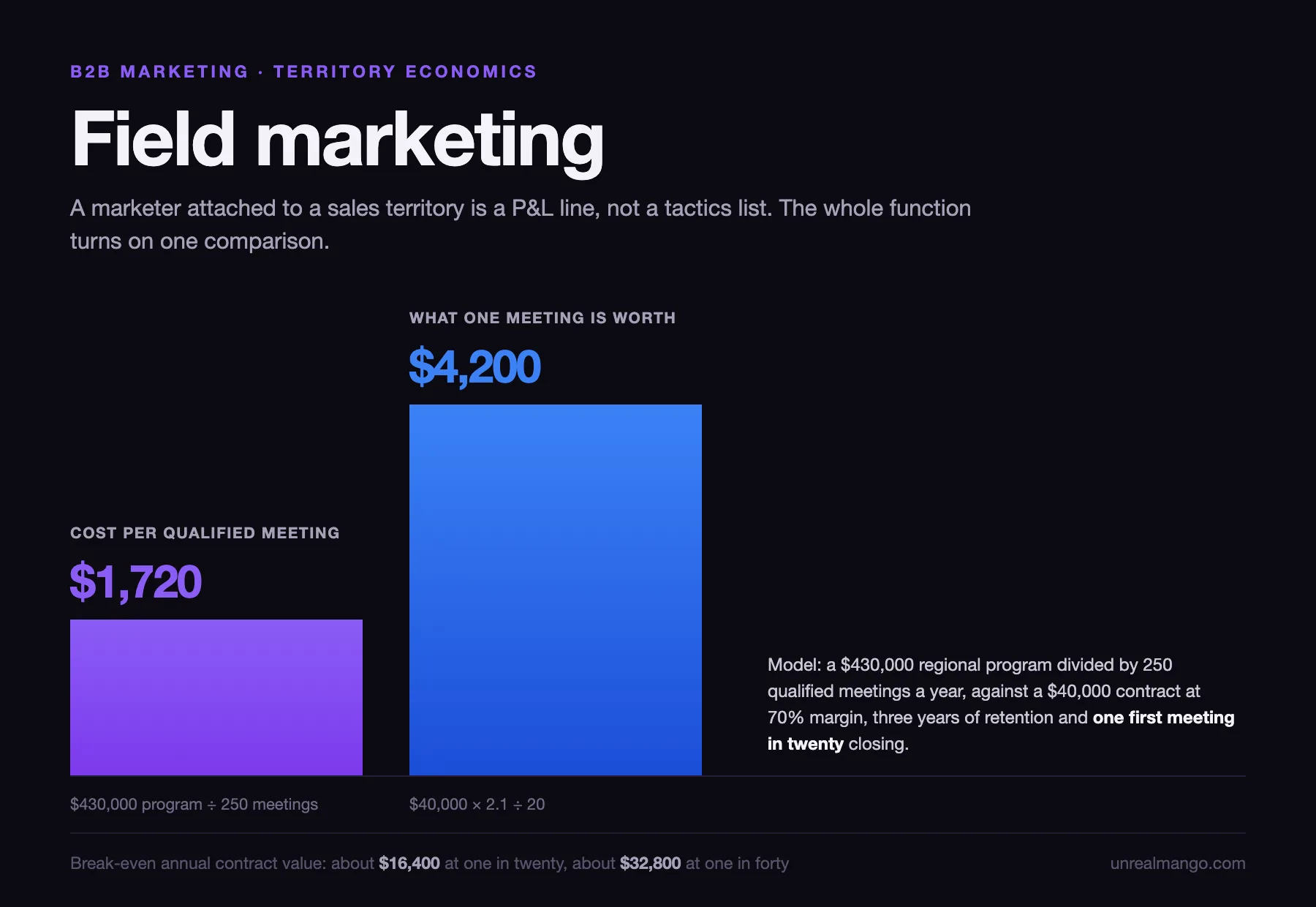
On the cost model below, a regional field program runs between $1,075 and $2,867 per qualified meeting. Take the middle of that range, $1,720, and the break-even sits between $16,400 and $32,800 of annual contract value, depending on whether one first meeting in twenty or one in forty ends in a signature. Below that band the function is a morale expense with a marketing label on it.
How this was checked. For this query in the United States on August 23, 2026, Google returned seven organic results, an AI Overview, a People Also Ask block, a discussions-and-forums panel and a perspectives panel. In order: Salesloft, a Reddit thread in r/marketing, Paperflite, Goldcast, Indeed, Cvent and Wikipedia. Four of them — Salesloft, Paperflite, Goldcast and Cvent — define the term and list tactics in almost the same order. Indeed answers a career question instead, and Wikipedia is still on the older retail definition. Not one publishes a cost per meeting, a break-even, or a rule for deciding whether the territory deserves a marketer at all. Three of the six People Also Ask questions are career questions, which is a fair signal that the query is crowded with people asking different things — so the first job of this page is to separate them.
Four different jobs are called field marketing, and this page is about one
The phrase is doing four jobs at once — three of them visible in the search results for it, which is why those results never settle into one shape. Sorting them takes one table, and it is the cheapest thirty seconds on this page.
| What the phrase means | Who uses it that way | The unit of work | Where you meet it |
|---|---|---|---|
| A B2B marketing function attached to a sales territory | Software, hardware and services vendors with regional sales teams | A region or segment, with a program budget | This page |
| Retail merchandising, sampling and in-store demonstration | Consumer brands and the staffing agencies that put people into their shops and shopping centers | A store visit or a shift | Encyclopedia definitions, and most listings that advertise a “field marketing agency” |
| The job title | Recruiters and job boards | A role, a level and a salary band | Careers guides and salary pages |
| A Field Marketing Organization, or FMO | US life and health insurance distribution | A contracted independent agent | Searches that pair the phrase with “insurance” |
The retail meaning is the older one and it has not gone anywhere. In consumer goods, field marketing means putting people into shops: sampling stands, merchandising resets, demonstration crews, audits of whether the display actually went up the way the planogram said. It is a labor-supply business, priced per shift and per store visit, and the agencies that run it are the ones bidding on the commercial phrase. That work shares a name with the subject of this page and almost nothing else — different buyer, different cost structure, different metric. If you arrived looking for a crew to stand in two hundred supermarkets on Saturday, the rest of this page will not help.
What a field marketer owns: a region, a number and a budget
Three things define the function, and none of them is a tactic.
A territory. Usually geography, sometimes an industry vertical, sometimes a named list. Whatever it is, it has to match how the sales team is carved up. A marketer covering the Midwest while the sellers are organized by industry is a coordination tax rather than a function.
A number attached to that territory. Pipeline created and pipeline influenced inside the patch, in dollars, in the same quarter the sales team is working. This is the part that separates field marketing from everything else in the department. Corporate marketing owns channels and assets; field marketing owns a line of the sales plan.
A program budget with local discretion. The right to decide that this quarter the region needs two dinners and no trade show, without escalating. Take the discretion away and the role degrades into event logistics for campaigns designed somewhere else.
What lands on the desk follows from those three: regional roadshows and half-day sessions, executive dinners of eight to twelve, partner and channel co-marketing, a small trade show program, local paid media and trade press, enablement for the sellers in the region, and customer advisory sessions with in-region references. None of that is unique to field marketing. Corporate runs dinners too. The difference is that a field program is judged on what the territory produced, not on how the dinner went.
Field marketing beside demand generation, account-based marketing and events
These four are constantly mistaken for one another because they buy the same things. The difference is not the channel list. It is what each one counts as its unit of work, and therefore what it fails at.
| Field marketing | Demand generation | Account-based marketing | Event marketing | |
|---|---|---|---|---|
| Unit of work | A territory or segment | A channel and an offer | A named company | A single event |
| Primary metric | Pipeline sourced and influenced inside the patch | Cost per qualified lead across the funnel | Engagement and pipeline per account | Return on one event’s full cost |
| Budget shape | Program dollars per region, held locally | Media budget per channel, held centrally | Research and content per account | A line item per show |
| Planning horizon | The quarter, tied to the sales plan | Rolling, tied to channel performance | The buying cycle of the list | The event calendar |
| Failure mode | Becomes an events desk with no number of its own | Volume the sales team refuses to work | Cost per account exceeds what the contract is worth | A good show that nobody follows up |
The overlaps are real and they are fine. A field program will run events; an account-based marketing program will use field events as one of its plays; demand generation will supply the region with content it did not have to make. What causes arguments is when two of them claim the same opportunity, which is a reporting problem covered further down rather than a strategy problem.
One boundary worth stating plainly: the economics of a single event — booth cost, the freight and rigging lines nobody budgets for, what a show has to return before it earns its place — is a separate question with its own arithmetic, and Unreal Mango covers it in a dedicated piece on event marketing strategy. Field marketing sits a level above that. It decides how much of a territory’s budget goes into events at all, against dinners, partner activity and local media.
The unit of account is cost per qualified meeting, and the denominator is where it breaks
Field marketing is bought in dollars and sold in conversations, so the number that matters is what one conversation costs. Almost every field program that reports a flattering cost per meeting is cheating on the denominator rather than the numerator.
A qualified meeting, defined tightly enough to be worth dividing by, has five properties: it is scheduled rather than bumped into, it involves a named person from the target segment, it has an agreed agenda, a seller takes it, and it survives seven days without being cancelled. Badge scans are not meetings. Business cards in a fishbowl are not meetings. A booth conversation that never converts into a calendar invitation is not a meeting. Count those and the cost per meeting drops by a factor of ten while the pipeline stays exactly where it was — which is the tell. Where the handoff to sales sits and what “qualified” is allowed to mean are the same argument as the line between a marketing and a sales qualified lead, one level up.
Here is what a single regional program costs in a year. Every line is a model input, deliberately round, and meant to be replaced with your own.
| Annual cost of one regional field program | Amount |
|---|---|
| One field marketer, salary and benefits | $230,000 |
| Regional events, venue, catering, travel | $120,000 |
| Local paid media, trade press and list rental | $50,000 |
| Content, gifting and production for the region | $30,000 |
| Total | $430,000 |
Method, and where it is weakest. The salary line is derived rather than guessed: the US Bureau of Labor Statistics puts the median annual wage for marketing managers at $161,030 as of May 2024, and its Employer Costs for Employee Compensation release for March 2026 puts wages and salaries at 69.9% of total employer cost in private industry. That grosses the median up to $230,372, rounded here to $230,000. The 69.9% is an all-occupations private-industry average and management roles carry a different split, so treat it as an approximation. But the salary is not the fragile input. The fragile input is the definition in the paragraph above, because it sets the divisor.
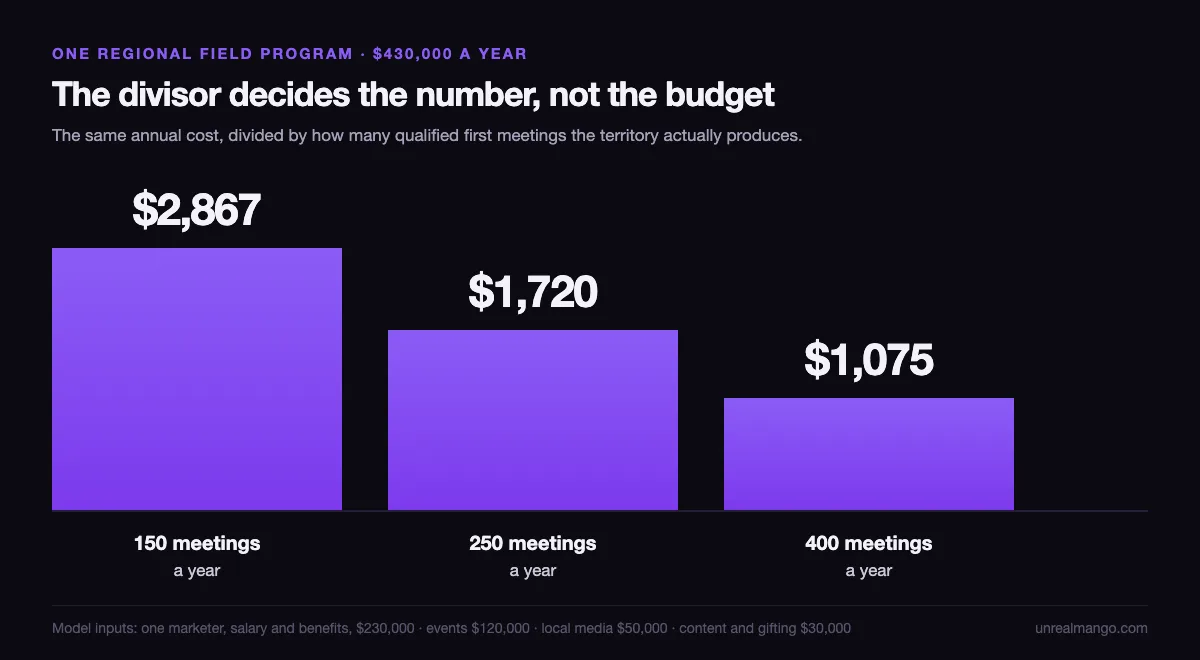
| Qualified meetings a year, one region | 150 | 250 | 400 |
|---|---|---|---|
| Cost per qualified meeting | $2,867 | $1,720 | $1,075 |
One marketer producing 400 qualified first meetings a year is a strong program in a dense territory. One producing 150 is common and not shameful. The spread between them is a factor of 2.7, and it moves the answer far more than trimming any line in the cost table does.
What a first meeting has to be worth before the program pays for itself
The other half of the arithmetic is what a meeting returns. One first meeting is worth the annual contract value, times gross margin, times the years the customer stays, times the share of first meetings that end in a signature.
The table below runs that on a 70% gross margin and three years of retention, so each cell is the contract value multiplied by 2.1 and divided by the close rate. It is the ceiling on what you can afford to pay for a meeting, not a forecast.
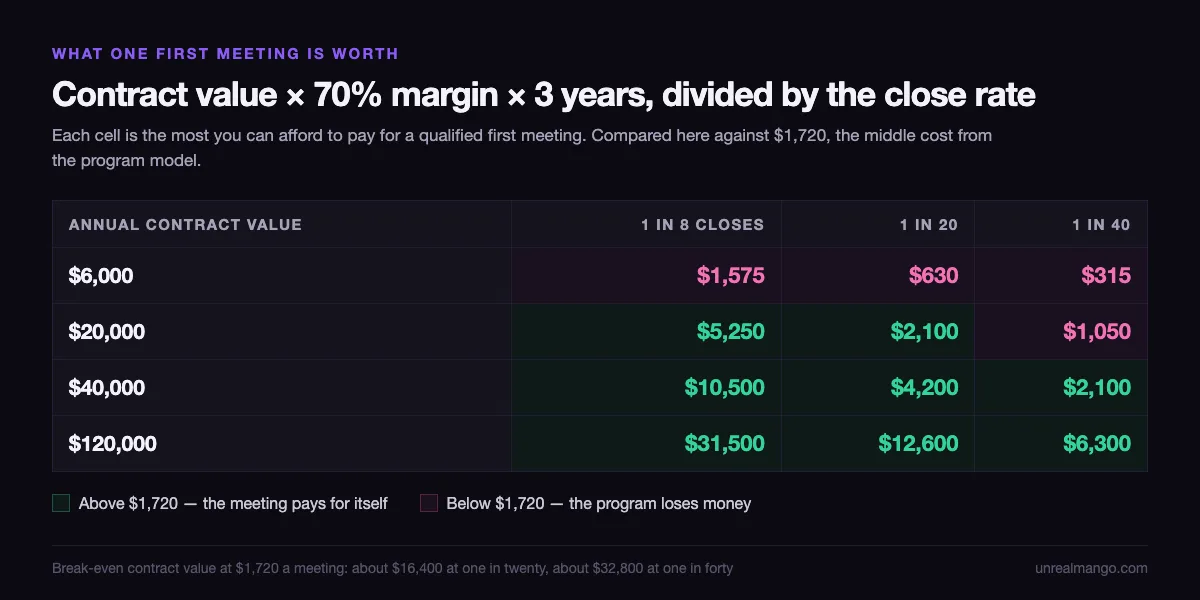
| Annual contract value | 1 in 8 closes | 1 in 20 | 1 in 40 |
|---|---|---|---|
| $6,000 | $1,575 | $630 | $315 |
| $20,000 | $5,250 | $2,100 | $1,050 |
| $40,000 | $10,500 | $4,200 | $2,100 |
| $120,000 | $31,500 | $12,600 | $6,300 |
Read it against the middle cost of $1,720 a meeting. The $6,000 contract never clears it, at any close rate in the table. The $20,000 contract clears it at one in eight and one in twenty, and fails at one in forty. Everything from $40,000 upward clears it at all three. Solving the same equation the other way gives the break-even directly: at $1,720 a meeting, field marketing needs about $16,400 of annual contract value at a one-in-twenty close rate, and about $32,800 at one in forty.
Two things follow, and the second one is the useful one. First, small-contract businesses should not staff a field function, because they cannot pay for the meetings it produces — which does not mean they should not attend events, only that they should not build a territory role around them. Second, and less obvious: the cheapest way to fix a field program that is underwater is almost never to cut the budget. It is to raise the close rate on the meetings it already produces, because the close rate divides the whole thing. Moving from one in forty to one in twenty halves the required contract value; cutting the events line by 20% moves the cost per meeting by a fraction of that.
Where that money comes back is a separate question from whether it comes back at all, and field programs are slow: the meeting happens in March, the deal closes in September, the cash arrives across the following year. Whether the function is affordable in the meantime is a payback period question, not a return question.
Sourced pipeline and influenced pipeline, and why the function is reported twice
Every field marketer is measured on two numbers that must never be added together.
Sourced pipeline is the opportunity whose first recorded touch was a field program: the dinner, the roadshow, the regional campaign. It is a small, hard, defensible number, and it undercounts the function badly, because the field touch that mattered was often the third one.
Influenced pipeline counts every opportunity where a field touch appears anywhere in the history before close. It is a much larger number — assume three to five times sourced as a planning figure and check it against your own pipeline before quoting it anywhere — and it is not a claim on credit. It is a coverage statistic: this is how much of the territory’s pipeline the program was present for.
Report both, label them, and never sum them. Then fix two settings in writing before the quarter starts, because arguing about them afterwards is how field programs lose budget. The first is the attribution window: how long after a field touch an opportunity still counts as influenced. Ninety days is a common choice and it is a choice, not a measurement — a shorter window flatters central campaigns and a longer one flatters field. The second is the tie-break rule when a central campaign and a field program both touched the same account, which needs to be settled by policy rather than by whoever exports the report first. Proving that any of this pipeline would not have existed without the program is a different exercise entirely, involving holdouts and regional tests, and it is not what either of these two numbers does.
What the function looks like at 20 people, 200 people and 2,000 people
The tactics lists published for this term assume a company that already has a field team. Most companies asking the question do not, and the honest answer changes shape three times on the way up.
| About 20 people | About 200 people | About 2,000 people | |
|---|---|---|---|
| Who runs it | The founder or the single marketer, part-time | One field marketer per one to three territories | A field team with its own leader, four to twelve territories |
| What carries it | Dinners of eight to twelve and partner events; no booths | Regional roadshows, a small booth program, executive dinners | A full show calendar, regional campaigns, customer advisory boards |
| Where the budget sits | Inside the one marketing budget | A named territory line | A field P&L allocated per region |
| Reporting | Nothing formal; the pipeline is visible by eye | Sourced and influenced, per territory, per quarter | The same, plus territory-level cost per meeting |
| The characteristic mistake | Buying a trade show booth before anyone can follow up on it | Copying central campaigns into regions instead of building for them | Central and field both working the same accounts in the same region |
The twenty-person case deserves its own warning. At that size a field program is one person’s calendar, and the binding constraint is not budget but follow-up capacity: eight dinners produce more conversations than the founders can chase, and the ones they cannot chase are worth zero. Build the calendar backwards from how many first meetings the team can actually take in a month. That number is usually humiliating and it is the real plan.
A quarterly field plan that fits on one page
Field marketing plans fail when they are lists of events with dates. A plan that survives a quarterly business review is a chain of arithmetic where each column produces the next, and it has six columns: territory, segment, budget, meetings that budget buys, opportunities those meetings produce, and pipeline. The wider marketing plan sits above this; the field page of it works like the worked row below.
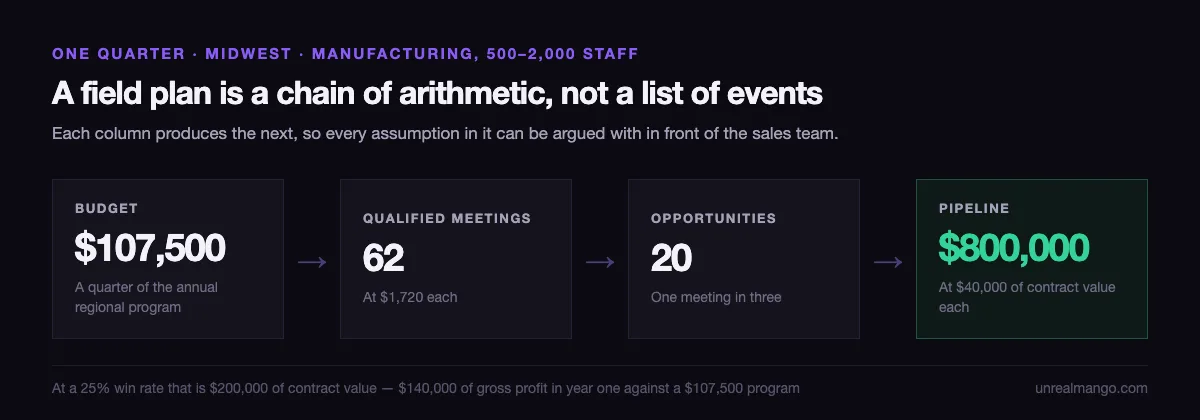
Take the Midwest, manufacturing companies of 500 to 2,000 staff, one quarter, and the middle cost from the model above.
- Budget: $107,500, a quarter of the annual regional program.
- Meetings it buys: 62, at $1,720 each.
- Opportunities: 20, if one first meeting in three becomes a qualified opportunity.
- Pipeline: $800,000, at $40,000 of contract value each.
- Closed business: $200,000 of annual contract value, at a 25% win rate — $140,000 of gross profit in the first year against a $107,500 program, and roughly three times that across the retention period.
Now the plan can be argued with, which is the point. A sales leader who thinks one in three is generous can say so, and the budget column moves in front of everyone. A field marketer who is handed a pipeline target can run the chain backwards and show what it costs. Compare that to a plan that says “Q3: two roadshows, one regional dinner, Manufacturing Expo” — nobody can disagree with it, because it does not claim anything.
Formats and dates still belong on the page, off to the right. They just do not lead.
The four places a field program quietly stops being funded
Four failure points account for most field programs that quietly stop being funded, and none of them is about the quality of the events.
The territory definitions do not match. Marketing carves by geography, sales carves by industry or account list, and the field marketer ends up serving three sellers with three different views of the same patch. Fix this first; everything downstream inherits it.
Nobody owns the follow-up window. The single most expensive gap in field marketing is the first two days after an event. Write the rule down: the seller contacts named attendees within two business days, the field marketer holds the list and chases the seller until they do, and unworked names return to nurture after a week rather than sitting in a spreadsheet.
The marketer reports to central marketing but is measured on a sales number. That is workable, but only if the field marketer sits in the territory’s forecast calls. Being accountable for a number produced in a room you are not in is not a job, it is an appraisal risk.
Both sides claim the same opportunity. Central campaigns and field programs will touch the same accounts, and if the credit rule is unwritten the quarterly review becomes an argument about reports rather than about the territory. Decide the rule while nobody has anything at stake.
Field marketing is not a set of tactics. It is a decision to run part of the marketing budget as a P&L attached to a piece of the sales plan, and it earns its place when a meeting in that territory costs less than a meeting there is worth. If working out whether that is true for your business is the question you actually have, that is the kind of thing our marketing strategy work starts with — a territory, a number, and the arithmetic between them.
10 / Reader questions
Frequently asked questions
01What is the meaning of field marketing?
Field marketing is business-to-business marketing organized around a sales territory. One marketer owns a region or segment, holds a program budget for it, and is measured on meetings and pipeline from that patch. The term also carries an older retail meaning: in-store sampling, merchandising and demonstration work.
02What is the difference between field marketing and marketing?
The difference is the unit of accountability: field marketing owns a slice of geography or segment and answers to a sales number for that slice, while marketing as a whole owns channels, brand and the funnel end to end. The tactics overlap almost completely.
03What does a field marketing manager do?
A field marketing manager plans and runs programs for one or more sales territories: regional events, executive dinners, partner activity, local media and sales enablement. The role negotiates the quarterly plan with the sellers who cover the same patch and reports pipeline sourced and influenced in it.
04Can you give me an example of field marketing?
A software vendor gives one marketer the Midwest. She runs six dinners for manufacturing operations directors, two regional roadshows, co-hosts two partner half-days and buys trade media. Sixty-two first meetings come out of the quarter, twenty become opportunities, and the region reports that pipeline separately from national campaigns.
05What skills are needed for field marketing?
Three things carry the job: event and vendor operations that survive contact with a venue, commercial arithmetic strong enough to defend a cost per meeting, and the diplomacy to co-plan with sellers who do not report to you. Everything else is learnable on territory.
06Is field marketing the same as retail merchandising?
No — the phrase covers several unrelated things, and these are two of them. In consumer goods, field marketing means staffing shops with sampling, merchandising and demonstration crews. In business-to-business software and services, it means a marketer attached to a sales territory. This page describes the second.