
Published
Marketing agencies charge $2,500 to $15,000 a month on retainer, 3% to 20% of ad spend for media management, or $10,000 to $49,999 for a one-off project. Which of the four billing models you sign changes what the same work costs you more than the headline rate does.
The sources behind every figure below. For this query in the United States on 11 August 2026, the organic results were a five-year-old Reddit thread in first place, then WebFX, Element Three, gobrandnation, LYFE Marketing, Clutch, HawkSEM and Teamwork, wrapped in an AI Overview and a discussions-and-forums block. Five of those eight are agency blogs; Clutch is a directory and Teamwork a software vendor. Every one of them publishes a range, and none reconciles its range with anybody else’s. Two further pages below come from the results for marketing agency retainer, pulled the same day: Clicks Geek and Stackmatix. Market rates come from Clutch’s digital marketing pricing guide dated 10 August 2026, built from the 106,043 companies listed on its platform, from its separate advertising agency pricing guide dated August 2026, and from the published figures of the pages named above, with dates where those pages carry one. Survey data comes from the ANA’s Trends in Agency Compensation, 18th edition, fielded in 2022 among 101 client-side marketers covering 336 agency relationships. Anything derived rather than published is labelled as derived.
What marketing agencies charge per month, and what that number covers
| Engagement | Typical fee | What normally sits inside | Source |
|---|---|---|---|
| Small business, ongoing | $1,500–$4,000 a month | a narrow scope, monthly reporting | gobrandnation, January 2026 |
| The retainer model generally | $2,500–$10,000 and up a month | agreed scope, strategy, reporting | gobrandnation, January 2026 |
| Retainer-only benchmark | $3,500–$15,000 and up a month | ongoing scope, project work excluded | Clicks Geek, May 2026 |
| Full digital marketing engagement | $5,000–$50,000 a month | strategy, creative, media, measurement | Clutch digital marketing guide, August 2026 |
| One-off project | $10,000–$49,999 | a defined deliverable with an end date | Clutch advertising guide, August 2026 (most common bracket) |
| Hourly work | $100–$149 an hour | audits, training, short interventions | Clutch, August 2026 (US, Canada, Australia) |
None of those figures includes the ad spend itself. Media budget is money you pay to Google, Meta or LinkedIn from your own account, and it is separate from anything the agency invoices. If you are pricing paid media specifically, the arithmetic of media budget against management fee is worked through in our Google Ads cost breakdown, linked further down, rather than repeated here.
The four ways agencies bill for the same work
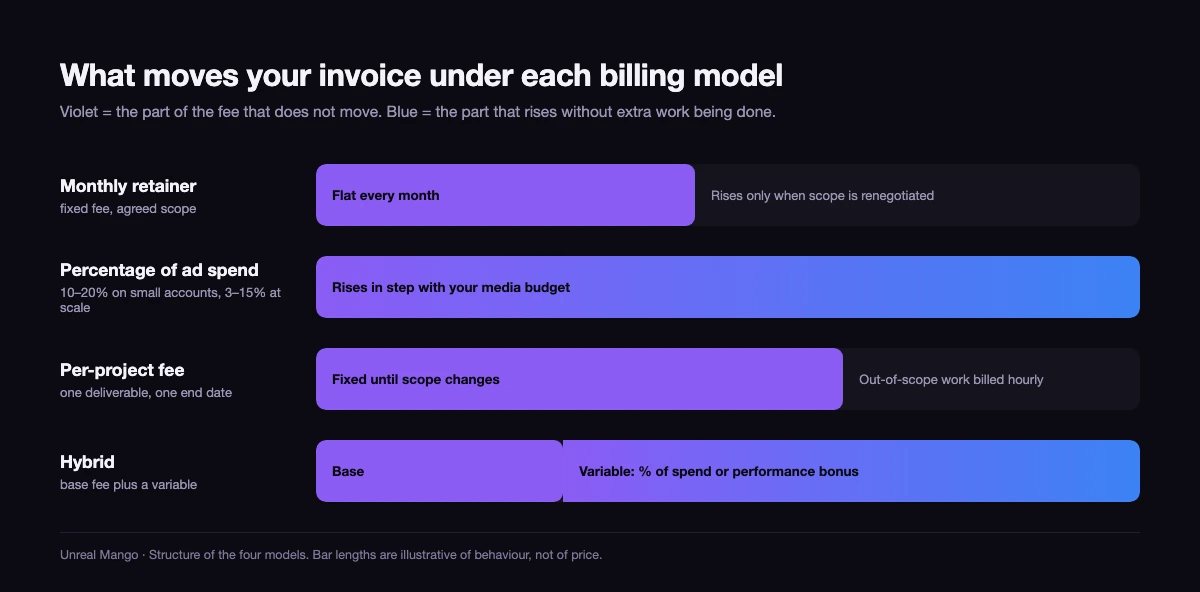
Every proposal you receive resolves to one of four structures, or to a named blend of two of them.
Monthly retainer. A fixed recurring fee for an agreed scope. Predictable for both sides, and the model most agencies push, because it makes their revenue forecastable. Your risk is that the scope is described in outcomes rather than volumes, so a quiet month and a punishing month cost you the same.
Percentage of ad spend. The fee is a share of what you spend on media. Two bands are in circulation and they describe different segments rather than contradicting each other: we publish 10% to 20% for small-account Google Ads management, while Element Three publishes 3% to 15% for media buying at agency scale. Your risk is structural: at whatever rate your contract fixes, the fee rises when you scale the budget, and scaling a budget three times over almost never triples the work. This is the model where that is the entire mechanism, and hybrids inherit it through their variable half.
Per-project fee. One number for one defined deliverable with an end date: a launch campaign, a rebrand, a site. Your risk is that anything discovered mid-project is out of scope by definition, and out-of-scope work is billed at the rate card.
Hybrid. A smaller base fee plus a variable component, usually a percentage of spend or a performance bonus. Your risk is that you now have two mechanisms to audit instead of one, and hybrids are where the arithmetic quietly stops being checkable.
Effective hourly rate, the number that makes four models comparable
You cannot compare a $7,500 retainer with a $25,000 project or with 15% of a $40,000 media budget while they are in different units. Convert all of them to one:
Effective hourly rate = total you pay in a period ÷ hours actually worked on your account in that period.
That is the question no proposal answers voluntarily, and the only one that makes four models sit on the same axis. Clutch’s US, Canadian and Australian bands put the market reference at $100 to $149 an hour as of August 2026, so $125 is a serviceable midpoint for a sanity check. The hours a retainer has to deliver to hit that midpoint are derived below, using a full-time month of 173 hours (2,080 working hours a year ÷ 12).
| Monthly retainer | Hours needed to reach $125/hour | Share of one full-time person |
|---|---|---|
| $2,500 | 20 | 12% |
| $5,000 | 40 | 23% |
| $7,500 | 60 | 35% |
| $10,000 | 80 | 46% |
| $15,000 | 120 | 69% |
Read the middle column as the question to ask before signing. A $10,000 retainer is fair at 80 hours a month and expensive at 30. Neither number is visible in the fee, and agencies that cannot answer it are usually the ones whose answer would be 30.
The column also kills a common assumption in the other direction. A $2,500 retainer that buys 20 hours is not a small version of a marketing department; it is half a working week, spread across a month, for everything you asked for. Most disappointment with cheap retainers is arithmetic, not effort.
Our own position, stated plainly. We run monthly retainers and we are not the cheap option. What the fee buys is that the owners are the people on the account, so the hours are senior hours rather than junior hours billed at a blended rate. That is a trade against volume, and it is the wrong trade for anyone who needs a large quantity of routine execution.
Where each pricing model stops being the cheaper one for you
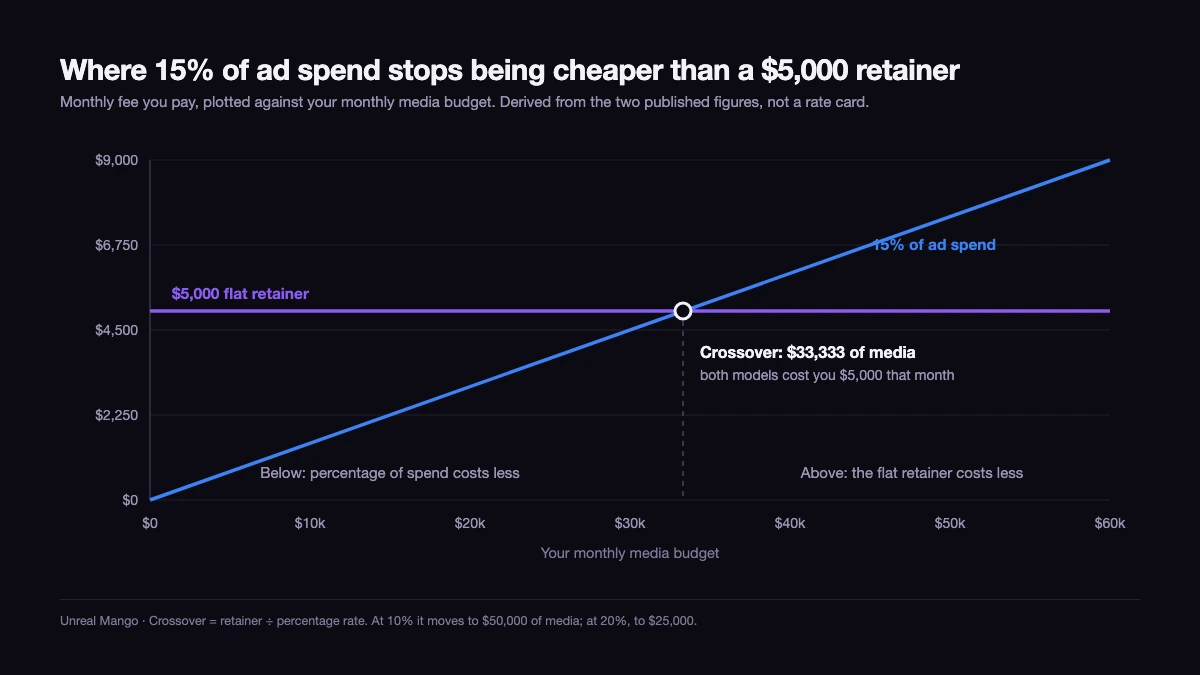
Each pair of models crosses at a calculable point. Below the crossover, one is cheaper; above it, the other. Three of these rows are derived, not published: the $5,000 retainer is a round figure chosen for legibility, and the percentages are the bands named earlier. Only the last row uses a pair somebody published together. All four assume your rate is fixed in the contract, which is the normal case; a contract that steps the percentage down above a spend threshold moves its crossover to the right.
| Comparison | Crossover point | Cheaper below it | Cheaper above it |
|---|---|---|---|
| 20% of ad spend vs $5,000 retainer | $25,000 of monthly media | percentage of spend | flat retainer |
| 15% of ad spend vs $5,000 retainer | $33,333 of monthly media | percentage of spend | flat retainer |
| 10% of ad spend vs $5,000 retainer | $50,000 of monthly media | percentage of spend | flat retainer |
| $25,000 project fee vs $7,500 retainer | 3.3 months of engagement | flat retainer | one-off project fee |
The media rows say something agencies rarely volunteer: at a fixed rate, percentage of spend is the client-friendly model at small budgets and the expensive one at large budgets, which is the opposite of how it is usually sold. At $8,000 of monthly media, 15% is $1,200, and no flat retainer competes. At $80,000 of monthly media, the same 15% is $12,000 for work that has not grown tenfold. That is precisely the pressure that pushes larger buyers onto the 3%-to-15% band rather than the 10%-to-20% one, and the reason a fixed percentage with no step-down is worth negotiating before you scale, not after.
The project row uses the pair Stackmatix published in April 2026 as its own worked example, a $7,500 monthly retainer against a $25,000 project fee. Divide and the break-even is 3.3 months. Work that genuinely finishes inside a quarter is cheaper on a retainer; anything that runs past 3.3 months is cheaper as a fixed project fee, assuming the scope holds. That last clause is doing a lot of work, which is the next section.
What a marketing retainer buys, and what arrives as a separate invoice
A retainer buys agreed hours against an agreed scope. It does not buy the things below, and every one of them turns up as a separate line, usually in month two, when the relationship is too new to argue about.
| Line item | Paid to | Published figure where one exists |
|---|---|---|
| Ad spend | the platform, from your own account | your media budget; no agency fee covers it |
| Onboarding and discovery | the agency, once, before the retainer starts | $10,000–$20,000 (Element Three, undated) |
| Software and licences | vendors, or the agency with a markup | $200 to $25,000 and up (Element Three, undated) |
| Media fee charged on top of a retainer | the agency | 3%–15% of media (Element Three, undated) |
| Production and assets | studios, photographers, stock libraries, talent | quoted per shoot; no market range is published |
| Third-party pass-throughs | wire services, influencers, sponsors, translators | quoted per placement |
| Out-of-scope and rush work | the agency, at its rate card | $100–$149 an hour in the US (Clutch, August 2026) |
Two of those seven rows deserve a note. The media-fee row is the one to read carefully: a retainer covering strategy and creative frequently does not include the fee for buying the media, so it arrives on top. And a discovery fee of $10,000 to $20,000 before month one is not a hidden charge if it is disclosed, but it does change the first-year total by more than most retainer comparisons do — on Element Three’s own figures it exceeds two months of a $5,000 retainer before any work starts.
The eighth item is not a cost until you leave, which is why it belongs outside the table. Ad accounts, analytics properties, tag containers, domains and creative source files should be registered in your name from day one. Reconstituting three years of conversion history because the account sat inside the agency’s business manager is the one item here with no published price and no invoice, and the only one you cannot buy back at any rate card.
Eight published price ranges, and what each one is actually counting
Every page below publishes a number, and the numbers disagree by roughly three orders of magnitude. They are not contradicting each other so much as measuring different things. Seven of the eight rank for this query; Clicks Geek ranks for marketing agency retainer, and the Reddit thread that ranks first here publishes no range at all. The right-hand column is our reading of each page’s scope, not a claim any of them makes about its own method.
| Source and date | Published figure | Scope it appears to cover |
|---|---|---|
| WebFX, March 2026 | $50–$3,500 a month, covering 59% of businesses | reads as per-service line items across all business sizes; a $50 floor cannot be agency labour at any published hourly rate |
| HawkSEM, undated | $500–$10,000 and up a month | an open-topped range, so the “and up” is carrying an unstated amount of it |
| Teamwork, February 2026 | $2,500–$12,000 a month | a glossary entry listing several per-service averages rather than one bundled fee |
| gobrandnation, January 2026 | $2,500–$10,000+; $1,500–$4,000 for small business | the only page that splits by client size, which is why its floor sits above WebFX’s |
| LYFE Marketing, May 2026 | $650–$20,000, average about $3,500 | social media management alone, not a full-service engagement |
| Clicks Geek, May 2026 | $3,500–$15,000 and up a month | retainer pricing specifically; it ranks on the retainer query, not this one |
| Element Three, undated | $10,000–$20,000 discovery; $200–$25,000+ technology; 3–15% media | fee components, deliberately not a monthly total |
| Clutch, August 2026 | $100–$149/hour and most projects $10,000–$49,999 (advertising guide); $5,000–$50,000 a month across 106,043 listed companies (digital marketing guide) | self-reported bands from two separate pricing guides, not one dataset |
The practical consequence: a range you find online is only usable if you know its denominator. WebFX’s $50 floor and Clicks Geek’s $3,500 floor are seventy times apart, because one counts single line items across all business sizes and the other counts full retainers only. Neither is wrong. Comparing them directly is.
How the largest advertisers pay, and why smaller ones pay differently
The ANA has, by its own account, fielded this survey among client-side marketer members for more than fifty years. In the 18th edition, fielded in 2022 across 101 marketers and 336 agency relationships, 82% used fee-based compensation in at least one agreement, up from 68% in 2016. Among advertisers spending $500 million or more a year, 53% used fixed or output-based fees, against just 5% in 2016. Among smaller advertisers, 76% were still on labour-based fees.
That split is the useful part. Across the six years between those two measurements, the top of the market moved from “pay for hours” to “pay for a defined output” — from 5% to 53% — largely for administrative reasons, while smaller advertisers went on buying time. If you are being quoted a retainer with no stated hours and no stated deliverable volume, you are being sold the small-advertiser model without the one thing that makes it auditable.
Performance-based compensation is also moving in the opposite direction to its reputation. In the same survey, 41% of marketers used performance incentives alongside fees, down from 48% in 2016 and 61% in 2013. The model marketed hardest to small businesses as the modern alternative has been shrinking among the advertisers with the most leverage to demand it, mostly because agreeing what counts as performance turns out to be harder than agreeing a fee. The ANA published a 19th edition on 2 November 2025 covering 99 member organisations; its figures sit behind membership, so the percentages above remain the most recent published openly.
Which pricing model each service line usually comes on
| Service | Model it usually arrives on | Where its own rates are worked out |
|---|---|---|
| Paid media management | percentage of spend, or hybrid with a base | Google Ads cost breakdown |
| SEO | monthly retainer, occasionally with a milestone bonus | SEO pricing guide |
| Website build or redesign | project fee, with a separate maintenance retainer after launch | website redesign cost |
| Content and social | retainer, priced by deliverable volume per month | — |
| Branding and identity | project fee, sometimes with a usage licence attached | — |
| Fractional or advisory | small retainer with a stated hour cap | — |
Two things this table is not. It is not a recommendation to buy each line from a different supplier, which is how brands end up paying three onboarding fees. And it is not a shortlist method; choosing between agencies is a separate exercise from choosing between billing structures, and a good model with the wrong team still fails. If you want the whole stack under one owner group, that is what our services are organised around.
What to settle before the first invoice, not after
PMI’s Pulse of the Profession found that 52% of projects completed in the previous twelve months experienced scope creep or uncontrolled change, up from 43% five years earlier. That was 2018 data across project work generally, not agency retainers specifically, but the direction is the point: scope drift is the normal case, not the exception, and every item below exists because of it.
- Hours, reported. Does the retainer state a committed number of hours, and are they reported monthly at task level? Without this, the effective hourly rate above cannot be calculated at all.
- Unused hours. Do they roll forward, expire at month end, or get invoiced regardless? All three are defensible; only one of them is in your contract.
- Who works on the account. Names and seniority, agreed in writing. Fees rarely fall when the team quietly changes.
- The rate card for out-of-scope work. Agreed before it is needed, not quoted in the moment when you have no leverage.
- What counts as a revision. A defined number of rounds per deliverable, and a written line between a revision and a new request.
- Notice period and work in progress. How much notice, and what happens to half-finished work and source files when it is served.
- Ownership of accounts and assets. Ad accounts, analytics, tag containers, domains and source files in your name from the first day.
Every one of those is cheap to agree in week one and expensive to litigate in month nine. The fee is the part of an agency relationship that gets negotiated hardest and the part that predicts the outcome least.
10 / Reader questions
Frequently asked questions
01How much do marketing agencies charge?
Between $2,500 and $15,000 a month for an ongoing retainer, or $10,000 to $49,999 for a one-off project, which is the most common project bracket on Clutch as of August 2026. That retainer span joins gobrandnation's $2,500 floor from January 2026 to Clicks Geek's $15,000 ceiling from May 2026. Narrow scopes for a small business start nearer $1,500.
02How much do marketing agencies charge per month?
Most monthly retainers land between $2,500 and $10,000. Published ranges differ by what they measure: gobrandnation put small-business retainers at $1,500 to $4,000 in January 2026, Clicks Geek put retainers at $3,500 to $15,000 and up in May 2026, and Clutch describes digital marketing engagements at $5,000 to $50,000 a month.
03How much do marketing agencies charge per hour?
In the United States, Canada and Australia, $100 to $149 an hour, according to Clutch's pricing guide dated August 2026 and drawn from its listed companies. Agencies in Poland list $50 to $99, and agencies in the Philippines, Ukraine, Spain and Mexico list $25 to $49. Those are self-reported bands, not audited rates.
04What is a marketing agency retainer?
A recurring agreement under which you pay a fixed fee, usually monthly, to reserve an agency's ongoing capacity within an agreed scope. It is a commitment to a volume of work over time rather than to a deliverable. The scope is the part that decides whether the fee is fair, not the amount.
05What is a reasonable retainer fee for a marketing agency?
One that divides into a sensible hourly rate. Take the monthly fee and divide it by the hours the agency commits to; if the result sits far above the $100 to $149 an hour Clutch reports for the US market, you are paying for something other than labour, and the agency should be able to say what.
06Is it worth hiring a marketing agency?
It depends on whether you need more than one specialism at less than full-time. An agency is worth it when you need paid media, content, design and analytics but cannot justify four salaries. It is poor value when you need one skill continuously, because a single in-house hire will cost less per hour.
07What are the downsides of using a marketing agency?
You lose direct control of timing, you share the team with other clients, and your account can quietly move to junior staff without the fee changing. The structural fix is contractual, not conversational: agree who works on the account, how hours are reported, and what happens to the work if you leave.
08What is the typical retainer fee for a marketing consultant?
Lower than an agency retainer, because one person carries it. A consultant retainer usually buys advisory time and prioritisation rather than production capacity, so the same monthly fee covers far fewer delivered hours. Compare the two on hours committed, not on the monthly number, or the consultant will always look expensive.