Published
Ask every customer, at the same point in the transaction, using the review link or QR code generated from your own Business Profile. That is the entire legal method. Everything that goes wrong with Google reviews goes wrong because a business added something to that sentence: an incentive, a filter, or a staff quota.
The rules changed twice in 2026, and most published guides still quote a version of Google’s policy that was deleted in 2017. This is the current set, each rule dated.
How many Google reviews you need to reach the local pack, by category
There is no universal number, and any guide that gives you one has not looked at the data. Local Falcon analysed 50.4 million US search results across 1,993 business categories in Q4 2025, deduplicated to one result per unique location-and-keyword pair, and published the review counts of the businesses actually appearing in Google’s local 3-pack. Across the seven categories below the medians run roughly fifty-fold apart; across the full 1,993, wider still.
| Category | Median reviews in the 3-pack |
|---|---|
| Home health care | 20 |
| General contractor | 28 |
| Electrician | 56 |
| Plumber | 215 |
| HVAC contractor | 244 |
| Dentist | 346 |
| Breakfast restaurant | 976 |
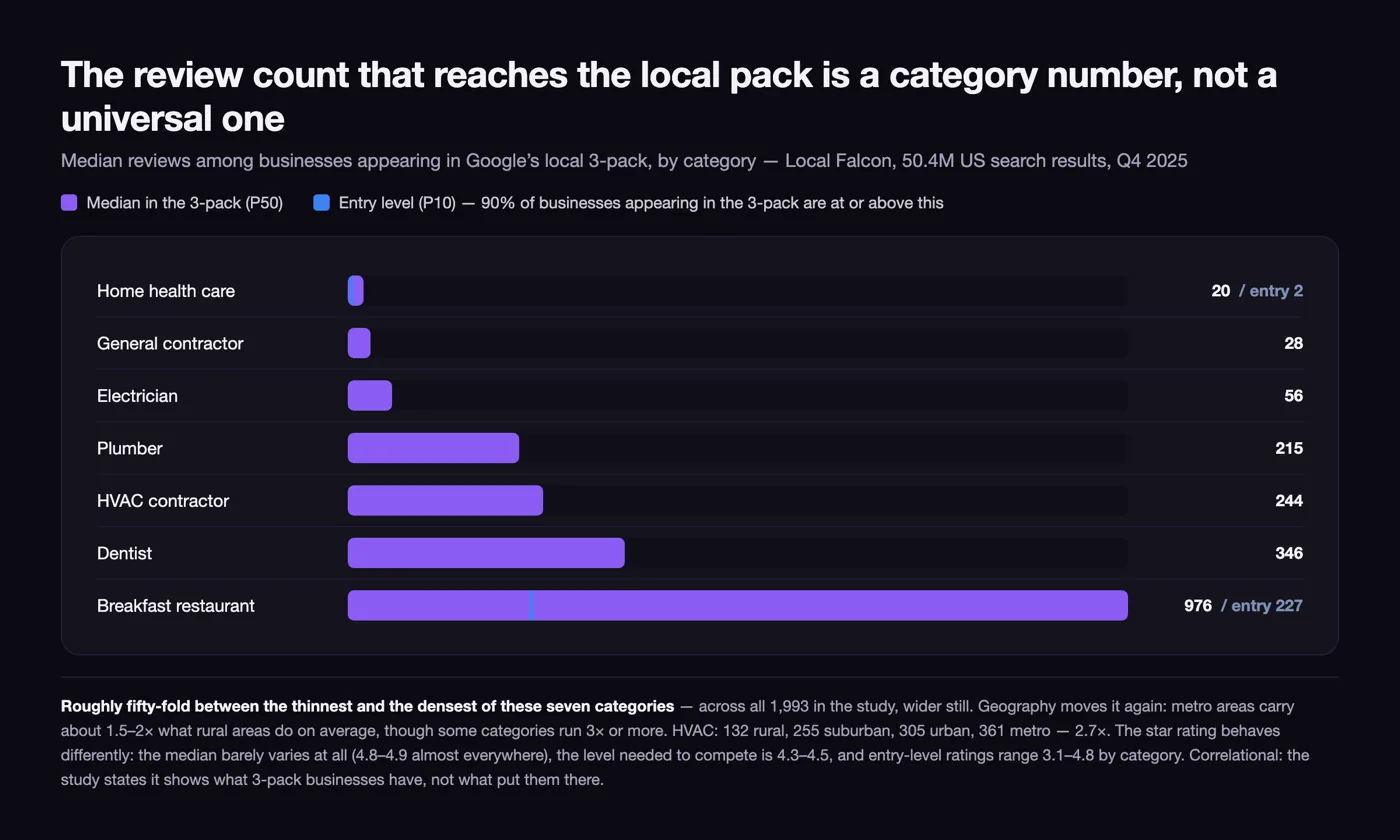
The entry level is far lower. Local Falcon reports it as the tenth percentile — the level 90% of businesses appearing in the 3-pack are at or above, not an observed floor. Home health care sits at 2 reviews, breakfast restaurants at 227. That gap is the useful part: in a thin category a handful of reviews puts you in the running, and in a saturated one two hundred only gets you to the door.
Geography moves the number again. Averaged across categories, metro areas carry roughly 1.5 to 2 times what rural areas do — but the spread is wide, and the study warns some categories run 3× or more. Both of its worked examples are above the average: HVAC contractors run a median of 132 in rural areas, 255 suburban, 305 urban and 361 metro, which is 2.7×; dentists run 180 rural to 462 metro, 2.6×.
Two caveats, and Local Falcon states the first one itself: this is correlation, not causation. It shows what businesses in the 3-pack have, not what put them there. And the star rating behaves differently from the count. At the median it barely varies at all — almost every category sits at 4.8 to 4.9. The study puts the level needed to compete at 4.3 to 4.5, while entry-level ratings range more widely by category, from 3.1 to 4.8. The count is a category-specific target; the rating is close to universal only among the winners.
On the customer side the threshold is much lower and much blunter. BrightLocal’s Local Consumer Review Survey, published 11 February 2026 with a panel of 1,002 US adults — BrightLocal does not disclose when the fieldwork ran — found 47% of consumers will not use a business with fewer than 20 reviews, 68% will only use a business with four or more stars, and 31% now require 4.5 or better — up from 17% the year before. Separately, 74% look for reviews written in the last three months, which means a review count you built two years ago and stopped maintaining is worth less than it looks.
Create the review link and QR code from your own profile
Google finally documented this properly. A dedicated help page for generating the review link and QR code appeared at the end of December 2025 — recent enough that most articles ranking for this topic predate it and describe an older interface.
The path Google gives: open your Business Profile, go to Read Reviews, then Get more reviews, and copy the link or right-click to save the QR code image. One constraint worth knowing before you try it on your phone: Google states that review QR codes can only be generated on a computer browser, not on mobile.
Google names the distribution channels it expects you to use: receipts, thank-you emails, chat, a printed in-store display, and sharing by email, WhatsApp or Facebook.
SMS is not on that list, and this matters more than it sounds. Google does not mention text messaging anywhere in its review documentation — not to permit it, not to restrict it. There is no Google rule about message frequency, timing, or wording for review requests. If you see one quoted, it was invented. The real constraints on texting customers in the US are TCPA and carrier rules, which are a separate problem with separate lawyers.
Also worth knowing before you build the flow: a customer must be signed in to a Google Account to leave a review, though the account can use a non-Gmail address. In practice this is the single biggest source of drop-off between the tap and the posted review, and no amount of copywriting fixes it.
When to ask, and what nobody can actually tell you about response rates
Ask at the point where the customer has the result in front of them and the interaction is closing: at checkout, at handover, at the end of the appointment. Not the next week, when the memory has flattened into a general impression.
That much is uncontroversial. What follows is the part usually stated with more confidence than the evidence supports.
There is no published, methodologically sound figure for what share of asked customers actually leave a Google review, and none broken down by channel. We looked specifically for a primary source with a disclosed denominator — “we sent N review requests, X% were completed.” Every result was vendor content marketing. The common claims that SMS converts three to five times better than email, or that text requests get 20–30% response rates, come with no sample size, no time period, and no methodology. Treat them as sales material until someone publishes the denominator.
The closest thing to a survey-grade number is old and measures something else. BrightLocal asked 1,031 US consumers in October 2017 whether they had ever been asked to leave a review for a local business and whether they did: 68% of those asked said they had. That is a lifetime self-report, not a per-request conversion rate, and the two get conflated constantly.
The related “70% of consumers will leave a review if asked” is BrightLocal’s own headline from its 2016 edition (n=1,062, September 2016) and is often defended on that basis. The objection is not that it was misquoted. It is that it measures the same thing as the 2017 number — whether a consumer has ever left a review after ever being asked — and that a lifetime self-report tells you nothing about what one request to one customer list will return. Two different numbers in that survey both happen to be 70%: the share of consumers who had been asked, and the share of those who then left one. Quoting either as a forecast for your next campaign is the error.
The other number worth retiring is “consumers read 10 reviews before trusting a business.” That is BrightLocal’s 2020 edition, fielded November 2020, and the question no longer appears in the current survey. If you use it, date it.
Every Google review rule in force right now, with the date it appeared
Google’s review policy lives on one page — Prohibited & restricted content, in the Maps user-generated content help, mirrored inside Business Profile Help. That page carries no publication date, no last-updated stamp and no changelog. Google has never published a version history for it. So the dates below come from Google’s own dated blog posts where they exist, and otherwise from the date the change was first documented live by local-search practitioners. Where a date is a sighting rather than an announcement, it is labelled as one.
| Rule, as Google words it | Where it lives | Dated |
|---|---|---|
| “Offer incentives – such as payment, discounts, free goods and/or services - in exchange for posting any review or revision or removal of a negative review” is prohibited | Fake Engagement, and repeated under Rating Manipulation | Long-standing; restated on the rewritten Tips page, sighted 27 Jan 2026 |
| “Discourage or prohibit negative reviews, or selectively solicit positive reviews from customers” | Rating Manipulation | Added 12 Apr 2018; absent from the docs for roughly 8–10 months in 2022; restored 6 Oct 2022 |
| “When soliciting reviews, merchants should not require or pressure users to leave ratings or write reviews while on the premises, nor should they request that specific content be included” | Rating Manipulation | Sighted live 20 Feb 2026 |
| “Merchants requesting that staff solicit a certain number of reviews” is prohibited | Rating Manipulation, sub-bullet | Sighted live 17 Apr 2026 |
| “Merchants requesting that staff solicit reviews that include specific content, including content that identifies a staff member” is prohibited | Rating Manipulation, sub-bullet | Sighted live 17 Apr 2026 |
| “Content exhibiting unusual volumes or patterns of review contributions that are indicative of efforts to manipulate a place’s rating” is removed | Rating Manipulation | Present in the Feb 2026 restructure |
| Reviews based on “a conflict of interest… current or former employment, a contractual or consultory relationship, or other professional or personal affiliations” are removed | Rating Manipulation | Present in the Feb 2026 restructure |
| “Content that has been posted from multiple accounts by or at the request of one person” is removed | Fake Engagement | Long-standing |
| What Google does allow: “Solicit or encourage the posting of content that does represent a genuine experience, without offering incentives to do so or attempting to influence the rating or the contents of the review” | Both sections | Long-standing |
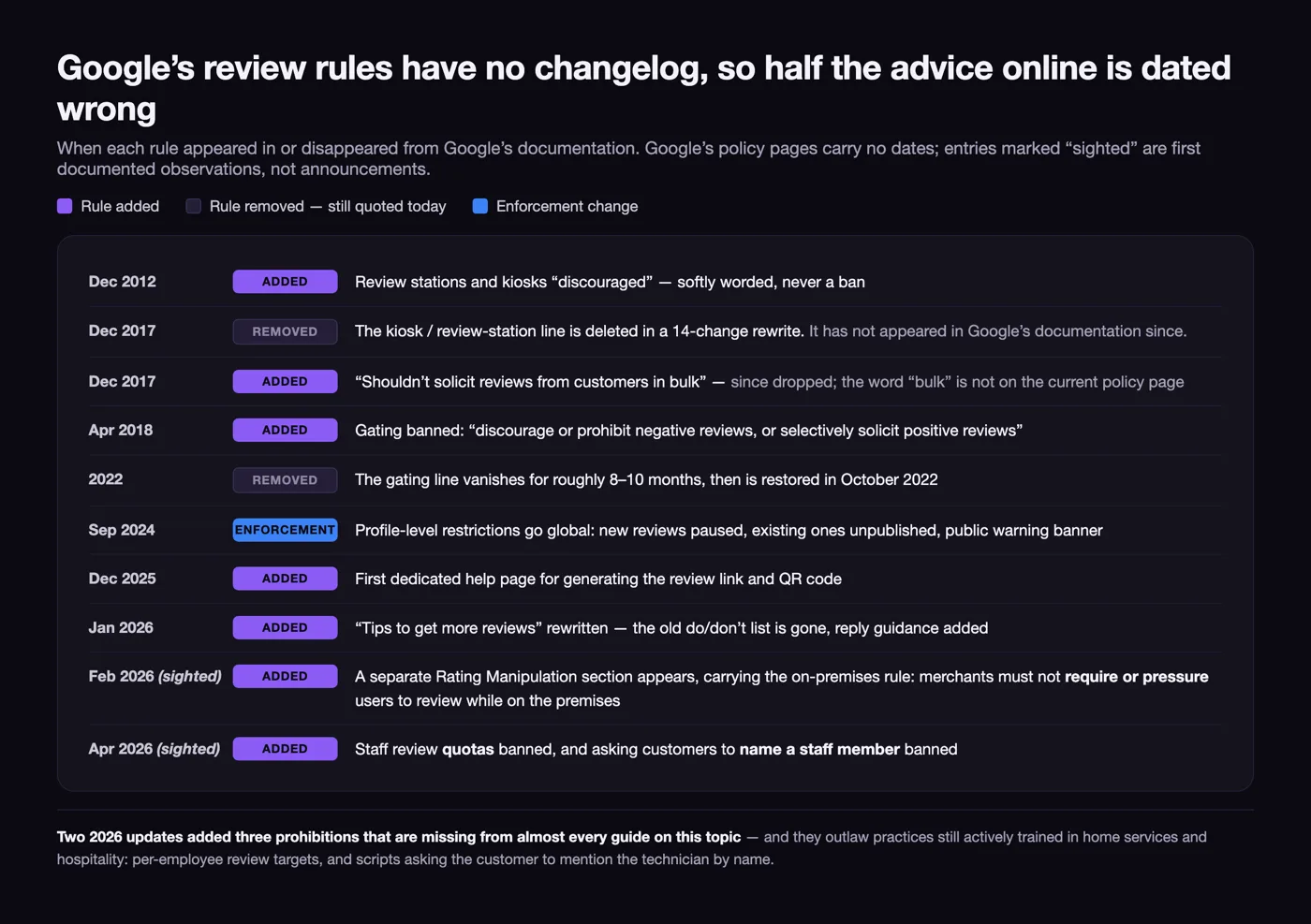
Three of those prohibitions arrived across two 2026 updates, and they are missing from almost every guide on this topic.
The on-premises pressure rule does not ban asking in your venue. It bans requiring or pressuring someone to post while they are standing there. Google’s own help page for the review QR code tells you to print and display it in your store, so the line is drawn at the pressure, not at the place. The same bullet carries the general no-scripting rule — you may not request that specific content be included — which is what the April 2026 staff-member sub-bullet then sharpens.
The staff quota rule is the one that quietly outlaws a common practice. If you have told your team that each of them should bring in five reviews a month, that is now named in Google’s policy. So is the script where the customer is asked to mention the technician by name — a standard tactic in home services, and one that a great many businesses are still actively training.
Three review rules everyone quotes that Google no longer publishes
This is the part worth checking against whatever guide you were reading before this one.
“Google prohibits review stations and kiosks.” It did, once, in soft form: a December 2012 guideline said Google “discourage[s] review stations or kiosks set up at your business location that are solely for soliciting reviews.” A harder version — “don’t set up review stations or kiosks at your place of business just to ask for reviews written at your place of business” — existed until Google’s December 2017 rewrite of the review guidelines, when it was removed. The words “kiosk” and “review station” appear nowhere in Google’s current documentation. We checked the prohibited-content page, the Tips page, the business representation guidelines and the missing-reviews page by literal word search. The current, narrower rule is the on-premises pressure line quoted above.
“Don’t solicit reviews in bulk.” This one was added in that same December 2017 rewrite and has since been dropped. The word “bulk” does not appear on Google’s current policy or Tips pages. What replaced it is not a solicitation rule at all but a detection signal: Google removes content showing “unusual volumes or patterns of review contributions.” Those are different things. One tells you not to email your list; the other tells you that a hundred reviews arriving in one afternoon looks like manipulation regardless of how you asked.
“Reviews from the same IP address or Wi-Fi network get filtered.” There is no Google source for this at all. The strings “IP address” and “Wi-Fi” appear nowhere in the policy, and the only mention of devices is about emulators and device-tampering services. This is entirely industry inference that hardened into folklore through repetition.
Google is also silent on two things people assume are settled: how long a warning banner stays on a profile, and how many suspicious reviews trigger one. Its published phrasing is “for set period of time” on the restrictions page and “temporarily paused” on the blog. Any specific figure is someone’s guess.
Review gating: one sentence from Google, and a different law entirely in the US
Review gating is the pattern where you survey customers first, then route the happy ones to Google and the unhappy ones to a private feedback form. Vendors still sell it. Both Google and US regulators treat it as a problem, but for different reasons and under different authorities, and almost every article that covers this gets the second one wrong.
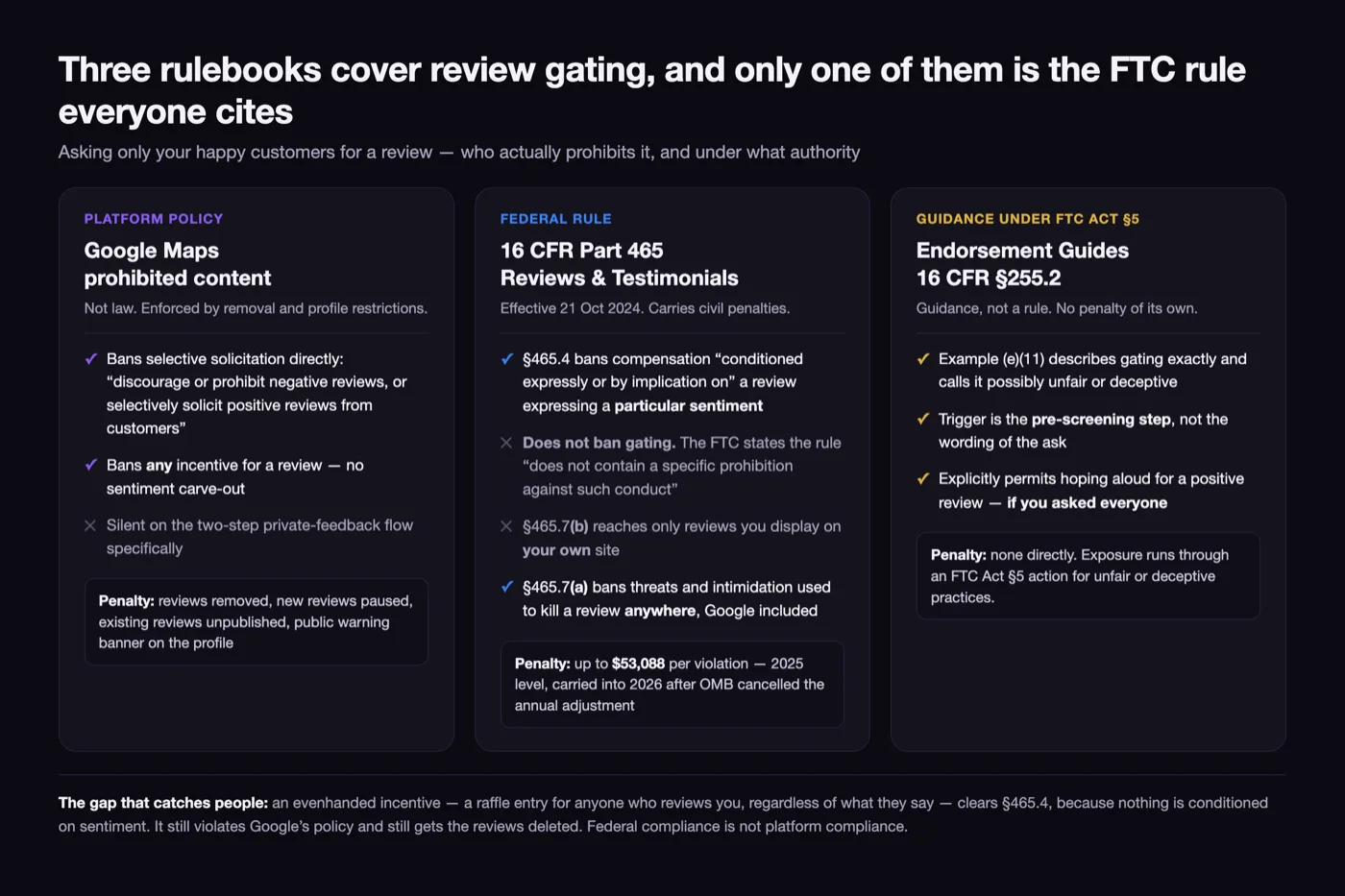
Google’s position is one sentence. Merchants must not “discourage or prohibit negative reviews, or selectively solicit positive reviews from customers.” That covers the selection step directly. Google has never used the word “gating,” and Google has never addressed the specific two-step private-feedback flow — that reading is inference, not a quote. Worth noting the asymmetry: Google recommends taking a conversation private after a negative review is posted (“politely request that the reviewer contact you via phone or email to resolve the issue privately”), while prohibiting the selection that happens before.
The US legal position is where the received wisdom is wrong. The FTC’s Rule on the Use of Consumer Reviews and Testimonials, 16 CFR Part 465, was announced 14 August 2024, published in the Federal Register on 22 August 2024 and took effect 21 October 2024. It does not contain a review-gating prohibition. The FTC says so itself, in its own published Q&A: asked whether a business can ask for reviews only from customers it thinks are happy, the answer is “The rule does not contain a specific prohibition against such conduct. But this practice could violate the FTC Act.”
So the exposure is real but it comes from Section 5 of the FTC Act as interpreted by the Endorsement Guides, not from the 2024 rule. The Guides’ own worked example, 16 CFR §255.2(e)(11), describes the practice exactly:
“A marketer contacts recent online, mail-order, and in-store purchasers of its products and asks them to provide feedback to the marketer. The marketer then invites purchasers who give very positive feedback to post online reviews of the products on third-party websites. Less pleased and unhappy purchasers are simply thanked for their feedback. Such a practice may be an unfair or deceptive practice if it results in the posted reviews being substantially more positive than if the marketer had not engaged in the practice. If, in the alternative, the marketer had simply invited all recent purchasers to provide feedback on third-party websites, the solicitation would not have been unfair or deceptive, even if it had expressed its hope for positive reviews.”
That last clause is the practical permission most businesses do not know they have. You may tell customers you would appreciate a good review. What you may not do is decide who gets asked based on what you think they will say.
The distinction matters for a second reason: the Guides are guidance, not a rule, and they do not carry the rule’s civil penalty. Part 465 violations do — up to $53,088 per violation. That figure was set for 2025 and still applies in 2026, because OMB cancelled the government-wide inflation adjustment in a memorandum dated 17 April 2026 after the funding lapse stopped BLS from publishing the CPI figure the calculation needs.
What Part 465 does prohibit, precisely, is buying sentiment. Section 465.4 bans providing “compensation or other incentives in exchange for, or conditioned expressly or by implication on, the writing or creation of consumer reviews expressing a particular sentiment, whether positive or negative.” Read that against Google’s rule and you get a genuine gap: incentives that are not tied to sentiment are permitted by the FTC and still prohibited by Google. The FTC’s Q&A says giving incentives for reviews is fine “as long as there isn’t an express or implied requirement that the reviews have to express a particular sentiment.” Google’s policy has no such carve-out — any incentive in exchange for posting a review is fake engagement. A raffle entry for anyone who reviews you clears §465.4 — nothing is conditioned on sentiment — and still gets your reviews deleted. Clearing §465.4 is not the same as clearing the FTC Act, which is a broader instrument; but on the platform side there is no argument to have.
Section 465.7, the review-suppression section, has two halves that are usually collapsed into one, and the difference decides whether it applies to you at all. Paragraph (b) — misrepresenting that the reviews you display are all or most of the reviews you received, when negative ones are withheld — is limited to reviews shown on your own website or platform, so it does not reach anything happening on Google. Paragraph (a) has no such limit. It applies to “anyone” who uses “an unfounded or groundless legal threat, a physical threat, intimidation, or a public false accusation” to stop a review being written or to get one removed. A baseless defamation threat sent to a Google reviewer to make a one-star review disappear sits squarely inside it.
Enforcement so far has landed on flagrant conduct rather than sloppy solicitation. The FTC sent warning letters to ten unnamed companies on 22 December 2025. A settled action against supplement seller TruHeight followed on 13 April 2026, over several thousand employee-written five-star reviews and products given in exchange for five-star ratings: a $4 million judgment, largely suspended, with $750,000 actually payable. A second case, against a company that allegedly built thousands of fake home-repair listings with fake reviews attached, was filed by DOJ on 11 May 2026 and is still pending. No ordinary small business has been actioned over how it asks.
What enforcement looks like when it lands on your profile
Google’s enforcement is faster and more consequential than the FTC’s, and it is where a small business will actually feel this.
The published scale, from Google’s post of 16 April 2026 covering calendar year 2025: more than 292 million policy-violating reviews blocked or removed, alongside more than a billion published; 79 million inaccurate or unverified edits to places on Maps blocked; posting restrictions placed on more than 782,000 accounts; and more than 13 million fake Business Profiles removed. The prior year’s post, from 7 April 2025 covering 2024, reported 240 million reviews and 12 million profiles — so the review number rose about 22% year on year.
Note the date shift: the 292 million figure is 2025 data published in 2026, and it is routinely quoted as a 2026 number.
What happens to a profile Google flags, in Google’s own words: it “will not be able to receive new reviews or ratings for set period of time,” its “existing reviews or ratings will be unpublished for set period of time,” and it “will display a warning to let consumers know that fake reviews were removed.” The trigger Google describes is “a sudden spike in spam reviews.” These profile-level restrictions were UK-only before going global in September 2024.
Read that sequence carefully, because it is the actual risk of a badly designed review push. The punishment is not that the bad reviews get removed. It is that your legitimate reviews get unpublished, new ones are blocked, and a banner tells every prospective customer that fake reviews were found on your profile — during the exact period you were trying to build trust.
If you need to report a review that violates policy, Google’s published timelines are “typically several days” for evaluating a reported review and “up to 5 business days” for a profile-level appeal. You get one appeal per review, up to ten reviews per form. Reviews removed for policy violations are not restored. Getting a genuinely unfair review taken down is a different discipline with a different success rate, and it deserves its own treatment rather than a paragraph here.
Two smaller mechanics that catch people out. Your replies are moderated too — typically within ten minutes, but Google says some take up to 30 days, and a non-compliant reply has to be edited before it posts. And replying matters more than most owners assume: 80% of consumers in BrightLocal’s 2026 survey said they are likely to use a business that responds to all of its reviews, while generic or templated replies put off 50%.
A review request that passes both rulebooks
Everything above collapses into a short operating standard. Ask everyone, ask the same way, ask at the same moment, offer nothing, specify nothing.
- Generate the link and QR code from your own profile, on a desktop browser. Do not use a third-party link generator — you do not need one, and Google’s path takes under a minute.
- Pick one trigger point and automate it: invoice sent, job marked complete, appointment closed. The trigger has to be something that happens to every customer, not something you decide case by case. That is what makes the solicitation generalized, which is the FTC’s express safe harbour and Google’s stated allowance.
- Send the same message to everyone who hits that trigger. No pre-survey. No sentiment routing. No separate list for the customers you liked.
- Say nothing about what the review should contain. No star target, no request to mention a staff member, no suggested wording. Requesting specific content is prohibited under the on-premises bullet sighted in February 2026, and the staff-member version became its own named violation in April 2026.
- Offer nothing. No discount, no free item, no prize draw, no loyalty points. Google’s rule has no sentiment carve-out, so even an evenhanded incentive is a violation on its side.
- Set no staff targets. Team review quotas are named in the policy. Train the ask; do not count it per person.
- Reply to everything, briefly and specifically, and take complex complaints to phone or email.
You are allowed to say you would appreciate a positive review — the FTC’s own example confirms it, provided you asked everyone. What you cannot do is choose the audience.
The one thing this article deliberately leaves alone is the profile itself: categories, photos, services, posting cadence and the rest of Google Business Profile optimisation are a separate job with separate rules, and reviews land on a badly configured profile the same way water lands on a roof with no gutters. That is worth doing first, and it is a topic of its own.
For most small businesses the hard part is not knowing the rules. It is the trigger point in step two — the operational discipline of making the ask happen automatically for every customer, every time, without someone remembering. That is a systems problem, not a marketing one, and it is the kind of thing we set up as part of marketing for small businesses rather than as a campaign.
Sources, and what each figure was measured on
- Review counts and star ratings in the local 3-pack: Local Falcon, “What 50 Million Search Results Reveal About Ranking in the Local 3-Pack,” published 14 January 2026. 50.4 million US search results across 1,993 categories, Q4 2025, deduplicated to one result per location-and-keyword pair. Correlational: the study states it does not prove reviews caused the rankings.
- Consumer thresholds (47% under 20 reviews, 68% four-star floor, 31% at 4.5+, 74% three-month recency, 80% reply preference): BrightLocal Local Consumer Review Survey, published 11 February 2026, panel of 1,002 US adults. BrightLocal does not publish a fieldwork date.
- 68% of asked consumers left a review: BrightLocal Local Consumer Review Survey 2017, October 2017, 1,031 US consumers. Lifetime self-report, not per-request conversion.
- Google policy wording: Prohibited & restricted content (Maps user-generated content policy), Tips to get more reviews, Create a Google link or QR code to request reviews, Business Profile restrictions for policy violations, Report inappropriate reviews, and Appeal Business Profile content & profile restrictions. None of these pages carries a visible date; dates in the table above are Google blog posts or first documented sightings, as labelled.
- Enforcement volumes: Google Maps blog, 16 April 2026 (2025 data) and 7 April 2025 (2024 data).
- FTC rule text: 16 CFR Part 465, current eCFR text. Announcement 14 August 2024, Federal Register 22 August 2024, effective 21 October 2024. Gating position: FTC’s published Consumer Reviews and Testimonials Rule Q&A. Endorsement Guides example: 16 CFR §255.2(e)(11).
- Civil penalty: $53,088 per violation, set at 16 CFR 1.98 for 2025 and carried into 2026 under OMB Memorandum M-26-11, 17 April 2026.
09 / Reader questions
Frequently asked questions
01Is it legal to buy Google reviews?
No. A purchased review is a fake review under §465.2 of the FTC's Rule on the Use of Consumer Reviews and Testimonials, which took effect 21 October 2024 and carries civil penalties of up to $53,088 per violation; paying for positive sentiment separately violates §465.4. It also violates Google's fake engagement policy, which gets the reviews removed.
02Can you pay to get more Google reviews?
No, if the payment is tied to leaving a review at all. Google's policy prohibits offering payment, discounts, or free goods and services in exchange for posting a review, revising one, or removing a negative one. The FTC rule is narrower: it bans compensation conditioned on the review expressing a particular sentiment.
03How many Google reviews do I need to show up in the local pack?
It depends entirely on your category. Local Falcon's analysis of 50.4 million US search results from Q4 2025 found median review counts among 3-pack businesses of 20 for home health care, 56 for electricians, 215 for plumbers, 346 for dentists and 976 for breakfast restaurants. Metro areas carry roughly 1.5 to 2 times what rural areas do on average, and more in some categories.
04Can I ask only my happy customers for a Google review?
No. Google's policy explicitly prohibits merchants from selectively soliciting positive reviews from customers. In the US, the practice also risks an FTC Act violation under the Endorsement Guides, though it is not banned by the FTC's 2024 reviews rule itself. Ask everyone, at the same time, in the same way.
05Can Google detect fake reviews?
Google reported blocking or removing more than 292 million policy-violating reviews during 2025, published on 16 April 2026. Detection is now partly Gemini-based and can stop a contribution before it goes live. A sudden spike in suspicious reviews can pause new reviews on your profile and put a public warning banner on it.
06How long does Google take to remove a review I reported?
Google publishes two numbers and no others. Reported reviews take "typically several days" to evaluate, and a profile-level appeal takes "up to 5 business days." Any faster figure you see quoted is invented. Reviews removed for policy violations are never restored.