
Published
An influencer contract template is a starting draft for a lawyer, not a substitute for one. Four clauses decide almost every dispute that follows: usage rights, exclusivity, whitelisting access, and who answers when a disclosure is missing. The rest of most templates is boilerplate that never gets read twice.
This is not legal advice. Nothing here creates a lawyer-client relationship, and none of it is tailored to your jurisdiction, your deal or your risk. Treat every clause below as a question to bring to a qualified lawyer, not as language to paste into a signature block. US law is cited because the enforcement record referenced here is American; if your creator, your audience or your entity sits elsewhere, different rules apply.
The number worth carrying into the negotiation: in 2025, four US class actions over undisclosed influencer relationships claimed more than $1 billion in damages between them, and each of them named the brand and individually named creators as defendants. Those are amounts sought in complaints, not judgments — but they are the reason the disclosure clause is no longer the boring part of the document.
How this was checked. Regulatory text is quoted from the current editions of 16 CFR Part 255, 16 CFR Part 465 and 16 CFR 1.98 on eCFR, read in August 2026, with the amendment dates the register shows. Case names, courts, docket numbers and filing dates come from law-firm reporting on the complaints, and where two firms report a damages figure differently, both figures appear. Where a legal point is genuinely unsettled, this page says so instead of resolving it, and where a number is an industry convention rather than a rule, it is labelled as one.
Four clauses decide almost every influencer dispute
The first result Google returns for this query is a raw .docx file sitting in a marketing platform’s upload folder. That is a fair summary of the category: the market supplies documents, not decisions. The decisions live in four clauses.
| Clause | What the argument later sounds like | What the clause has to state |
|---|---|---|
| Usage rights | “We only agreed to the one post” | Named channels, named territories, a term with a start and an end, and the price of an extension |
| Exclusivity | “That brand isn’t a competitor” | A named category or a named list of brands, with dates, not “for the duration of the campaign” |
| Whitelisting | “They ran ads off my handle for months” | How access is granted, its expiry, a spend cap, edit rights, and how it is revoked |
| Disclosure | “The creator was supposed to handle that” | The exact wording and placement required, a proof-of-live obligation, a fix window, and indemnity |
The definitions of the first three — what usage rights, exclusivity and whitelisting actually mean, and the published uplift ranges creators quote for them — are set out in our media kit examples guide. This page is about the drafting: what the clause has to say to survive the argument.
Usage rights: write the licence, not the label
A usage rights clause is a copyright licence. Licences fail on four axes, and a template that names all four is already better than most.
Channels. “Marketing materials” is not a channel. “The brand’s owned Instagram, TikTok and YouTube accounts, its website, and its email newsletter” is. If paid social is intended, name it separately — organic reuse and paid amplification are different risks for a creator and are priced differently.
Territory. Worldwide is fine if worldwide is what is being paid for. It usually is not, and it is the cheapest concession to hand over by accident.
Term. A term needs a trigger and a length: twelve months from the date of first publication beats twelve months from signature when the shoot slips. Perpetuity is the term creators most often sign without pricing. Aspire’s State of Influencer Marketing 2026, drawn from nearly 900 marketers and creators, reports that 67% of brands bake content usage rights into the creator’s initial contract or rate — meaning the negotiation happens once, at the start, or not at all. Aspire does not publish when the survey was fielded, so read the figure as a snapshot of the report’s year rather than of any particular month.
What happens at expiry. Most templates stop at the end date and never say what the end date obliges anyone to do. Add it: the brand stops running the content, removes it from active placements within a stated number of days, and does not have to scrub archives or third-party reposts it does not control. That last carve-out is what makes the clause acceptable to a brand instead of unenforceable.
Two more provisions worth naming explicitly. Sub-licensing — whether the brand may pass the content to retailers, marketplaces or distributors, which is where “we only agreed to their channels” usually goes wrong. And the extension price, agreed at signature. An option priced later is an option priced during a dispute.
Exclusivity a court can actually measure
Exclusivity clauses fail because they describe a category rather than defining one. “The creator shall not promote competing products” invites a fight about what competes.
Three drafting choices remove the fight:
- Name the category or the brands. A closed list of named competitors is the most enforceable version. A category definition works if it is anchored to something external — a retailer’s own category taxonomy, a defined product type — rather than to the brand’s opinion.
- Date the window. Start date, end date, both calendar dates. “For the duration of the campaign and a reasonable period after” is not a period.
- Carve out what already exists. Pre-existing agreements, ambassadorships and evergreen affiliate links the creator cannot unwind. A creator who signs an exclusivity clause they are already breaching has handed the brand a termination right on day one, which serves neither party.
Then decide whether exclusivity survives termination. If the deal ends in month two of a six-month exclusivity window, does the creator stay locked out? The defensible answer is that exclusivity ends when payment stops, unless the brand pays to keep it running.
Whitelisting is access, and access needs an off switch
Whitelisting — the brand buying media that appears to come from the creator’s own handle — runs on platform mechanisms with fixed shapes: Meta’s Partnership Ads, formerly Branded Content Ads, and TikTok’s Spark Ads with their post authorization codes. What those mechanisms are is covered in our media kit guide. What a contract has to add is the governance around them.
- Duration of the grant, stated separately from the usage rights term. The two are routinely conflated and they are not the same permission.
- A spend ceiling, or at minimum a notification threshold. A creator’s handle carrying six figures of spend is a different reputational proposition from one carrying $2,000.
- Edit rights. Whether the brand may alter the creative, add overlays, or run a cut-down version — and whether the disclosure survives the edit, because it is the brand’s ad now.
- Metric contamination. Paid amplification distorts the creator’s own organic engagement figures, which is the number their next deal is priced on. Agreeing upfront that the creator may exclude whitelisted spend from their reported figures is a small concession that removes a real grievance. The mechanics of which denominator gets distorted are in our guide to calculating engagement rate.
- Revocation. How access ends: automatically at a stated date, immediately on termination, and with a stated obligation on the brand to stop the ads rather than merely to let the code lapse.
Disclosure wording the FTC accepts, and the shorthand it rejects
The operative rule is 16 CFR 255.5: where a connection between endorser and seller “might materially affect the weight or credibility of the endorsement” and is not reasonably expected by the audience, it “must be disclosed clearly and conspicuously.” Free or discounted product counts. So does early access, and so does the mere possibility of being paid or winning a prize.
“Clearly and conspicuously” is defined in 16 CFR 255.0: the disclosure must be “difficult to miss (i.e., easily noticeable) and easily understandable by ordinary consumers,” and in an interactive medium such as social media it “should be unavoidable.”
The FTC’s own influencer guidance, Disclosures 101 for Social Media Influencers — published November 2019 and last updated 3 December 2024 — is unusually specific about wording, and a contract can simply adopt it by reference:
| Accepted | Rejected |
|---|---|
| “advertisement”, “ad”, “sponsored” | “sp”, “spon”, “collab” |
| “Thanks to [Brand] for the free product” | a bare “thanks” |
| compressed forms the creator writes where characters are tight — “AcmePartner”, “Acme Ambassador” | “ambassador” standing alone |
| #ad or #sponsored, placed with the message | any disclosure behind a “more” link, in a bio only, or at the end of a video |
Three placement rules the same guidance sets out, each of which belongs in the deliverables schedule rather than in the legal boilerplate: superimpose the disclosure on image posts and leave it up long enough to read; put it inside the video in both audio and visual form, not only in the description; and repeat it periodically during a livestream. The FTC also warns against relying on a platform’s built-in disclosure tool alone — use it in addition to your own. And it notes that tags, likes and pins can themselves be endorsements.
Two obligations make the clause operational instead of decorative. First, proof of live: the creator sends the live URL within a stated number of hours. Second, a fix window: a stated period — twenty-four hours is common and defensible — to correct or delete a non-compliant post on notice, before any remedy bites.
Those two are not brand paranoia. 16 CFR 255.1 says advertisers should “provide guidance to their endorsers on the need to ensure that their statements are not misleading and to disclose unexpected material connections”, “monitor their endorsers’ compliance”, and “take action sufficient to remedy non-compliance and prevent future non-compliance.” The Guides are advisory in form, but a brand that cannot show it did those three things has no answer to the section, whatever its contract says.
Guides against rule: the two routes to a civil penalty
This is the distinction most influencer-contract content skips, and it changes what the disclosure clause is actually protecting against.
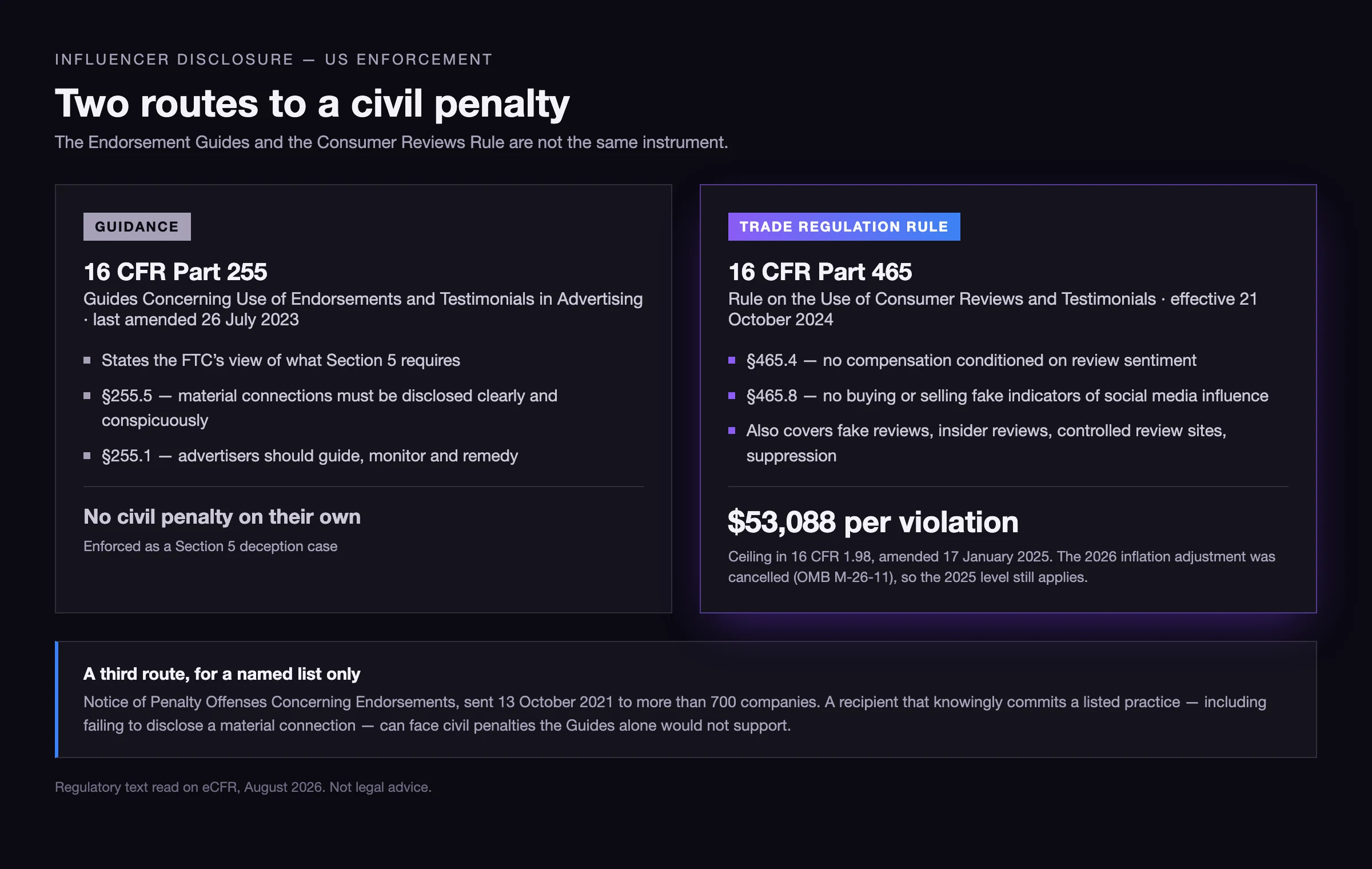
The Endorsement Guides at 16 CFR Part 255, last amended 26 July 2023, are guides. They state the FTC’s view of what Section 5 of the FTC Act requires; they do not themselves carry civil penalties. An enforcement action under them proceeds as a deception case.
The Rule on the Use of Consumer Reviews and Testimonials, 16 CFR Part 465, effective 21 October 2024, is a trade regulation rule. Knowing violations expose a business to civil penalties — the ceiling in 16 CFR 1.98 currently reads $53,088 per violation, as amended 17 January 2025. That figure is normally re-adjusted for inflation every January, but the 2026 adjustment was cancelled — OMB Memorandum M-26-11 directed agencies to keep using the 2025 levels because the data the statute requires was not produced — so the 2025 number is still the live one. Check it before quoting it anyway; that is the kind of figure that moves without announcement. The rule’s sections cover fake reviews (§465.2), sentiment-conditioned incentives (§465.4), undisclosed insider reviews (§465.5), company-controlled review sites (§465.6), review suppression (§465.7) and fake indicators of social media influence (§465.8).
There is a third route worth knowing about, because it applies retroactively to a specific list of companies. On 13 October 2021 the FTC sent a Notice of Penalty Offenses Concerning Endorsements to more than 700 companies, covering practices including falsely claiming a third-party endorsement, misrepresenting whether an endorser is an actual user, and failing to disclose a material connection. A recipient that then commits one of those practices with knowledge can face civil penalties even though the Guides alone would not support them. The ceiling stated at the time was $43,792 per violation; it has since risen to the same $53,088 figure through the annual adjustments.
The trap in the approval clause. §465.4 prohibits providing compensation or other incentives “in exchange for, or conditioned expressly or by implication on, the writing or creation of consumer reviews expressing a particular sentiment, whether positive or negative.” The rule defines a consumer review narrowly — an evaluation published to a platform dedicated in whole or in part to receiving and displaying such evaluations — and the FTC answers the influencer question directly in its own rule Q&A: hiring influencers to review products does not engage §465.4, because “hired influencers are providing testimonials,” and a hired influencer’s social post counts as a celebrity testimonial rather than a review. The moment the deliverables schedule includes an Amazon review, an app-store rating or a Trustpilot entry, that shelter disappears and the section applies — at which point a payment term reading “subject to the creator posting a favourable review” is the violation. Split the deliverable, or pay for the post rather than for the sentiment.
More than $1 billion was claimed against four brands in a single year
The FTC is no longer the main litigation risk. Four class actions filed in 2025 changed the shape of the exposure:
| Case | Court | Filed | Damages sought |
|---|---|---|---|
| Dubreu v. Celsius Holdings, Inc. et al. | C.D. Cal., No. 5:25-cv-00180 | 22 Jan 2025 | at least $450 million |
| Bengoechea et al. v. Shein et al. | N.D. Ill., No. 1:25-cv-01402 | 10 Feb 2025 | over $500 million |
| Negreanu v. Revolve Group, Inc. et al. | C.D. Cal., No. 2:25-cv-03186 | April 2025 | over $50 million |
| Sulici et al. v. Color Image Apparel (Alo Yoga) et al. | N.D. Ill., No. 1:25-cv-03928 | 11 Apr 2025 | reported as more than $150 million, and elsewhere as in excess of $75 million |
One qualifier on the Alo Yoga row, because it is the only figure the reporting disagrees about: Frankfurt Kurnit and Davis+Gilbert both put the claim above $150 million, Morgan Lewis puts it in excess of $75 million. The total across the four complaints therefore lands somewhere above $1 billion, not at a single defensible number — which is enough for the point being made and not enough to quote to two decimal places.
Three things about that table matter for the contract.
The creators were named too. The Shein complaint names seven individual influencers, the Celsius complaint three, and the Alo Yoga complaint more than a dozen. A creator who assumed the brand carried the risk was wrong in all three.
The claims are pleaded through state law. The FTC Act does not give consumers a private right of action, so these complaints run on state consumer-protection statutes — the Shein filing pleads Illinois, California, Pennsylvania, Virginia and D.C. statutes among others, and the Celsius filing runs on California’s Unfair Competition Law, False Advertising Law and Consumers Legal Remedies Act — with the FTC’s disclosure standard supplying the yardstick. The practical consequence: complying with the Guides is not just regulator management, it is the defence in private litigation.
The alleged defect is placement, not absence. The recurring allegation is that disclosures existed but sat behind a “more” button or below the fold — which is exactly what 255.0’s “unavoidable” language addresses. A contract that specifies where the disclosure goes is doing more work than one that specifies that a disclosure exists.
These are pleadings. None of the figures above is a judgment, and complaints routinely claim more than they recover. They are useful as a measure of what the plaintiffs’ bar now considers worth filing.
The audience-authenticity warranty almost no template carries
§465.8 makes it a violation to sell, distribute, purchase or procure fake indicators of social media influence that the party “knew or should have known to be fake” and that materially misrepresent their influence or importance for a commercial purpose. The rule defines those indicators broadly: followers, friends, connections, subscribers, views, plays, likes, saves, shares, reposts and comments.
Read the section carefully before assuming it reaches a brand that hires a creator with a bought audience — on its own terms it does not. It bites the party whose own influence is being misrepresented, which is the creator, and a brand paying for a post is not purchasing indicators. The section is worth knowing because it tells you what your counterparty is exposed to, and because it made buying followers a named federal violation rather than merely tacky.
The brand-side exposure comes from somewhere else, and the article has already named it: §255.1 makes the advertiser answer for misleading endorsements and tells it to monitor. Inflated audience figures are what make a reach claim in a campaign report wrong, and a brand repeating a number it never checked is making the claim.
Either way the drafting answer is the same, and it is cheap: a representation and warranty that the creator’s audience metrics have not been artificially inflated by purchased followers or engagement, that they will not be during the term, and that a breach is a termination event with fees refundable pro rata. Add a right to request platform-native analytics rather than a screenshot from a third-party dashboard, and a right to verify against the engagement-rate denominators described earlier.
This clause is rare in downloadable templates, which is not surprising: the section that made it worth writing has only been in force since October 2024.
Ownership does not transfer by default in the US
Under US copyright law the creator owns what they shoot. A brand that wants ownership rather than a licence has to say so, and “work made for hire” usually will not get it there.
17 U.S.C. §101 makes a commissioned work a work made for hire only if it falls within nine enumerated categories — a contribution to a collective work, part of a motion picture or other audiovisual work, a translation, a supplementary work, a compilation, an instructional text, a test, answer material for a test, or an atlas — and the parties sign a written agreement saying so. A standalone Instagram Reel is not obviously any of those. Whether a social video counts as “part of a motion picture or other audiovisual work” is arguable, and a clause whose effect depends on winning that argument is a weak clause.
The reliable construction is an express assignment of copyright, signed, with a licence-back to the creator so they can keep the post on their own feed and in their portfolio. Most creators will take that trade if it is priced; almost none will take it silently.
Three adjacent terms belong in the same section. Raw files — whether the brand receives unedited footage and stills, which is a separate and more valuable grant than the finished post. Minimum live period — how long the post stays up on the creator’s own channel before they may delete it. There is no standard here and no authority to cite: quoted floors run from the length of the campaign to ninety days, so pick a number and write it rather than inheriting one. And music and third-party rights — platform-licensed audio generally cannot be relicensed to a brand for paid use, so a whitelisted ad built on a trending track is a rights problem the contract should push onto whoever chose the track.
Termination, morality clauses and what survives them
A morality clause drafted as “conduct that brings the brand into disrepute” gives the brand a right it can only exercise by making a subjective judgment the creator can contest. Objective triggers are enforceable and negotiable: criminal charges, a platform ban, a finding by an advertising regulator, a breach of the disclosure obligation after notice.
Reciprocity is worth offering. A creator asked to accept a morality clause with no mirror is being asked to carry brand risk for free, and a mutual clause costs a brand very little in practice.
Nothing below is a default rule — survival is entirely a function of what the survival clause says. These are the positions worth writing down before anyone has a reason to argue about them:
- Usage rights — survive for whatever term was granted and paid for, unless termination was for the creator’s breach.
- Exclusivity — ends when the payment stream ends. This is a negotiating position, not a legal default; a clause silent on the point can be read the other way.
- Confidentiality — survives, with a stated period.
- Whitelisting access — ends immediately, with a positive obligation on the brand to stop the ads rather than merely to let the authorization lapse.
- Payment for delivered work — payable for anything delivered and accepted before termination, which is the term creators most often lose by not asking for it.
Add a kill fee for cancellation before delivery. A creator who blocked out a shoot day has an opportunity cost whether or not the brand still wants the post. There is no published benchmark for the number; 50% is the figure most often quoted as an anchor in creator contracting, and tiering it by how much notice was given is a reasonable way to make it feel fair to both sides.
The clause order to hand a lawyer
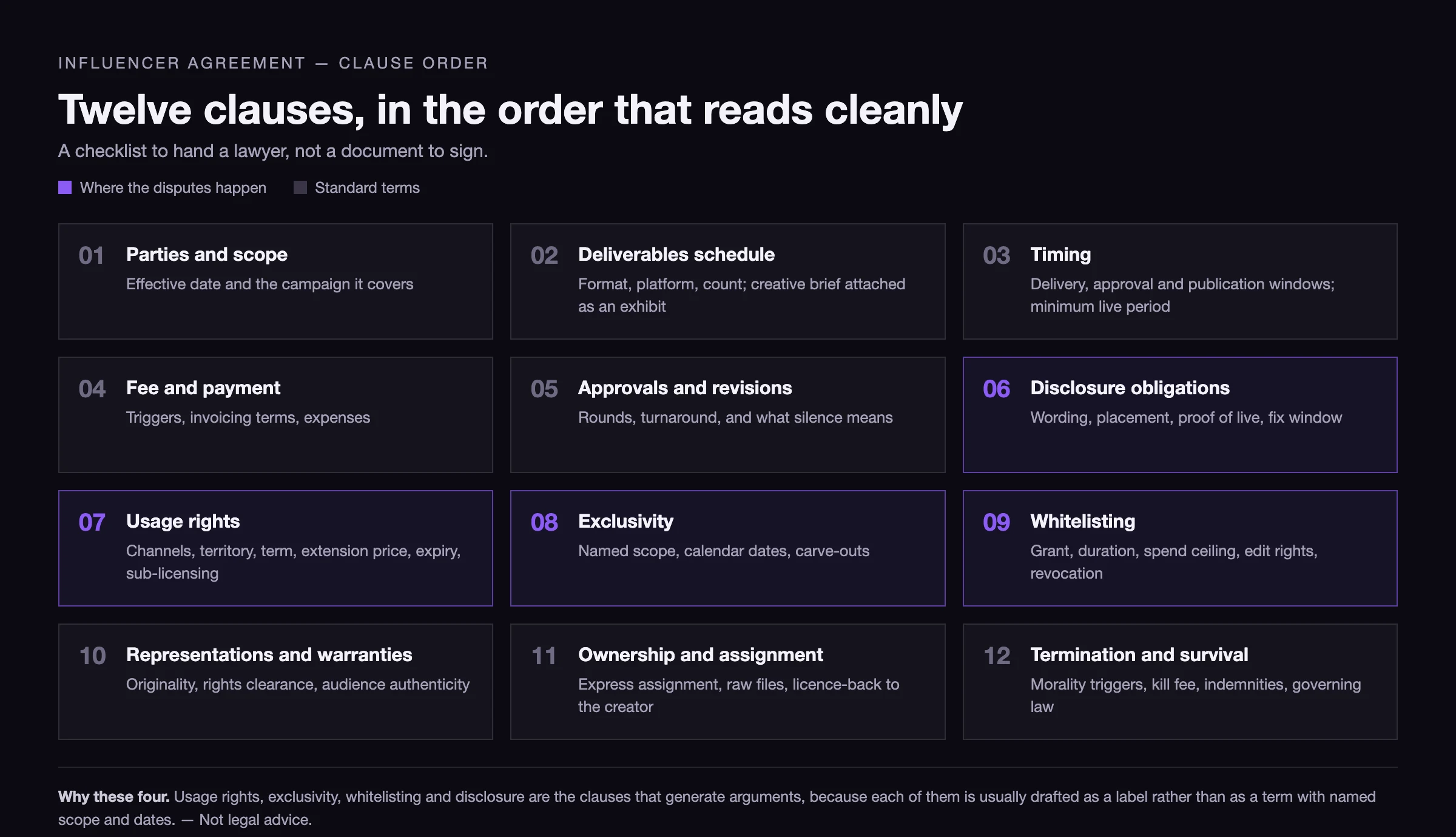
The value of a template is the checklist, not the prose. This is the order that reads cleanly and puts the negotiated terms where both sides will actually look:
- Parties, effective date, and the campaign it covers
- Deliverables schedule — format, platform, count, and the creative brief attached as an exhibit rather than described in the body
- Timing: delivery dates, approval window, publication window, minimum live period
- Fee, payment triggers, invoicing terms, expenses
- Approvals and revisions — number of rounds, turnaround, and what silence means
- Disclosure obligations — wording, placement, proof of live, fix window
- Usage rights — channels, territory, term, extension price, expiry obligations, sub-licensing
- Exclusivity — named scope, calendar dates, carve-outs
- Whitelisting — grant, duration, spend ceiling, edit rights, revocation
- Representations and warranties — originality, rights clearance, audience authenticity
- Ownership and assignment, raw files, licence-back
- Termination, morality triggers, kill fee, indemnities, survival, governing law
Attaching the creative brief as a numbered exhibit rather than paraphrasing it in the contract is a small structural choice that prevents a large class of dispute: the brief can be updated by agreement without reopening the agreement. Our guide to writing a content brief covers what that exhibit needs to contain.
A last word on the thing this article cannot do for you. Every clause above is a question, and the answers are jurisdiction-specific, deal-specific and risk-specific. Take the checklist to a lawyer; do not take the checklist instead of a lawyer. What we can help with is the side of the problem that sits before the contract — briefing, sourcing and vetting the creators in the first place, which is what our influencer marketing team does.
12 / Reader questions
Frequently asked questions
01What should be included in an influencer contract?
Parties, deliverables, timing, fee and payment terms, usage rights, exclusivity, whitelisting access, disclosure obligations, approval and revision limits, audience-authenticity warranties, ownership of raw files, termination and survival. Most templates cover the first five well and the rest thinly, which is why disputes cluster in the back half of the document.
02Is an influencer contract template legally binding?
A filled-in template signed by both parties can form a binding contract, but that is not the useful question. The useful question is whether its terms are specific enough to enforce. Clauses saying content may be used "in marketing materials" or exclusivity "in the category" are the ones that collapse when the parties disagree about what they meant.
03Who is legally responsible if an influencer does not disclose an ad?
Both, in different ways. The FTC's Endorsement Guides make advertisers liable for failing to disclose unexpected material connections, and 16 CFR 255.1 tells them to guide endorsers, monitor compliance and remedy failures. An indemnity clause moves the cost to the creator afterwards; it does not move the brand's exposure. The 2025 class actions named brands and individual creators as co-defendants.
04How long should usage rights last in an influencer contract?
Long enough to run the campaign and no longer, with a priced option to extend. A defined term — say six months from first publication, on named channels, in named territories — is enforceable. "In perpetuity, worldwide, all media" is common in templates and is the single term creators most often accept without pricing, which is why it is worth negotiating first.
05What is whitelisting in an influencer contract?
Whitelisting is the brand running paid ads from the creator's own handle rather than its own. Contractually it is an access grant, not a content licence, so it needs its own terms: how the access is granted, how long it lasts, what the brand may spend behind it, who may edit the creative, and how access ends. Definitions of the term sit in our media kit guide.
06Do gifted collaborations need a contract?
Yes, and they need a disclosure more than paid deals do. Free or discounted product is a material connection under 16 CFR 255.5 whether or not the creator was asked to post. A gifting agreement can be short, but it should still state that the product was provided free, that the creator must disclose it, and what the brand may and may not do with the resulting content.
07Can a brand ask an influencer for a positive review?
Not if the deliverable is a review on a review platform. 16 CFR 465.4, effective October 21 2024, prohibits compensation conditioned expressly or by implication on a review expressing a particular sentiment. The FTC's own Q&A on the rule says hiring influencers to review products does not engage that section, because hired influencers are providing testimonials rather than reviews. The moment an Amazon, app-store or Trustpilot entry appears in the deliverables list, that shelter is gone and sentiment-conditioned payment becomes a rule violation.
08Do I need a lawyer for an influencer contract?
For a one-off gifting deal, a short written agreement built from a template is usually proportionate. For anything with paid amplification, exclusivity, or content the brand intends to run beyond the campaign, a lawyer in the relevant jurisdiction should see it. This article is not legal advice and is not a substitute for that review.