Published
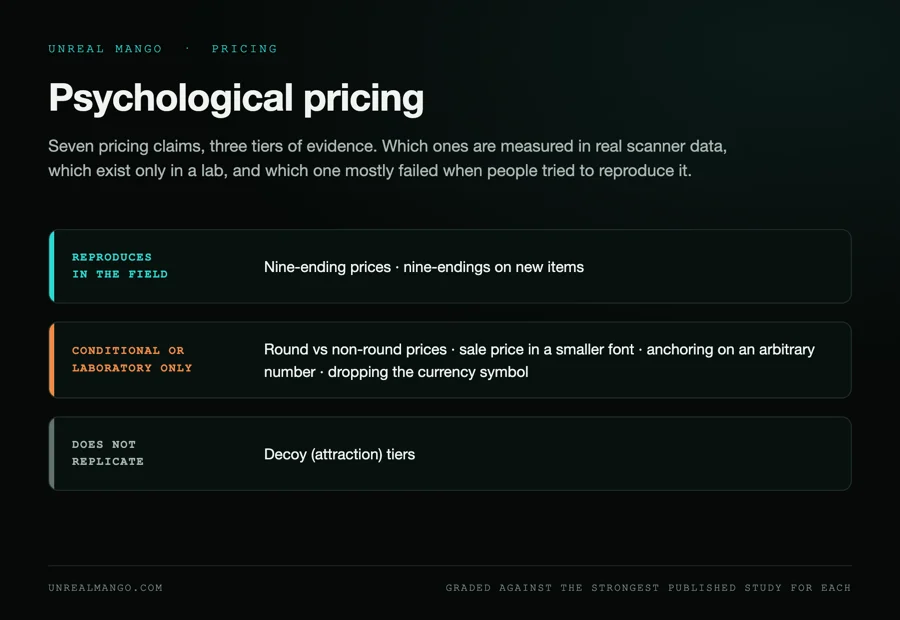
Psychological pricing is the practice of setting or displaying a price to change how large it feels, not what it buys. One part, prices ending in nine, is measured in field data covering 78 million price observations. Other parts, including the decoy effect, fail to replicate. The difference decides which are worth copying.
How this was checked. Eight of the nine pages on the first screen of results for this term list the same tactics in one flat sequence: charm pricing, prestige pricing, anchoring, decoys, bundles, hiding the cents. The exception is the top-ranked result, a write-up of a single study. Not one of the nine separates a tactic measured in field data from a tactic that rests on a single small study, and five of them are published by billing, payments or sales-software vendors. This article grades seven pricing claims against the strongest published study for each, naming the study, its setting and its sample. Where a claim is our inference rather than a finding, it is marked as one.
The headline number: in the largest published estimate of the effect, consumers respond to a one-cent increase away from a ninety-nine-ending price as if it were more than a twenty-cent increase. That is the strong end of psychological pricing. At the weak end, ninety-one attempts to produce the decoy effect returned eleven reliable results.
What psychological pricing covers, and why its tactics are not equally proven
Psychological pricing is an umbrella over any decision about how a price is expressed rather than what it is. The number itself may be identical: $200.00, $200, 200.00 and “two hundred dollars” all take the same amount from the same bank account. The claim is that they do not take the same amount of persuasion — and that a tactic which also moves the number, from $200 to $199.99, is doing two things at once.
That umbrella hides a very wide spread in evidence. Underneath it sit effects estimated from tens of millions of scanner price observations, and effects demonstrated on stylised stimuli — a toaster oven reduced to a durability rating of 7.2 and an ease-of-cleaning rating of 5.5. Both arrive in a marketing article as a bullet of equal weight. They are not of equal weight, and the practical consequence is direct: one of them will survive contact with your buyers and the other will quietly do nothing while you congratulate yourself.
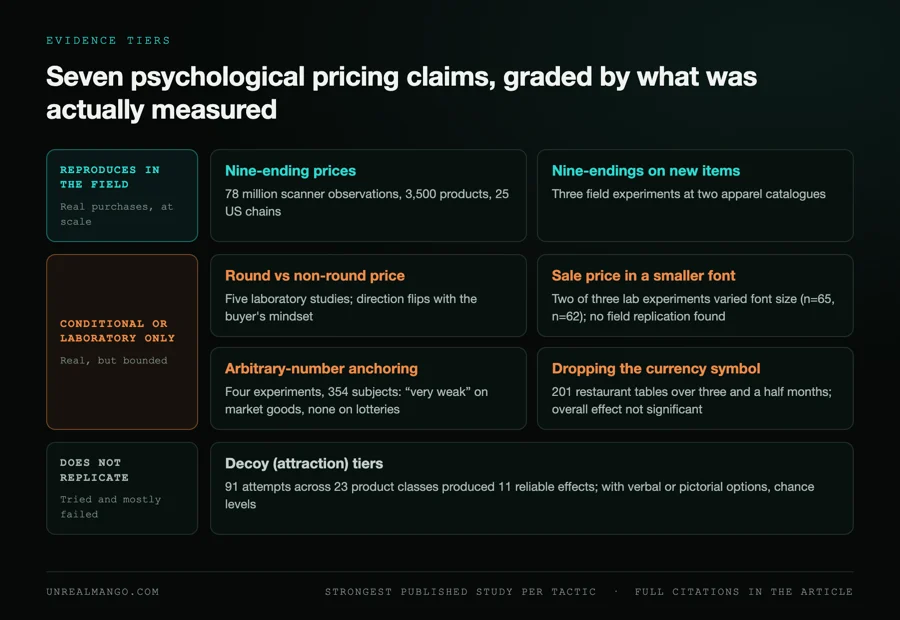
Three tiers are enough to sort them, and every row of the table below carries one of exactly these three labels. Reproduces in the field means the effect has been estimated from real purchases at scale. Conditional or laboratory only means it exists but has been shown mainly in controlled settings or in a single small study, or reverses depending on the buyer’s state of mind. Does not replicate means people have tried repeatedly to reproduce it with realistic stimuli and mostly failed.
Does the .99 trick actually work? The nine-ending evidence in full
Yes — and it is the only tactic in this article with two independent classes of evidence behind it.
The first is experimental. Eric Anderson and Duncan Simester ran three field studies at two women’s apparel catalogues, manipulating price endings deliberately, and published the results in Quantitative Marketing and Economics in 2003. Their abstract states the finding plainly: “use of a $9 price ending increased demand in all three experiments.” These were real catalogues mailed to real customers, not a survey.
The second is observational and much larger. Avner Strulov-Shlain’s paper More Than a Penny’s Worth: Left-Digit Bias and Firm Pricing, published in The Review of Economic Studies in 2023, works from retail scanner data on 3,500 products sold by twenty-five US chains between 2006 and 2019 — 78 million observations. Structurally estimating the size of left-digit bias, he finds consumers “respond to a one-cent increase from a ninety-nine-ending price as if it were more than a twenty-cent increase.”
Read that carefully, because it is easy to inflate. It does not say a $4.99 price feels like $4.79. It says the marginal penny at the boundary carries more than twenty times its arithmetic weight — the jump from $4.99 to $5.00 is felt as a jump of over twenty cents. Away from that boundary the pennies behave normally. The whole effect lives at the digit rollover, which is exactly why it shows up as bunching in real price lists rather than as a general discount illusion.
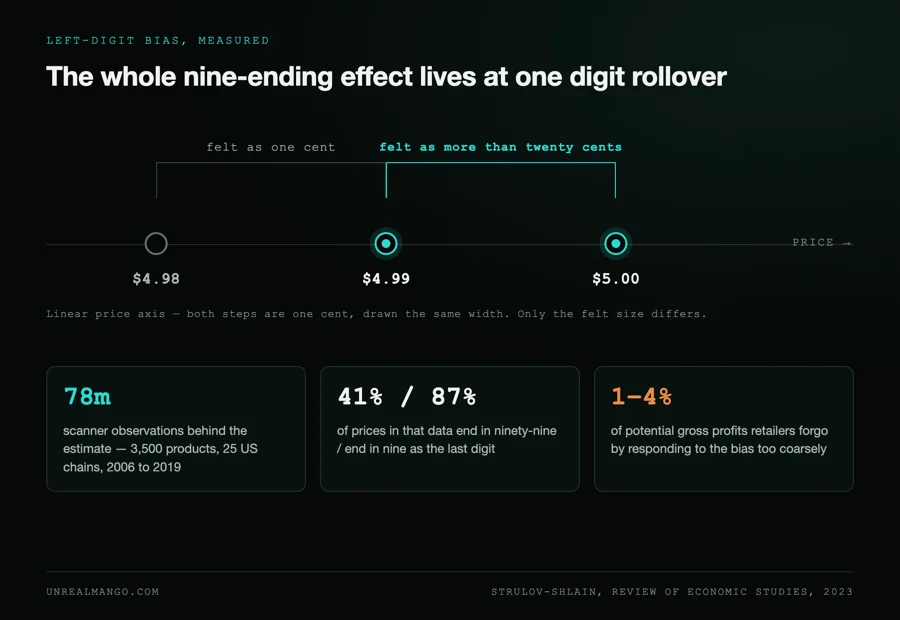
The same paper contains the finding that vendor guides never quote, because it is unflattering to the tactic as usually taught. Retailers do use nine-endings heavily — 41% of prices in that data end in ninety-nine and 87% end in nine — but they use them as a habit rather than an optimisation. Strulov-Shlain calculates that retailers “forgo 1–4% of potential gross profits” through that coarse response. The bias is real; the standard industry reaction to it is measurably wrong.
Where nine-endings stop paying: new items, sale cues and informed buyers
Anderson and Simester’s second conclusion is the one that decides whether the tactic applies to you at all. The demand increase, their abstract states, “was stronger for new items than for items that the retailer had sold in previous years,” and there is “some evidence that $9 price endings are less effective when retailers use ‘Sale’ cues.” Their own explanation: nine-endings “may be more effective when customers have limited information.”
That is a boundary condition, not a footnote. The effect is a shortcut buyers use when they have nothing better to judge with. Give them something better — a familiar item whose price they remember, an explicit sale sign doing the same job — and the shortcut loses value.
The implication for anything sold on consideration is unavoidable, and we state it as an inference rather than a measured result: a buyer comparing three written quotes, with a budget line and a procurement step, is the low-uncertainty case that nine-endings are least suited to. Pricing a retainer at $4,999 does not make it feel cheaper to someone who has already read what it includes; it makes the seller look like a shop. No published field experiment has tested nine-endings in a B2B services sale, and any page that tells you it works there is filling a gap in the literature with confidence.
The decoy effect: ninety-one attempts, eleven reliable results
The decoy — a third option that nobody is meant to buy, added to make one of the other two look better — is the tactic most often presented as settled science and least supported by replication.
Two papers in the same 2014 issue of the Journal of Marketing Research took it apart. Shane Frederick, Leonard Lee and Ernest Baskin argued in The Limits of Attraction that the effect “may be restricted to stylized product representations in which every product dimension is represented by a number,” and that such effects “do not typically occur when consumers experience the product (e.g., taste a drink) or when even one of the product attributes is represented perceptually.” They close by questioning “the practical significance of the effect.”
Sybil Yang and Michael Lynn ran the attempts themselves, rather than tallying other teams’ published tries. Across “ninety-one attempts to produce an attraction effect (involving a total of 23 product classes and 73 different decoyed choice sets),” they found “only 11 reliable effects — significantly fewer than expected given the statistical power of the studies.” Where options were distinguished by meaningful verbal descriptions or by pictures, attraction effects occurred at chance levels.
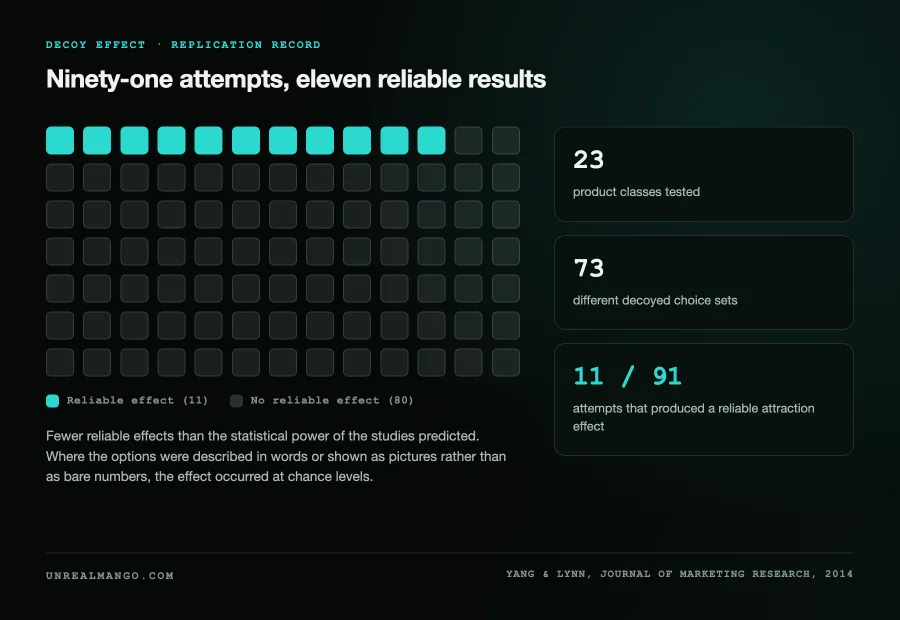
Note what those two papers have in common. The effect appears when options are reduced to bare numbers on a grid, and disappears when the options look like things a person might actually buy. A pricing page is somewhere between the two — it is a grid of numbers, but the tiers carry names, feature lists and often screenshots. Nobody has shown the effect survives at that point, and the two papers above are the closest anyone has come to testing it against options a person might actually recognise.
Dollar signs and shrunken cents: what the source studies actually tested
Two formatting tricks circulate as established practice: drop the currency symbol, and set the cents in a smaller font. Both trace back to studies far smaller than their reputation.
The dollar-sign advice comes from one report: $ or Dollars: Effects of Menu-price Formats on Restaurant Checks, by Sybil Yang, Sheryl Kimes and Mauro Sessarego, published as Cornell Hospitality Report Vol. 9, No. 8 in May 2009. The setting was lunch at St. Andrew’s, the teaching restaurant at the Culinary Institute of America in Hyde Park, New York, between 6 August and 19 November 2007. Three menu versions were used: prices with a dollar sign and cents, numerals only, and prices written out in words. Of 256 completed surveys, 55 were discarded for guest-count discrepancies, leaving 201 tables in the analysis. Note that the numeral-only menu dropped both the dollar sign and the cents ($20.00 versus 20.), so the contrast is not a clean test of the symbol on its own.
Here is the part the retellings drop. After controlling for party size, dining duration and tip, “the overall price format effect on total check was still not significant.” What was significant, at p<0.05, was one contrast within it: parties given numeral-only menus spent $3.70 more than the average party, while the other two formats each ran $1.85 below average — a $5.55 gap the authors translate to roughly 8.15% per person, while noting that per-person spending “was not our unit of analysis.” They also found no significant difference between “$20.00” and “twenty dollars.”
That is one meal period at one restaurant staffed by culinary students, run over three and a half months, with an overall effect that did not reach significance. It may well be true. It is not a basis for restructuring a pricing page.
The smaller-cents advice is usually traced to Keith Coulter and Robin Coulter’s Size Does Matter, in the Journal of Consumer Psychology in 2005 — but that paper never varied the size of the cents. Two of its three experiments set the whole lower price in a smaller font than the regular price beside it (65 and 62 participants); the third varied verbal attribute descriptors rather than type at all (62 participants). What the abstract reports is that congruent magnitude representations “result in more favorable price knowledge (i.e., greater value perceptions and lower price judgments) and increased purchase likelihood.” That is a legitimate laboratory result about relative type size across a whole price, and a thin foundation; we found no field replication at scale to put beside it. The advice as it circulates — shrink the cents specifically — has no direct source at all.
Round versus non-round prices: an effect that flips with the buyer’s mindset
“Round numbers signal prestige” is the usual one-line version. The study underneath it says something more conditional and more useful.
Monica Wadhwa and Kuangjie Zhang, in the Journal of Consumer Research in 2015, propose that rounded prices such as $200.00 are processed fluently and therefore “encourage reliance on feelings,” while non-rounded prices such as $198.76 are processed disfluently and “encourage reliance on cognition.” The fit between the two produces a sense of “feeling right” — and, crucially, that fit “can make positive reactions toward the target product more positive and negative reactions more negative.” Five studies support it.
Two consequences follow. First, roundness is not a prestige signal on its own; it is a match to the mode of the decision. Second, the effect is symmetric, which means a rounded price on a feelings-driven purchase amplifies whatever the buyer already thinks — including doubt. This is laboratory work, and applying it to a B2B quote assumes a decision mode that nobody has verified there.
Anchoring on an arbitrary number, and the re-test that found almost nothing
Reference pricing — showing a higher struck-through number beside the one you want paid — is usually justified by the anchoring literature, and specifically by the demonstration that a number as meaningless as the last two digits of a social security number shifts what people will pay.
That demonstration has not held up well. Drew Fudenberg, David Levine and Zacharias Maniadis re-ran the manipulation and published the result in American Economic Journal: Microeconomics in 2012. Their abstract: “We reexamine the effects of the anchoring manipulation of Ariely, Loewenstein, and Prelec (2003) on the evaluation of common market goods and find very weak anchoring effects. We perform the same manipulation on the evaluation of binary lotteries, and find no anchoring effects at all.” The re-test ran four experiments and 354 subjects in total: three on common market goods (244 subjects, the first of them 84, 79 after exclusions), and a fourth on binary lotteries (110 subjects) — which is the one that returned nothing.
The careful reading is narrow. This does not show that reference prices fail — a struck-through former price is informative, not arbitrary, and buyers are entitled to treat it as evidence about the market. It shows that the specific claim used to sell the tactic, that any number in view drags valuations with it, is weaker than its reputation. If your reference price is real, it works because it is real. If it is invented, you are relying on a mechanism that a direct re-test could barely detect, while carrying the regulatory risk of a fictitious former price.
Psychological pricing examples graded by the evidence behind each one
| Tactic | Strongest published study behind it | What it measured | Tier |
|---|---|---|---|
| Nine-ending prices | Strulov-Shlain, Review of Economic Studies, 2023 | 3,500 products, 25 US chains, 2006–2019, 78m observations | Reproduces in the field |
| Nine-endings on new items | Anderson & Simester, QME, 2003 | Three field experiments, two apparel catalogues | Reproduces in the field |
| Round prices for feeling-led buys | Wadhwa & Zhang, JCR, 2015 | Five laboratory studies | Conditional or laboratory only |
| Sale price in a smaller font than the regular price | Coulter & Coulter, JCP, 2005 | Two of three laboratory experiments varied font size (n=65, n=62); the third varied verbal descriptors (n=62); no field replication found | Conditional or laboratory only |
| Anchoring on an arbitrary number | Fudenberg, Levine & Maniadis, AEJ: Micro, 2012 | Four experiments, 354 subjects; “very weak” effects on market goods (Exps. 1–3, n=244), none on binary lotteries (Exp. 4, n=110) | Conditional or laboratory only |
| Dropping the currency symbol | Yang, Kimes & Sessarego, Cornell, 2009 | 201 tables over three and a half months; overall effect not significant; the numeral-only menu also dropped the cents | Conditional or laboratory only |
| Decoy or attraction tiers | Yang & Lynn, JMR, 2014 | 91 attempts, 23 product classes: 11 reliable effects | Does not replicate |
Two of the seven rows carry field evidence. Four sit in the middle tier for different reasons: two rest on laboratory work alone, one was re-tested across four experiments and came back very weak, and one rests on a single restaurant study whose overall effect was not significant. The seventh has been tried ninety-one times and mostly failed.
The disadvantages that follow from the evidence rather than from a list
The usual disadvantages section warns that psychological pricing “can look manipulative” and “may not suit luxury brands.” Both are true and neither is derived from anything. The evidence supports four sharper ones.
A nine-ending is a discount cue, and cues compete. Anderson and Simester report some evidence that the effect weakens where a “Sale” cue is already present, and suggest it works best where information is scarce. A price ending in nine is therefore doing category-signalling work, and the category it signals is value retail. On a premium position, that is a cost, not a free gain.
Copying an unreplicated tactic spends the credibility of the replicated ones. A pricing page with a decoy tier invites the buyer to work out what the tier is for. When they do, everything else on the page is re-read as a device.
Presentation cannot repair a value gap. Every effect above operates on perception of a number the buyer is already prepared to consider. If the price sits outside the range your differentiation supports, the ending is irrelevant — which is a question of what the buyer’s alternative costs and what your difference is worth, worked through in value-based pricing.
The lab effects are symmetric. Wadhwa and Zhang found that a matched price format makes negative reactions more negative as well as positive ones more positive. A tactic that amplifies whatever the buyer already feels is not a one-way lever.
Which of these belong on a price list you actually publish
For high-volume, low-consideration retail, nine-endings are the one tactic here that earns its place on evidence, and the evidence also says where the return is largest: on items buyers have no stored price for. Treating the ending as a blanket rule rather than optimising against the demand you actually face is the behaviour that, on Strulov-Shlain’s estimate, costs retailers 1–4% of potential gross profits.
For considered purchases — services, B2B software, anything with a quote or a call — the honest answer is that the field evidence runs out. What remains defensible is the negative advice: do not build a tier whose only job is to be rejected, do not show a reference price you cannot substantiate, and do not spend attention on digit endings that would be better spent on what the buyer is comparing you against.
Whether any of this moves your own numbers is a measurement question, and price experiments are a discipline of their own — segments leak into each other, existing customers see the test, and the legal exposure differs from a button-colour trial. That is a separate subject from the one this article covers, and it is not settled by running a price through the same testing habit you use on a headline. What the effects above can legitimately inform is how a price is presented once it is set: the format, the sequence, the comparison shown beside it. That is conversion work rather than pricing work, and it is the half of the problem where these findings actually apply.
11 / Reader questions
Frequently asked questions
01What is meant by psychological pricing?
Psychological pricing means setting or displaying a price so that it changes how large the number feels, rather than changing what the buyer gets. It covers nine-endings, round prestige prices, reference prices shown beside the offer, decoy tiers and menu formatting. The label describes an intention, not one tested mechanism, which is why the tactics grouped under it differ so sharply in how well they hold up.
02Does the .99 trick actually work?
In retail, yes, and it is the best-measured effect in the whole set. Analysing scanner data covering 3,500 products sold by twenty-five US chains, Avner Strulov-Shlain found that consumers respond to a one-cent increase from a ninety-nine-ending price as if it were more than a twenty-cent increase. Anderson and Simester's field experiments suggest the effect is stronger where the buyer has less information about the item.
03What are some examples of psychological pricing?
Charm prices ending in nine, round prestige prices, a struck-through reference price beside the offer, a decoy tier that exists to flatter another tier, bundle and buy-one-get-one framing, and menu prices printed without a currency symbol. Grading those examples matters more than listing them: the first rests on 78 million price observations, the last on 201 tables from one restaurant's lunch service over three and a half months. Bundles and buy-one-get-one framing are not graded here — no field study of comparable quality was found.
04What are the advantages and disadvantages of psychological pricing?
The advantage is that presentation costs almost nothing to change and, for nine-endings, measurably moves demand. The disadvantages are that a nine-ending also reads as a discount cue and fights a premium position, that several popular tactics do not survive replication attempts, and that no price format rescues an offer the buyer does not already value.
05Why do so many prices end in 9?
Because retailers are responding to left-digit bias, and they respond too bluntly. In the scanner dataset behind the strongest published estimate, 41% of prices ended in ninety-nine and 87% ended in nine as the last digit. Strulov-Shlain calculates that retailers forgo 1–4% of potential gross profits by treating the ending as a rule of thumb instead of optimising against the demand they actually face.
06Does psychological pricing work in B2B?
Probably much less — but that is our inference, not a measured finding: no published field experiment has tested nine-endings in a B2B services sale. Anderson and Simester found nine-ending effects were stronger for new items than for items the retailer had sold in previous years, and suggested $9-endings may be more effective when customers have limited information. A buyer with a procurement process and three comparable quotes is the opposite of that case.