Published
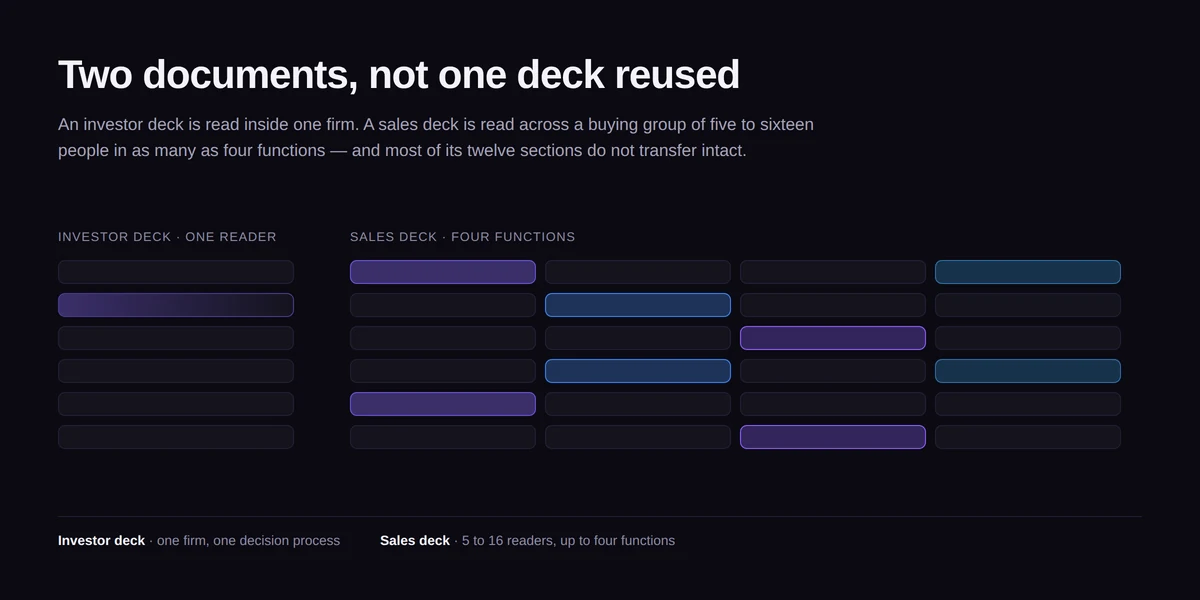
A sales pitch deck argues that one buying group should purchase something now. An investor deck argues that a fund should own part of a company. They can describe the same business on the same day, and only three of the investor deck’s twelve sections survive the move with their aim changed: the buyer’s problem replaces the market, evidence replaces projections, and a dated next step replaces the ask.
How this was checked. For this query in the United States on 10 August 2026, the first page is a shelf of galleries — eight examples, 24, 30, 34 — plus one 2016 essay that has held the top spot for years. Figma’s guide, the one with 34, treats a sales deck as a style inside a pitch deck collection: two of its numbered examples are sales decks, sitting between investor decks as variations of the same document. That is the framing this article disagrees with. None of the nine organic results separates the two as different documents with different readers, or grounds the sales version in evidence about who those readers are. The audience figures below come from Gartner’s B2B buyer surveys and the loss figures from the research behind The JOLT Effect; each carries its sample and field dates.
The argument a selling deck has to win, and the group that has to agree on it
An investor deck is read inside one firm. However many partners weigh in, they share a decision process, a mandate and a vocabulary, and they are underwriting risk: the question is whether this company could be worth many times its price.
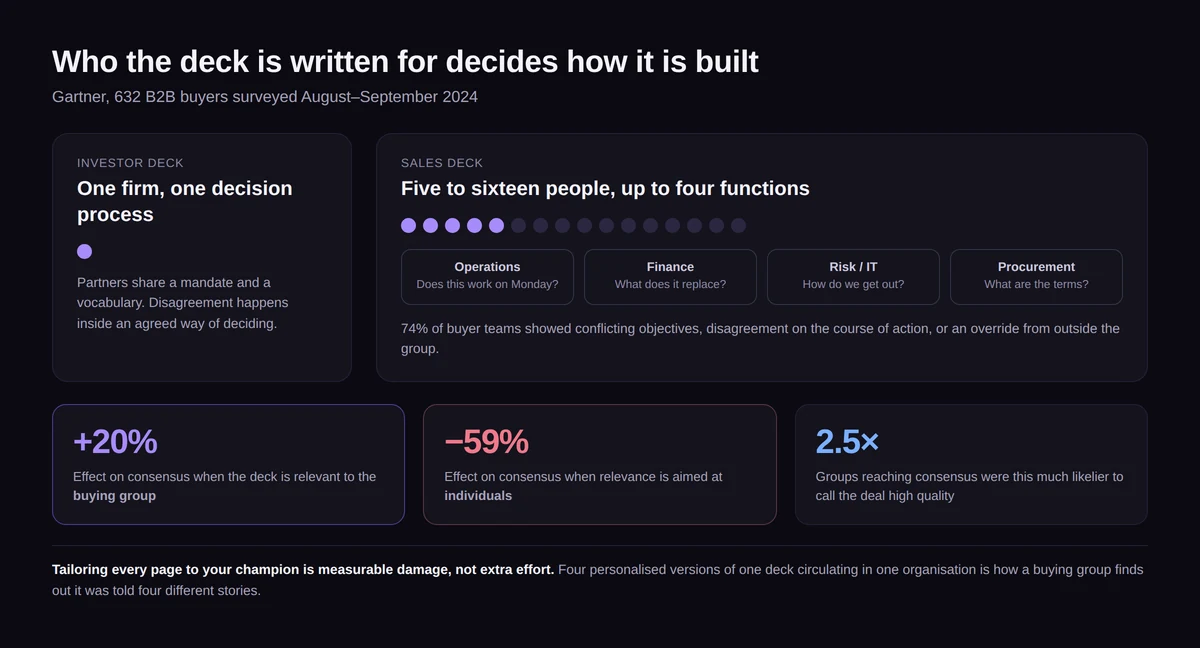
A sales deck lands somewhere else entirely. In Gartner’s survey of 632 B2B buyers, run through August and September 2024, buying groups ranged from five to 16 people across as many as four functions, and 74% of those buyer teams showed what Gartner calls unhealthy conflict — members with conflicting objectives, disagreement on the best course of action, or being overruled by someone outside the group. Groups that did reach consensus were 2.5 times more likely to say the deal they signed was high quality.
That is the whole design brief for a selling deck. It is not a persuasive letter to your champion; it is a document that has to hold together while four functions with different incentives read it separately.
One finding from that survey should change how most decks get built. Relevance aimed at the buying group as a whole improved consensus by 20%. Relevance aimed at individuals had a 59% negative impact on it. Buyers who experienced group-level relevance were three times more likely to report a high-quality deal. The instinct to tailor every slide to the one person who likes you is, measured this way, actively working against the decision you need.
The practical test is simple. Print the deck, hand it to someone in finance, someone in operations and someone in IT, and ask each of them what they would have to agree to for this to go ahead. If the three answers do not overlap, the deck is written for a person rather than for a group.
Section by section: what carries over from an investor deck and what does not
The twelve-section outline of an investor deck is settled ground — what goes in a pitch deck, slide by slide covers it and there is no point repeating it here. What is not settled is which of those sections still means anything once the reader is a customer rather than a fund.
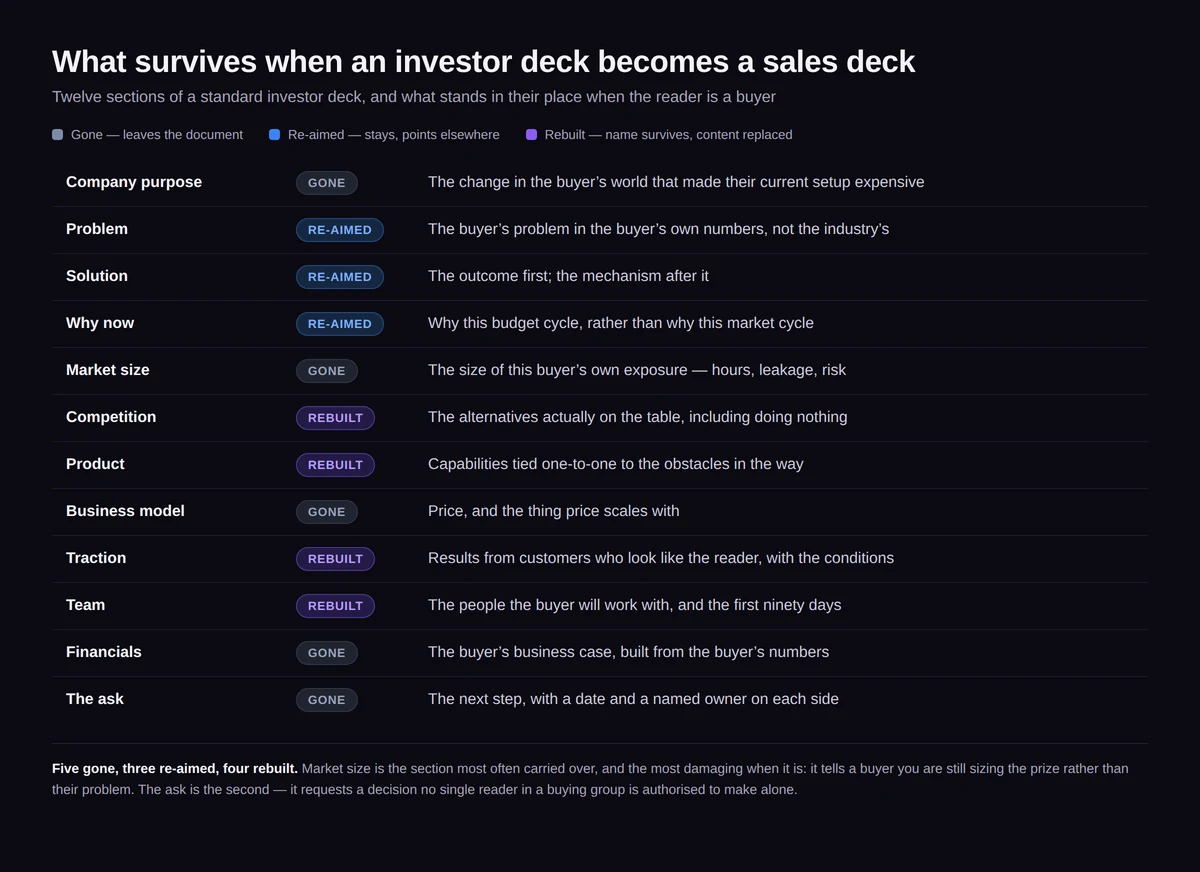
Three verdicts are possible. Gone means the section leaves the document. Re-aimed means the section stays and points somewhere else. Rebuilt means the name survives and everything under it is replaced.
| Investor deck section | Verdict | What stands in its place in a sales deck |
|---|---|---|
| Company purpose | Gone | The change in the buyer’s world that made their current setup expensive |
| Problem | Re-aimed | The buyer’s problem in the buyer’s own numbers, not the industry’s |
| Solution | Re-aimed | The outcome first; the mechanism after it |
| Why now | Re-aimed | Why this budget cycle, rather than why this market cycle |
| Market size | Gone | The size of this buyer’s own exposure — hours, leakage, risk |
| Competition | Rebuilt | The alternatives actually on the table, including doing nothing |
| Product | Rebuilt | Capabilities tied one-to-one to the obstacles in the way |
| Business model | Gone | Price, and the thing price scales with |
| Traction | Rebuilt | Results from customers who look like the reader, with the conditions |
| Team | Rebuilt | The people the buyer will work with, and the first ninety days |
| Financials | Gone | The buyer’s business case, built from the buyer’s numbers |
| The ask | Gone | The next step, with a date and a named owner on each side |
Five sections leave the document, three survive with their aim changed, four keep the name and change everything underneath. That is the honest conversion rate of an investor deck into a selling one, and it is why decks converted by opening the old file and editing it read as documents about the vendor.
Two rows deserve their own note. Market size is the section most often carried over, and the most damaging when it is. A total addressable market tells a buyer nothing about whether to sign; it tells them you are still thinking about the size of the prize rather than the size of their problem. The ask is the second. An investor deck ends with a number and a use of funds. A sales deck that ends the same way asks for a decision the reader is not authorised to make alone, which is a good way to end a meeting with a group of five to 16 people and no next step.
One business, two decks: the same five facts in a different order
Take a worked example — the company and its figures are invented for this article, but the shape is the ordinary one. A 40-person software company sells shift-scheduling to regional hospital groups. Five facts are true about it on any given morning:
- Hospital groups lose nursing hours to manual shift swaps run over text messages and paper.
- Across its first three customers, unfilled shifts fell by roughly a third in the first two quarters.
- Revenue tripled over two years off a small base.
- Both founders spent a decade in hospital operations before starting the company.
- The realistic alternatives are two established workforce vendors and a spreadsheet.
Every one of those facts appears in both decks. What changes is which fact opens, which fact is the proof, and which fact is merely context.
| Position | Investor deck leads with | Sales deck leads with |
|---|---|---|
| Opening | Fact 1 as an industry-wide problem worth a large market | Fact 1 as this hospital’s own overtime line |
| Second | Fact 3 — growth as evidence the market is responding | Fact 2 — a third fewer unfilled shifts, with the conditions |
| Third | Fact 4 — why this team wins the category | Fact 5 — the alternatives, doing nothing included |
| Fourth | Fact 2 as early proof of the thesis | Fact 4 — who is on the implementation call |
| Fifth | Fact 5 as a defensibility argument | Fact 3 as reassurance the vendor will still exist |
| Close | Round size and use of funds | A pilot on two named wards, starting a given month |
Read the two columns side by side and the difference is not tone. Growth is a headline for an investor and a background check for a buyer. The team is the thesis for an investor and a logistics question for a buyer. Competition proves defensibility to one reader and narrows a shortlist for the other. Nothing was rewritten; the same five facts were re-ranked, and only the close is genuinely new in each column — one asks for money, the other asks for a first step.
The reason the buyer’s column opens with fact 1 stated as their own overtime line rather than as an industry problem is the group again. An industry-level problem is agreeable to everyone in the room and binding on no one. A number pulled from the reader’s own operation forces the four functions to argue about the same thing, which is the only way a group gets to consensus.
Four sales pitch deck examples, written out slide by slide
Galleries of finished decks are easy to find and hard to use: you see a screenshot, not the argument underneath it. These four are outlines instead. Each one is a different selling situation, and the situation — not taste — decides the order.
1. The change-first deck, for a category the buyer has not shopped for yet
The best-known public example of this shape is the Zuora deck that Andy Raskin took apart in The Greatest Sales Deck I’ve Ever Seen, published on 15 September 2016 and still ranking first for this query a decade later. His structure runs in five moves: name a big, relevant change in the world; show there will be winners and losers; tease the promised land; introduce features as “magic gifts” for overcoming obstacles on the way to it; and present evidence that you can make the story come true. His opening instruction is the part most decks break: do not start with your product, your headquarters, your investors or your clients.
Use it when the buyer does not yet believe they have the problem. The sequence:
- The change. One shift, dated, outside your company. The line to land: this already happened to you.
- Winners and losers. Two futures, named. Standing still is a choice with a cost.
- The promised land. The state they end up in, before any mention of software. This is what you are buying.
- The obstacles. Three or four things in the way. We know why you have not fixed this already.
- The capabilities. One per obstacle, in the same order as slide 4. Each of these exists because of an obstacle you just read.
- The evidence. Customers who look like them, with conditions attached. It has worked where the constraints match yours.
- The next step. Small, dated, reversible. Here is the smallest version of this you can agree to.
The risk is real and worth naming: a change-first opening in front of a buyer who already knows the problem cold reads as a lecture. Which is why the second shape exists.
2. The displacement deck, for a buyer who already has a vendor
Nothing here needs to be established except that switching is worth the pain. The change slide is out; a switching-cost slide is in.
- Where you are now. Their current setup described accurately enough that they relax. We have read your stack.
- The gap. One thing their incumbent structurally cannot do, not five things it does badly. This is not a feature comparison.
- Parity. Everything they already rely on, still working. You lose nothing.
- The asymmetry. The one axis where you are not comparable. This is the reason to move.
- The migration. Weeks, owners, what breaks. Someone has thought about the ugly part.
- The proof. A customer who made the same switch. This exact move has been survived before.
- The next step. A parallel run, not a rip-out. The first step is reversible.
3. The committee deck, for a purchase with four functions in the room
When the group is at the larger end of Gartner’s five-to-16 range, the deck stops being a narrative and becomes a document with addressed sections. The order is still an argument, but every function has to be able to find its own page without reading the others.
- One-page summary. The whole case in six lines. Read this if you read nothing else.
- The operational case. Hours, throughput, error rates. For the person who runs the thing.
- The financial case. Cost, what it replaces, when it pays back. For the person who signs.
- The risk and security case. Data, uptime, exit. For the person paid to say no.
- The implementation case. Who does what, and when. For the person who inherits it.
- The alternatives. Including doing nothing, costed. We have not hidden your options.
- The decision. What each named person is being asked to agree to. No one has to guess their part.
This is the shape where individual-level personalisation does the most damage. Four tailored versions of the same deck circulating in one organisation is how a group discovers it was told four different stories.
4. The new-business deck, for selling a project rather than a product
Agencies and studios sell an outcome that does not exist yet, which makes evidence and process carry the weight a product demo would carry elsewhere.
- What we heard. Their brief, played back sharper than they gave it. You have been listened to.
- The read. What we think the actual problem is. We are worth paying for judgement, not hours.
- The approach. Three or four moves, in order. This is a method, not an improvisation.
- The proof. Two pieces of work with the constraints they were made under. Comparable conditions, not a showreel.
- The team. The people who will be on the calls. These names, not a capability slide.
- Scope and price band. What is in, what is out, what moves the number. Nothing here is a surprise later.
- The next step. A paid discovery or a defined first phase. A small yes is available.
Slide one is the one most studios skip and the one that decides the pitch. Playing the brief back is also the cheapest quality check available: if the design brief you were given cannot be restated in six lines, the project was underspecified before anyone opened a slide.
Where the deck is actually read: forwarded, skimmed, opened without you
The meeting is not the moment the deck does its work. In Gartner’s later survey of 646 B2B buyers, fielded through August and September 2025, 67% said they preferred a rep-free buying experience, and 45% used AI at some point during a recent purchase. Buyers with high decision confidence were twice as likely to report a high-quality deal as buyers with low decision confidence.
Three build consequences follow, and they are decisions rather than polish.
The sent file and the presented file are not the same document. A page that only makes sense when you narrate it needs the narration written on it. The usual fix is a single line under the headline stating the conclusion, so the page argues without you standing next to it.
The deck will be read in pieces, out of order. Someone in procurement opens it at the pricing page. Someone in security opens it at the risk page. Each page needs enough context to be legible cold, which is the opposite of the presented version’s instinct to keep everything sparse.
Something that is not a person may read it first. When nearly half of buyers put AI somewhere in their process, text baked into images stops being a design choice and starts being a legibility problem. Numbers belong in text, tables belong in tables, and the summary page belongs at the front where a summariser will find it.
None of this argues for a longer deck. It argues for a deck built as a document — where the sequence carries the reasoning and each page can be lifted out and still stand up. That is the difference between design that decorates a pitch and presentation design that makes each claim land in one glance.
The last job of a sales deck: making the decision safe, not asking for it
Most decks are built as though the enemy were a competitor. The evidence says otherwise. Matt Dixon and Ted McKenna’s research behind The JOLT Effect, run across 2.5 million recorded sales conversations, found that 40% to 60% of all lost deals ended in no decision at all. Challenger’s write-up of the same work reports medium-to-high indecision showing up in 87% of deals, and win rates falling to 6% on calls where indecision ran high.
A buyer who does nothing has not chosen a rival. They have decided that being wrong is more expensive than being slow. A deck that closes by asking for the order does nothing about that; a deck that closes by shrinking the cost of being wrong does.
In practice that means three pages most decks do not have:
- What this looks like if it goes badly. The failure mode, named by you rather than discovered by them. Naming it is the cheapest credibility available.
- The first thirty days. Dates, owners, the first thing that will visibly work. Indecision thrives on vagueness about what happens on Monday.
- What we do not do. The boundary of the offer, stated plainly. Buyers cannot calibrate risk against a vendor who claims everything.
This is also where the deck stops carrying the deal on its own. A document can make a decision feel safe; it cannot tell you whether the group in front of you is a live buying group or a research committee — which is what the difference between a marketing-qualified and a sales-qualified lead is trying to measure in the first place.
Sources, and what each figure was measured on
Buying group size, the 74% unhealthy-conflict figure, the 2.5× consensus effect and the +20% / −59% relevance findings come from Gartner’s sales survey of 632 B2B buyers conducted in August and September 2024, announced 7 May 2025. The 67% rep-free preference, the 45% AI usage figure and the decision-confidence comparison come from Gartner’s survey of 646 B2B buyers conducted in August and September 2025, announced 9 March 2026. Loss-to-indecision figures come from Matt Dixon and Ted McKenna’s analysis of 2.5 million recorded sales conversations, published as The JOLT Effect in 2022, with the 87% and 6% figures as reported by Challenger. The five-move narrative structure is Andy Raskin’s, from The Greatest Sales Deck I’ve Ever Seen, published 15 September 2016 and analysing Zuora’s deck. The 10/20/30 rule referenced in the FAQ is Guy Kawasaki’s. The hospital-scheduling company used as a worked example is invented, and its figures are illustrative.
08 / Reader questions
Frequently asked questions
01What should a sales pitch deck include?
A sales pitch deck should include the change that makes the buyer's current setup expensive, their problem stated in their own numbers, the outcome they end up with, the obstacles between them and that outcome with the capability that removes each one, evidence from customers who resemble them, pricing and what it scales with, and a dated next step. Notice what is missing: market size, funding history and an ask. Those belong to a deck written for investors.
02What is the difference between a sales deck and a pitch deck?
A sales deck asks a buying group to purchase something; an investor pitch deck asks a fund to buy equity. The audience is the real difference. An investor deck is read inside one firm that already agrees on how it makes decisions, while a sales deck is read by five to 16 people across as many as four business functions who often do not agree at all, which changes both the order of the argument and what counts as proof.
03Can I reuse my investor pitch deck as a sales deck?
No, and the reason is structural rather than cosmetic. Of the twelve sections in a standard investor deck, five leave the document completely, three survive only with their aim changed, and four keep their name while everything underneath them is replaced. What comes out the other side is a new document that happens to describe the same company, which is why decks converted by editing the old file read as decks about the vendor rather than about the buyer.
04Does the 10/20/30 rule apply to a sales deck?
Not really. The 10/20/30 rule is Guy Kawasaki's advice for pitching investors — ten slides, twenty minutes, no type below thirty points — and it assumes one presenter in a room with an audience that stays until the end. A sales deck is usually forwarded and read after the meeting by people who were never in the room, so the binding constraint is whether each page argues on its own, not how many pages there are.
05What should you leave out of a sales pitch deck?
Leave out the company history timeline, the logo wall with no context, the feature list that arrives before the outcome, the total addressable market, the org chart and any framing that reads as a request for money rather than a decision. Also leave out heavy personalisation aimed at your champion: Gartner's 2024 survey of 632 B2B buyers found that relevance pitched at one individual had a 59% negative impact on group consensus.