Published
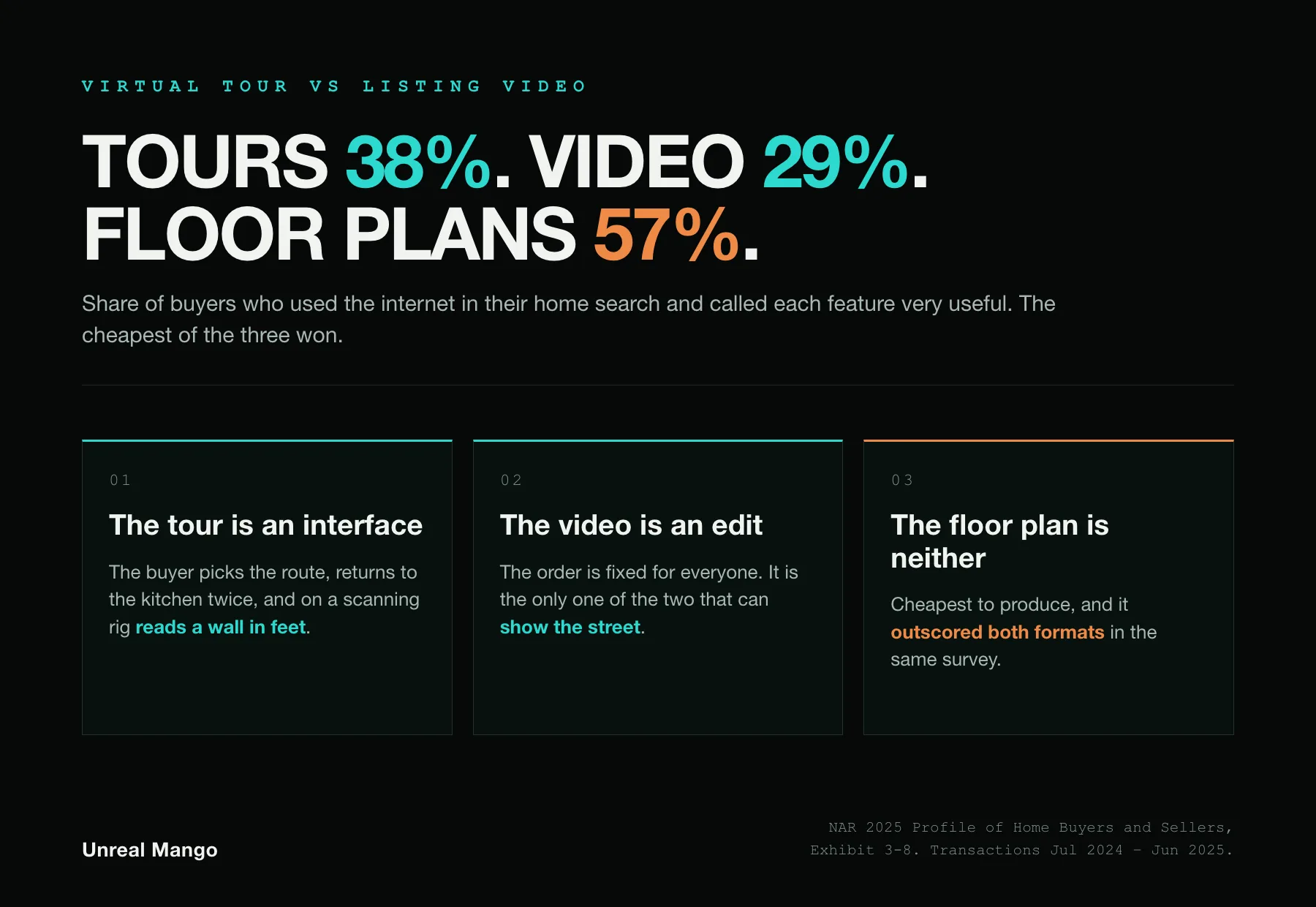
A 3D virtual tour and a listing video answer different questions. The tour lets a buyer walk the floor plan in any order and, on scanning rigs, read a room in feet; the video decides what they see and in what sequence. Buyers rate tours more useful than video, 38% against 29%, in NAR’s 2025 survey.
Six axes where a 3D tour and a listing video actually differ
Almost every page that compares these two formats is published by a company that sells one of them, which is why the comparison usually collapses into “immersive” versus “emotional”. The differences that decide a listing are duller and more specific than that.
| Axis | 3D virtual tour | Listing video |
|---|---|---|
| Who chooses the order | The buyer, on every visit | The editor, once, for everyone |
| Layout evidence | Adjacency, route and — on measuring rigs — room dimensions | Only what the cut happens to include |
| Everything outside the walls | Weak — outdoor scans exist but degrade in sun and open space | Street, light, approach, neighbourhood |
| Where production time goes | On site, scaling with floor area | After the shoot, scaling with revision rounds |
| What it can tell you about a viewer | Rooms revisited, time per room | Retention curve and the second they left |
| What a change to the home costs | A rescan of the affected floor | A re-edit, or a reshoot |
Read down the tour column and a pattern appears: everything a tour is good at happens inside the property line. Read down the video column and its real advantage is the part of the purchase a tour reaches badly.
A 3D tour is an interface; a listing video is an edit
The clean way to hold these apart is to stop calling both of them content. A tour is a piece of software the buyer operates. A video is a finished artefact they watch.
That distinction predicts almost everything else. Because the tour is operated, the buyer can do things you never planned: walk from the primary bedroom to the kitchen to check how far the coffee is in the morning, return to the second bathroom three times because that is where the deal will be won or lost, stand in the doorway of the small bedroom and decide whether a cot fits. None of that is a scene anyone would have shot. It is the buyer running their own questions against the house.
Because the video is edited, it can do the one thing the tour cannot: assert. It can put the school two streets away next to the kitchen island, show the light at six in the evening, and hold on the thing the property is actually being sold on. Sequence is an argument. A tour has no sequence, so it makes no argument at all — which is a strength when the buyer’s questions are better than yours, and a weakness when they are not.
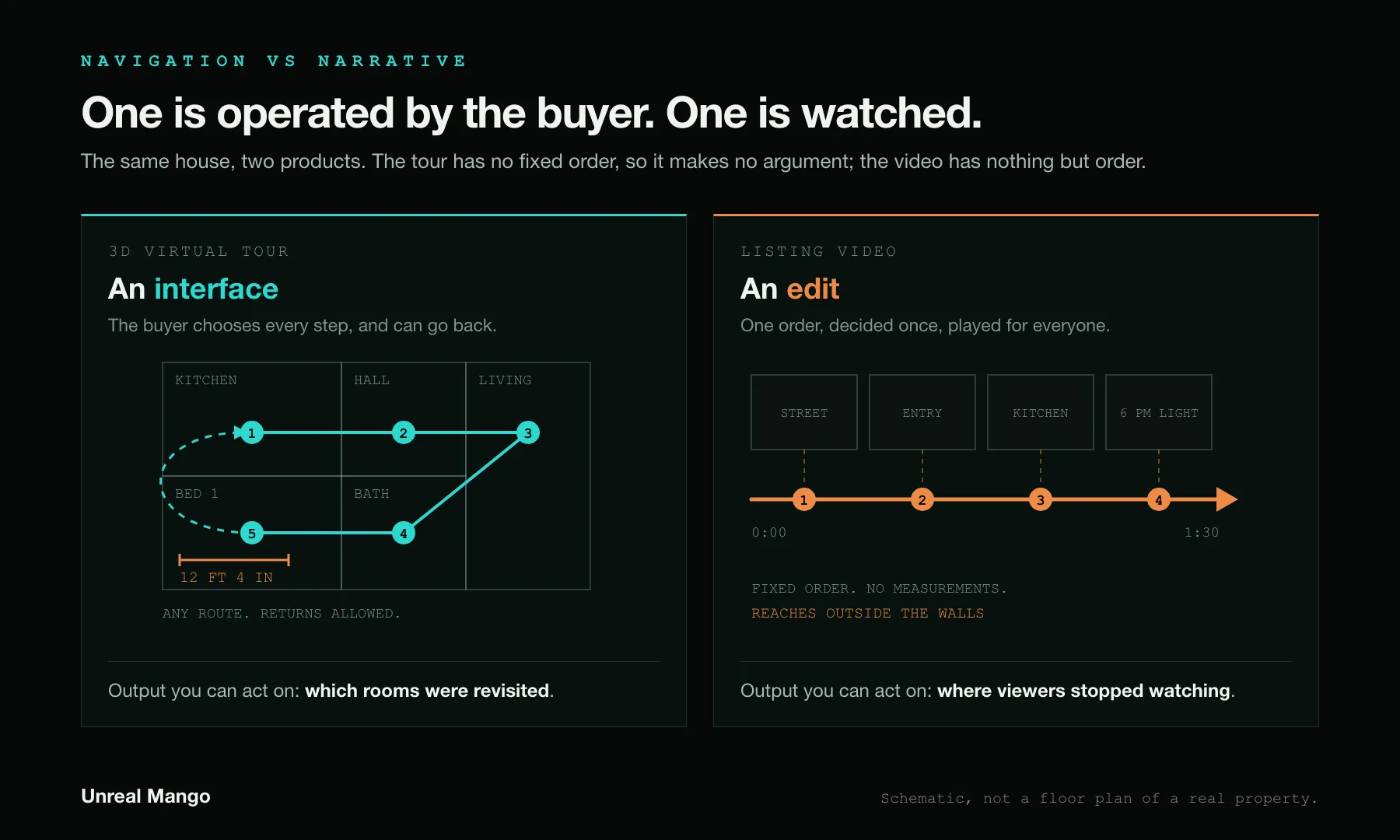
There is one practical consequence worth acting on. If your listing’s strongest feature is the layout — the flow, the sightlines, the fact that the addition actually works — the tour is doing the selling and the video is decoration. If the strongest feature is anything outside the front door, the video is doing the selling and the tour is a reference document.
38% of online buyers called virtual tours very useful, 29% said it about video
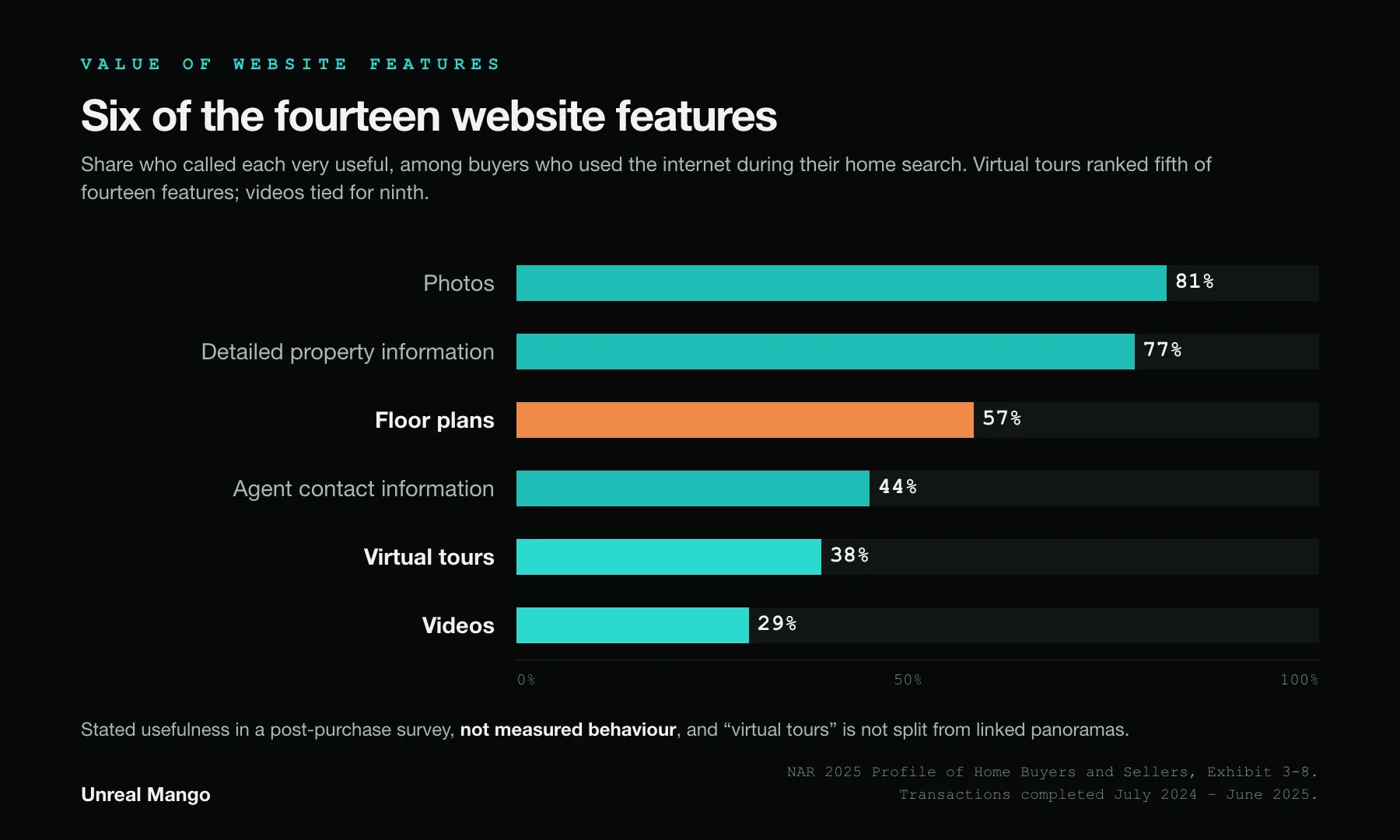
NAR’s 2025 Profile of Home Buyers and Sellers asked buyers who used the internet during their home search which website features they found very useful. The top of the ranking, from Exhibit 3-8 (fourteen features in all), covers transactions completed between July 2024 and June 2025:
| Website feature | Found very useful |
|---|---|
| Photos | 81% |
| Detailed information about properties for sale | 77% |
| Floor plans | 57% |
| Real estate agent contact information | 44% |
| Virtual tours | 38% |
| Detailed information about recently sold properties | 34% |
| Neighborhood information | 34% |
| Pending sales and contract status | 32% |
| Interactive maps | 29% |
| Videos | 29% |
That is the top ten of fourteen; the four features below videos scored 24% and lower. Two ties are real rather than an artefact of rounding — the two 34% rows, and interactive maps against videos at 29% — so read videos as ninth-equal, not ninth.
Two qualifiers before anyone builds a budget on this. First, it measures stated usefulness in a post-purchase survey, not behaviour, and buyers are not reliable narrators of their own attention. Second, it does not separate a full 3D tour from a set of linked panoramas — “virtual tour” in a consumer survey means whatever the listing called a virtual tour.
With both qualifiers applied, the nine-point gap between tours and video is still the closest thing to a neutral number in this comparison, and it points the same way the format logic does: an interface that answers layout questions beats a film that answers none of them, for the majority of listings where layout is the question.
Floor plans outscore both formats and cost the least to make
The row nobody quotes from that exhibit is the third-highest one. Floor plans were called very useful by 57% of the same buyers — nineteen points above tours and twenty-eight above video — and a floor plan is the cheapest artefact of the three to produce, because it is either a by-product of a scan that is already happening or a short job on its own.
Adoption has moved to match. CubiCasa, which produces floor plans from phone scans, said in October 2025 that its own floor plans now reach one in three new US listings, up from 2% of listings in early 2022. That is a vendor’s own count of its own reach, so read it as an order of magnitude rather than a measurement of the market — but a format moving from rare to routine in under four years is not the trajectory of something buyers ignore.
The practical reading: if you are choosing between a tour and a video on a limited budget, you are probably choosing wrong. Order the floor plan first, on every listing, then decide which of the two formats the property earns.
Square footage from a tour is a marketing number until ANSI rules are applied
This is where the tour’s measurement layer gets oversold. A depth-capture rig will hand you room dimensions and a total area figure, and it is genuinely useful — for a buyer deciding whether a sofa fits, and for you, when a buyer asks a question you would otherwise answer with a guess.
A marketing area readout is not gross living area, because it usually counts everything. But the gap is in the counting rules, not in the nature of a scan: a vendor that applies ANSI Z765 to the same scan produces GLA data an appraiser can import, and CubiCasa sells exactly that report to US appraisers off a phone scan. Fannie Mae requires the measuring standard Square Footage-Method for Calculating: ANSI Z765-2021 for hybrid appraisals and appraisals requiring interior and exterior inspections, with effective dates of April 1, 2022 or later on loans sold to Fannie Mae. It is not required for desktop appraisals or for 2- to 4-unit dwellings, and it is not used at all where the architectural design is an apartment-style or multifamily building — ownership type does not decide that, the building’s design does. Where it does apply, the standard is a set of counting rules rather than a tolerance:
| ANSI Z765-2021 rule | What it does to a scanned total |
|---|---|
| Measurements taken to the nearest inch or tenth of a foot; floor-plan sketches reported to the nearest tenth of a foot, final area to the nearest whole square foot | Sets the precision the figure is stated at, which a marketing readout rarely matches |
| Finished area requires a ceiling height of at least 7 feet; in a room with a sloping ceiling, at least 50% of the finished square footage must clear 7 feet, and no part below 5 feet counts at all | A sloped room is in or out as a whole — under half at 7 ft and the room drops entirely; over half and it counts, minus whatever sits below 5 ft |
| Space partially or completely below grade is reported as below-grade area | A finished basement never joins the above-grade figure |
| Openings to the floor below, such as two-storey foyers, are excluded | A dramatic entry subtracts from the total instead of adding to it |
So the honest way to publish it is to say which number you are publishing. A scanned area figure and a gross living area figure will differ on most houses that have a basement, a vaulted entry or a converted attic, and the difference is the standard working as designed, not an error anyone made. Label the tour’s figure as scanned area, keep the appraisal figure separate, and cite the source of whatever square footage appears in the listing copy. Your MLS will have its own rules about what a listing may claim; those are worth reading before the first tour goes up, and they are a separate conversation from this one.
Nobody publishes an honest average price, and here is what moves yours
The reason every “virtual tour cost” article gives you a wide range with no source is that on-site capture is quoted on request, not published. Rather than repeat a number nobody measured, here is the structure of the bill, which is the part you can actually negotiate.
Software is the smallest line. Capture apps exist at zero — Zillow’s 3D Home app is free to use — and paid platforms are priced on how many tours you keep hosted, not on how many you shoot. If a quote is dominated by subscription cost, you are being sold hosting, not capture.
Floor area drives capture time, and capture time drives the invoice. A scan is a sequence of stops. Double the floor area and you roughly double the stops, and with them the time on site. What does not halve on a small home is the fixed part — the trip, the setup, the upload and the publish. This is why quotes are per square foot far more often than per listing, and why the per-square-foot rate is higher at the bottom of the range.
The measured floor plan is a separate line, ordered with the scan or not at all. Ordering it afterwards usually means a second visit, which is the most expensive way to buy the cheapest deliverable.
Video costs move after the shoot, not during it. A tour is finished when the capture is finished; a video is finished when the edit is approved. That is where the two cost curves diverge, and why a video quote that does not state the number of revision rounds is not a quote.
Before comparing two providers, ask each for the deliverable list — files, formats, whether hosting is included, and what happens to the tour when you stop paying. Two quotes with the same headline number rarely buy the same set of files.
The two-week test for what your own market watches longer
Every claim about whether tours or videos hold attention longer is made by someone selling one of them, and there is no cross-format benchmark worth citing, because the two are not measured with the same instrument. A tour reports session duration in a viewer you embed; a video reports retention against a timeline. Those are different quantities wearing similar names.
The only number that means anything for your market is one you collect yourself, and one pair of listings over two weeks is enough to start:
- Pick two comparable listings — similar price band, similar layout, listed within days of each other.
- Give one a tour and one a video, and put both in the same slot in the listing, with the same thumbnail treatment and the same position in the photo order.
- For the tour, record unique visitors, median session duration and rooms visited per session. For the video, record views, median watch time and the percentage reaching the halfway point.
- Put both on one axis before you look at them: median engaged seconds — that is median session duration for the tour and median watch time for the video, both already recorded in step 3 and both reported by their own platform. It is crude, and it is the only quantity the two platforms both give you.
- Note the confounder in writing. An autoplaying video accumulates views a tour never gets credited for, because a tour requires a deliberate click. Compare the medians, never the totals.
Repeat the pairing on two or three more pairs across a quarter and you will have a defensible answer for your price band, which is more than the published literature can give you. It also tells you something the aggregate never will: which rooms buyers return to in your market, which is the single most actionable output a tour produces and the reason tours are worth wiring into how you follow up on real estate leads.
Empty new build, lived-in resale, land: what each listing needs
Format choice is mostly a property-type question, and the answer flips more sharply than the marketing suggests.
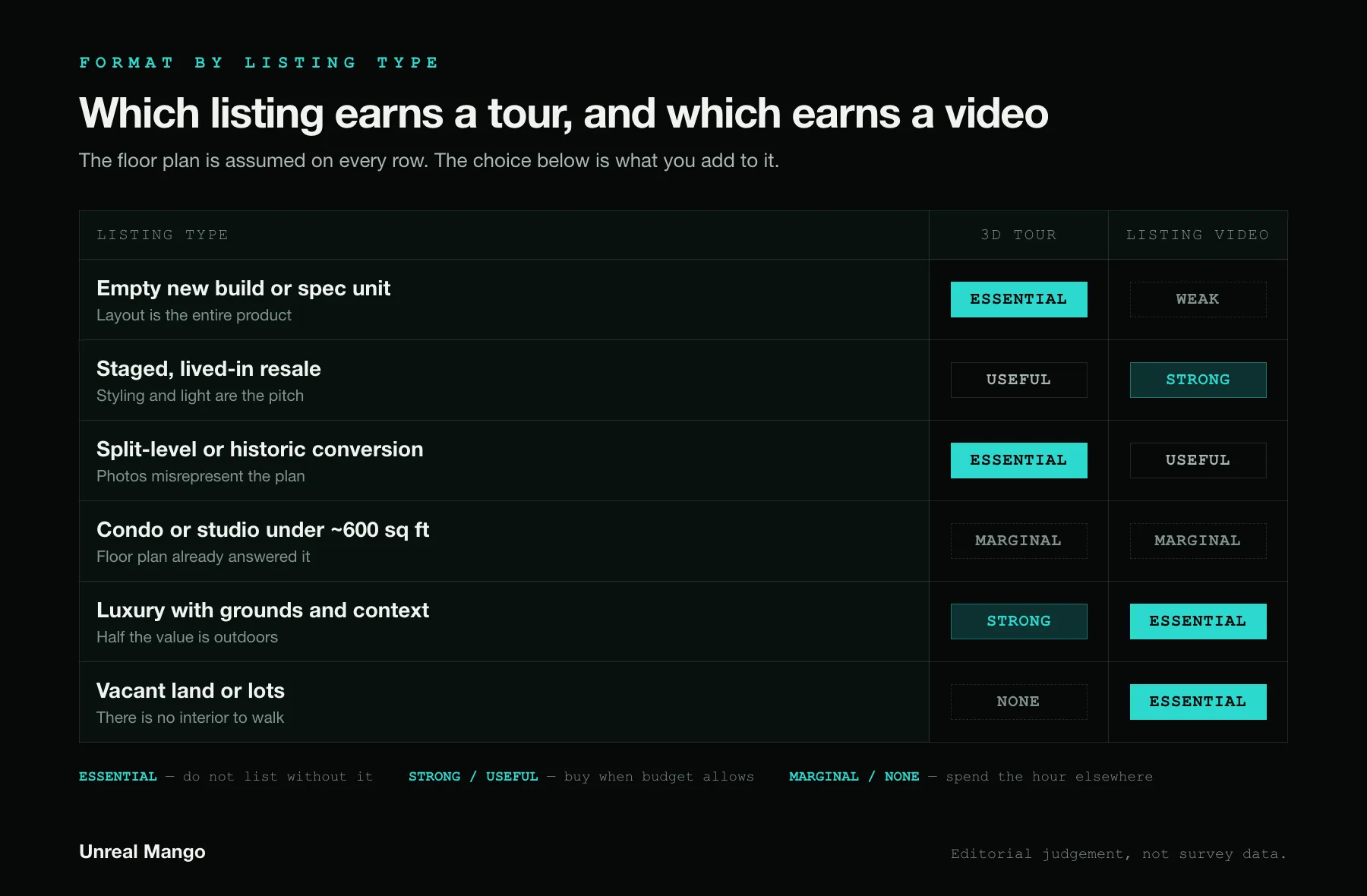
| Listing type | Tour | Video | Why |
|---|---|---|---|
| Empty new build or spec unit | Essential | Weak | Nothing to film and no atmosphere to capture; the layout is the entire product |
| Staged, lived-in resale | Useful | Strong | The video carries the styling and the light, which are what is being sold |
| Unusual layout, split-level, historic conversion | Essential | Useful | Photos misrepresent these houses; only walkable adjacency explains them |
| Small condo or studio under about 600 sq ft | Marginal | Marginal | Two photos and a floor plan already show the whole floor |
| Luxury with grounds and context | Strong | Essential | The interior still has to be walked; the grounds are the video’s half |
| Vacant land or lots | None | Essential | There is no interior to walk; stills and drone or ground video carry the listing |
The row that surprises people is the small condo. A tour of a 550 sq ft one-bedroom costs you the whole trip and setup for a fraction of the payoff, because the buyer’s layout question was answered by the floor plan before they clicked. Spend that hour on the next listing.
For developers and architecture practices marketing units that do not physically exist yet, neither format applies in its normal form — an unbuilt unit has to be built in 3D before it can be walked or filmed, which is a different production entirely and the reason real estate and architecture visualisation is its own discipline rather than a photography add-on.
One 360 camera against the phone already in the agent’s pocket
Equipment decides speed and quality, not whether you get a tour. Free phone apps produce publishable tours, which is why the self-capture debate is settled in practice even where it is still argued online.
- Phone alone. Works. Best on small, well-lit homes. Handheld sweeps stitch badly in dim rooms and in spaces with large blank walls, and capture time on a large home becomes the real cost.
- Tripod-mounted 360 camera. Cuts capture time materially on anything above a couple of bedrooms, holds detail in low light, and removes most stitching artefacts. This is the upgrade that pays back first for anyone shooting weekly.
- Depth-capture rig. Dimensions the buyer reads off the walls inside the tour itself, plus a reliable dollhouse view. Buy this for the in-viewer measurement layer; if you only need a measured floor plan, a phone scan will produce one.
One correction to a claim that circulates a lot, and one to the mirror image of it. A 360 camera does not, by itself, give you measurements — panoramas record what light hit the sensor, not how far away it was. But a measured floor plan does not need a depth sensor either: CubiCasa reconstructs one from an ordinary phone video scan, states LiDAR only as an accuracy upgrade — “though you can expect even higher precision when using a LiDAR device” — and sells the resulting ANSI Z765 GLA report to US appraisers. So the question to ask a quote is which measurement it promises: dimensions readable inside the viewer, or a delivered floor plan.
Floor plan first, then one format — not both on every listing
The sequence that survives contact with a real listing calendar:
- Floor plan on every listing. Highest rated of the three in the NAR ranking, cheapest to produce, and it answers the layout question before anyone clicks anything.
- Then one of the two, chosen by property type, using the matrix above rather than by habit.
- Both only where the property earns it — luxury with grounds, unusual layouts with strong context, anything where the value sits on both sides of the front door.
- Measure your own two-week comparison once, then stop guessing for the rest of the year.
The formats are not competitors. A tour is a reference document the buyer operates; a video is an argument you make. Most listings need the floor plan and one of the two, and the industry’s habit of buying both by default is the reason so many agents cannot say what either one did for them. Deciding which video assets a listing programme needs, and how they are cut and distributed, is a longer subject and belongs with real estate video marketing rather than here.
11 / Reader questions
Frequently asked questions
01Can realtors do virtual tours themselves?
Yes, and self-capture is now the ordinary case rather than the exception: phone capture apps are free, and a small home can be scanned and published in under an hour without a photographer on site. What you give up against a hired scan is capture speed on large homes and detail in dim rooms; a measured floor plan you can still order off your own phone scan.
02How much does a virtual tour for real estate typically cost?
There is no published average worth quoting, because on-site capture is quoted on request rather than published. Three inputs move your number: floor area, whether a measured floor plan is ordered together with the scan, and travel to the property. The hosting subscription is the smallest line in the total.
03What is the best virtual tour platform for real estate?
No single platform wins, and most pages ranking them are affiliate pages, so choose on four things you can verify before paying: whether the tour embeds in the feed your listings actually go to, whether it exports a measured floor plan, what happens to hosted tours when you stop paying, and capture time per thousand square feet.
04Are virtual house tours worth it?
On layout-driven listings they are: buyers who used the internet during their search rated virtual tours very useful at 38%, against 29% for video, in NAR's 2025 Profile of Home Buyers and Sellers. On a studio where two photos show the whole floor, a tour adds little that a floor plan has not already given the buyer.
05What equipment is needed for virtual property tours?
A phone and a free capture app are enough to publish a usable tour of a small home, so equipment decides quality and speed rather than whether a tour is possible at all. A tripod-mounted 360 camera cuts capture time and holds detail in dim rooms; on-screen dimensions require a rig with depth capture, though a measured floor plan does not — phone-scan vendors reconstruct one from ordinary video.
06Is a 3D tour the same as a 360 virtual tour?
No: a 360 virtual tour is a set of panoramas linked by hotspots, where the buyer looks around from fixed standing points but cannot move between them freely. A 3D tour reconstructs the space, so movement is continuous, a dollhouse view of the whole floor exists, and depth-capture rigs let the viewer read dimensions off the walls.