Published
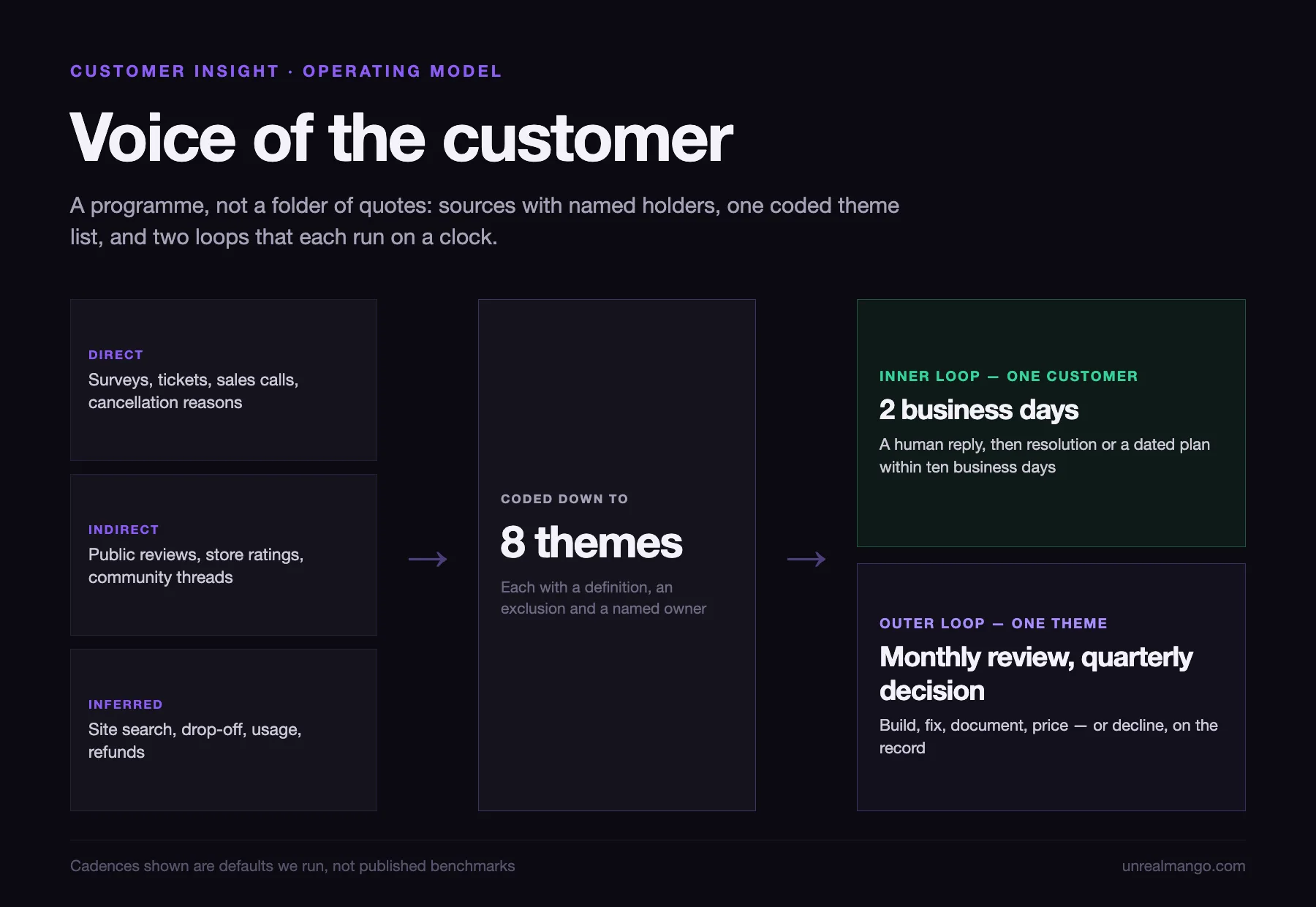
Voice of the customer (VoC) is the standing practice of collecting what customers say about your product — in surveys, support tickets, sales calls, reviews and site search — coding it into a small set of named themes, and routing each theme to someone who can act on it. It is a programme with an owner and a cadence, not a research project that ends.
The reason it has to be a programme is that internal opinion drifts away from customer reality faster than anyone notices. When Bain & Company surveyed 362 firms for Closing the delivery gap in 2005, 80% said they delivered a superior experience. Customers, asked separately, rated 8% of companies that way. That is not an effort gap. It is a measurement gap, and a folder of favourite quotes is exactly the kind of instrument that produces it.
How this was checked. For this query in the United States on 23 August 2026, Google returned an AI Overview, a People Also Ask block and nine organic results led by Qualtrics, Wikipedia, Gainsight, Salesforce, HBS Online, InMoment, Decagon, CustomerGauge and Sprinklr. Between them they define the term thoroughly and list the channels. None of them says who owns the programme, how often it runs, where the output physically lives, or how you would know it had died. That gap is what this page is for. Figures below carry their source and year where they are not ours.
Voice of the customer, separated from the three practices it gets filed under
Most confusion about VoC is really confusion about which of four adjacent practices someone means. They differ on who is being listened to, how long the listening lasts, and what the output is allowed to be.
| Voice of the customer | CX programme | Customer research | Market research | |
|---|---|---|---|---|
| Listens to | People who already buy from you | The same people, at defined touchpoints | A recruited subset, in depth | A defined population, customers or not |
| Runs for | Indefinitely, on a cadence | Indefinitely, tied to the journey map | The length of a study | The length of a study |
| Output | Named themes with owners | Scores per touchpoint plus fixes | Findings and a recommendation | Sizing, segments, a decision |
| Typically owned by | One named person, cross-functional | CX or operations | Product or design | Marketing or strategy |
| Fails by | Losing its cadence | Optimising the score, not the journey | Being read once and shelved | Answering a question nobody re-asks |
VoC is the widest and the least bounded of the four, which is exactly why it needs the tightest operating rules. A CX programme has a journey map to hang off. A research project has a deadline. VoC has neither, so if you do not give it an owner and a clock, the calendar will quietly reallocate it.
The term itself is older than the software industry that sells it. It arrives from quality engineering, where the useful move was never collection but translation: a customer statement becomes a need, a need becomes a critical-to-quality characteristic with a target and a tolerance. That translation step is the part worth keeping. “The reports are hard to read” is not actionable; “a monthly report should be understood without training in under two minutes” is.
One more distinction is worth learning early, because it maps directly onto how you will collect. Customer input arrives in three forms:
- Direct — the customer is talking to you on purpose: surveys, interviews, support conversations, sales calls, feedback forms, cancellation reasons they type themselves.
- Indirect — the customer is talking about you, not to you: public reviews, app store ratings, social posts, community threads, G2-style listings.
- Inferred — the customer is not talking at all, and behaviour is the statement: site search queries, drop-off points, feature usage, cancellation timing, refund reasons.
Programmes that only collect the first form are the ones that go stale, and the next section is why.
A survey-only programme hears the two ends of the distribution and calls it the middle
People who volunteer an opinion are not a random sample of people who have one. This is measurable, and it has been measured at scale on Amazon’s review corpus.
Hu, Zhang and Pavlou examined the ratings distribution there and reported it in Communications of the ACM in 2009: 78% of book reviews, 73% of DVD reviews and 72% of video reviews were four stars or higher. The shape is the famous J — a tall pile at five stars, a small bump at one, and almost nothing in between. Then they ran the control: a study in which everyone in the sample rated the same randomly chosen product, a music album, so nobody could self-select into silence. For that same album the distribution came back unimodal, and at the extremes it collapsed: only 3% gave five stars and 7% gave one star.
Two mechanisms produce the gap, and both are named in the paper:
- Purchasing bias. Only people already inclined toward a product buy it in the first place, so the pool of possible reviewers is pre-filtered upward. Nobody who would have hated it is in the sample.
- Under-reporting bias. Among buyers, those with polarised opinions are the ones who bother to post. Moderate experiences — which is most experiences — go unrecorded.
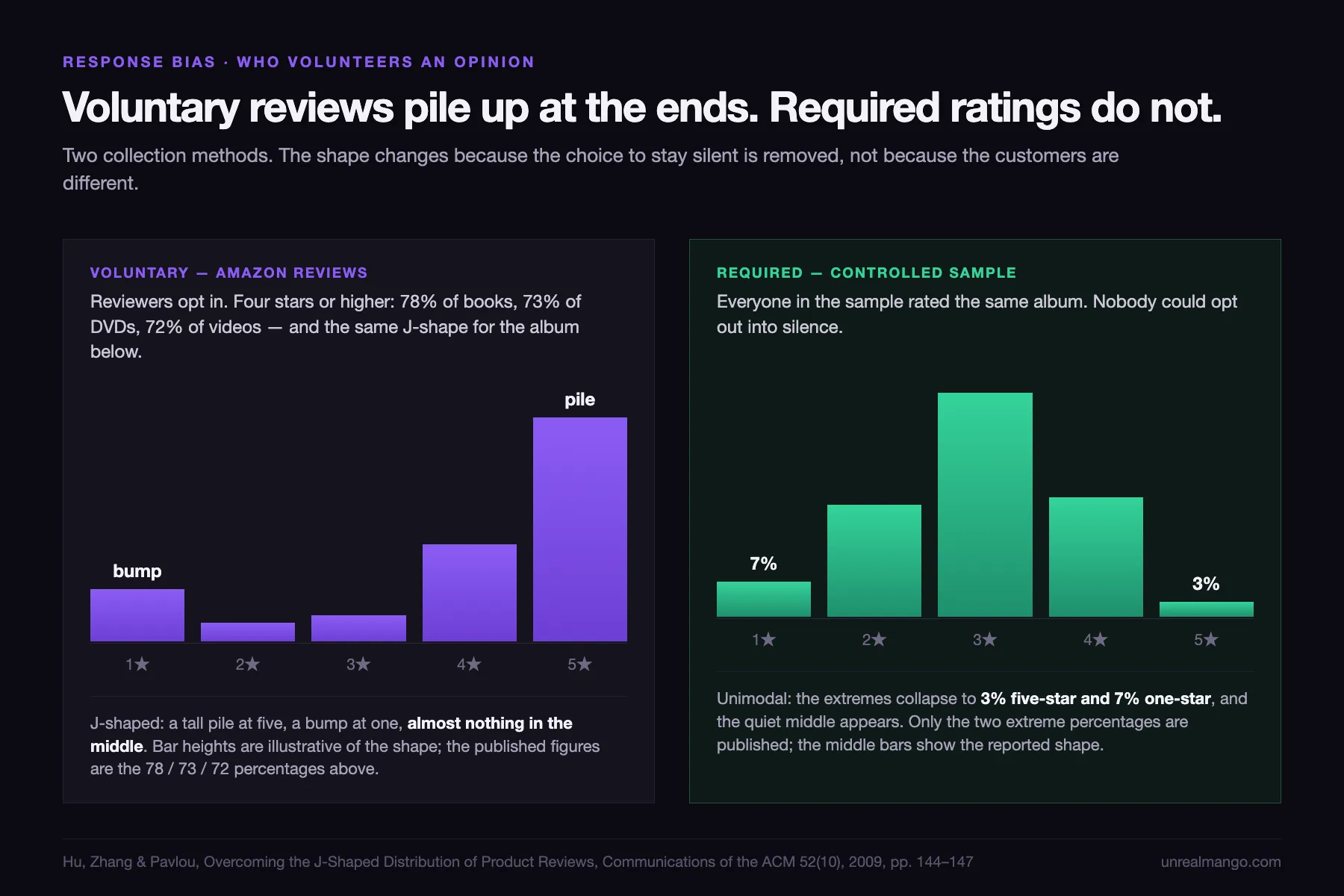
The practical consequence for a VoC programme is specific, and it is not “surveys are bad”. It is that direct, voluntary channels systematically over-represent your advocates and your angriest churners, and systematically lose the quiet majority whose experience was fine-but-not-compelling — which is precisely the group whose renewal is in play. A programme built only on survey responses and review monitoring will keep producing the same two stories, and both of them will be true and unrepresentative.
You compensate with the inferred sources, because they do not require anyone to volunteer. Every session that ends on the pricing page is a statement. Every site search for a word that returns nothing is a statement. Every account that cancels in month two while its usage looked healthy is a statement, and it is a statement from someone who would never have answered your email.
There is one exception worth knowing: a survey question that asks about loss rather than satisfaction gets closer to the quiet middle, because it forces a concrete judgement instead of a polite one. That is the mechanism behind the product-market fit survey, which asks how a user would feel if the product disappeared. It is the single direct instrument we would keep if we had to drop the rest.
Eight sources you already own, and the blind spot inside each one
Nearly every company that says it has no customer data is sitting on six months of it. The material exists; nobody has been assigned to read it. Below is the inventory we work through first, with what each source is genuinely good at and what it structurally cannot tell you.
| Source | Form | Good at | Blind to | Usually held by |
|---|---|---|---|---|
| Support chat and ticket text | Direct | Precise wording of friction, with frequency attached | Anything that made someone leave without asking for help | Support |
| Sales call recordings | Direct | Objections, competitor comparisons, the words buyers use for the problem | Post-purchase reality; everything after the deal closes | Sales |
| Won/lost reasons in the CRM | Direct | Why deals died, in a field you can count | Free-text quality — the field is filled in under time pressure | Sales ops |
| Cancellation and downgrade reasons | Direct | The end of the story, stated by the person ending it | Motives people will not type into a box on the way out | Billing or product |
| Public reviews and store ratings | Indirect | Unprompted language, and how you look to a stranger | The quiet middle, for the reasons above | Marketing |
| Site search queries | Inferred | Demand in the visitor’s own vocabulary, including for things you do not sell | Intent behind the search, and everyone who did not search | Web or analytics |
| Drop-off and session behaviour | Inferred | Where confidence breaks, at scale, without asking | Why — behaviour tells you the location, never the reason | Growth or analytics |
| Refund and return correspondence | Inferred | Expectation gaps stated in full sentences, with money attached | Low-value silent dissatisfaction that never becomes a refund | Finance or support |
Two rules make this inventory work rather than just exist.
Every source needs a named holder, not a department. “Support owns the tickets” means nobody exports them. A person owns the export, on a date. This is the single most common point of failure in the first month.
Never mix the three forms in one bucket. Direct, indirect and inferred inputs carry different biases, and merging them destroys your ability to sanity-check a theme. A theme that shows up in tickets and in site search and in cancellation reasons is real. A theme that appears only in reviews is a candidate. Keeping the source label on every verbatim is what lets you tell the two apart later.
From 400 comments to eight themes, without the categories drifting
This is where most programmes actually break. Collection is easy and feels productive; coding is tedious and is the only step that turns text into decisions. Four findings from the foundational study on the subject shape how we do it.
Abbie Griffin and John Hauser’s The Voice of the Customer (Marketing Science, 1993) reported the numbers that make the case for both redundancy and structure:
- One conversation gives you a third of the picture. In their analysis, a single one-on-one interview identified 33% of the 230 customer needs in the study; two interviews identified 51%. A programme is not a nicer version of a one-off study — it is the only way to get past half.
- One reader is not enough, and the shortfall is large. In their analyst test, a single analyst reading the transcripts identified 54% of the customer needs on average, with a range of 45% to 68%; it took seven analysts working over the same material to reach 99%. If one person codes your entire intake, your theme list is that person’s attention span with a chart on it.
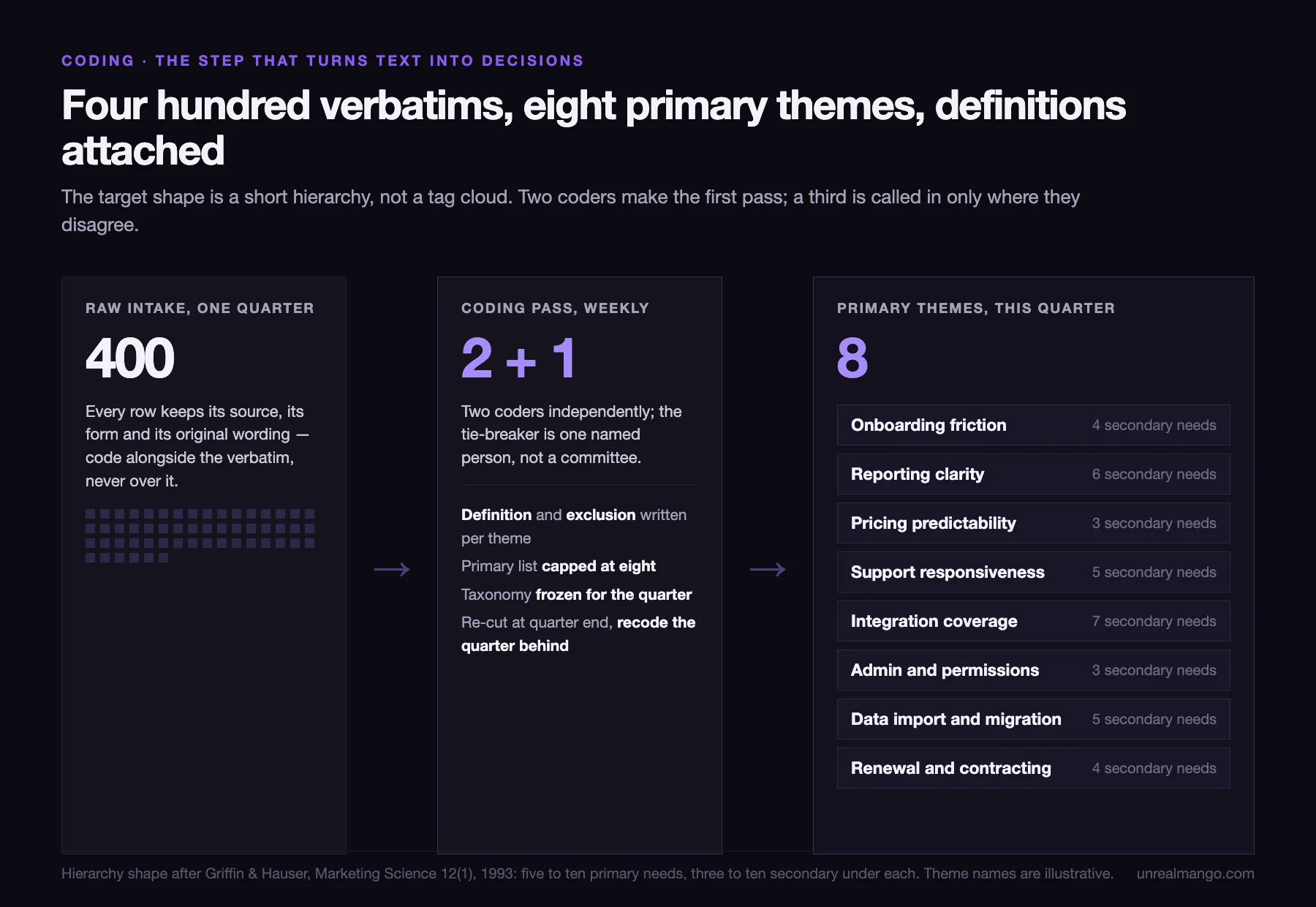
- Needs come in three levels. Five to ten primary, strategic needs sit at the top; each carries roughly three to ten secondary, tactical needs; operational detail sits beneath those. That shape is your target. If your theme list has 40 top-level entries, you have a tag cloud, not a taxonomy.
The fourth finding is easy to skip and worth more than the rest. When they compared hierarchies sorted by customers against hierarchies sorted by the project team, the customer-sorted version kept the customers’ own semantics — while the team’s version reflected how the firm builds things. Your internal product structure is the wrong skeleton for a theme list, because customers do not experience your modules; they experience their own workflow breaking.
The coding rules we hold a programme to
- Keep the raw wording forever. Code alongside the verbatim, never over it. The exact phrasing is the asset — it is what you will re-read next quarter and what your landing page will borrow.
- Two coders on the first pass, a third only on disagreements. Full triple-coding of every item is unaffordable outside research settings. Disagreement rate is also a useful signal: if two people disagree on more than roughly a fifth of items, the category definitions are too vague, not the coders.
- Every theme gets a one-sentence definition and an exclusion that routes somewhere. “Onboarding friction — anything blocking first successful use; excludes permission errors, which belong to Admin and permissions.” An exclusion that names no destination just creates orphans. Categories drift because they were never bounded, and drift is invisible until you compare two quarters and find the same theme measuring different things.
- Cap the primary list at eight. A ninth theme means merging two, not extending the list. The cap is a forcing function for prioritisation, and it sits inside the five-to-ten band the research describes.
- One named person breaks ties. Not a committee, and not the loudest stakeholder. Someone whose job title includes being wrong in public about which theme a comment belongs to.
- Freeze the taxonomy for a quarter, re-cut it deliberately. Changing categories mid-quarter destroys your only trend line. Re-cut at quarter end, and when you do, recode the previous quarter so the comparison survives.
Two loops, and a clock on each
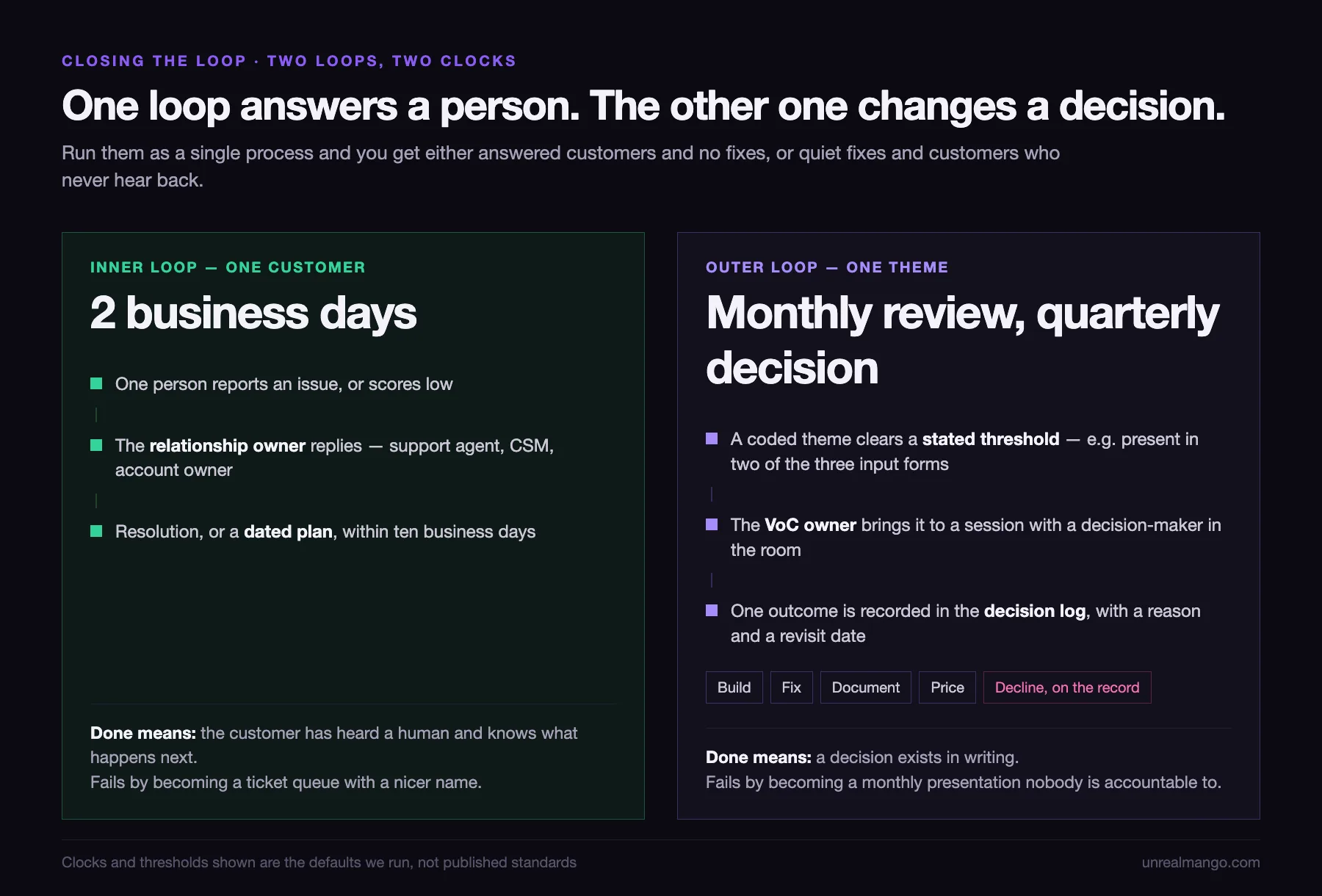
“Close the loop” is the most repeated instruction in this field and the least specified. It is two different loops with two different owners, two different clocks and two different definitions of done. Run them as one thing and you will either answer individuals and fix nothing, or fix things quietly while the people who reported them never hear back.
| Inner loop | Outer loop | |
|---|---|---|
| Trigger | One person’s issue, complaint or low score | A theme reaching a threshold across sources |
| Owner | The person who holds that relationship — support agent, CSM, account owner | The VoC owner, with a decision-maker in the room |
| Clock | Reply within two business days; resolution or a dated plan within ten business days | Reviewed monthly, decided quarterly |
| Done means | The customer has heard a human and knows what happens next | A decision is recorded: build, fix, document, price, or explicitly decline |
| Fails by | Becoming a ticket queue with a nicer name | Becoming a monthly presentation nobody is accountable to |
Three details decide whether these loops function.
The inner loop needs a service level, not an intention. Two business days is a working default because it is fast enough to matter to the person and slow enough to survive a Monday. Whatever number you pick, it has to be written down and reported against, because an unstated SLA is an SLA of “eventually”.
The outer loop needs a threshold and a decline option. A theme should enter the quarterly session when it clears a stated bar — appearing in at least two of the three input forms, or exceeding a set share of coded items. And the session must be allowed to say no, on the record, with a reason. A programme where every theme becomes a roadmap item is a programme that will be ignored within two quarters, because the roadmap cannot absorb it.
Declining out loud is what protects the programme. The recorded “we are not doing this, because X” is the artefact that lets you re-open the question in six months with evidence, and it is the one thing that stops the theme from being raised as new every quarter by someone who missed the last discussion.
Who owns voice of the customer, and what their calendar looks like
The owner is one person, named, with a fraction of their time formally allocated. In a company under about 200 people this is realistically a quarter to a third of one role, not a hire. What the role must have is not seniority but standing: the right to put a theme in front of the people who decide, and the obligation to come back with what was decided.
The owner does not need to sit in any particular department, and there is no correct answer between product, marketing, support and operations. There is an incorrect one: whoever owns VoC must not also own the number the programme reflects on. If the person responsible for the satisfaction score also decides which complaints become themes, the taxonomy will start protecting the score. Separate those two, even if it costs you the obvious candidate.
Their calendar, in full:
| Cadence | Who | What happens | Output |
|---|---|---|---|
| Continuous | Source holders | Verbatims land in one intake sheet with source, date and account | Raw intake |
| Daily | Relationship owners | Inner-loop replies inside the two-day SLA | Answered customers |
| Weekly, 45 minutes | Two coders | Code the week’s intake independently, flag anything urgent | Coded rows |
| Weekly, as needed | The tie-breaker | Rule on items the two coders assigned differently | Settled codes |
| Monthly, 60 minutes | VoC owner + functional leads | Re-count themes, review movement, publish the digest | One-page digest |
| Quarterly, 2 hours | VoC owner + decision-makers | Themes compete; each gets build, fix, document, price or decline | Decision log entries |
| Quarterly, after the session | VoC owner | Re-cut taxonomy if needed, recode the previous quarter | Comparable trend line |
Four artefacts hold all of it, and none of them requires a platform:
- Intake sheet — one row per verbatim: date, source, form (direct/indirect/inferred), account or segment, raw text, code, coder.
- Theme table — one row per primary theme: definition, exclusion, count this period, count last period, current status, owner.
- Decision log — one row per quarterly decision: theme, decision, reason, owner, date, revisit date. This is the artefact that proves the programme exists.
- Monthly digest — one page, sent to everyone, always in the same shape: what moved, what is new, what was decided, what was declined and why.
Software makes this faster once the loop is real. It does not create an owner, and buying it before you have one is the most expensive way to discover that. Start on a spreadsheet and a recurring calendar invite; upgrade when the spreadsheet is genuinely the constraint, which is usually somewhere past a few thousand verbatims a quarter.
Customer wording is landing page copy you have already paid for
The output of a VoC programme that most companies never use is the raw language itself. You have a corpus of sentences written by people in your exact buying situation, describing the problem in the vocabulary they actually think in — and meanwhile the page trying to sell to them was written in vocabulary invented internally.
The translation is mechanical once the intake sheet has source labels on it. Take the verbatims tagged to the pre-purchase and early-use stages, find the phrasings that repeat, and place each one where the objection it carries would otherwise stop someone.
| Raw customer wording | What it actually is | Where it belongs on the page |
|---|---|---|
| “I couldn’t tell if this was for a team our size” | Qualification anxiety | Subhead or the first line under the headline |
| “We already tried something like this and it died in month two” | Prior-failure objection | Directly beside the primary call to action |
| “It took a week to get anything out of it” | Time-to-value doubt | An early proof block with a real number |
| “I didn’t know what happens after I book a call” | Process opacity | Immediately below the form, before the button |
| “The pricing page didn’t say what happens if we grow” | Commitment risk | Pricing FAQ, in the customer’s own phrasing |
Two rules keep this honest. Use their nouns, not their grammar — you are borrowing vocabulary, not pasting testimonials into headings. And never invent a quote to fill a gap in the table; an empty row is information, and it means that objection is not actually in your data. If it is genuinely absent from a corpus of a few hundred verbatims, the objection you were about to answer is one your team imagined.
This is also the cheapest test available to you, because it is a copy change rather than a build. A theme that arrived through VoC, got written into page language, and moved a conversion rate is the fastest evidence a programme can produce that it pays for itself — which is what makes VoC and conversion rate optimisation the natural first pairing rather than VoC and the product roadmap. Roadmap items take two quarters to prove anything. A headline takes two weeks.
The number that tells you the programme is alive: decisions changed per quarter
Every VoC programme eventually gets asked to justify itself, and it almost always answers with the wrong number — response volume, or the score it tracks. Volume measures collection, which is the easy half. The score moves for reasons that have nothing to do with you, and moves too slowly to defend a budget.
The number we would report instead is how many decisions were made differently this quarter because of the programme, taken straight from the decision log: a build that got sequenced earlier, a feature that got declined, a price that changed, a page that got rewritten, a policy that got documented. Count only entries where the theme was the stated reason.
Read it as follows, on a quarterly cadence:
- Zero to two — decorative. The programme is producing reports, not decisions, and it will be cancelled by the person who notices first.
- Three to six — working. Enough to defend the time, small enough that the taxonomy is still doing its job of forcing choices.
- Seven or more — inspect it. Either VoC has become the routing label for work that was going to happen anyway, or the decisions are trivial ones that did not need a quarterly session.
Five signals that a programme has died while still holding meetings, in the order they usually appear:
- The digest goes out and nothing lands in the decision log. The programme has become a newsletter.
- The theme list has grown past the cap. A ninth primary category means nobody is merging, which means nobody is prioritising.
- The same theme appears as “new” in two different quarters. There is no decision log, or nobody reads it.
- The inner-loop SLA stops being reported. Not missed — unreported. Missing an SLA is a problem; not measuring it means the loop is gone.
- Only one person can explain what a theme means. The definitions were never written down, and the taxonomy is now personal knowledge.
The recovery in every one of those cases is the same and unglamorous: shrink the theme list, name the owner again, and put one decision on the log before the next digest goes out.
A first quarter that survives week three
Most programmes stall at the point where collection is running and coding has not started, because coding is the first part that feels like work with no visible output. This sequence is built to reach a recorded decision before that happens.
- Week 1 — name the owner and the tie-breaker. Two names, written down, with time allocated. Nothing else in this list works without this step, and skipping it is why most attempts do not reach week four.
- Week 1 — pick three sources, not eight. One direct, one indirect, one inferred. Support tickets, public reviews and site search queries is a good default because all three usually already exist and none needs a new tool.
- Week 2 — build the intake sheet and backfill 90 days. Backfilling matters: it gives you a corpus to code immediately instead of waiting a month for one to accumulate, and it means the first theme count has history behind it.
- Week 3 — first coding pass, two coders, cap at eight themes. Write the definition and the exclusion for each theme as you go, not afterwards. This is the week programmes die; putting two people in a room with a deadline is the countermeasure.
- Week 4 — publish digest one and start the inner-loop SLA. Both at once. The digest creates the expectation; the SLA creates the habit.
- Weeks 5–11 — run the weekly coding pass and the monthly digest. Change nothing about the taxonomy in this window, however tempting. You are buying a comparable baseline.
- Week 12 — the first decision session. Themes compete, each gets one of the five outcomes, everything goes in the decision log, including the declines. A quarter that ends without a recorded decline has not really run the session.
- Week 13 — re-cut the taxonomy once, and recode the quarter behind it. Then freeze again.
The distance between a VoC programme that works and one that quietly stops is not budget, tooling or volume of feedback. It is whether one person’s name is attached to it, whether the two loops have clocks, and whether anything ever gets written in the decision log. Everything else in this guide is detail underneath those three.
Where the cited figures come from
- Bain & Company, Closing the delivery gap (2005) — survey of 362 firms, of which 80% believed they delivered a superior experience; a separately surveyed customer sample rated 8% of companies that way.
- A. Griffin and J. R. Hauser, The Voice of the Customer, Marketing Science, vol. 12, no. 1 (1993), pp. 1–27 — one interview identified 33% of the 230 needs studied and two identified 51%; a single analyst identified 54% of the needs on average, range 45% to 68%, with seven analysts reaching 99%; the five-to-ten primary, three-to-ten secondary needs hierarchy; customer-sorted versus team-sorted structures.
- N. Hu, J. Zhang and P. A. Pavlou, Overcoming the J-Shaped Distribution of Product Reviews, Communications of the ACM, vol. 52, no. 10 (2009), pp. 144–147 — 78% of book, 73% of DVD and 72% of video reviews rated four stars or higher; a controlled study in which everyone rated the same randomly chosen product produced a unimodal distribution with 3% five-star and 7% one-star responses; purchasing bias and under-reporting bias.
- SERP snapshot for voice of customer, United States, desktop, 23 August 2026.
Cadences, thresholds, coding rules, the decisions-changed metric and the death signals in this guide are ours, drawn from how we run the practice, and are stated as defaults rather than findings.
11 / Reader questions
Frequently asked questions
01What is meant by voice of the customer?
Voice of the customer (VoC) means the standing practice of collecting what customers say about a product across surveys, support tickets, sales calls, reviews and search queries, coding it into a small set of named themes, and routing each theme to someone who can act on it. The term comes from quality engineering, where customer statements are translated into measurable requirements.
02What is a good VoC score?
There is no single VoC score, and treating one number as the programme is the most common way to kill it. VoC is a container for several metrics, usually NPS, CSAT and customer effort, each with its own scale and its own good band. A more useful health check is how many decisions changed because of the programme last quarter: under three, the programme is decorative.
03How do you write a voice of the customer statement?
Write it in the customer's own words first, then translate. Keep the raw quote intact, strip your product vocabulary out of it, name the need it expresses in neutral language, and attach one measurable requirement underneath. The order matters: a statement written directly as a requirement loses the wording that made it useful for copy and for spotting the same complaint again next month.
04What is the difference between voice of the customer and market research?
Voice of the customer is continuous listening to existing customers in order to fix and improve what exists, while market research is a bounded study of a defined population, customers or not, run to answer one question and then finished. VoC has an owner and a cadence; market research has a brief and a deadline. The two types of market research most often confused with VoC are customer satisfaction studies and usage-and-attitude surveys.
05What is voice of the customer in Six Sigma?
In Six Sigma, voice of the customer is the Define-phase input that gets translated into critical-to-quality characteristics: customer statements become needs, needs become measurable specifications with targets and tolerances. The discipline that survives outside Six Sigma is the translation step, where a vague statement is rewritten as something a process can be held to.
06How often should a voice of the customer programme run?
Continuously for collection, on a fixed clock for review. A workable default is individual issues answered within two business days, a weekly coding pass over the intake, a monthly re-count of themes with a published digest, and a quarterly decision session where themes compete for engineering and marketing time. The theme list itself stays frozen for the quarter and is re-cut only at quarter end. Programmes that skip the fixed clock quietly stop after the second cycle.
07What tools do you need to start a VoC programme?
A spreadsheet, a shared inbox and a recurring meeting are enough to start. The four artefacts that matter are an intake sheet where every verbatim lands with its source, a theme table, a decision log, and a monthly digest. Platform software makes a working programme faster; it does not make a missing owner appear.