Published
A content strategy is the set of standing decisions that governs what you publish: who it is for, what you promise them, which formats and channels you commit to, what you stop doing, and what a topic has to prove before it gets made. The test of whether you have one is short. It has to be able to reject work.
Most documents called content strategies cannot. They inventory topics, channels and goals, and every proposal that arrives passes, because nothing in an inventory is capable of saying no.
How this was checked. Everything Google served in the United States for “what is a content strategy” on 18 August 2026 was gone through: nine organic results, one AI Overview, four People Also Ask questions in the opening block. Eight of the nine results are articles and were read in full; the ninth is a video and was watched. All nine define the term and then explain how to build one. Not one of them offers a way to tell a strategy apart from a list of topics, which is the difference between the teams that have one and the teams that think they do.
Two different jobs are called content strategy
Page one for this term is not one conversation. It is two, and only one page on it hints at that — in its title, not in its definition.
Three of the nine organic results — Nielsen Norman Group, Brain Traffic and Lullabot — use content strategy to mean a product discipline: planning, structuring and governing the information inside a digital product so the words in an interface stay usable as the product changes. Five of them — Harvard Business School Online, MarketMuse, Salesforce, Coursera and Siteimprove — use it to mean a marketing discipline: deciding what a business publishes, for whom, on which channels, to move a business number. The ninth is a video about building one for a brand.
Google’s AI Overview does not separate them either. Its opening definition cites Nielsen Norman Group and Harvard Business School inside the same block, then assembles its list of “key parts” from the marketing sources. The result reads as one field with one definition. It is two fields, with two owners and two failure modes.
| As a product discipline | As a marketing discipline | |
|---|---|---|
| What it governs | The information inside a product: interface copy, help content, structure, taxonomy, lifecycle | What the business publishes outward: articles, video, social, email |
| Who owns it | Design or product, often a content designer | Marketing, usually whoever owns demand |
| The deliverable | A content model and a governance model | A set of publishing decisions and a pipeline that runs on them |
| What failure looks like | The product accumulates contradictory, unowned, stale copy | The team publishes constantly and cannot name what any of it changed |
| Who writes about it | Nielsen Norman Group, Brain Traffic, Lullabot | Harvard Business School Online, MarketMuse, Salesforce, Coursera, Siteimprove |
Both are real disciplines. This piece is about the second one. If what you need is the first, the three names in that left-hand column are the field’s own literature and a better starting point than anything a marketing agency writes, including us.
Strategy, plan, calendar and brief are four documents, not four names for one
The most common reason a content strategy cannot reject anything is that it is not a strategy at all. It is one of its neighbours, mislabelled. Four documents sit in a chain, and each one settles a question the document above it deliberately left open.
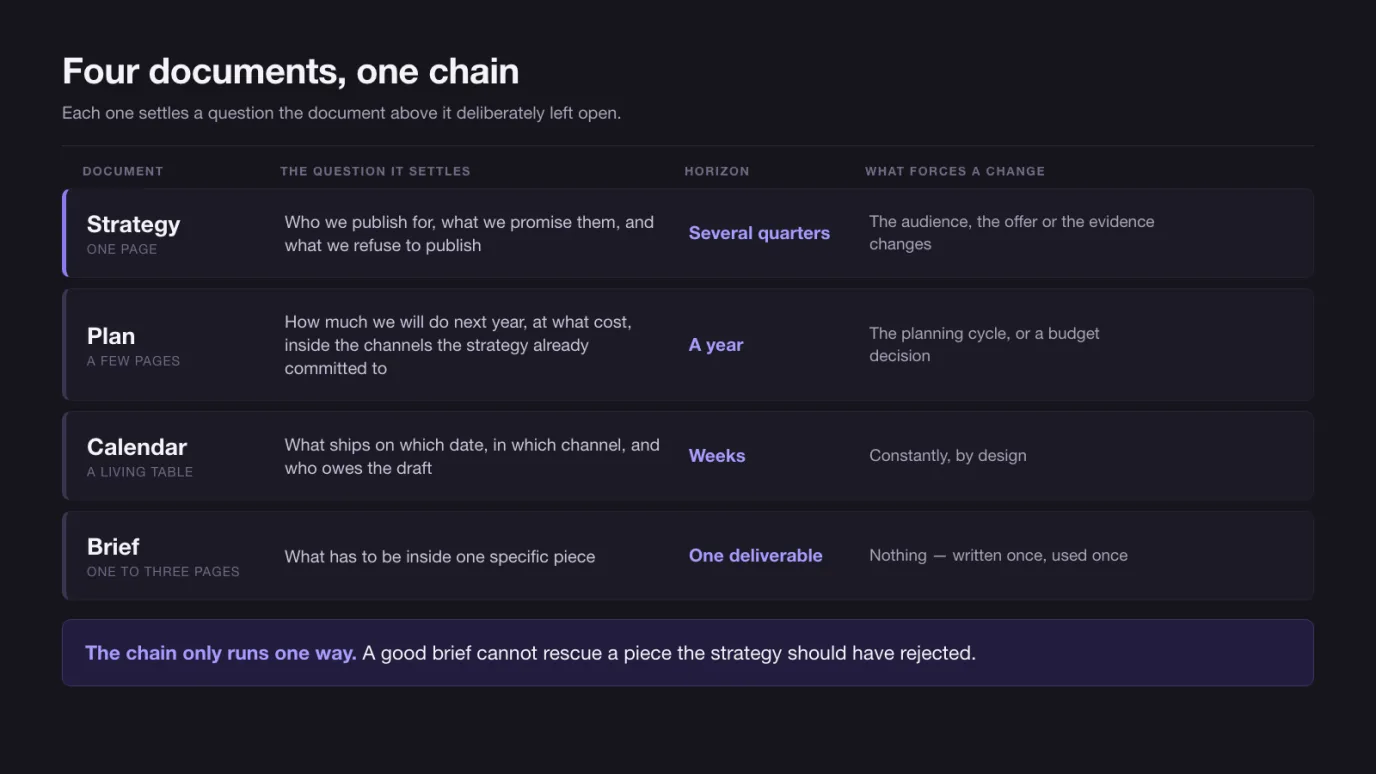
| Document | The question it settles | Horizon | What forces a change | Typical length |
|---|---|---|---|---|
| Strategy | Who we publish for, what we promise them, and what we refuse to publish | Several quarters | The audience, the offer or the evidence changes | One page |
| Plan | How much we will do next year, at what cost, inside the channels the strategy already committed to | A year, reviewed quarterly | The planning cycle, or a budget decision | A few pages |
| Calendar | What ships on which date, in which channel, and who owes the draft | Weeks | Constantly, by design | A living table |
| Brief | What has to be inside one specific piece | One deliverable | Nothing — it is written once and used once | One to three pages |
Read down that table and the failure modes fall out of it. A team with a calendar and no strategy publishes on schedule and cannot say why any given item was on it. A team with a strategy and no calendar agrees about everything and ships nothing. A team with good briefs and no strategy produces individually strong pieces that add up to nothing, because each one was argued on its own merits and never against the others.
The money and the volume get decided one layer down, in the marketing plan, which is also where the arithmetic from a revenue number back to a reach number belongs. Cadence against team size gets decided a layer below that, in the content calendar. Neither layer can compensate for a missing strategy. They can only execute the decisions it already made.
The rejection test: what has your strategy turned down?
Here is the test, and it takes about ten minutes.
Write down the last ten content ideas anyone in your business proposed. For each one, ask a narrow question: did the strategy document reject it, before a human argued about it in a meeting? Not “we decided against it eventually” — did the document decide, on criteria that existed before the proposal did?
Zero out of ten means you do not have a content strategy. You have a topic list with a cover page.
The test works because a strategy is a constraint, and a constraint that never binds is not one. Every real strategic decision costs something: choosing an audience means the other audiences read somebody else’s content, committing to two formats means the other four do not get made. A document that costs you nothing has not decided anything.
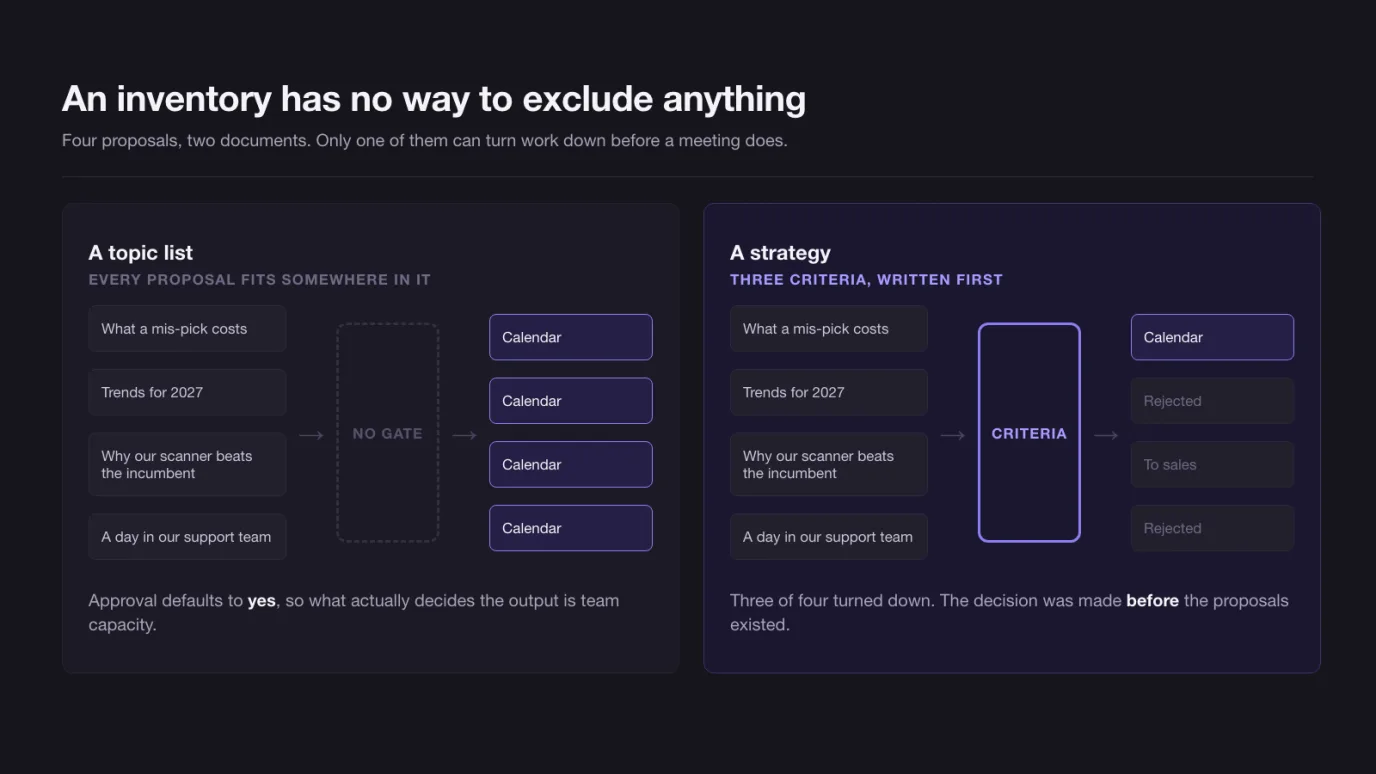
The slide into a topic list is short, and it runs the same way in every business that takes it:
- The document gets written as an inventory — the audiences we serve, the channels we are on, the themes we cover.
- An inventory has no mechanism for exclusion. Every proposal fits somewhere inside it.
- So approval defaults to yes, and the thing that actually decides what gets made becomes team capacity.
- Capacity is not a strategy. It fills the calendar with whatever was proposed most recently and most loudly.
- Six months later nobody can explain why the output looks the way it does, because no decision produced it.
The five standing decisions a content strategy has to settle
Five decisions. Each one produces a sentence, not a section. If your document runs to fourteen pages and does not contain these five sentences, the fourteen pages are describing work rather than deciding it.
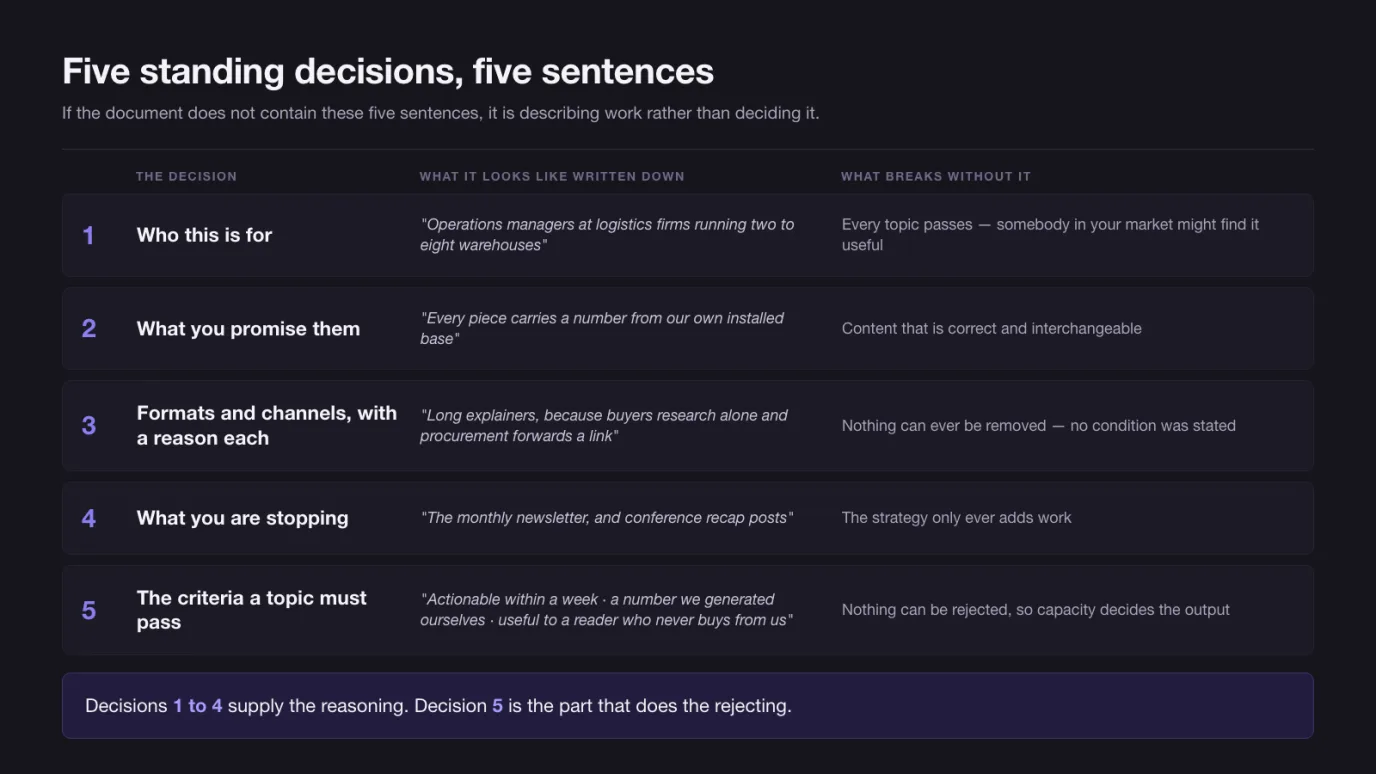
1. Who this is for, named specifically enough to exclude people. “Small and medium businesses” excludes nobody. “Operations managers at logistics firms running two to eight warehouses” excludes almost everybody, which is the entire point. Without this line every topic passes, because somebody somewhere in your addressable market might find it useful.
2. What you promise that audience that the pages already ranking do not. Not a tone of voice — a substantive claim about what your content contains and theirs does not: your own numbers, a process you actually run, a category of mistake you see every week. Without it your content is correct and interchangeable, and interchangeable content gets read once and forgotten.
3. Which formats and channels you commit to, with the reason written next to each. A format with no reason beside it is a habit. “Long explainers on the site, because our buyers research alone for weeks and procurement forwards a link” is a decision. “Blog, LinkedIn, YouTube, newsletter” is a list. Without the reasons, nothing on the list can ever be removed, because no condition was ever stated under which it stops being worth doing.
4. What you are stopping. The section every topic list omits. Naming what stops is the only part of the document that frees capacity; every other part consumes it. A strategy with no stopping section is a request for more headcount wearing a strategy’s cover.
5. The criteria a topic must pass to reach the calendar. Two or three of them, written before anybody proposes anything, each specific enough that two different people applying it to the same proposal land on the same answer. This is the mechanism. Decisions one to four supply the reasoning; this is the part that does the rejecting.
Voice, colour, logo use and the rest of the rules about how the brand appears are real and necessary, and they belong in a different document — brand guidelines rather than the strategy. A strategy that spends four pages on tone and none on exclusion has confused the two.
Five signs the document is a topic list wearing a strategy’s name
- There is no “we don’t” section. Search the file for the word “not”. If it only turns up in sentences about your audience’s problems, nothing in the document is being refused.
- Every heading is a topic, a channel or a goal. None of them is a decision with a price attached.
- The audience is described in firmographics only — headcount, industry, revenue band — and never by what they are trying to get done this quarter. Firmographics tell you who to email. They cannot reject a topic.
- Nothing in it could turn out to be wrong. A strategy contains claims evidence could overturn: this audience, this promise, this channel. If nothing in the document is falsifiable, nothing in it was decided.
- Two people on the team give different answers to “what does our strategy rule out?” This is the ten-second version of the whole test. Ask them separately. Different answers mean the rule lives in nobody’s head, and therefore nowhere.
A one-page content strategy, filled in
A worked example, so the five decisions are visible in their finished form. The business: twelve people selling handheld inventory-scanning hardware and the software that runs it, to regional third-party logistics firms. It is an illustration rather than a client, and the figures inside it are illustrative too.
- Audience. Operations managers at 3PLs running two to eight warehouses, who have been told to cut mis-picks without adding headcount.
- Promise. We publish the arithmetic. Every piece carries at least one number from our own installed base — error rates, payback periods, the labour maths — instead of a figure lifted from an analyst report. Nobody else in this category shows their working.
- Formats and channels. Two long explainers a month on the site, because these buyers research alone for weeks and procurement forwards a link. One LinkedIn post per explainer, because that is the only place these operations managers gather in public. Nothing else, because at twelve people a third channel means all three get run badly.
- Stopping. The monthly customer newsletter — six consecutive months of falling opens and nobody able to name a deal it touched. And conference recap posts, written for the people who attended and read by nobody who did not.
- A topic reaches the calendar only if all three of these are true: an operations manager could act on it within a week of reading it; it contains a number we generated ourselves; it is useful to a reader who never buys from us.
That is the entire document. It fits on one page, and a founder and a marketer argued it out in two hours. Almost all of the two hours went on decisions four and five.
Four proposals, and what the example strategy does with them
| Proposal | Verdict | Which criterion decided it |
|---|---|---|
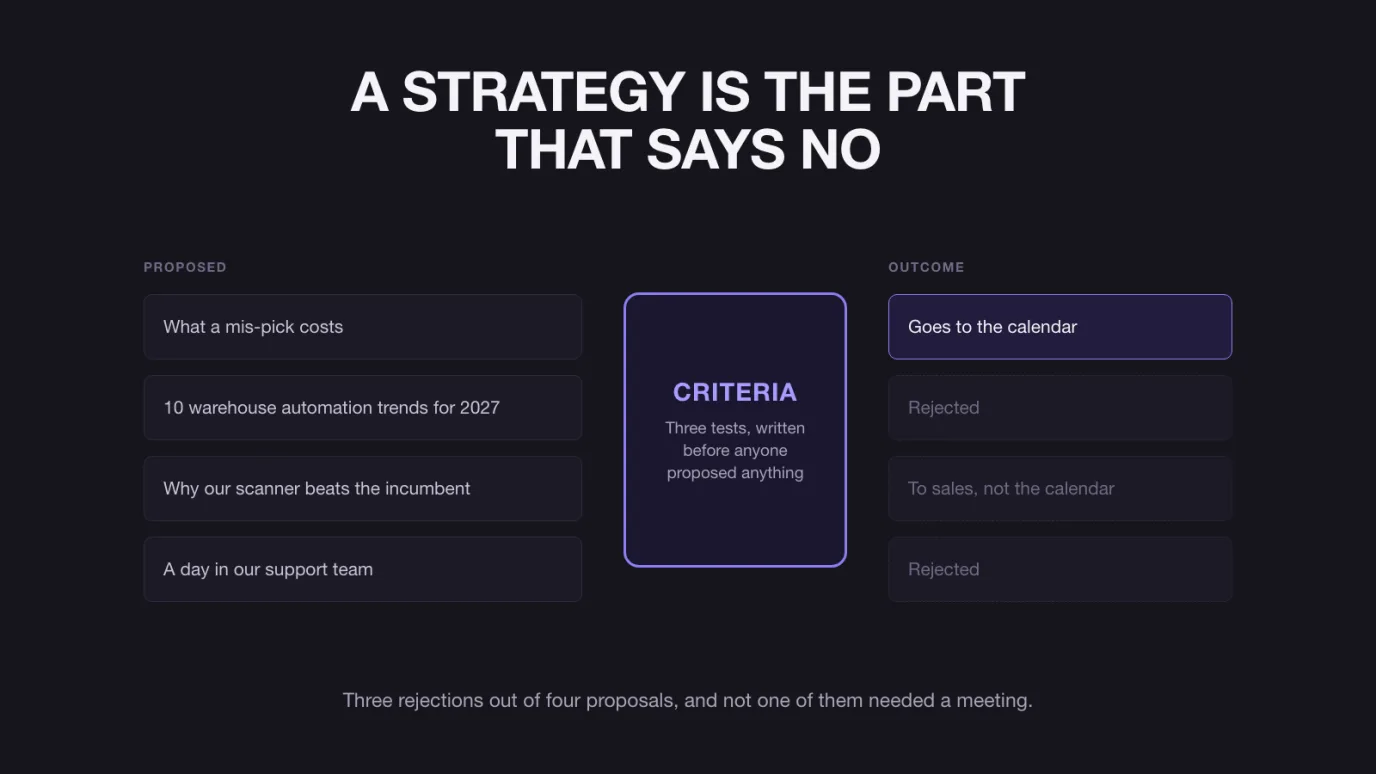
| “What a mis-pick actually costs, priced three ways” | Goes to the calendar | Passes all three — actionable within a week, built on our own error-rate data, useful even to a reader who never buys from us |
| “10 warehouse automation trends for 2027” | Rejected | Fails “actionable within a week” and “a number we generated ourselves” — every figure in it would be borrowed |
| “Why our scanner beats the incumbent” | Rejected as an article, moved to sales | Fails “useful to a reader who never buys from us” — a comparison only pays off for someone already choosing between vendors, which makes it sales enablement |
| “A day in the life of our support team” | Rejected | Fails “actionable within a week” — there is nothing in it for the reader to do |
Three rejections out of four proposals, and not one of them needed a meeting. That is what the document is for.
Note also what happened to the second one. The trends idea was not deleted; it was demoted to a single paragraph inside an explainer that does pass. Rejecting a topic as an article is not the same as rejecting the information in it, and strategies that cannot make that distinction get overruled within a quarter.
Who owns the strategy, and what forces a rewrite
One owner, and it has to be whoever is accountable for the result the content is supposed to produce. Committee ownership is the most reliable way to stop a strategy rejecting anything: a document that needs five approvals to turn a topic down will approve the topic instead, every time.
Rewrites run on triggers, not on a date:
- The audience changed. You are selling to a different buyer, or the same buyer’s job changed underneath them.
- The offer changed. New product line, new price band, new category.
- A rejection criterion has rejected nothing for two quarters. It is not binding. Either it is too loose to bite, or it describes work nobody was proposing anyway.
- A committed format or channel has produced nothing you can name for two quarters. Decision three recorded why you were doing it. When the why stops being true, the commitment goes with it.
An annual read-through is a floor, not the mechanism. Between rewrites, the honest place to look for whether any of this is working is lead quality rather than traffic, and the handoff from marketing qualified to sales qualified is where content either shows up or does not.
One job that looks like part of the strategy and is not: taking stock of everything you have already published and deciding what to keep, refresh, merge or delete. That is a separate exercise with its own thresholds, and it belongs after the strategy exists, not inside it.
If nobody in the business can carry that ownership, that gap is the real problem, and it is what you are buying when you hire out content marketing — not the writing, but the standing decisions and the discipline to keep applying them when somebody senior proposes a topic that fails the criteria.
Where the strategy hands off
The strategy decides what is allowed. Everything downstream of it executes that decision.
- The plan turns the allowed set into a budget and a volume for the year.
- The calendar turns the volume into dated slots with named owners.
- The brief turns one slot into a specification a writer can build from — the content brief covers the fields, in two versions depending on whether the writer already knows your product.
- The brand guidelines keep voice and visuals consistent across whoever ends up making it.
The chain only runs one way. A good brief cannot rescue a piece the strategy should have rejected. It will just produce a well-built article nobody needed.
What a content strategy will not do for you
Five limits, since none of the ranking pages state any.
It will not fix an offer nobody wants. Content makes existing demand find you. It does not manufacture demand for a product the market has already looked at and declined.
It will not create authority you do not have. Decision two has to be true. If you cannot name what your content contains that the incumbents’ does not, the strategy cannot invent it for you, and publishing more of the same will not close the gap.
It will not make an under-resourced team ship more. Cadence is arithmetic — hours available divided by hours per piece. A strategy changes which pieces get made, not how many.
It will not survive a new owner every quarter. Each new owner rewrites the document, and a strategy rewritten every quarter has never been in force long enough to be tested against anything.
It will not be written for you by a language model. A model drafts against a strategy well and researches faster than you can. It cannot supply decisions four and five. What you stop doing and what you refuse to publish depend on what your business sells, which customers you are willing to lose, and what you have already put out — none of which is in the model, and all of which is the part that does the work.
11 / Reader questions
Frequently asked questions
01What is a content strategy?
A content strategy is the set of standing decisions that governs what you publish: who it is for, what you promise that audience, which formats and channels you commit to, what you stop doing, and the criteria a topic has to pass before it gets made. It settles those once, so individual pieces are not argued from scratch every time.
02What is the difference between a content strategy and a content plan?
A strategy decides who you publish for and what you refuse to publish; a plan decides how much of it you will do next year and what it costs. The strategy changes when your audience, your offer or your evidence changes. The plan changes every planning cycle, inside the boundaries the strategy already set.
03What is an example of a content strategy?
One page holding five things: a named audience, the promise you make them, the formats and channels you commit to with a reason attached to each, a list of what you are stopping, and two or three criteria a topic must pass. A filled version for a company selling warehouse scanning systems is worked through below.
04What are the 5 pillars of content strategy?
There is no agreed list of five, and no two of the pages ranking for the phrase name the same pillars. The five decisions that do determine whether a strategy works are the audience, the promise, the format and channel commitments, what you stop doing, and the criteria that let you turn a topic down without a meeting.
05What are the 7 steps in creating a content strategy?
The step lists that rank for this question run between five and seven steps and broadly cover the same sequence: set goals, define the audience, research topics, choose formats, plan distribution, produce, measure. That sequence is sound for production. Note what it omits — a step where you decide what you will not publish.
06Is a content strategy the same as a content calendar?
No — the calendar is the schedule of what ships, when, in which channel and who owes the draft, while the strategy is what decides which items are allowed onto that schedule in the first place. A team with a calendar and no strategy fills every slot, because nothing in the system is capable of saying no.
07Who should own the content strategy?
One person, and it should be whoever is accountable for the result the content is meant to produce. Committee ownership is the most reliable way to stop a strategy rejecting anything: a document that needs five approvals to turn a topic down will approve the topic instead.
08How often should a content strategy be rewritten?
On a trigger, not on a date. Rewrite it when the audience changes, when the offer changes, when a rejection criterion has rejected nothing for two quarters, or when a format you committed to has produced nothing you can name for two quarters. An annual read-through is a floor, not the mechanism.