Published
An animatic is a storyboard cut to its real running time: the panels are held on screen for the exact length each shot will last, played against a recorded voice track and temporary sound. It is the first version of a video you watch rather than read — and the last version in which every structural decision is still a document, not finished work.
How this was checked. For this query in the United States on 10 August 2026, Google returned an AI Overview, a video pack and an organic top ten led by Reddit, Adobe, StudioBinder, Boords, Merriam-Webster and School of Motion. Between them the definition is settled and consistent: an animated storyboard, timed to sound, used to test pacing before production. What none of them covers is the side of it a client sits on — which of the five different documents the industry calls an animatic you are actually being shown, what approving one commits you to, and which questions stop being free the day after you say yes. That is what the sections below are for. The pipeline diagram and the change table describe how the stages depend on each other; neither is a price list, and this article deliberately quotes no figures.
An animatic is a storyboard playing at its real length
Merriam-Webster defines an animatic as “a preliminary sequence of shots, images, or sketches (as for a movie or an animated television program) that is filmed or arranged usually with a sound track and viewed to determine its effectiveness before being finalized”. The dictionary has the mechanics right. What no definition covers is the thing a client is actually agreeing to when they approve one. In production terms, an animatic is the storyboard placed on an editing timeline, with each panel given the duration its shot will have in the finished piece, cut against a scratch recording of the voice-over and rough music or effects.
Three things are therefore true of it at once. It is finished in structure — the shot order, the number of shots and the length of each are the ones the final piece will have. It is deliberately unfinished in craft — the drawings stay rough on purpose, because polishing them buys nothing at this stage and makes people reluctant to cut them. And it is watchable, which is the whole point: a sequence that reads well on paper can still feel slow, rushed or confusing when it arrives at the speed an audience will actually receive it.
An animatic is not the same as any of its neighbours:
- Not a storyboard. A storyboard is static and self-paced. You look at panel four for as long as you want. The audience will get exactly as long as the edit gives them.
- Not rough animation. Nothing in an animatic moves the way the final piece moves. A held drawing with a slow push-in is standing in for a shot, not attempting it.
- Not a first cut. A first cut is assembled from finished material and can only be changed by discarding work. An animatic is assembled from drawings and can be changed by redrawing one.
Five documents that all get called an animatic
The word covers a family, not a single deliverable. They differ in where the images come from and in what the thing is for, and that difference decides who should be in the room when it is shown. If you are quoted for “an animatic” without a qualifier, this is the first question to ask.
| Document | Images come from | What it is for | Typical audience |
|---|---|---|---|
| Storyboard animatic | Panels drawn for this project | Locking structure and timing before production starts | Client approval |
| Boardomatic | The same panels, minimal treatment | Testing an ad idea cheaply before it is made — timing, comprehension, appeal | Agency, client, and research respondents |
| Leica reel | Project panels, updated continuously | The living cut of an animated production, replaced shot by shot as animation is finished | The production team, throughout |
| Ripomatic | Existing footage cut from other films, adverts and stock | Pitching a treatment before anything original exists | Winning the brief or the budget |
| Stealomatic | Existing footage, chosen for tone above all | Selling a mood, when the argument is “it should feel like this” | Pitch rooms and mood approvals |
The distinction that matters commercially is between the first three and the last two. A storyboard animatic, a boardomatic and a Leica reel are all made of material created for your project, and every frame in them is a commitment someone intends to build. A ripomatic or a stealomatic is made of other people’s finished footage, which means it will always look better than the thing it is selling — the shots in it were lit, shot and graded by somebody with a completed budget. Approving a pitch reel is approving an intention. Approving a storyboard animatic is approving a specification.
The vocabulary is not policed, and in practice several of these words get used interchangeably — “ripomatic” and “stealomatic” especially, with the second usually meaning a ripomatic assembled purely for tone. What matters is not the label but the two questions behind it: were these images made for my project, and is this thing meant to sell an idea or to specify a build. Ask those before you ask what it is called. The name for the Leica reel, incidentally, comes from the Leica camera studios once used to shoot storyboard panels frame by frame.
A previs sits outside this table. Previsualisation is a rough three-dimensional block-through of camera, staging and action, used where the physical camera move or the geometry of a space is the thing in question. It answers whether a move is possible; an animatic answers whether a sequence reads. On most commercial and explainer work you will only ever see an animatic.
Script, storyboard, animatic: what gets fixed at each handover
Each document in the chain settles something the one before it could not, and inherits everything already settled. That is why they are produced in this order and why skipping one does not save the step, it only moves the discovery of its problems further down.
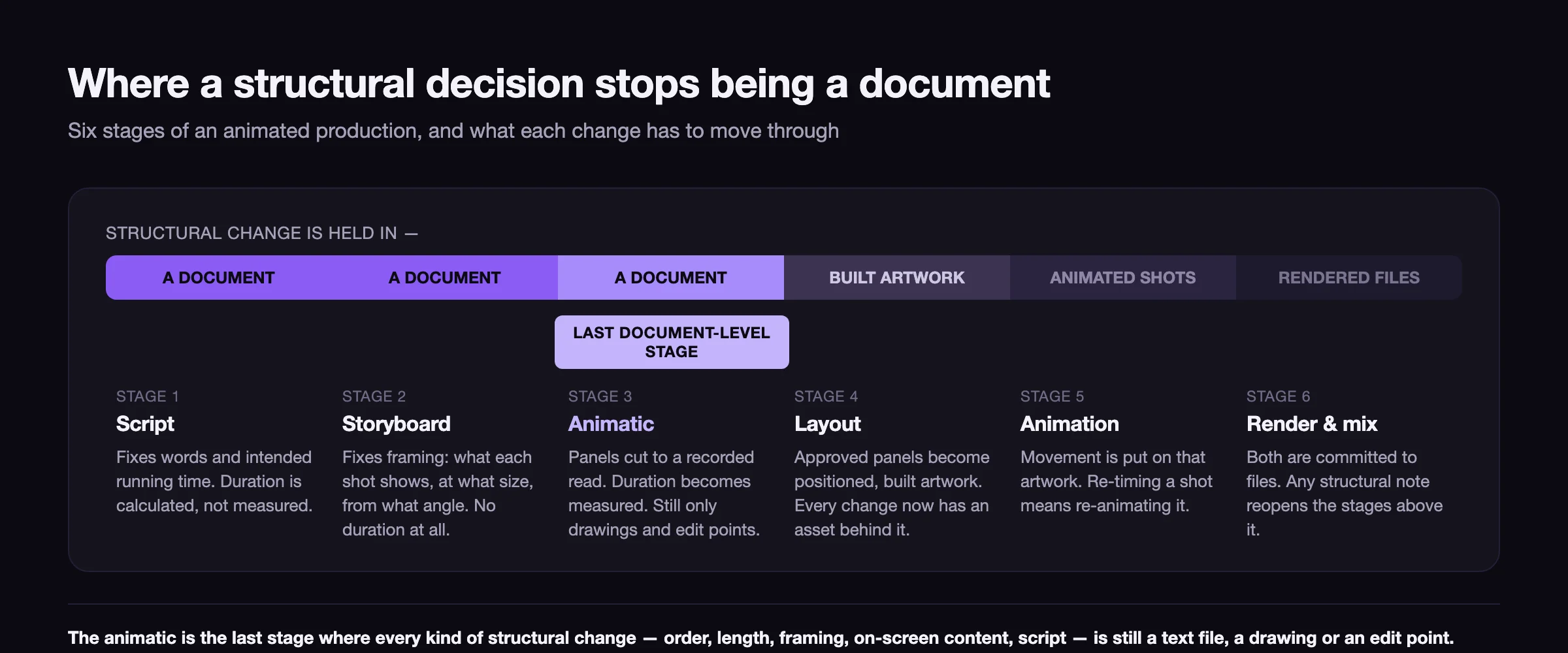
The script fixes the words and the intended running time. The storyboard fixes framing: what each shot shows, at what size, from what angle. Both are still forecasts about time — a script’s duration is calculated from word count, and a storyboard has no duration at all. The animatic is where the forecast is replaced by a fact, because the panels are now cut against a real recorded read. The word-count arithmetic that produces the forecast, and what to do when the two disagree, is covered in our guide to writing a video script; the animatic is where that arithmetic gets marked.
After the animatic the chain inverts. Layout turns approved panels into positioned, built artwork. Animation puts movement on that artwork. Render and mix commit both to files. From layout onwards, every document in the chain has an asset behind it: changing the document means reworking that asset, and from animation onwards it means rebuilding it.
The cost of a change is set by the stage it arrives at
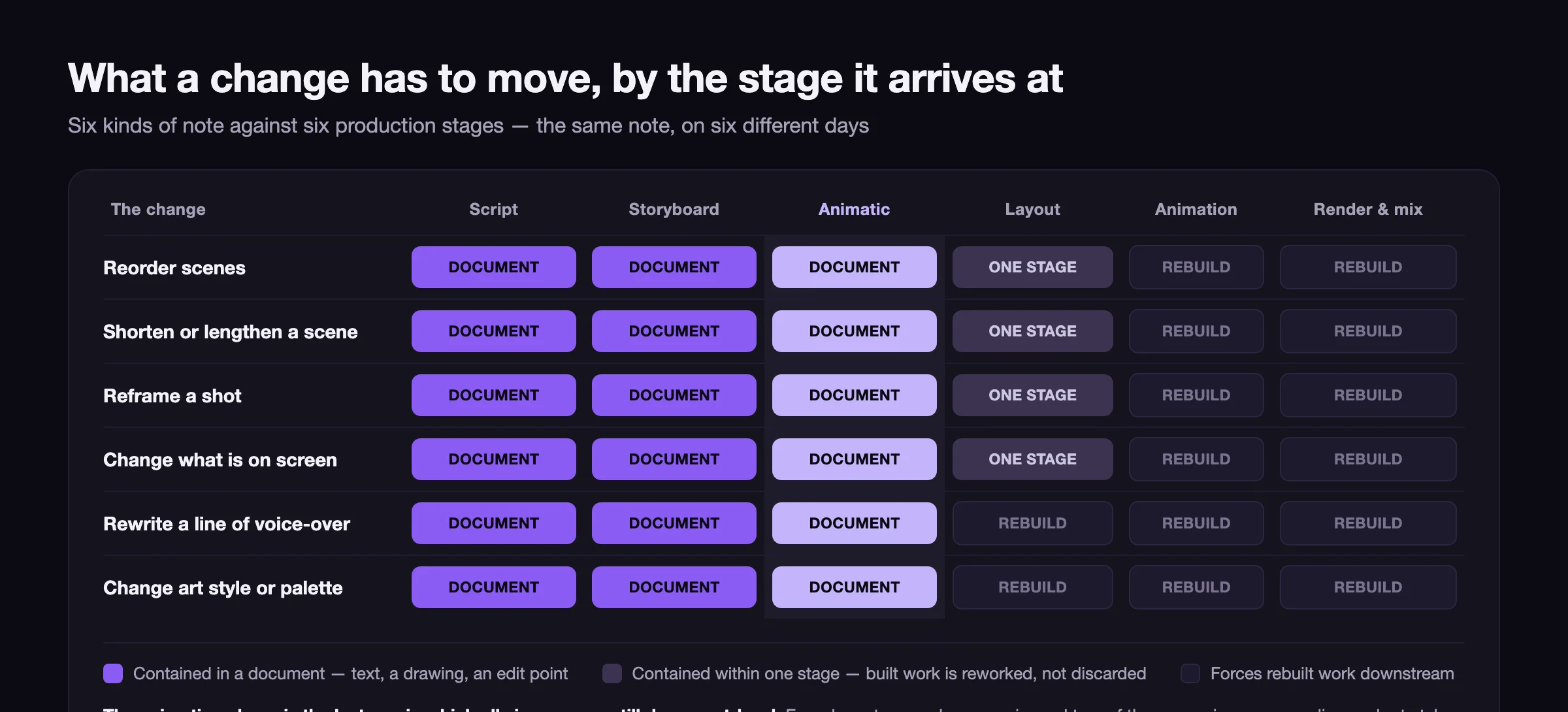
The same note costs different amounts on different days, and the variable is not how big the change is but how much produced work sits underneath it. “Swap shots four and five” is a two-second edit on an animatic. The same sentence after animation means two finished shots are re-timed, the transitions between three shots are rebuilt, and anything already rendered is rendered again.
| Change | At the animatic | After animation has begun |
|---|---|---|
| Reorder scenes | Move clips on a timeline | Re-time affected shots, rebuild the transitions between them |
| Shorten or lengthen a scene | Drag an edit point | Re-time the shot, re-cut the audio bed, adjust neighbouring shots |
| Reframe a shot | Redraw one panel | Rebuild the layout, re-animate anything keyed to the old framing |
| Change what is on screen | Redraw one panel | Rebuild or replace the asset, re-animate its movement |
| Rewrite a line of voice-over | Edit the text, re-record a scratch read | Re-record in the booth, re-time every shot under the line |
| Change art style or palette | Note it against a rough drawing | Rework every built asset in that style |
Read the two right-hand columns as the same work described twice. Nothing in the animatic column is easy because the change is small; it is easy because nothing has been built yet. That is the entire argument for the stage, and it is why the useful question at an animatic review is not “do I like this” but “what would I regret not saying now”.
Two structural facts follow. First, the animatic is the last stage at which every category of change above is still contained in a document — a text file, a drawing, an edit point. From layout onwards, not one of them is. Second, the categories do not expire together. Reordering, length, framing and on-screen content stay contained within a single stage through layout, so a note about them is uncomfortable rather than fatal. Voice-over wording and art style skip that middle step entirely: both go straight to rebuilt work the moment the first assets exist, because one re-times every shot beneath it and the other invalidates all of them. If you have one reservation you cannot articulate, the animatic is where you say so anyway.
Nine things to look at when the animatic lands in your inbox
Watch it three times. The first pass is for the feeling of it, at full length, without stopping — because that is the only viewing that resembles what the audience gets. The second and third are for this list.
- Does it run to length? Compare the total duration with the spec, not with your patience. A 60-second slot means 60 seconds, and four seconds over is a script problem to solve now.
- Does the first shot say what this is about? Judge it on its own, in isolation, on information rather than on polish. It is the only shot guaranteed to be seen, and whether it is beautiful is a question for a later stage.
- Can you follow it without knowing the brief? You cannot un-know the product. Send it to someone in your company who has not been in a single meeting about it and ask what they think it is selling.
- Is anything on screen for less time than it takes to read? Every on-screen text string, price, legal line and URL. Read each one out loud at a normal pace while it is showing.
- Is the same information paid for twice? A figure spoken in the voice-over and simultaneously written on screen usually costs two beats and delivers one.
- Is every shot doing a job you can name? If you cannot say in one clause what a shot is for, it is a candidate for the cut list rather than for animation.
- Is every mandatory element present, in shot, and on screen long enough? Disclaimers, legal lines, the product itself, the claim it is allowed to make. Judge presence, placement and duration only — how those elements are styled belongs to a look approval, not to this one.
- Are the cuts landing with the audio? Not the finished mix, which does not exist yet, but the beats of the read. Cuts that fight the sentence structure will still fight it at full quality.
- Which shot would you drop if you were told to lose eight seconds? Answer it even if nobody has asked. Knowing the answer in advance is what keeps a late change from becoming a negotiation.
Send notes as one consolidated list, timecoded, in one round. Notes that arrive in three separate emails across a week are not three times as useful; they are one revision performed three times.
What an animatic will not show you, however carefully you watch
An animatic is a reliable instrument for structure and an unreliable one for craft, and knowing which is which prevents both kinds of mistake — approving something that will not work, and rejecting something that will.
It cannot show you how movement will feel. Easing, weight, anticipation and settle are the substance of animation and are entirely absent from a held drawing. A transition that looks abrupt in an animatic is frequently the one that ends up smoothest.
It cannot show you finished legibility. Rough drawings are simpler than final artwork, so small elements read more easily in an animatic than they will on a phone screen against a detailed background. If something is borderline here, treat it as failing.
It cannot show you the emotional register of the final audio. A scratch read is flat by design and temporary music is a placeholder, so a sequence often plays colder than it will finish. Judge the timing of the audio, not its warmth.
It cannot show you colour, contrast or brand fidelity. Those belong to a design stage that has not happened, which is exactly why an animatic should not be signed off as a look approval. If you need to see the look, ask for a colour key or a still frame in final style — a separate deliverable, with a separate conversation, ideally against whatever your design brief already specifies.
And it cannot show you whether the piece was the right format to commission at all. That decision sat further upstream, at the point of choosing between 2D and 3D animation and their very different cost structures.
Animatics on live-action jobs, and where previs takes over
Animatics are associated with animation because that is where they are mandatory: without one, an animated production would begin building shots with no verified sense of how long anything runs. On live-action work they are optional, and the test for whether to build one is simple — the tighter the duration and the more expensive the shoot day, the more an animatic is worth.
On a scripted commercial with a fixed slot length, an animatic tells you before anyone is booked which shots the running time can genuinely afford. Cutting a setup at that point costs a conversation. Cutting it in the edit means it was scheduled, lit, crewed and shot first. The list of supporting shots an edit needs, and how it is derived, is a separate discipline covered in our piece on B-roll.
Where the question is physical rather than temporal — whether a crane move clears the set, whether two objects can be in frame together — previs answers it and an animatic does not. The two are complementary, and on the sort of work most brands commission you will need the animatic far more often than the previs.
Everything above is one idea applied repeatedly: discovery is cheap early and expensive late, and an animatic is a deliberate purchase of early discovery. Studios that skip it are not saving you the stage, they are deferring it to the point where the same conversation is held over finished work. If you are commissioning animated work and want the timing gate built into the schedule rather than bolted on when something goes wrong, that is how our 2D motion design projects are structured.
08 / Reader questions
Frequently asked questions
01What is an animatic in animation?
An animatic is the storyboard for an animated piece, cut to real duration against a recorded voice track and temporary sound. Each panel is held on screen for the length the finished shot will run, so the sequence can be watched rather than read. It is the first version of the project that plays.
02What does an animatic look like?
It looks like rough drawings holding still on screen, cutting from one to the next in time with a voice track, with occasional slow pans or simple moves to suggest camera direction. The drawing quality is deliberately low. What is finished about it is the timing, not the artwork.
03What is the difference between a storyboard and an animatic?
A storyboard is a set of static panels you read at your own pace; an animatic is those same panels cut to a timeline with sound, so it plays at the speed the audience will experience. The storyboard answers what each shot shows. The animatic answers whether the sequence works at real length.
04What is the difference between an animatic and the final animation?
An animatic contains the final structure but none of the final craft. Shot order, shot length, framing and script are all as they will be; movement, character performance, finished artwork, colour and the real soundtrack are not. Anything an animatic gets wrong is still a document problem, not a re-render.
05What is a ripomatic, and how is it different from an animatic?
A ripomatic is assembled from existing footage cut from other films, adverts and stock libraries, so a concept can be pitched before anything original is drawn. An animatic uses original panels drawn for this project. A ripomatic sells the idea; an animatic specifies the piece that will be built.
06Do you need an animatic for a live-action shoot?
Not always, but it earns its place whenever the edit is tightly timed or the shoot is expensive. On a scripted advert with a fixed duration it tells you before the shoot day which shots the running time can actually afford, which is the cheapest possible moment to lose one.
07How long does an animatic take to produce?
Studios usually quote it in days rather than weeks for a short commercial or explainer, once the storyboard is approved and the panels exist. The time goes into the edit and the scratch audio, not into rendering, so the figure moves with shot count rather than with finish quality. Ask your studio for theirs before the stage begins.
08What can still be changed after the animatic is approved?
Craft, not structure. Drawing quality, colour, easing, performance detail and sound design all improve after approval and are expected to. Shot order, shot length, what appears in each frame and the script are the things approval is meant to settle, and each one gets more expensive to reopen from that point on.