
Published
GEO in marketing stands for generative engine optimization: shaping content and online presence so that AI assistants and AI search features cite it inside their generated answers, rather than only ranking it as a blue link somebody clicks. The same three letters used to mean geotargeting, and both meanings are still in active circulation.
GEO is the practice of getting cited inside AI-generated answers.
- It is not geotargeting. Geofencing, geomarketing and geo-modifiers are about where the user is standing. Generative engine optimization is about which sources a model quotes.
- It is not a Google feature. Google publishes documentation for AI Overviews and AI Mode; it has never published a GEO specification, and says no special optimization exists.
- It is not a replacement for SEO. The measurable relationship is overlap, and two studies below put that overlap at 38% and 90% because they count different things.
How this was checked. In August 2026 we pulled the live US search results for “what is geo in marketing”, twelve months of Google Ads demand data behind that phrase and its neighbours, and the primary documents that the pages currently ranking for it mostly do not cite: Google’s developer documentation on AI features, the Search Console generative AI report launched on 3 June 2026, the 2023 research paper that introduced the term, and four independent measurement studies, two of which look like they contradict each other. Where they look like they contradict each other is the part worth reading. Every figure below is given with the sample it came from.
The three letters carry two meanings, and only one of them is growing
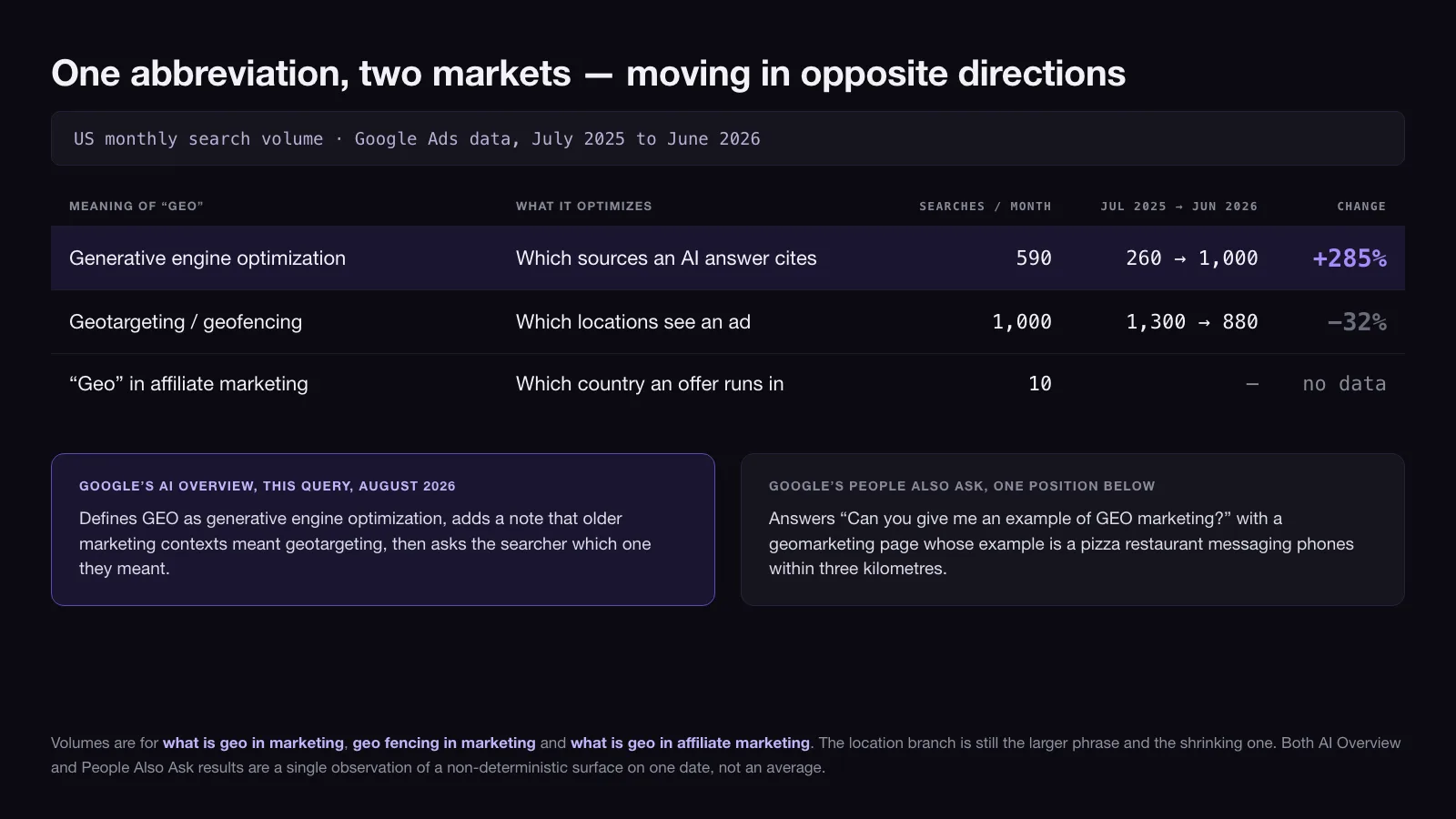
Both meanings are live, and the search data separates them cleanly. In the United States, what is geo in marketing runs at 590 searches a month, at a keyword difficulty of 20 on the 0–100 scale the keyword tools use — and its twelve-month curve climbs from 260 in July 2025 to 1,000 in June 2026, close to a fourfold rise. The location branch of the same abbreviation moves the other way: geo fencing in marketing is the larger phrase at 1,000 searches a month, and its own curve falls from 1,300 in July 2025 to 880 in June 2026.
| The two meanings | What it optimizes | US monthly volume | Year-on-year |
|---|---|---|---|
| Generative engine optimization | Which sources an AI answer cites | 590 (what is geo in marketing) | +285% |
| Geotargeting / geofencing | Which locations see an ad | 1,000 (geo fencing in marketing) | −32% |
A third meaning exists in affiliate marketing, where “geo” means the country an offer runs in. It is small — ten searches a month for the explicit phrasing — but it is the reason an affiliate manager and a content strategist can use the word all day and never notice they are discussing different things.
The ambiguity is not hypothetical, and Google itself is visibly caught in it. On the live results page for this query, the AI Overview opens by defining GEO as generative engine optimization, adds a parenthetical noting that older marketing contexts used “geo” as shorthand for geotargeting, and then closes by asking the searcher which of the two they actually meant. One position below it, the People Also Ask box carries the question “Can you give me an example of GEO marketing?” — and answers it with a page about geomarketing whose example is a pizza restaurant sending offers to phones within three kilometres.
Terminology inside the generative camp is not settled either. Among the ten pages ranking for this query in August 2026, one agency article dated October 2025 expands the acronym as “generative experience optimization” rather than “generative engine optimization”. That is a small thing, but it is a fair signal of how young the vocabulary is: the field is roughly three years old and has not finished agreeing on what its own initials mean.
The term comes from a 2023 paper whose 40% is not a traffic number
“GEO: Generative Engine Optimization” was posted to arXiv in November 2023 by Pranjal Aggarwal, Vishvak Murahari, Tanmay Rajpurohit, Ashwin Kalyan, Karthik Narasimhan and Ameet Deshpande, and presented at the ACM SIGKDD conference in 2024. Nearly every “GEO can boost visibility by up to 40%” line in circulation traces back to it. The number is real. What it measures is not what most people repeating it assume.
The authors built GEO-bench, a benchmark of 10,000 queries — 8,000 for training, 1,000 for validation, 1,000 for testing — drawn from nine sources spanning 25 domains: eight existing datasets including MS MARCO, Natural Questions, ELI5 and trending queries from Perplexity’s Discover feed, plus a set of queries generated by GPT-4. They then rewrote source pages nine different ways and measured, on the 1,000-query test split, what happened to those pages inside generated answers.
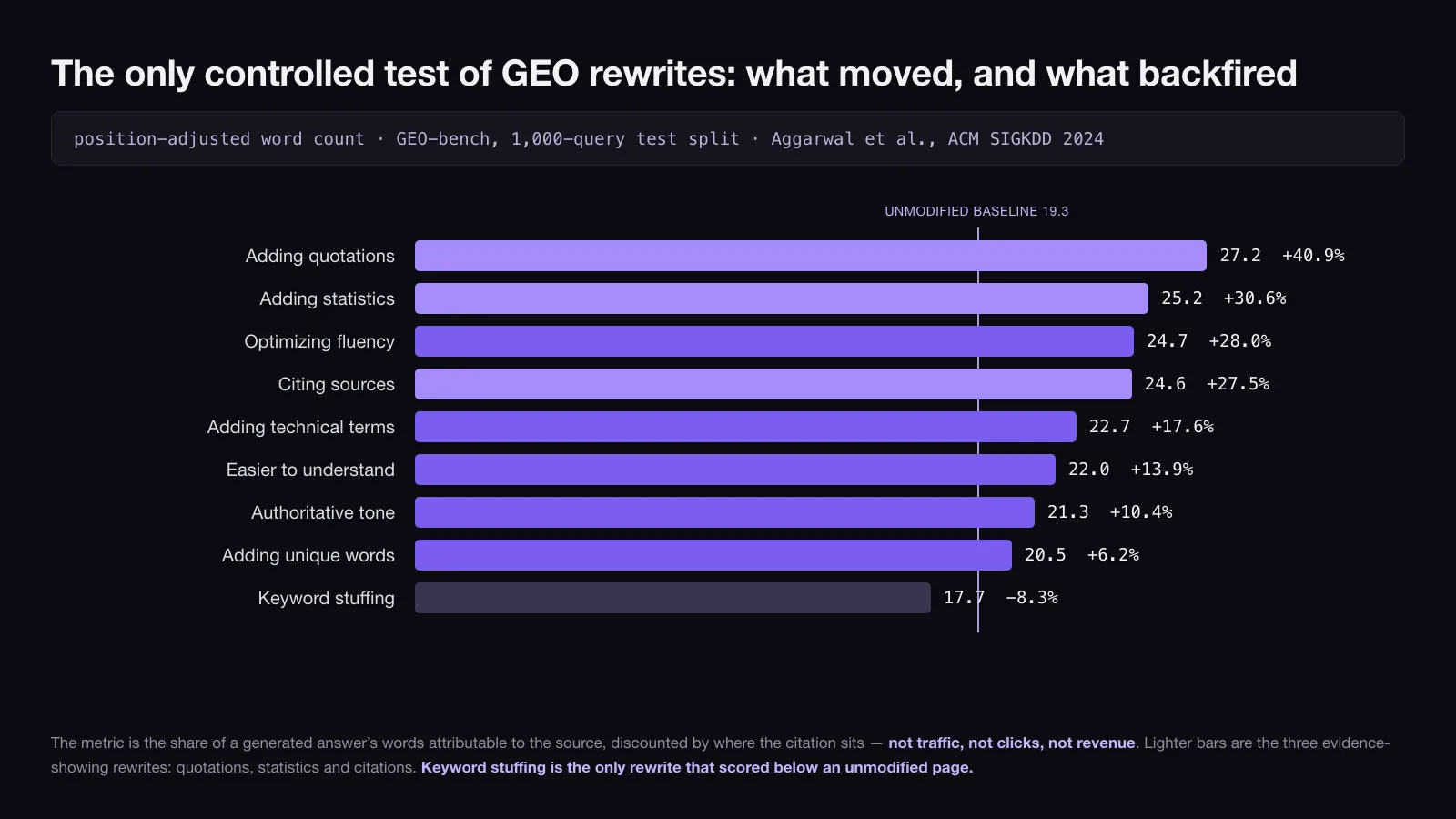
The two things they measured are both proxies. The first, position-adjusted word count, is the share of the answer’s words attributable to your source, discounted by how far down the citation sits. The second, subjective impression, is a seven-dimension score — relevance, citation influence, uniqueness, position, content count, click likelihood and diversity — assigned by GPT-3.5. Neither is a click, a session or a sale.
| Rewrite applied to the source page | Score | Change against baseline |
|---|---|---|
| Adding quotations from credible sources | 27.2 | +40.9% |
| Adding relevant statistics | 25.2 | +30.6% |
| Optimizing fluency | 24.7 | +28.0% |
| Citing sources | 24.6 | +27.5% |
| Adding technical terms | 22.7 | +17.6% |
| Making the text easier to understand | 22.0 | +13.9% |
| Adopting an authoritative tone | 21.3 | +10.4% |
| Adding unique words | 20.5 | +6.2% |
| Keyword stuffing | 17.7 | −8.3% |
| Unmodified source (baseline) | 19.3 | — |
Two things in that table are worth more than the headline. Keyword stuffing, the tactic the whole discipline was born opposing, is the only rewrite that landed below the unmodified baseline — the classic manipulation moved the number the wrong way. And three of the top four are the same move in different clothes: quotations, statistics and citations are all ways of showing your evidence rather than asserting it. The fourth, fluency, is writing better.
The finding with the most consequence for a small site sits further down the paper, and it belongs to one method rather than to the discipline as a whole. Citing sources produced a 115.1% increase in visibility for websites ranked fifth in the search results, while the visibility of the top-ranked website fell by 30.3% on average. The authors read this as generative engines reducing the advantage that established domain authority carries in classic search.
Treat the whole set with the qualifier the authors would apply themselves: these are results from a benchmark harness, run against the models of 2023–2024, scored partly by another model. Whether the same rewrites move the same needle inside today’s engines has not been demonstrated at that scale by anyone since.
What Google’s documentation asks for is what technical SEO already asks for
Google publishes guidance for site owners on its AI features, and it is unusually blunt. Three sentences from it settle most of the arguments the vendor market is currently having.
On requirements: “There are no additional requirements to appear in AI Overviews or AI Mode, nor other special optimizations necessary.” On file formats: “You don’t need to create new machine readable files, AI text files, or markup to appear in these features.” On method: “The best practices for SEO remain relevant for AI features in Google Search.”
The eligibility conditions it does list are the familiar ones — the page has to be indexed, eligible for snippets, and compliant with the ordinary technical requirements of Search. The controls are the familiar ones too: nosnippet, max-snippet and noindex limit what appears in AI features exactly as they limit what appears in a normal result. If you want a checkable version of that gate, it is the same crawl-and-index pass as any other audit; our technical SEO audit checklist covers what breaks eligibility in practice.
The llms.txt file deserves a specific mention, because an entire product category grew up around it. Google’s John Mueller, asked about it in reporting from 2 June 2026, said the file “has existed for years, yet none of the AI systems use it”, and that its value is “purely speculative for now”. His broader position, from a Reddit thread reported on 8 January 2026, was the same in a different key: “What you call it doesn’t matter, but ‘AI’ is not going away, but thinking about how your site’s value works in a world where ‘AI’ is available is worth the time. Also, be realistic and look at actual usage metrics and understand your audience.”
One honest limit on all of the above: Google is describing Google. OpenAI, Anthropic and Perplexity each run their own crawlers and retrieval stacks and publish nothing equivalent. “No special optimization is necessary” is a documented statement about one surface, not a law that covers every assistant your buyers use.
Two studies measured the overlap with organic rankings and got 38% and 90%
If ranking and being cited were the same thing, GEO would be a marketing label on existing work. If they were unrelated, it would be a separate discipline. The published measurements land in between, and they look like they disagree far more than they do.
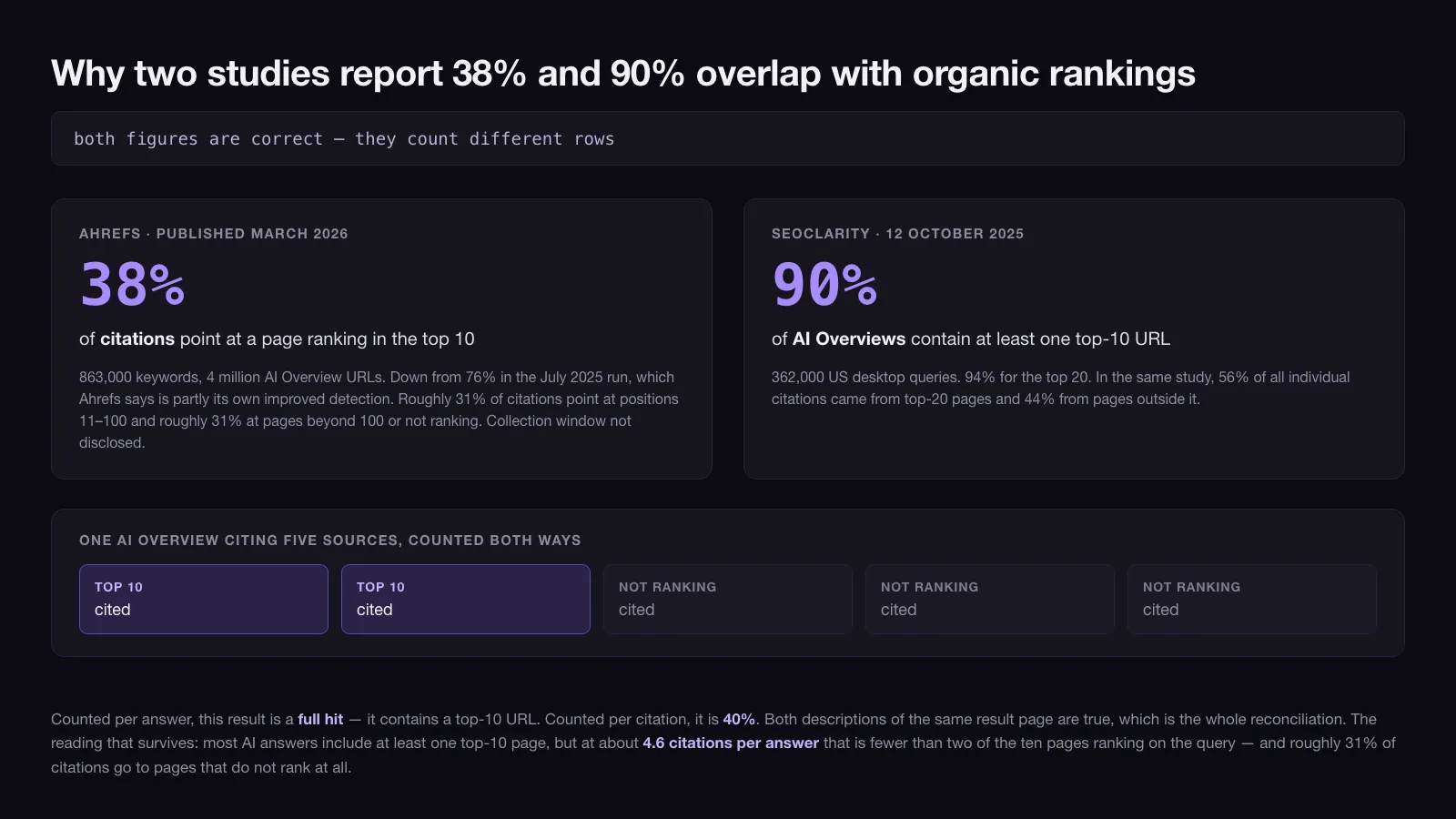
Ahrefs, publishing in March 2026 from 863,000 keywords and 4 million AI Overview URLs, found that 38% of citations pointed at a page that also appeared in the top 10 organic results — down from 76% in its own July 2025 study. Of the rest, roughly 31% pointed at pages ranking between positions 11 and 100 and roughly 31% at pages ranking beyond position 100 or not at all. Two caveats travel with that figure: Ahrefs cautions that its own detection method improved between the two runs, so the drop is not cleanly a change in Google’s behaviour, and it does not publish the window over which the data was collected.
seoClarity, analysing 362,000 US desktop queries on 12 October 2025, reported that 90% of AI Overviews contained at least one URL that also appeared in the top 10, and 94% for the top 20. The same study found that 56% of all citations came from top-20 pages and 44% from pages outside it.
| Study | What one row of the data is | Question it answers | Result |
|---|---|---|---|
| Ahrefs, published March 2026 | One citation | What share of citations point at top-10 pages? | 38% |
| seoClarity, October 2025 | One AI Overview | What share of AI Overviews include at least one top-10 page? | 90% |
| seoClarity, October 2025 | One citation | What share of citations point at top-20 pages? | 56% |
The reconciliation is arithmetic, not opinion. An AI Overview that cites five sources — two of them ranking in the top 10, three of them ranking nowhere — counts as a full hit in the per-answer view and as 40% in the per-citation view. Both descriptions of that same result page are correct.
What survives from these figures is narrower than the headline versions of them. Most AI Overviews do contain at least one page that also ranks in the top 10 — but that is a fact about the answer, not about your page. On Ahrefs’ own totals the average AI Overview carries about 4.6 citations, and if 38% of those belong to top-10 pages, fewer than two of the ten pages ranking on that query are cited in any given answer. Meanwhile roughly 31% of citations go to pages that rank nowhere at all, and 44% come from outside the top 20. Ranking is neither necessary nor sufficient, which is exactly why the acronym exists and exactly why it is not a new profession.
Measuring GEO when the click never happens
For the first two years of this discipline, the honest answer to “how do we measure it” was that you could not, with first-party data. That changed on 3 June 2026, when Google launched a dedicated generative AI performance report in Search Console.
The report combines impressions from AI Overviews and AI Mode, excludes experimental Search Labs features, and can be segmented by page, country, device and date. What it does not give is longer than what it does: no clicks, no click-through rate, no average position, no indication of which passage was used, no revenue. Google has said it is still working with website owners to decide which additional metrics would be useful, and rolled the report out to a subset of owners first. Two counting details are worth knowing before anybody builds a dashboard on it. Property-level totals will not necessarily match the sum of page-level figures, because a single generated response can show more than one URL from the same site. And clicks from these surfaces are not missing from Search Console altogether — Google’s documentation says a click on an external link inside an AI Overview counts as a click; it simply lands in the overall Search totals rather than being broken out in this report.
Set expectations for the click side with the best public measurement of it. Pew Research Center tracked 900 US adults across 68,879 Google searches, using browsing activity from March 2025 and results collected 7–17 April 2025. An AI summary appeared on 18% of those searches. Where one appeared, users clicked a traditional search result in 8% of visits; where none appeared, 15% — close to double. Clicks on a link inside the summary itself happened in 1% of visits. The median summary ran 67 words and 88% of them cited three or more sources.
The assistant side moves faster than any of this. Similarweb’s data covering June 2025 to May 2026 has ChatGPT’s share of generative AI website visits falling from roughly 76% to roughly 53%, Gemini rising from under 9% to around 27–28%, and Claude going from about 2% to about 9%. Over the same window, the share of ChatGPT responses citing external sources rose from about 1.6% to about 6.8% — with travel and hospitality queries near 23% and professional services under 4%.
That last split is the number most B2B teams should look at first. If your category sits near the professional-services end, the surface you are being sold optimization for is currently thin, and the correct sequencing is to baseline impressions now and re-measure in a quarter rather than to rebuild a content programme around it. A repeatable format for that baseline is the same one used for any other audit; ours is laid out in the SEO audit report template, and the reporting cadence question is where most of this ends up living rather than the tactics question. Where it becomes a working programme rather than a diagnosis, that is SEO with one more surface attached to it.
Four claims about GEO that the evidence does not support
Each of these is in wide circulation in 2026, and each is contradicted by a document or dataset already cited above.
- “You need an llms.txt file.” Google’s documentation says no new machine-readable files are needed, and Mueller says none of the AI systems use the file. Publishing one is harmless; buying a product to generate one is buying a solution to an undocumented problem.
- “GEO delivers a 40% lift.” The 40% is a change in position-adjusted word count — a mechanical measure of how much of a generated answer is attributable to your page — on a research benchmark, measured once, in 2023–2024. It is not traffic, not clicks and not revenue, and the same paper shows the size of the effect depends heavily on where you already rank.
- “You can track your AI visibility precisely.” The only first-party breakdown any platform publishes is an impression count from one vendor, with no clicks, position or passage attached to it. Every share-of-voice percentage beyond that comes from sampled prompting — a survey method, not a census, and one whose sample nobody outside the vendor can inspect.
- “Optimize for ChatGPT.” One assistant’s share of generative AI web visits moved from roughly 76% to roughly 53% in twelve months while another tripled. A plan pinned to a single engine is dated before it ships.
None of that makes the underlying shift imaginary. Answers are being generated above the links, they cite sources, and the citation is worth something whether or not the click follows. It makes the vendor layer around the shift much younger and much less measured than its confidence suggests.
AEO, LLMO and AI SEO name overlapping work, not separate disciplines
AEO — answer engine optimization — is usually presented as optimizing for direct answers: featured snippets, voice results, the box above the links. LLMO, or large language model optimization, and “AI SEO” are used for roughly the same territory as GEO. Search demand shows people trying to tell them apart: what is aeo and geo in digital marketing runs at 70 searches a month in the US and is up 27% quarter on quarter, and aeo and geo in digital marketing is up 1,300% year on year off a small base.
The useful distinction is narrow. Answer engine optimization describes extraction — a system lifting a passage you wrote and showing it. Generative engine optimization describes synthesis — a system writing its own passage and deciding whether to attribute part of it to you. That difference matters for what you write, because an extractable answer has to be self-contained in a couple of sentences — Pew found the median AI summary ran 67 words — while a citable one has to carry a fact worth attributing.
It matters much less for who does the work. None of these acronyms is a Google product term with a published specification, and the commercial phrasings built on them carry keyword difficulty scores in the single digits on the same 0–100 third-party scale — which says how new the labels are, not how hard the underlying work is.
What actually changes in a content brief
Nothing in this article argues for a new team or a new budget line. It argues for six changes to how a page is specified, all of which are cheap and all of which are supported by something above rather than by a vendor deck.
- Answer in the first two sentences. This one is our own editorial rule rather than a published finding, but the mechanism is not in dispute: extraction needs a self-contained answer, and a paragraph that opens with “it depends” gives a generative engine nothing to lift.
- Quote and cite. The two highest-scoring rewrites in the only controlled study of this were adding quotations and adding statistics, and citing sources came fourth of nine. They also happen to be what a careful editor asks for anyway.
- Put the sample next to the number. A statistic with its method attached survives being repeated by a model that has to decide whether to trust it; one without a method is indistinguishable from a claim.
- Do not stuff keywords. It is the only tested rewrite that scored below an unmodified page, at −8.3%.
- Keep structured data in sync with what is visible. That is Google’s own listed practice for AI features, and it is a maintenance rule rather than a tactic.
- Measure with impressions and a date, not with a share-of-voice score. Baseline before you change anything, because a delta on a weak metric is more honest than a level on an invented one.
The brief itself is where these live or die, since none of them survive being remembered at draft time; our content brief format has the fields they attach to. And the honest summary of the discipline in 2026 is that GEO named a real change in where answers appear, then acquired a vendor layer several years ahead of its own evidence. The work that is documented to help is the work that was already good practice: be indexable, answer directly, show your evidence, and check whether the surface you are optimizing for exists yet in your category.
09 / Reader questions
Frequently asked questions
01What does GEO stand for in marketing?
GEO stands for generative engine optimization: structuring content and online presence so that AI assistants and AI search features cite it inside their generated answers. In older marketing usage the same three letters were shorthand for geotargeting, which is why the qualifier matters. As of August 2026 Google's own AI Overview for this query flags both meanings.
02What is the difference between GEO and SEO?
The difference is the surface, not the technique. SEO aims at a ranked link the user clicks; GEO aims at a citation inside a generated answer the user may never click through. Google's documentation states that no separate optimization is required for its AI features, so most of the underlying work is the same work.
03Will GEO replace SEO?
Not on Google's own account: its documentation states there are no additional requirements to appear in AI Overviews or AI Mode and that SEO best practices remain relevant for them. What changes is measurement. Pew Research found users clicked a search result in 8% of visits where an AI summary appeared, against 15% where none did.
04Is GEO in marketing the same as geotargeting?
No. Geotargeting, geofencing and geomarketing deliver ads or content based on where a user is; generative engine optimization is about being cited by AI systems. They share an abbreviation and nothing else. US search demand splits the same way: over the twelve months to June 2026 the geofencing phrasing fell 32% while the generative one rose about 285%.
05What is the difference between AEO and GEO?
AEO — answer engine optimization — is usually described as optimizing for direct answers such as featured snippets and voice results, and GEO as optimizing for synthesized, generated answers. In practice most vendors use the two labels interchangeably, and neither is a Google product term with a documented specification behind it.
06How do you measure GEO?
Since 3 June 2026, Google Search Console has reported impressions from AI Overviews and AI Mode in a dedicated generative AI performance view. It gives impressions only — no clicks, no click-through rate, no average position and no indication of which passage was used — so anything beyond impression counts is an estimate, not a measurement.
07Do you need an llms.txt file for GEO?
No. Google's documentation states you do not need to create new machine-readable files, AI text files or markup to appear in its AI features. Google's John Mueller has said of llms.txt that the file has existed for years yet none of the AI systems use it, and called its value purely speculative for now.