Published
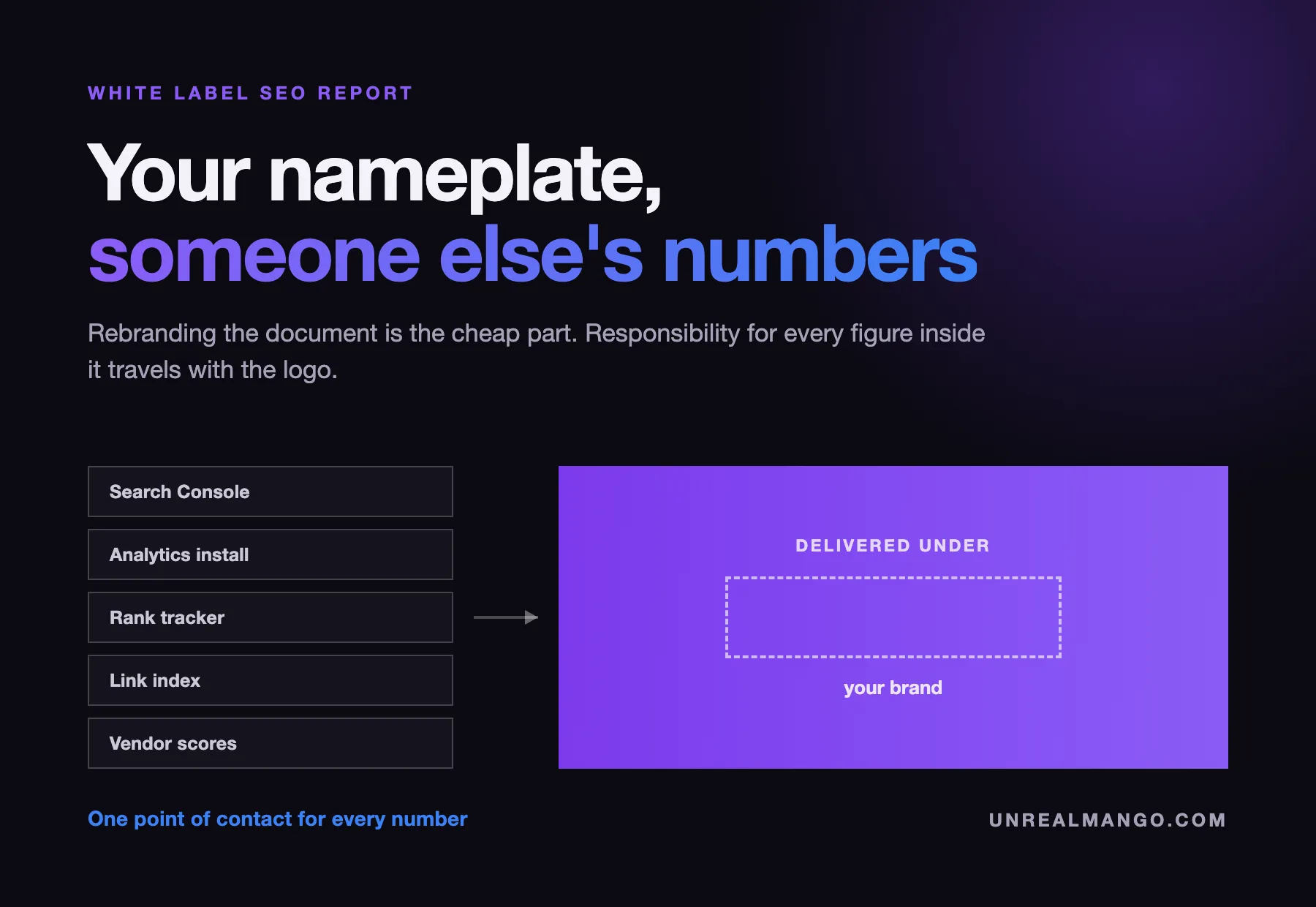
A white label SEO report is a search performance report produced by one party and delivered under another party’s brand. The vendor’s logo comes off, the agency’s goes on, and the client sees a single supplier. What travels with that logo, and what almost nobody writes down, is responsibility for every figure inside the document.
Most published advice on this topic is organised around features, because most of it is written by the companies selling the dashboards. This is organised around exposure: which numbers you can stand behind, which ones you are only passing on, and what happens on the day a figure with your name on it turns out to be wrong.
What changes hands in a white label SEO report
Three things move when a report is rebranded, and they move independently.
Presentation moves first: the cover, the colours, the sending domain, sometimes a custom subdomain for a live dashboard. This is the part every vendor advertises, and it is the part that carries almost no risk.
Measurement moves next, and quietly. The moment a figure comes from a vendor’s crawler, index or model rather than from the client’s own accounts, the definition of that figure belongs to the vendor. You are reporting their arithmetic under your name.
Judgement moves last, and this is where white-labelling stops being a design decision. When the commentary, the recommendations or the priorities in the document were written by someone else, the client is reading a third party’s professional opinion with your signature at the bottom.
An arrangement that moves only the first is a printing choice. One that moves all three has changed what you are selling, and past that point there is a fourth step where the work itself moves too.
Rebranding a report and reselling the work are separate deals
The phrase covers both, and the search results for it cheerfully mix them. The distinction is worth being pedantic about, because the exposure is not comparable.
In the first case you did the work. A platform assembled the evidence, you removed its branding, and the document describes decisions you made and can defend. The worst realistic outcome is a broken chart.
In the second case a third party did the work, and the report is the visible end of a delivery chain you do not control. Now the document is not just describing someone else’s numbers, it is describing someone else’s judgement about a client who believes they hired you. The worst realistic outcome is a strategy you would not have chosen, running for months, under your name.
Both get sold as “white label SEO”. Only one of them is really about reporting.
Where responsibility for each number sits once your logo is on it
Every figure in a search report has a producer, and the producer is almost never the agency. What the branding does is collapse that chain into a single point of contact.
| Figure in the report | Who actually produces it | What can move it with nobody touching the site | Who the client asks |
|---|---|---|---|
| Clicks and impressions from Google | Google, through Search Console | Reprocessing of recent days, changes to how Google counts a result | You |
| Sessions, engaged sessions, conversions | The client’s own analytics install | A consent banner change, a developer release, a tag that stops firing | You |
| Keyword positions | The rank tracker’s crawler | The tracker’s location and device settings, and how it decides to treat AI Overviews and result packs | You |
| Backlink counts | A third-party link index | The index’s own refresh cycle and inclusion rules | You |
| Domain strength scores | A vendor’s model | A model update the vendor ships when it suits them | You |
| Site health score out of 100 | A crawler’s scoring rubric | A rubric change in a product release | You |
| AI search visibility or share of voice | A vendor’s sampling method | The sample of prompts, the model version, and the day it was run | You |
The last column does not vary, and that is the whole point of the table. This is not a list of what belongs in a client report — what a monthly SEO report should carry, and what should be cut from it, is a separate question about composition that we treat on its own. This is a map of who has to explain each line when it looks wrong, and the answer is the same regardless of who calculated it.
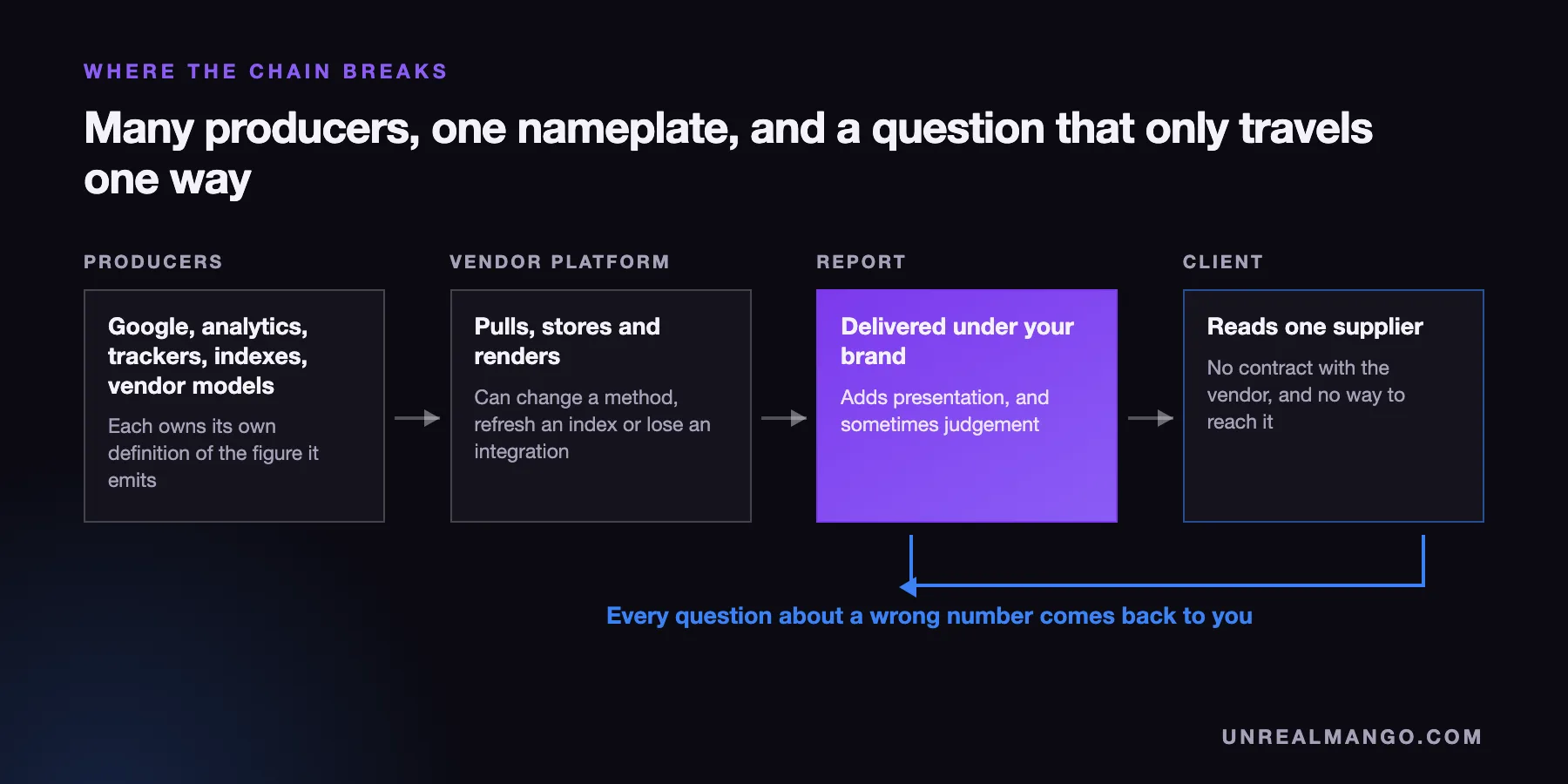
Two practical consequences follow. First, any figure whose definition lives inside a vendor’s product is a figure you cannot fully warrant, so the honest move is to name the tool next to it rather than present it as a fact of the world. Second, the numbers you can warrant most strongly are the ones from the client’s own accounts, because the client can open them without you. A report weighted towards accounts the client controls is a report you can defend on a call. That weighting is also the practical reason the SEO work we take on starts by getting the client’s own measurement into a state worth reporting from, before any document design question comes up at all.
Four levels of white-labelling, and what each one lets you promise
Vendors sell this as one product. It behaves as four: the three things that move inside the document, plus a fourth where the work itself moves. The level you are actually at decides the sentence you are allowed to say to a client.
| Level | What is white-labelled | What you can still honestly promise | What breaks first |
|---|---|---|---|
| 1. Presentation | The document and the dashboard skin | Everything: the work, the reading, the recommendation | Export limits and dashboard downtime |
| 2. Measurement | The crawler, tracker or index producing the figures | The interpretation, not the instrument | A metric definition changes and your trend line gets a step in it that has nothing to do with the site |
| 3. Analysis, which is judgement | The commentary and the recommendations | The process, and only if you read every line before it goes out | A follow-up question on a call that the commentary cannot answer |
| 4. Delivery | The strategy and the execution as well | The outcome, only as far as your contract with the vendor lets you | Priorities: your client’s odd, low-volume problem is the first thing to fall off a shared production queue |
Most agencies believe they are at level one and are operating at level two, because measurement slips across without an invoice line marking the moment. Nobody signs a document that says “we are now reporting a vendor’s definition of a link”. You simply add a widget.
The jump that deserves a decision rather than a drift is from two to three. At level three you are forwarding professional judgement, and the only defensible version of it is one where every line is reviewed by someone who could have written it. If that review is happening properly, the time saved is smaller than the sales page implies. If it is not happening, you are not reviewing recommendations, you are laundering them.
Search Console and analytics disagree by design, and you own the explanation
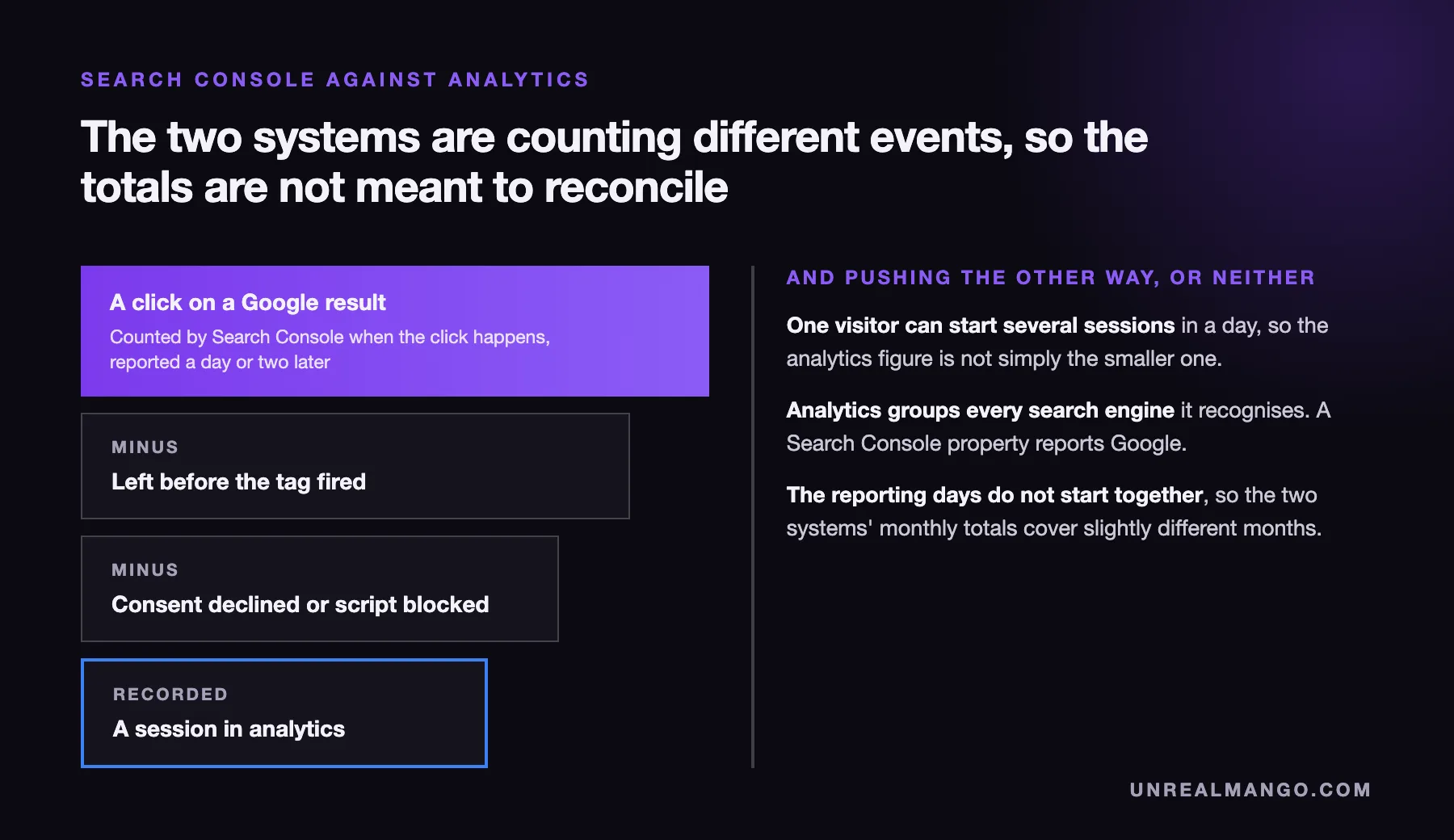
Put clicks from Search Console and organic sessions from analytics on the same page and they will not match. This is not a bug in either tool and it is not a sign that something is broken. It is what happens when two systems measure different objects, and a branded report that presents them as one agreed set of facts is setting up an argument it will have to lose later.
The gap has several independent sources, and they do not all push the same way:
- They count different events. Search Console counts a click on a search result. Analytics counts a session that a tag successfully reported. One click can produce no session at all if the visitor leaves before the tag loads, and one visitor can produce several sessions in a day.
- Consent and blocking hit only one side. A declined consent banner, a blocked script or a privacy-focused browser can remove the session while the click still happened. Search Console never sees the refusal.
- The scope of “organic” differs, in both directions. A Search Console property reports Google. The organic channel in an analytics property groups every search engine it recognises, so the analytics figure covers ground the Search Console figure does not. It runs the other way too: the performance report shows web results by default, leaving image, video and news clicks out until you change the filter, and a domain property covers subdomains an analytics property may not.
- Landing pages are recorded at different moments. Search Console records the URL that appeared in the result, and attributes performance to the canonical Google picked for that page, which is not always the address the visitor clicked. Analytics records the page that finished loading, which after a redirect is a different address again.
- The days do not start together. Search Console buckets data on its own reporting day; analytics uses the time zone configured on the property. When those differ, the two systems’ monthly totals cover slightly different months, and comparing one against the other is comparing two windows that never quite aligned.
- One side is still settling. Search Console data arrives with a lag, usually a day or two, and recent days can still be revised after they first appear, so a report pulled on the first of the month and the same report pulled a week later may not be identical.
None of that is difficult to explain. It is only difficult to explain for the first time, in front of a client, in a meeting about something else. The fix is a single standing line in the document: name which system each figure came from, and state once that the two are counted differently and are not expected to reconcile. Say it in the first report, before anyone has a reason to be suspicious of the answer.
If the losses on the analytics side are large enough to change decisions rather than merely to look untidy, the underlying collection method is the thing to fix, and the trade-offs of moving that collection onto your own infrastructure are worked through in the guide to server-side tracking. What a report cannot do is close the gap by choosing whichever number looks better that month.
When the vendor changes its method after the report is signed
This is the failure the reporting-tool market never discusses, and it is the one that damages a branded report most, because it arrives after delivery.
Vendors revise how they calculate things. Sometimes the revision is applied going forward, which puts a step in your trend line on a month when nothing happened to the site. Sometimes it is applied retroactively across history, which is worse in a specific way: the report you sent in March no longer reproduces from the same tool in June, and the client’s copy and your copy now disagree.
Integrations fail in a quieter fashion. An API on the vendor’s side is deprecated, a permission expires, an account is disconnected during a client’s own IT change, and a widget starts returning nothing. A scheduled report will send that cheerfully, with a chart of zeros and your logo on top of it.
Three habits absorb most of this, and none of them cost anything:
- Archive what you sent, not just what generated it. Keep the delivered file. If the tool rewrites history, your archive is the only record of what the client was actually told.
- Name the tool and the pull date beside any figure the tool defines. A number with its instrument attached survives a methodology change as a comparison problem. The same number presented bare becomes a credibility problem.
- Never let a report leave on a schedule without a person opening it. Automated delivery is the feature that turns a broken integration into a client-facing incident, and it is switched on by default in most platforms.
When a series does get rebased, say so in the report where it happens, in one sentence, with the old and new values side by side. Clients forgive a vendor changing its formula. They do not forgive discovering it themselves.
Disclosure: what you can leave unsaid and what you cannot deny
Using a subcontractor is ordinary commerce, and absent terms saying otherwise there is usually no obligation to volunteer a supplier list. That is the honest version of the permission most white label sales pages imply, and it has two conditions attached. Read the master agreement first: enterprise and public sector contracts frequently restrict subcontracting outright. Then read the data clause, because the paragraph below can require disclosure whatever the branding arrangement says.
Within those limits you can leave the arrangement unmentioned. You cannot state that work is done in-house when it is not, and you cannot deny a subcontractor when a client asks directly. The first is a business arrangement. The second can amount to a misrepresentation, and it is the one that tends to surface in the worst possible setting, because clients usually find out from a signature block, a shared document’s revision history or an email thread that was forwarded one step too far.
There is a second question that has nothing to do with branding and is easy to miss. If a vendor gains access to a client’s analytics data, that vendor is handling the client’s data through you. Where the client is covered by UK or EU data protection law, the usual reading is that you act as a processor and the vendor as a sub-processor — a stronger reading for an analytics property holding identifiers than for Search Console’s aggregated figures. Article 28 does not let a processor engage another processor without the controller’s prior written authorisation, either specific to that vendor or given generally in advance, and a general authorisation still obliges you to tell the client when a sub-processor is added or replaced and to give them a chance to object. That is a contract question rather than a marketing one; it belongs with whoever drafts your client agreements, not with a reseller’s sales page, and none of this is legal advice.
The practical version for a small agency is short. Put a plain sentence in the master agreement saying you may use subcontractors and that you remain responsible for their work. Then the disclosure question is settled in advance, in writing, and no answer on a call has to be improvised.
Five answers a client should be able to get about a branded report
Written from the other side of the table, because no vendor can write this section without a conflict of interest. If you are the client, these five questions establish more about a reporting relationship than any dashboard tour will.
- Which figures here come from my own accounts, and can I open them myself right now? Anything that fails this test is a vendor’s model, not a measurement of your site.
- Who produced the analysis in this document — your team, a tool, or a third party? A straight answer is a good sign whatever the answer is. Hesitation is the signal.
- If we stop working together, what do I keep? Accounts, historical data, exports, the dashboard itself. A branded dashboard that dies with the retainer is a rental, and its history is not yours.
- If a number in a past report turns out to be wrong, who tells me, and when? The useful answer describes a habit, not an intention.
- Has anything changed in how these figures are calculated since the last report? Ask it every quarter. The months where the answer is yes are the months the trend line is not comparable.
An agency that can answer all five without preparation is one where somebody reads the report before it goes out. That is a better indicator than anything on the cover.
Why reselling SEO usually costs a small agency more than it earns
The reseller’s margin is payment for carrying risk you do not control. That is a reasonable trade at scale, where the volume of accounts averages the risk out and a standardised delivery pipeline is genuinely cheaper than doing the work. It is a poor trade for a boutique, for three reasons that have nothing to do with virtue.
The first is the follow-up question. A small agency’s proposition is direct access to the people doing the work. Resold delivery survives until a client asks why a particular decision was made, at which point the answer has to be relayed rather than given, and the relay is visible. Everything the agency charges a premium for is contained in that one moment.
The second is fit. The reason a client chose a small firm is usually a problem that does not fit a template: an odd site architecture, a niche with almost no search volume, a market where the obvious keyword is somebody else’s brand. Standardised delivery is efficient precisely because it does not look for those, and a shared production queue prioritises the accounts that run smoothly.
The third is the accumulation. Every engagement you deliver yourself makes the next one faster to diagnose. Work you resell teaches you nothing, and after a couple of years of it you have a client list and no more capability than you started with.
We do not resell delivery at Unreal Mango, and the reason is the first of those three rather than any objection to the model. The follow-up question is the product. The arithmetic underneath a retainer — what an hour actually buys, and why two quotes for the same scope can differ by a multiple — is a separate discussion, and one we keep out of this piece deliberately.
The client who wants a report like the big agencies send
This request comes up often, and it is almost never a request about design. Three things are usually underneath it, and each has a better answer than a rebranded dashboard.
Sometimes the client wants comparability — proof that they are getting what a larger competitor gets. The answer is to show which figures come from their own accounts, since those are the only ones any agency of any size can produce, and a bigger logo does not improve them.
Sometimes they want something forwardable — a document their own manager can read without them in the room. That is a writing problem, solved by putting the conclusion on the first page in plain sentences, and a heavier dashboard makes it worse rather than better.
Sometimes they want reassurance, which is the honest one, and it usually means the last few conversations have been vague. No document fixes that. A short call where somebody explains what moved and what they intend to do about it fixes it, and it takes less time than redesigning the report.
The nameplate on the cover is the cheapest part of a white label SEO report and the only part every vendor sells. Everything that makes the document worth sending — the provenance of each figure, the note when a definition changed, the person who can answer the next question without asking anyone — has to be supplied by the agency whose name is on it.
11 / Reader questions
Frequently asked questions
01What is a white label SEO report?
A white label SEO report is a search performance report produced by one party and delivered under another party's brand. A vendor's platform pulls the data and renders the document, the vendor's logo is removed, the agency's is applied, and the client receives it as the agency's own work.
02What does white label SEO mean?
White label SEO means one company performs search work that another company sells under its own name. It covers a range: at one end only the reporting is rebranded, at the other the strategy, the execution and the reporting are all done by a third party while the client sees a single supplier.
03Do you have to tell clients you use a white label provider?
Not usually as a matter of course, unless your contract says otherwise — and where the provider will touch the client's analytics data, data protection terms normally require the client's authorisation anyway. What you cannot do is deny it when asked, or claim in-house capability you do not have. Silence about a subcontractor is an ordinary business arrangement; a direct denial is the version that ends relationships.
04Who is responsible if a number in a white label report is wrong?
You are, as far as the client is concerned. In most arrangements the client has no contract with the vendor and no way to reach it, so the vendor's error arrives as your error. Your recourse against the vendor is a separate matter that the client neither sees nor cares about.
05What is the difference between a white label SEO report and a white label SEO service?
A report is presentation: the numbers describe work you did, and only the document is rebranded. A service is delivery: the work itself is done by someone else. They are sold under the same phrase and carry very different exposure, because in the second case you are promising an outcome you do not control.
06Is there a free white label SEO report template worth using?
Free templates solve the layout problem, which is the smallest problem. What a template cannot supply is the discipline around it: archiving the file you actually sent, naming the tool and the pull date beside every figure the tool defines, and having a person open each report before it goes out. A blank template with those three habits beats a polished one without them.
07Should a small agency resell white label SEO?
Rarely, if the thing it sells is direct access to experienced people. Resold delivery holds up until the client asks a follow-up question on a call, at which point the answer has to be relayed rather than given. For an agency whose entire proposition is that relay does not happen, that moment is expensive.