Published
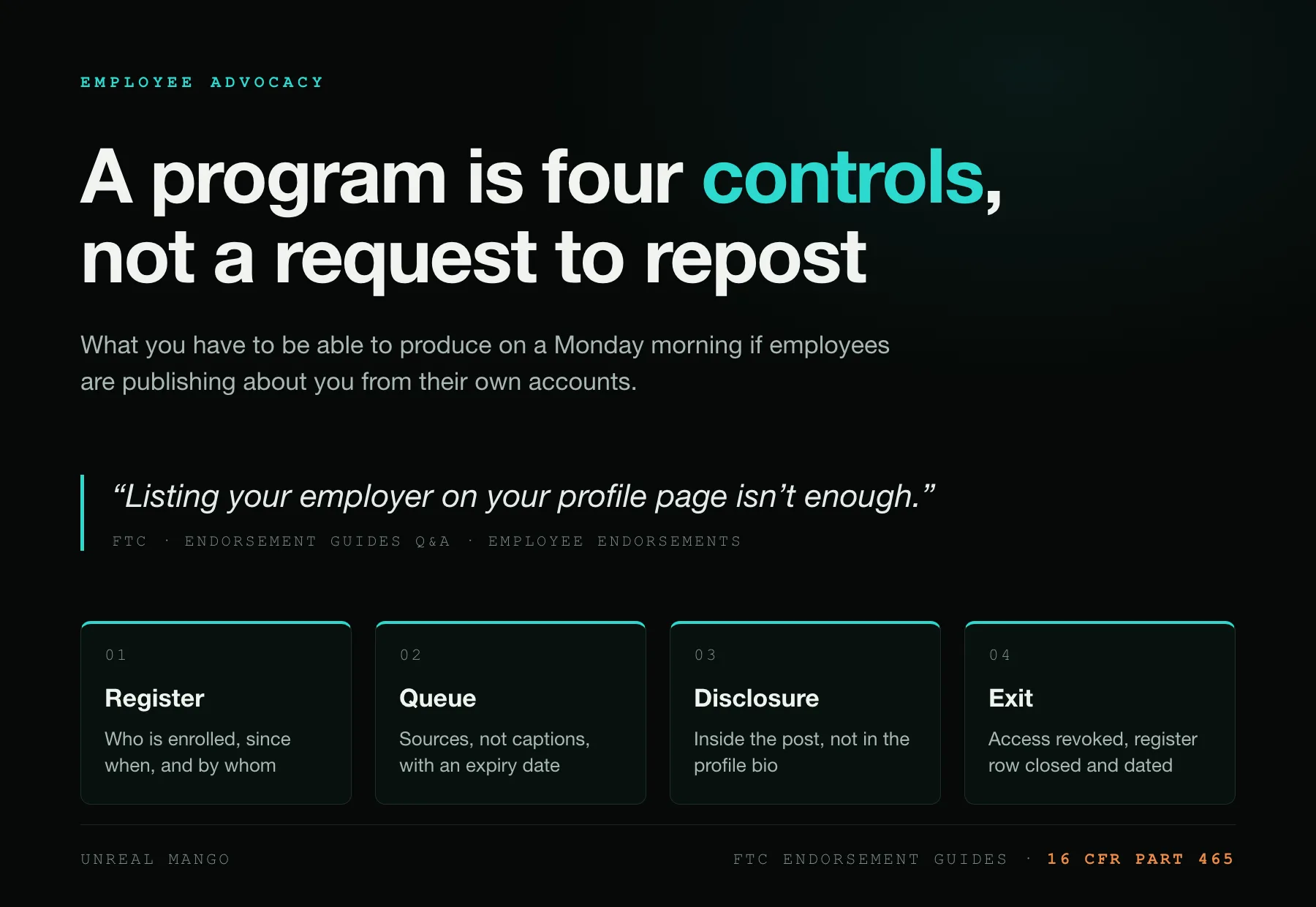
Employee advocacy is a program in which named employees publish about their employer from their own accounts, under rules the company can show. Four controls turn it from a request into a program: a register of who takes part, a supplied content queue, a disclosure standard, and a defined exit.
How this was checked. The United States search results for this term on 30 August 2026 returned eight organic pages: seven belong to companies selling employee advocacy platforms, the eighth to a commercial HR training site. Google’s AI Overview sat above them with nine references across eight domains — seven commercial, one an online course catalogue — and not an independent publisher among them. So the definitions below are not the contested part; the operational and legal ones are. Every regulatory sentence quoted here comes from the current text on ftc.gov and eCFR, read in full rather than summarised, and the widely repeated reach multiples are followed to the end of their citation trail rather than passed on.
What separates an advocacy program from a request to repost
Most of what is published under this heading describes an outcome, not a mechanism. The mechanism is four artifacts. If you cannot produce all four on a Monday morning, you have a habit rather than a program, and the difference matters the first time somebody outside the company asks a question about a post.
| Control | The request version | The program version | Artifact it produces |
|---|---|---|---|
| Who takes part | Whoever saw the message | Named, dated, opt-in | A register with entry and exit dates |
| Where content comes from | A link dropped in a channel | A queue with sources and expiry | A weekly queue with a named owner |
| How the relationship is stated | Assumed from the profile | Written standard, inside the post | A one-line disclosure rule |
| What happens on exit | Nothing | Access revoked, row closed | An exit date and the name who closed it |
A program of employee posts is not a substitute for the company’s own channel. The editorial calendar of the company page, its cadence and its analytics are a separate discipline with separate metrics, and mixing the two is how both end up unmeasured. This page is only about what individual people publish from their own accounts.
The author register: who is in the program, since when, and who removes them
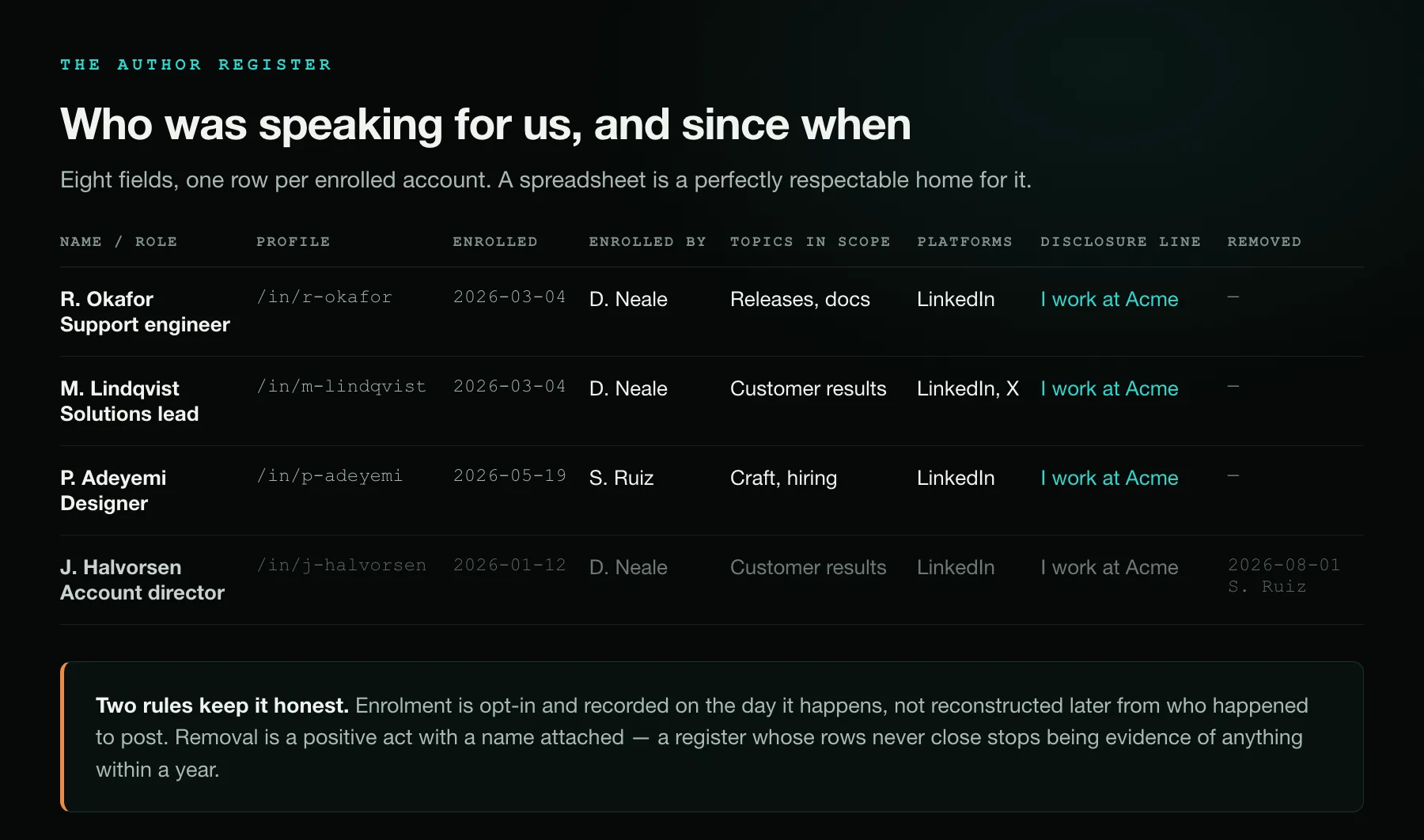
The register is the artifact almost nobody builds, and the only one that answers the question that actually gets asked: who was speaking for us in March, and on whose authority.
Eight fields are enough, and a spreadsheet is a perfectly respectable home for them.
| Field | Why it is there |
|---|---|
| Name and role | Identifies the person and the credibility they carry |
| Personal profile URL | The account being enrolled, not the person’s email |
| Date enrolled | The start of the period you are answerable for |
| Enrolled by | A named person, not a department |
| Topics in scope | What they were asked to talk about |
| Platforms in scope | Enrolment on one network is not enrolment on all |
| Disclosure wording agreed | The exact line they will use |
| Date removed and by whom | Closes the period cleanly |
Two rules keep it honest. Enrolment is opt-in and recorded on the day it happens, not reconstructed later from who happened to post. And removal is a positive act with a name attached, because a register whose rows never close stops being evidence of anything within a year.
Content supply: what reaches an advocate’s queue in a normal week
The failure mode of every program that dies in month three is the same: enthusiasm at launch, nothing in the queue by week six. Supply is an operational commitment, not a campaign.
A workable week is two to four items. Each item carries four things, and the fourth is the one that gets skipped:
- A source, not a caption. A release note, a customer result, a published figure, a photograph from a site visit. Something the participant can read and form an opinion about.
- One line on why it matters to this person’s network. A support engineer and a sales lead need different reasons to care about the same release.
- An expiry date. Items that sit in a queue past their relevance are why participants stop opening it.
- An explicit instruction to write it themselves. Supplied copy published verbatim across forty profiles is not forty endorsements; it is one company communication distributed forty times, and it reads that way to anyone scrolling.
That last point has a legal edge as well as an editorial one, and the next three sections are about it. Where the queue delivers finished text and the participant only presses publish, the company’s authorship is difficult to argue away.
One boundary worth naming: this is supply, not approval. Whether a post needs sign-off before it goes out, who holds that switch, and what auto-approval changes are questions about permission rather than content, and they are worked through in the guide to LinkedIn thought leader ads, where the same people and the same posts show up on the paid side.
The employee disclosure the FTC spells out, and why a profile does not count
This is the section missing from every page currently ranking for this term, and it is not an edge case. The Federal Trade Commission publishes a question-and-answer page on its Endorsement Guides with a section headed employee endorsements, and it is unusually direct.
Asked whether an employee can mention their company’s products to their own social networks, the FTC answers that if the employer allows it, “you should disclose your relationship to the company.” Then it closes the loophole most people reach for next:
Listing your employer on your profile page isn’t enough. After all, people who just read what you post won’t get that information.
The same page extends this to resharing. Where several employees shared a company post on their own initiative, without being asked, the FTC’s answer is that whether disclosure is needed depends on whether the shares could be viewed as promoting the company’s products or services, and if so, “employees endorsing the post should disclose their relationship to the company.” It even supplies the wording: something as light as noting that it is your company’s product does the job.
The placement standard is the same in both instruments; what changes is whether it binds. 16 CFR 255.0(f), the codified definition inside the Endorsement Guides themselves, says that in an interactive electronic medium “the disclosure should be unavoidable,” and Example 9 there already spells out both failures this section is about: a disclosure that lives only on the profile page, and one that appears only after a reader clicks more. 16 CFR 465.1(c)(4) takes the identical sentence, changes should to must, and moves the click-or-hover test out of an example and into the definition — a disclosure “is not clear and conspicuous if a consumer must take any action, such as clicking on a hyperlink or hovering over an icon, to see it.”
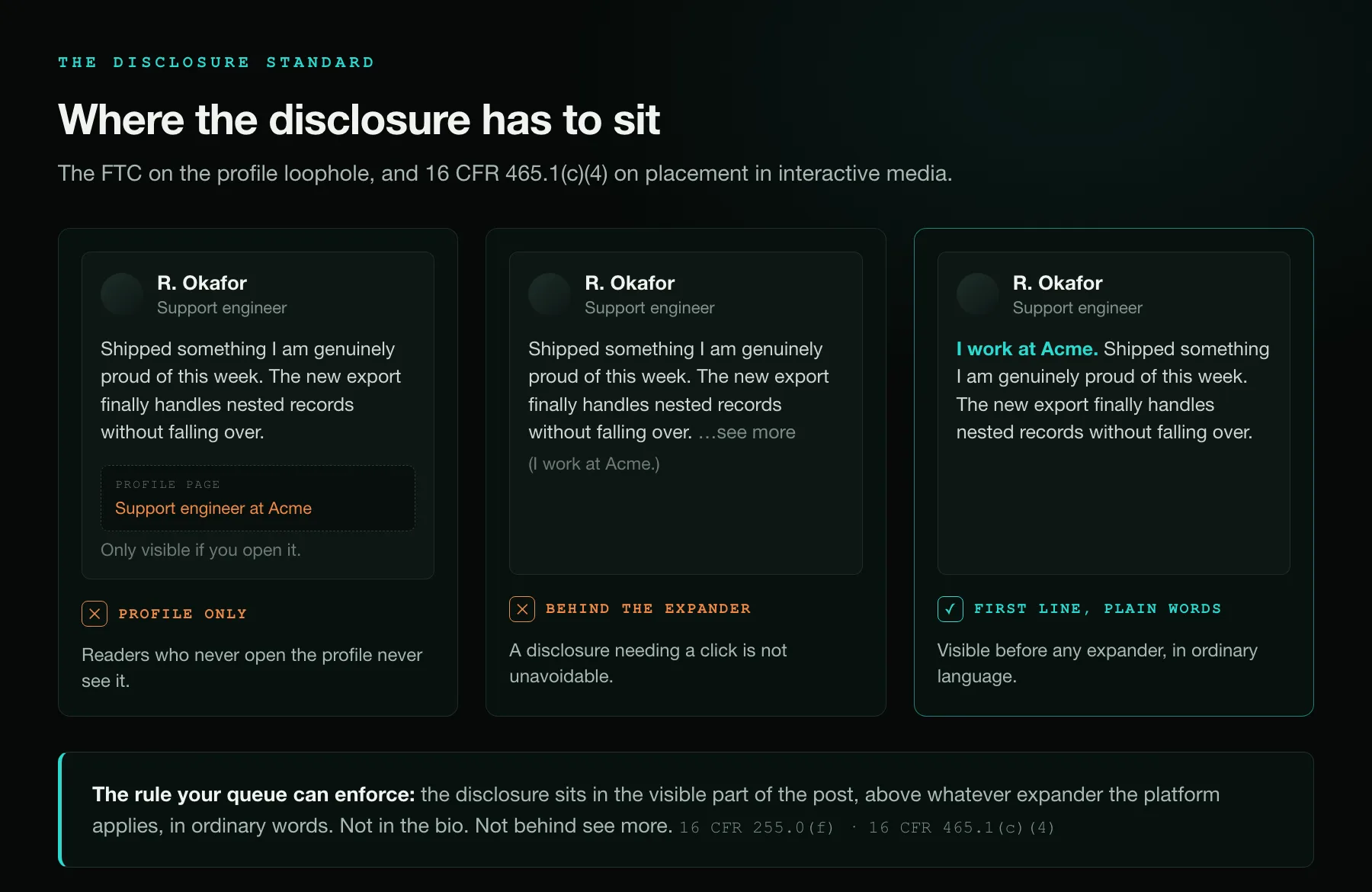
Read together, those two produce one operational rule your register can record and your queue can enforce: the disclosure sits in the visible part of the post, above the fold of whatever expander the platform applies, in ordinary words. Not in the bio. Not behind see more. On hashtags we go further than the FTC does: the Commission allows that a hashtag “can be a clear and conspicuous disclosure” and treats “#XYZ_Employee” as something readers would understand, while adding that it would be “much clearer to use the words ‘my company’s’ or ‘my employer’s’ in the body of the message.” We take the words and drop the hashtag, so that a single form is enforceable across a whole register.
The monitoring line: why encouraging posts moves the duty onto the company
Here is the passage that should change how an advocacy program is designed, and which not one of those eight vendor pages quotes. The FTC is asked whether a company is liable when an employee posts an undisclosed review despite a policy forbidding it. The answer begins reassuringly:
It wouldn’t be reasonable to expect you to monitor every social media posting by all of your employees. However, you should establish a formal program to remind employees periodically of your policy.
That first half is the sentence every social media policy leans on. The second half is already an expectation you will have to answer for: a formal program, and periodic reminders, not a clause signed once at onboarding. The FTC then goes further, saying that if you learn about undisclosed employee reviews you should remind the employees of the policy and ask them to remove the reviews or add an adequate disclosure. And then the line that matters most:
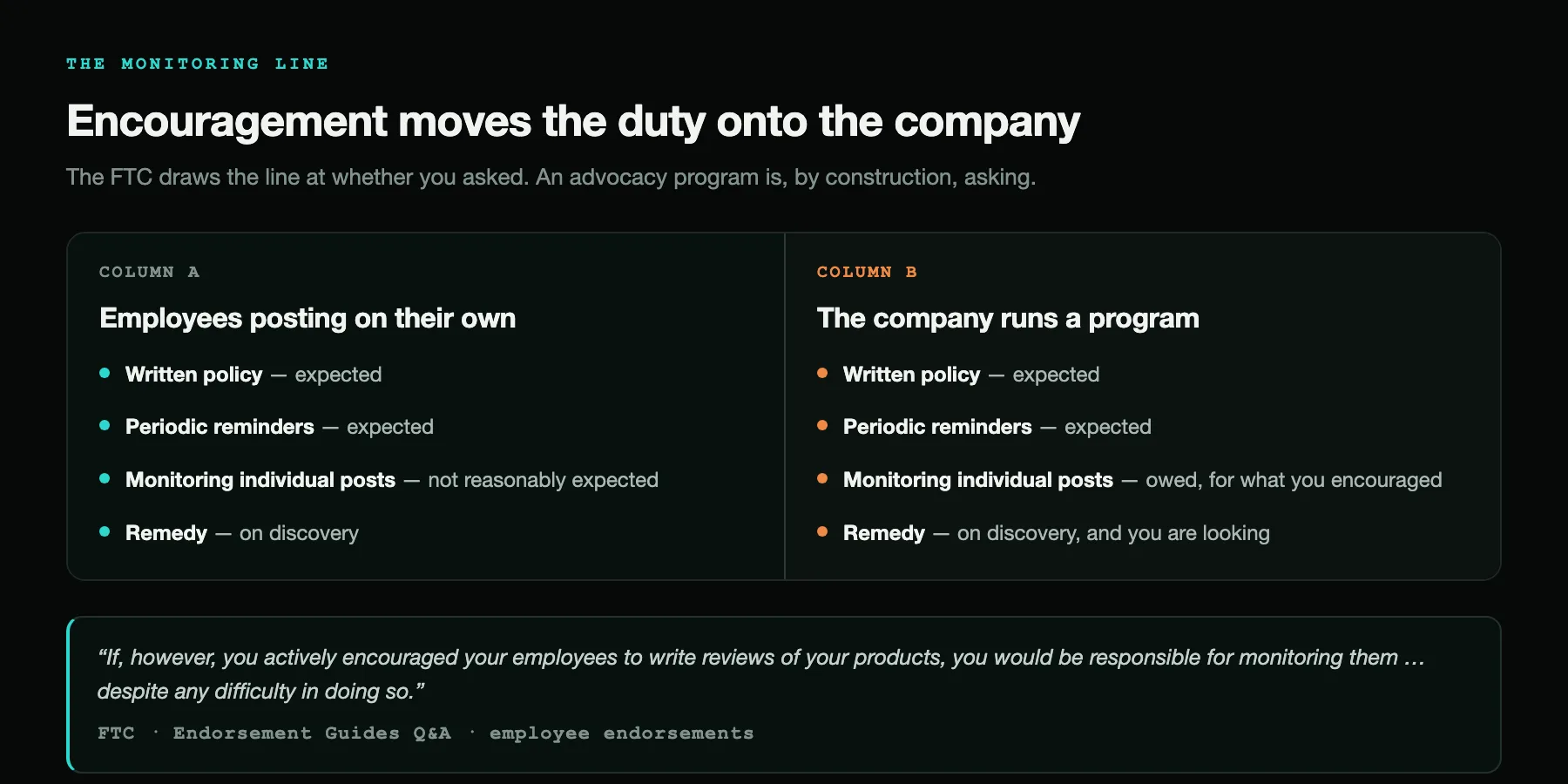
If, however, you actively encouraged your employees to write reviews of your products, you would be responsible for monitoring them (both in terms of disclosing that they are employees and for problematic claims) despite any difficulty in doing so.
An employee advocacy program is, by construction, active encouragement. That is its entire purpose. The scope of the FTC’s sentence is reviews of your products specifically, so a program whose queue is culture posts, hiring news and conference photographs is not obviously inside it. But the moment the queue asks people to talk about the product, the company has moved from the column where monitoring is unreasonable to the column where it is owed.
| Employees posting on their own | Company runs a program | |
|---|---|---|
| Written policy | Expected | Expected |
| Periodic reminders | Expected | Expected |
| Monitoring individual posts | Not reasonably expected | Owed, for what you encouraged |
| Remedying what you find | On discovery | On discovery, and you are looking |
Which is an argument for scoping the queue deliberately rather than for abandoning it. A program that knows which of its items are product claims can monitor that subset and leave the rest alone.
Insider testimonials: the clause that makes a written instruction mandatory
The Endorsement Guides are guidance. The Rule on the Use of Consumer Reviews and Testimonials, 16 CFR Part 465, in force since 21 October 2024, is a trade regulation rule, and section 465.5 is titled insider consumer reviews and consumer testimonials. Two of its paragraphs point straight at an advocacy program.
Paragraph (b)(1) makes it a violation for a business to disseminate, or cause the dissemination of, a consumer testimonial about itself or its products by one of its officers, managers, employees or agents where the testimonialist’s material relationship is not disclosed clearly and conspicuously, the relationship is not otherwise clear to the audience, and the business knew or should have known about the relationship. A company that pushes an item into a queue and watches employees publish it knows exactly who they are.
That paragraph does leave one exit the Endorsement Guides do not: it bites only where the relationship is “not otherwise clear to the audience,” so a relationship the audience can already see is outside it, and the Commission illustrates the point with a testimonialist filmed in the company’s own offices or wearing its uniform. It is not something a program can lean on, because it is judged after the fact and against a particular audience rather than in advance and across a register. Operationally the disclosure still goes in the post.
Paragraph (c)(1) is narrower than it first looks, and its scope deserves the same statement the previous section gave the FTC’s. It is built on the rule’s own definition of a consumer review: an evaluation “published to a website or platform dedicated in whole or in part to receiving and displaying such evaluations.” A post on a personal LinkedIn feed is not that; under this rule it is a testimonial, which is why (b)(1) reaches an ordinary advocacy queue and (c)(1) does not. Paragraph (c)(1) switches on when the queue starts asking people to write on G2, Google, Trustpilot or the review section of your own site.
When it does switch on, it engages only after a solicitation has actually produced an insider review carrying no disclosure. At that point three sub-clauses describe how the liability attaches to the officer or manager who asked, and the second is the one to read twice: they “did not instruct that prospective reviewers disclose clearly and conspicuously their relationship to the business.”
So the absence of an instruction is one of three routes in, not a violation standing on its own. It still turns a piece of nice-to-have documentation into a control for any queue that touches a review platform: the instruction has to exist, be written, be dated, and be repeated on a schedule you can show. There are carve-outs — the rule’s own generalized solicitations to purchasers, asking them to post about their experiences, sit outside both paragraphs — but “we assumed everyone knew” is not among them.
A Part 465 violation is a rule violation, which means civil penalties are available under Section 5(m)(1)(A) of the FTC Act where the violator acted with actual knowledge, or with knowledge fairly implied on the basis of objective circumstances, that the act is unfair or deceptive and is prohibited by that rule. The statutory ceiling is inflation-adjusted in 16 CFR 1.98, which on 30 August 2026 still showed $53,088 per violation, the figure set in January 2025. How the guidance route and the rule route differ in what they can actually cost, and which disclosure wording the Commission has accepted in practice, is worked through in the influencer contract template; the law is the same, applied to a creator you pay rather than a colleague you employ. None of this is legal advice, and a program that touches regulated claims should be read by someone who does that for a living.
Offboarding an advocate: what happens to the posts after they leave
Short section, because the answer is short and the detailed version belongs elsewhere.
The posts stay up. They were published from a personal account, in the person’s own words, and the company never owned them; there is no mechanism by which employment ending retracts them, and asking for deletion of an accurate historical post is usually a worse look than leaving it. What ends is access: the queue, the shared drive, the internal channel where items are discussed.
The register row closes on the same trigger that revokes the email account, with an exit date and the name of whoever closed it, because a leaver still sitting in an open register is precisely the gap that makes the register worthless as evidence. Anything still running as paid media on that person’s post is a separate and more urgent problem with its own checklist, and that is the offboarding case handled in the thought leader ads guide linked above.
Measuring employee advocacy by active share of the register, not reach
Reach is what platforms report and what vendor dashboards are built to display, which is exactly why it is the wrong headline metric: it goes up when one person’s post happens to travel, and it says nothing about whether the program still exists.
Three numbers describe a living program.
Active share of the register. Participants who published at least once in the period, divided by participants enrolled at the end of it. A register of 60 with 41 people publishing at least once in the quarter gives an active share of 68 percent. The number to watch is the direction across quarters, not the level; a program that goes from 68 percent to 40 percent has a supply problem that no reach chart will surface.
Median posts per active participant. Median rather than mean, because one prolific participant pulls a mean upward while the long tail of one-post participants sits under it.
Disclosure rate. Take a sample of posts from the period and count how many carry a disclosure in the visible part of the post. This is the only one of the three that is a compliance metric, and it is the one that makes the monitoring duty in the previous sections answerable rather than theoretical.
None of the three requires a platform. A spreadsheet, the register, and an hour a quarter will produce all of them, which is worth knowing before a per-seat contract is signed on the argument that measurement demands software.
Where the employee advocacy reach claims come from, and where the trail ends
Every page on this subject asserts that employee-shared content reaches further and is trusted more than the same content from the brand account. Google’s AI Overview asserts it too, in the form that branded messages gain significantly more reach and engagement when shared by employees. The claim is plausible. The sourcing is not what it appears to be.
Follow the citations and they do go somewhere. The 561 percent, or “over 5x”, reach figure is attributed to MSLGroup; an 8x engagement figure to MSL Group; a 7x lead-conversion figure to an IBM study; the 10x network figure to LinkedIn. Two of those trails are even clickable, so click them. The “over 5x further” link goes to a two-page PDF hosted on a car-dealership marketing site, whose own line reads “Brand messages reached 561% further when shared by employees vs the same messages shared via official brand social channels (Source: MSLGroup)” — a bullet with a name in brackets, no publication, no year, no sample, no method. The “10x larger” link goes to a LinkedIn Elevate ebook that states the figure flatly while sourcing its neighbours, Edelman for a trust multiple and IDC for a survey percentage, and sourcing the 10x to nothing. The trail does not end at a product page; it ends one hop later, in a document that names a research house but never the research.
LinkedIn’s own explainer, one of the pages the AI Overview cites, does publish a figure, and it is the origin of the 10x everyone repeats — but it is a multiplier of network size, not of reach: employees “collectively have social networks ten times larger than a corporate brand does.” The page attributes that to “our research” and links nothing; the nearest link goes to the Elevate product page. The same passage adds that employee shares have “double the click-through-rate of corporate shares,” also unsourced. LinkedIn’s own PDF then restates the figure as “your employees have a network that is 10 times larger than your company’s follower base” — dropping the word collectively, which is the whole difference between all your staff added together and any one of them.
So the honest position is not that the numbers do not exist. It is that none of them arrives with a method: no sample, no period, no definition of reach, no way for you to reproduce it. Any specific multiplier you find should be read as a figure whose method was never published rather than as a property of the channel.
The usable substitute is your own baseline, and it takes one week to build: publish an asset from the company account, have the register publish about the same asset in the same week, and compare the two totals. Be clear about what that number is and is not. Reach is still the wrong measure of whether the program is alive, which is what active share is for; it is the right measure for a one-off, local answer to what the register added on one specific asset, which is the question a budget conversation actually asks. That number is small, local, and true, which makes it a far better basis for that conversation than a multiple whose method was never published.
Getting the register, the queue and the disclosure standard running is a few days of work and then a standing commitment; the standing part is where most programs quietly fail. If you would rather that commitment sat with a team that already owns the calendar, the queue and the reporting, that is what our social media marketing engagement is built to carry.
10 / Reader questions
Frequently asked questions
01What is an employee advocacy program?
An employee advocacy program is a named set of employees who publish about their employer from their own social accounts under written rules the company can produce on request. The rules cover who is enrolled, where their content comes from, how they disclose the employment relationship, and what happens when they leave.
02What is an example of employee advocacy?
A support engineer posts about a release her team shipped, on her own LinkedIn profile, in her own words, with a line saying she works there. The company supplied the release note and the suggested angle; she wrote the post. That combination of a supplied source, a personal account and a visible disclosure is the whole pattern.
03Does an employee have to disclose that they work for the company?
Where the post promotes the employer or its products, yes. The FTC's endorsement Q&A tells employees to disclose their relationship to the company, and states plainly that listing the employer on a profile page is not enough, because people who only read the post never see the profile. The disclosure belongs in the post itself.
04Do the FTC rules apply to social posts, or only to reviews?
Both, through different instruments. The Endorsement Guides address employee endorsements on social media as guidance. The Rule on the Use of Consumer Reviews and Testimonials, 16 CFR Part 465, is an enforceable trade regulation rule and reaches reviews and testimonials by insiders, including employees and their relatives. An advocacy queue can produce either.
05What are the best practices for an employee advocacy program?
Keep participation voluntary and recorded, supply source material rather than finished copy, require the participant to write the post themselves, mandate a disclosure inside the post, and revoke queue access on the same trigger that revokes email. Everything else is a tooling preference; those five are what an auditor would ask you to show.
06How do you measure employee advocacy?
Measure active share of the register: participants who published at least once in the period, divided by participants enrolled at the end of it. Add the median posts per active participant and the share of sampled posts carrying a disclosure. Total reach is a platform metric and tells you nothing about whether the program is alive.