
Published
Choose a digital marketing agency on five checks: a scope written down before you shop, case studies that name a baseline, who owns the ad accounts and analytics when you leave, how conversions are counted and reported, and the notice period. Everything else on a pitch call is presentation, not evidence.
Where the material below comes from. The competitive picture is a snapshot of the United States organic results for how to choose a digital marketing agency, taken on 11 August 2026: seven pages, most of them agency blogs, wrapped in an AI Overview, a video pack, a People Also Ask block and a discussions block. Platform behaviour is taken from vendor documentation, which is dated and named at the point where each figure appears. Everything else is our own scoping and reporting practice as an owner-run studio, and it is labelled as such rather than presented as market data.
Every ranking page we read tells you to define your goals, review case studies and look for transparent communication. Not one of them tells you what a transparent answer actually sounds like, which platform settings decide whether a report can be trusted, or who owns the accounts when the relationship ends. That is the gap this page fills, and we are on the selling side of it, which is exactly why we know where the seams are.
Five checks that decide the outcome before you sign
The decision is made in five places, and four of them sit outside the pitch deck. Run these in order, because each one is cheaper to fix than the one after it.
| # | Check | What it actually tests | Where it fails in practice |
|---|---|---|---|
| 1 | A scope written by you first | That both sides are describing the same job | “Full-service digital marketing” with no deliverable list, so the quotes are not comparable |
| 2 | A baseline inside every case study | That the claimed result is falsifiable | Percentages with no starting number and no dates |
| 3 | Ownership of accounts and assets | That you can leave with your data and your history | Ad accounts, analytics and tag containers created inside the agency’s own structure |
| 4 | A stated method for counting conversions | That the monthly number can be reconciled with yours | A conversion count with no platform and no attribution window attached |
| 5 | Exit terms | That leaving costs you weeks rather than quarters | Automatic renewal with a long notice period, agreed to unread |
Checks one and two decide whether you pick a competent partner. Checks three, four and five decide how much it costs you if you pick the wrong one, which is the part almost no buying guide covers. Treat them as insurance you buy before the incident, not after.
What to ask on the first call, and what a passing answer sounds like
Question lists are easy to find. Answer keys are not, and the answer is where the information is. A good answer to any of these contains a number, a name or a date. A weak answer contains an adjective.
| Ask this | A passing answer | A failing answer |
|---|---|---|
| Who does the day-to-day work, and how many other accounts does that person carry? | Names the person and gives a number, typically four to eight accounts | “You’ll have a dedicated team” |
| What happens in the first thirty days? | An audit, a measurement fix and a named diagnostic before any spend | “We’d get campaigns live and start optimising” |
| What result in six months would make you call this a failure? | A number and a date, offered without prompting | “We prefer not to frame it that way” |
| Which of your case studies is closest to us, and what did not work in it? | Names one and describes a dead end they abandoned | Every project went well |
| Whose accounts will the ads and analytics live in? | Yours, with the agency added to them and holding admin access, not the reverse | “We set it up on our side, it’s simpler” |
| How do you count a lead? | A definition with exclusions and a deduplication rule | “Conversions as reported by the platform” |
| What do you need from us, and what happens if we are slow? | A list, a cadence and a stated consequence | “We handle everything” |
| What is the notice period? | The number of days, from memory | “Let’s not worry about the exit yet” |
Two of those deserve emphasis. The account question is the only one on the list whose answer is expensive to reverse, and the utilisation question is the only one that predicts response time for the next twelve months. A specialist carrying fifteen accounts is not dishonest, but they cannot also be reachable within a day, and the pitch will not say so.
One more, worth asking of any search-focused engagement: which of your recommendations need developer time? Ask for the technical SEO audit checklist items they expect to hit first. A search proposal with no engineering dependency in it has either not looked at the site or is planning to work only on the parts that require no permission.
How to read an agency case study without taking its word for it
A case study is a claim, and claims have a structure that makes them checkable. Five tests, in the order that eliminates fastest.
- Is there a baseline period, stated in dates? “Before” without a date range is not a baseline. Seasonality alone can move a quarter by enough to swallow the effect you are trying to measure.
- Are absolute numbers shown next to the percentages? A jump of 300% is a different fact depending on whether it runs from 8 qualified leads a month to 32, or from 800 to 3,200. The first is a start; the second is a company changing shape.
- Was the channel isolated? Ask what else was running. A paid social case study that overlaps a PR push, a price change or a product launch is measuring the quarter, not the work.
- Is the timeframe the whole engagement or the best window inside it? Twelve months of work reported as “the strongest quarter” is selection, and it is invisible unless you ask.
- Can anyone confirm it? A named client, a reference call, or nothing. Anonymised case studies are legitimate under a confidentiality agreement, but then the agency should be able to arrange the call instead.
Here is the same claim written both ways. Unverifiable: “We grew organic traffic by 300% and quadrupled inbound leads.” Verifiable: “Between January and June, organic sessions went from 2,100 to 8,400 a month and qualified inbound leads from 8 to 32. No paid search ran in either period; a pricing page rebuild launched in March and is part of the result.” The second version invites you to argue with it. That is the point of it.
The second version also carries its own qualifier about the pricing page, which is the honest way to present a result you did not produce alone. Ask for that qualifier. If the agency cannot name a single confounder in six months of work, it either did not look or is not telling you.
Who owns the ad accounts, the analytics and the creative when you leave
This is the check that costs the most to skip and takes the least time to make. The rule is one sentence: every account should be created by you and shared with the agency, never created by the agency and shared with you. What makes it worth a section is that the platforms differ in how hard the second arrangement is to undo, and none of the ranking guides says so.
Google Ads. A manager account, still widely called an MCC, links to your account rather than absorbing it. Google’s manager account documentation states that “users with administrative access to those accounts can terminate the relationship with the manager account at any time by unlinking their account from the manager account.” The condition hiding in that sentence is administrative access on the ads account itself. If the agency created the account and holds the only admin seat, there is nothing on your side to unlink from, and recovering it becomes a support request rather than a click.
Google Analytics 4. A property lives inside an Analytics account, and moving one between accounts is not a unilateral act. Google’s documentation for moving a property requires Administrator and Editor roles on both the source and the destination account, and the move is blocked when the two accounts sit in different Google Marketing Platform organisations; a destination account also caps at fifty properties by default. In plain terms: if your historical data was collected into an agency’s Analytics account, getting it out requires their cooperation on the day you least want to need it.
Meta. Assets — the page, the ad account, the dataset formerly called the pixel — belong to one Business Manager. An agency can be added as a partner on assets you own, or it can create those assets inside its own Business Manager and grant you access. Only the first arrangement survives the end of the relationship intact. This is structural rather than a quoted policy, and it is checkable in ten seconds inside your own Business settings.
Search Console and tag containers. Two quiet ones. If your Search Console property was verified by a DNS record or a tag the agency controls, verification can lapse when their access is removed. If your site’s tags run through a Google Tag Manager container owned by the agency, every measurement on the site depends on an account you cannot administer.
| Asset | Who should own it | How to check today | What it costs to fix later |
|---|---|---|---|
| Google Ads account | You, with the agency linked in via its manager account and holding admin access, not the reverse | Account access page: is your email an admin? | Support escalation, campaign history at risk |
| GA4 property | You, in your own Analytics account | Admin, then Account access management | A property move needing both parties’ cooperation |
| Meta ad account, page, dataset | You, agency added as partner | Business settings, Partners tab | Rebuilding audiences and losing learning history |
| Google Tag Manager container | You | Container Admin, User Management | Republishing every tag on the site |
| Search Console property | You, verified by a method you control | Settings, Ownership verification | Losing historical search data access |
| Creative source files | You, assigned on payment | The contract, not the invoice | Re-creating artwork from exported files |
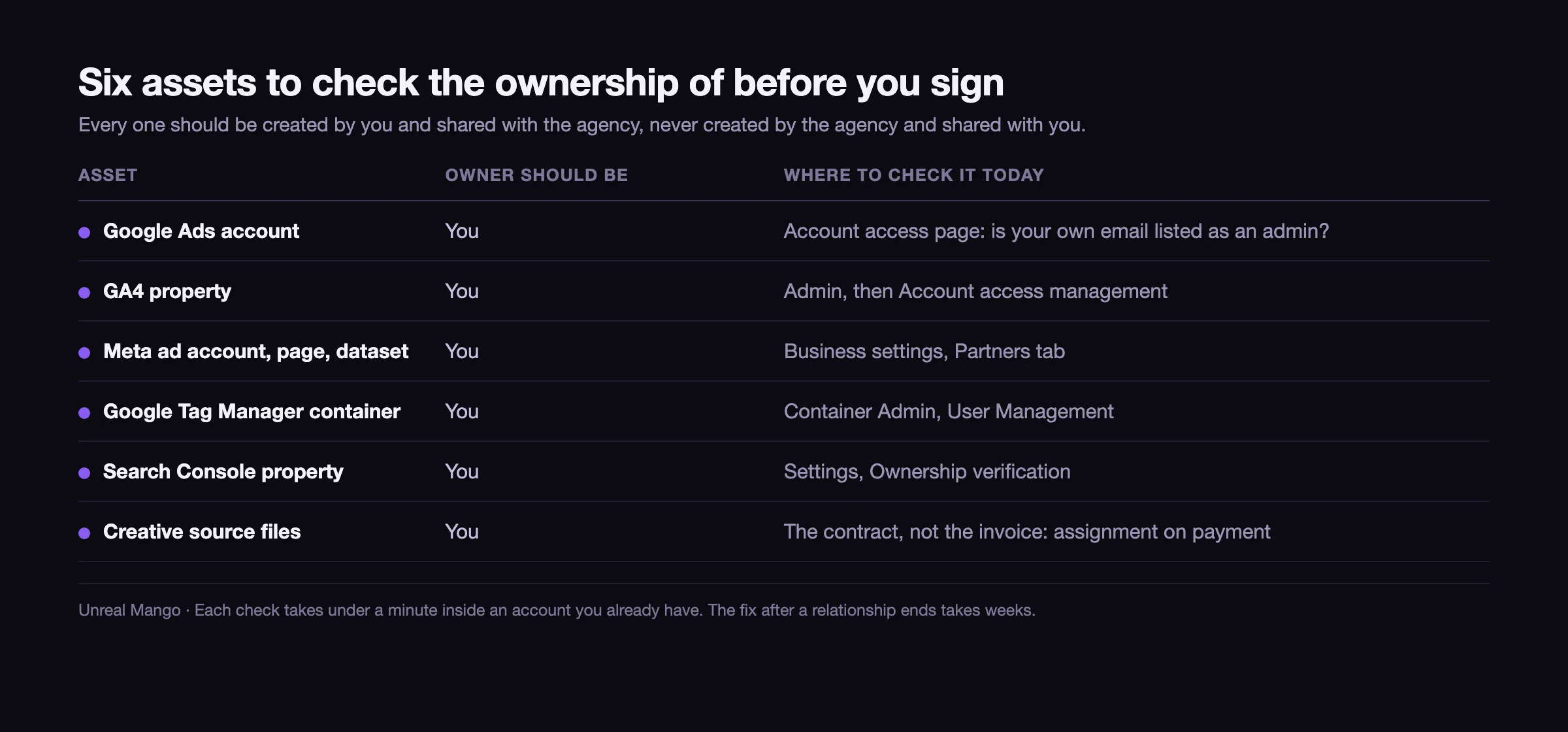
Creative deserves its own line because the failure is different. Exported files are usually handed over without argument; layered design files, project files and raw footage are often not, and without them the next supplier rebuilds rather than edits. Assignment of the finished work on payment, including source files, is a normal clause, and an agency that resists it is telling you something about how it plans to keep you.
Reporting red flags that survive a polished dashboard
Most reporting complaints are described as a transparency problem. Usually they are a definitions problem, and definitions can be agreed in advance.
The attribution window is the single biggest one. Each platform counts a conversion only if the touchpoint it can see falls inside a window it sets by default, and the defaults do not match. A conversion count reported without naming both the platform and the window is not a measurement.
| Platform | Default click window | Default view or engagement window | Adjustable to |
|---|---|---|---|
| Google Ads conversions | 30 days | 1 day view-through | 1 to 90 days for clicks, depending on the conversion source |
| GA4 key events | 90 days for most key events, 30 days for first_open and first_visit | 3 days for engaged-view key events | 30 or 60 days for most, 7 days for acquisition |
| Meta ads | 7 days | 1 day engage-through and 1 day view-through | Set per ad set; the 28-day click window is no longer available for optimisation |
Google Ads and GA4 rows from Google’s own conversion window and key event lookback documentation. Meta row reflects the defaults for a website conversion ad set after the March 2026 change, which narrowed click-through to clicks on ad links.
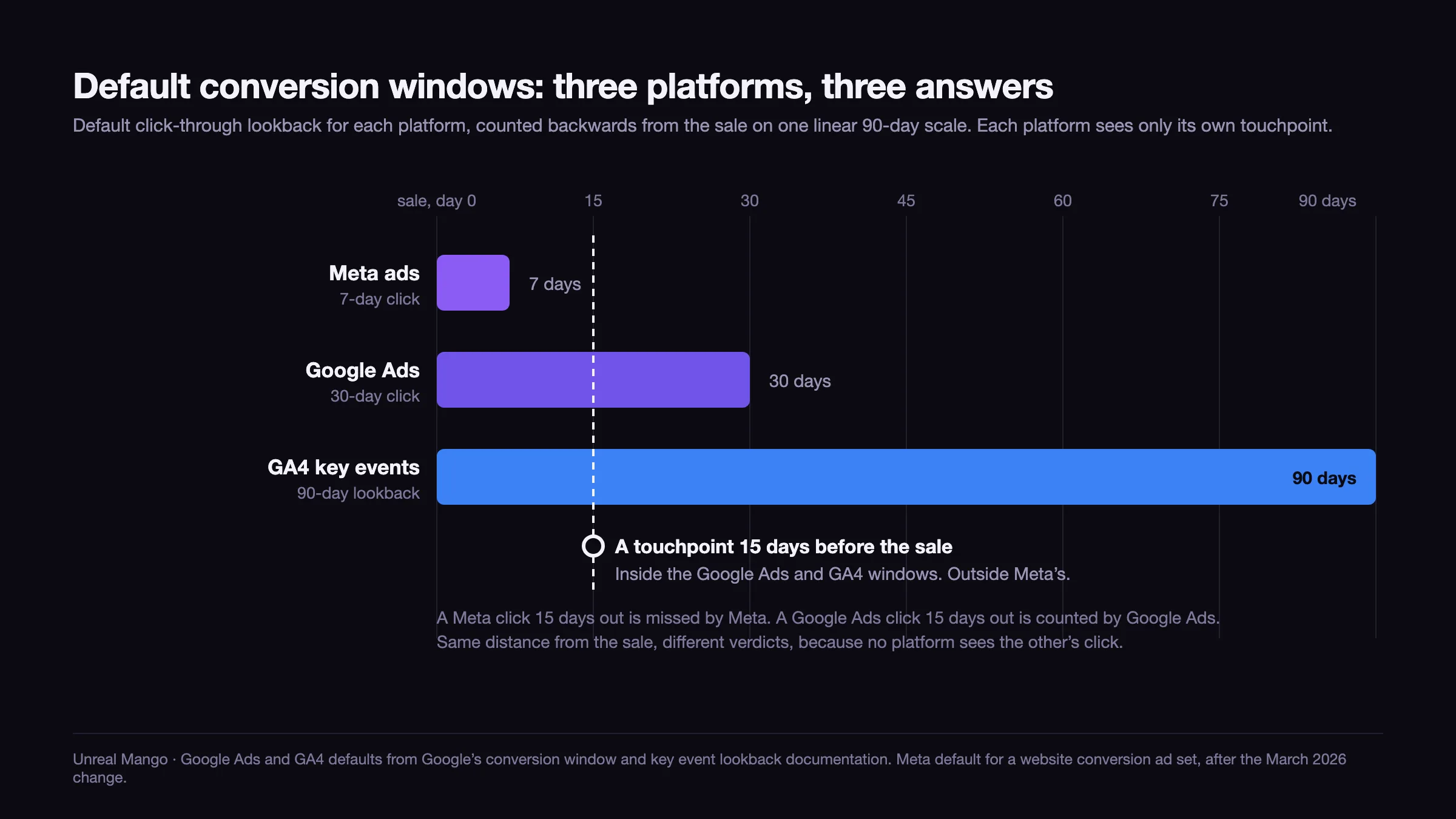
Follow one purchase through those rows. A customer clicks a Meta ad on 5 March, clicks a Google search ad on 18 March and buys on 20 March. Meta sees a click fifteen days before the sale, outside its seven-day window, and reports nothing. Google Ads sees a click two days before, inside its thirty-day window, and reports one conversion. GA4, with a ninety-day lookback on that key event, sees both touchpoints and divides credit according to whichever attribution model the property is set to. One purchase, three defensible numbers, and an argument every month until somebody writes the windows down.
Branded search counted as demand you created. This one is worth checking on any search engagement. Clicks on your own company name would mostly have arrived anyway, and they are the easiest line on a report to grow. Search Console lets you filter queries containing your brand and see the split. Ask for branded and non-branded reported as separate lines from month one, and the argument disappears before it starts.
No pre-engagement baseline. If the first report is also the first measurement, there is nothing to compare it to. Thirty days of clean data before launch is the cheapest thing you will ever buy, and it is the reason a good agency will not want to launch in week one.
Leads without a rule. “Leads” that count every form submission include duplicates, test entries and spam. Agree the deduplication rule and the exclusions before the first invoice, and ask for the raw export alongside the summary. Our SEO audit report template sets out the same principle for audit findings: a number is only useful when the method that produced it is written next to it.
Vanity metrics leading the deck. Impressions and reach are inputs, not outcomes. They belong in a report, but not on the first page, and an agency that leads with them for three months in a row is managing the relationship rather than the account.
Boutique against network: what actually changes on your account
Both models work. They fail differently, and the differences are structural rather than a matter of quality.
| Axis | Owner-run studio | Large network agency |
|---|---|---|
| Who does the work | The people who pitched | A delivery team you meet after signing |
| Seniority on your account | Senior hours, fewer of them | More hours, more of them junior |
| Channel breadth | Narrow and deep | Wide, thinner per channel |
| Escalation path | One step | Account manager, then director |
| Capacity risk | One person’s absence moves your timeline | Absorbed by the bench |
| Process and documentation | Light, sometimes too light | Heavy, sometimes too heavy |
| Best fit | One to three channels, decisions weekly | Many markets and channels, procurement involved |
We are the left-hand column, and it is worth saying where that is the wrong answer: if you need six channels across four languages next quarter, a studio our size is not the efficient choice, and you should not let a good first call talk you out of that arithmetic. If you need two or three channels run by the people you actually spoke to, the left column is the one that behaves as promised. Our services overview is organised that way on purpose, by discipline rather than by package.
The one thing to test in either model is substitution. Ask who was on the last three pitches and who is on those accounts today. In a studio the answer is the same names; in a network it is a normal handover, and normal is fine as long as it is disclosed before you sign rather than discovered in week three.
In-house or agency, decided on coverage rather than cost
The comparison is usually run on money, and money is the second question. The first is coverage: how many distinct disciplines does your plan need, and how many hours a week does each one need?
Write the plan out as a list of disciplines — paid search, paid social, SEO, content, design, analytics, email — and put weekly hours next to each. Then read the shape:
- One discipline needing thirty hours a week or more. Hire. The knowledge compounds internally and the coordination cost of an external supplier is pure overhead.
- Four or five disciplines needing three to eight hours each. Use an agency. You cannot hire a fifth of a paid media specialist, and a generalist hire covering all five will be genuinely good at one of them.
- One discipline at thirty hours plus two at five. The common answer, and the reason most companies end up hybrid: hire for the deep one, contract the shallow ones.
The hybrid split that works is not by channel but by what has to stay inside: the offer, the pricing, the CRM and the speed of response to an inbound lead are internal by nature, and no supplier can own them for you. Channel execution, creative production and measurement plumbing travel well.
The cost side of the same decision — what an in-house salary really carries once you load it, and where the crossover sits — is worked through in our guide to SEO pricing, which runs the arithmetic properly rather than in a paragraph. Choosing a partner and choosing a payment model are separate exercises; our guide to what marketing agencies charge covers the second one and is worth reading before you compare quotes, because two quotes on different billing models are not comparable numbers at all.
When hiring an agency is the wrong move
An agency multiplies whatever your business already does with attention. If the thing being multiplied is broken, you get a faster version of the same result and a monthly invoice. Five preconditions, all of which are cheaper to fix than to outsource around.
- Nobody answers inbound within a working day. Response time beats almost every acquisition improvement available to you, and it costs nothing to fix. Fix it first, then buy traffic.
- There is no measurement baseline. Without thirty days of clean data before launch, you will never be able to separate the agency’s work from the weather. Install measurement, wait a month, then start.
- The offer converts below its category and you already know it. More visitors to a page that does not convert produces more evidence that it does not convert. A brand audit or a straight conversion review is the cheaper first spend.
- Fulfilment is already at capacity. Demand you cannot serve turns into refunds and bad reviews, which are more expensive than the ads that produced them.
- You cannot give the engagement two to four hours a week. Approvals, access, product knowledge and feedback all come from your side. Engagements starve on client input more often than on agency effort, and no contract fixes it.
There is a sixth case that is not a failure at all: the real need is one launch rather than a programme. A rebrand, a site rebuild, a single campaign — those are projects with an endpoint, and buying them as an ongoing retainer means paying for capacity you stop using in month four. Size the commitment to the shape of the work, using a marketing budget template to see how much of the year the project actually occupies before you agree to twelve months of anything.
Contract clauses that decide what you keep when it ends
Read the exit before you read the rate card. Seven clauses do almost all of the work, and none of them is unusual to ask for.
| Clause | What to ask for | Why it matters on the way out |
|---|---|---|
| Notice period | Thirty days, stated in days rather than “reasonable notice” | A ninety-day notice on an auto-renewing term is a full quarter of paying for work you have stopped valuing |
| Automatic renewal | A renewal reminder sent in writing before the window closes | Renewal windows are missed by calendar, not by intention |
| Account and asset ownership | Named platforms, named account holders | Turns the check in the section above into an enforceable term |
| Data portability | Raw exports and dashboard handover on request, not only PDFs | Reports you cannot re-cut are a record, not data |
| Creative assignment | Assignment on payment, including editable source files | Decides whether the next supplier edits or rebuilds |
| Scope changes | Who may approve one, and in what written form | The single most common source of a disputed invoice |
| Named personnel | Notice when the lead on your account changes | Makes the substitution question from the first call durable |
A non-solicit clause will usually appear as well, and it is reasonable. Check that it is mutual and time-boxed rather than open-ended, and that it covers hiring rather than talking.
None of the above is about price. That is deliberate: the rate is the easiest thing to compare between two agencies and the least predictive of how the year goes. The clauses in this table are the ones you will remember in month fourteen.
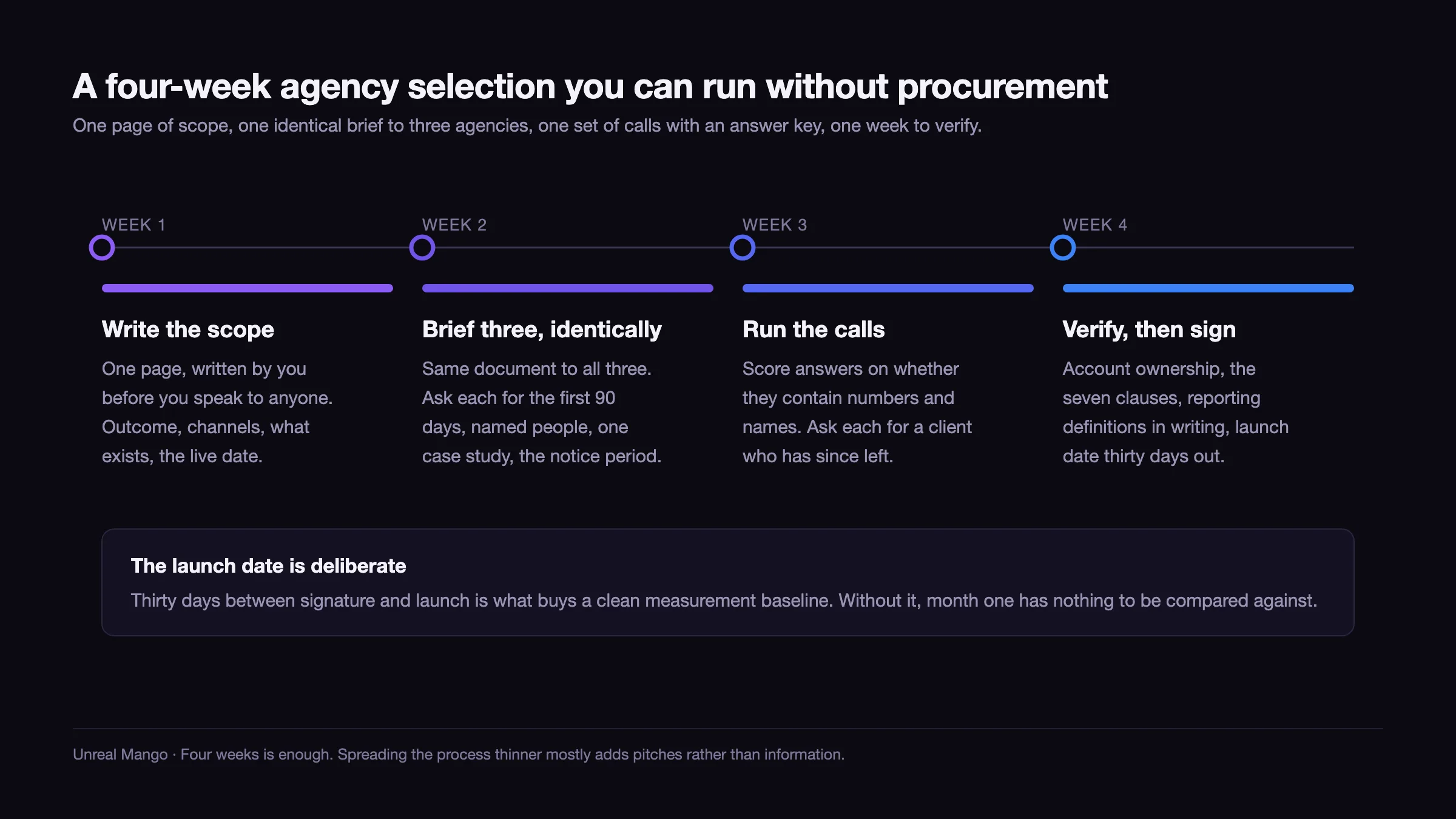
A four-week selection process you can run without a procurement team
Four weeks is enough, and spreading it thinner mostly adds pitches rather than information.
Week one — write the scope yourself. One page: the business outcome, the channels you believe are involved, what already exists, what you can supply, and the date something has to be live. Writing it before you talk to anyone protects you from buying the thing the first agency happens to sell. Our guide to writing a content brief works as a template for the deliverable half of it.
Week two — shortlist three and send all three the same brief. Not four, not seven. Identical inputs are what make responses comparable; a bespoke conversation with each agency produces three proposals that cannot be laid side by side. Ask each for the same four things: approach for the first ninety days, the named people, one comparable case study with baseline numbers, and the notice period.
Week three — run the calls with the answer key. Use the question table above and write down which answers contained numbers. Ask each for one reference from a client who has since left; the willingness to offer that is itself a data point, and the call is more informative than a happy-customer reference by a wide margin.
Week four — verify, then sign. Check ownership of every account against the table above, read the seven clauses, agree the reporting definitions in writing, and set the launch date thirty days after signature so the measurement baseline described earlier can be collected before anything goes live.
One habit is worth carrying past the signature. At the end of month three, ask for the same case-study tests to be applied to your own account: baseline dates, absolute numbers, what else was running, and the branded and non-branded split. An agency that reports on itself the way you asked it to report on its past work is the one you will still be working with in year two.
11 / Reader questions
Frequently asked questions
01How do you choose the right digital marketing agency?
By testing five things before you sign: a written scope both sides agree on, case studies that name a baseline period, who owns the ad accounts and analytics, how conversions are counted and reported, and the notice period. Everything else on a pitch call is presentation rather than evidence.
02What questions should I ask a digital marketing agency before hiring?
Ask who will do the work and how many other accounts they carry, what happens in the first thirty days, what result would count as failure, whose name the ad accounts sit under, and how a lead is defined. Good answers contain numbers and names; weak ones contain adjectives.
03Who should own the Google Ads account, the agency or the client?
The client. A Google Ads manager account links to your account rather than absorbing it, and Google's documentation states that users with administrative access can terminate the relationship at any time by unlinking. That only helps if you hold administrative access on the ads account itself, so ask for it before launch.
04Is it worth hiring a digital marketing agency?
It depends on coverage, not on price. An agency pays off when your plan needs four or five disciplines for a handful of hours each per week, and it disappoints when the real need is one discipline running continuously. Count disciplines and weekly hours first; the answer usually falls out of the count.
05What are the red flags when choosing a marketing agency?
Guarantees of rankings or revenue, assets built inside the agency's own accounts, reports with no named attribution window, results shown only as percentages, a pitch team you never meet again, and a contract that auto-renews on a long notice period. Every one of them is checkable before you sign.
06How do I choose an SEO agency specifically?
Use the same five checks, then add three SEO-specific ones: ask for the technical audit before the strategy, ask for the branded and non-branded split of your search traffic in every report, and ask which recommendations need developer time. An SEO proposal with no engineering dependency is incomplete.
07How do I check that an agency's case studies are real?
Ask for the baseline period in dates, the absolute numbers behind every percentage, what else was running at the same time, and a reference from a client who has since left. A result that cannot be stated as a before-and-after pair of numbers cannot be verified at all.
08Should I hire an agency or build an in-house team?
Hire in-house when one discipline needs more than about thirty hours a week and the knowledge is worth keeping in the building. Use an agency when four or five disciplines each need a few hours. Most companies end up with both, with in-house owning the offer, the CRM and response time.