Published
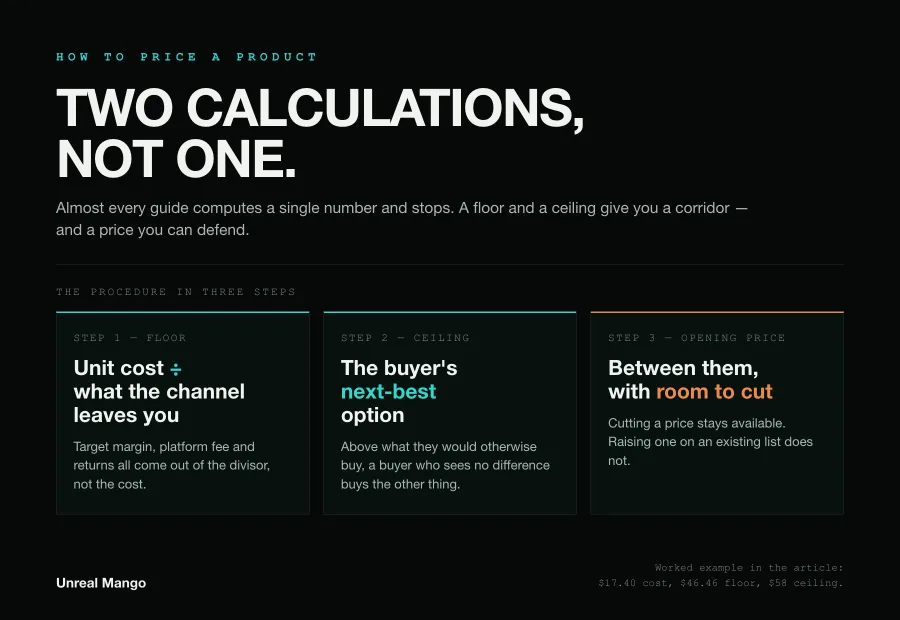
To price a product, build a cost floor and a value ceiling, then choose a number between them. The floor is your unit cost divided by what the channel leaves you after fees and returns; the ceiling is what your buyer’s next-best option costs. A single number is a guess; a corridor is a decision.
Almost every published guide to this question calculates one number and stops. Add up costs, apply a markup or a target margin, glance at a competitor, publish. That produces a price you cannot defend when someone asks why it is not 20% lower, and it gives you nothing to work with the first time a stockist asks for terms or a customer asks for a discount.
The procedure below produces four things instead: a unit cost you can recalculate, a floor per sales channel, a ceiling, and a published price list with a discount limit built into it. The worked figures throughout follow one illustrative product — a cloth-bound notebook made in runs of 500 — and they are an arithmetic demonstration, not a benchmark for your category. Substitute your own inputs; the structure is what transfers.
What one unit costs you before a single dollar of margin
Unit cost has two halves that behave differently, and mixing them is the first place the calculation goes wrong. Direct costs are incurred per unit and stay flat whatever your volume. Fixed costs are incurred per month and get cheaper per unit the more you make.
| Cost line | Per unit |
|---|---|
| Materials: paper block, board, cloth | $6.20 |
| Assembly labour: 12 minutes at $22/hour | $4.40 |
| Packaging: box and insert | $1.10 |
| Inbound freight and duty | $0.90 |
| Direct subtotal | $12.60 |
| Overhead: $2,400/month across 500 units | $4.80 |
| Total production cost per unit | $17.40 |
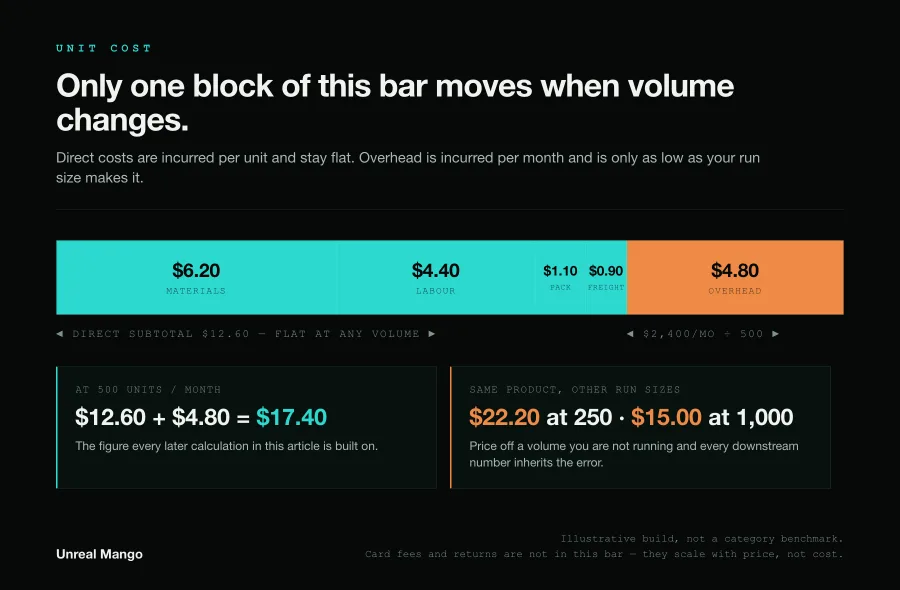
The overhead line is the one that moves. At 250 units a month it is $9.60 and the unit costs $22.20; at 1,000 units it is $2.40 and the unit costs $15.00. If you price off a cost figure calculated at a volume you are not actually running, every downstream number inherits the error. Recalculate the allocation whenever the run size changes, and use the volume you are confident of rather than the one you are hoping for.
What is deliberately not in this table: card processing, marketplace commission and returns. Those are proportional to price, not to cost, so they cannot be added to a cost figure before the price exists. They belong in the divisor, and that is the next step.
Markup and margin are different multipliers, and confusing them underprices you
The most common rule of thumb in this category is “multiply your cost by two or three.” It is a markup rule, and markup is not margin. Markup is stated against cost; margin is stated against price. A 2x markup on a $17.40 unit is a $34.80 price and a 50% margin — that is, 50% of the price, not of the cost. That same price, after 2.9% card processing, a $0.30 transaction fee and a 4% returns allowance, leaves 42.2%.
| Markup on cost | Price | Margin before channel costs | Margin after channel costs |
|---|---|---|---|
| 2.0x | $34.80 | 50.0% | 42.2% |
| 2.5x | $43.50 | 60.0% | 52.4% |
| 3.0x | $52.20 | 66.7% | 59.2% |
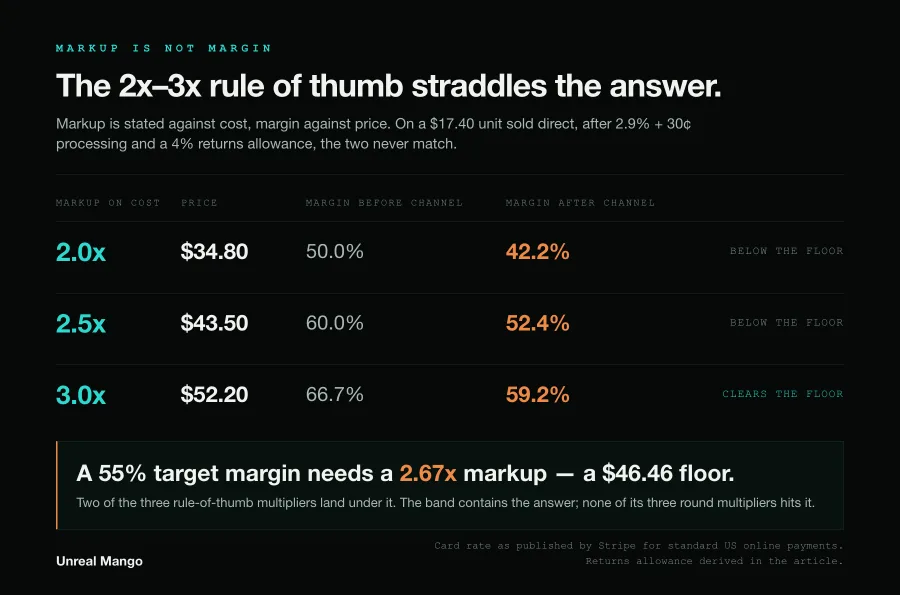
Two consequences follow. The first is that a target expressed as margin needs a different multiplier than the same-sounding number expressed as markup: a 55% margin after channel costs requires a 2.67x markup on this cost base, not 1.55x and not 2x. The second is that the popular 2x–3x band contains the answer but none of its three round multipliers lands on it. On these inputs 2x and 2.5x both sit below the floor calculated in the next section, and only 3x clears it. A rule of thumb that is wrong two times out of three is not a rule.
The price floor is your cost divided by what the channel leaves behind
The floor is the lowest price at which the unit still hits your target margin once the channel has taken its share. Everything proportional to price goes into the denominator:
Floor = (unit cost + fixed per-order fee) ÷ (1 − target margin − channel rate − returns allowance)
For the direct channel, with a 55% target margin, Stripe’s published standard US online card rate of 2.9% plus 30¢, and a 4% returns allowance:
$17.70 ÷ (1 − 0.55 − 0.029 − 0.040) = $17.70 ÷ 0.381 = $46.46
The returns allowance is worth deriving rather than guessing. NRF and Happy Returns, whose merchant sample was 358 ecommerce professionals at large US merchants — those above $500 million in revenue — surveyed in summer 2025, reported that retailers expected 15.8% of the year’s sales to come back, totalling $849.9 billion, against 16.9% and $890 billion the year before — and that 19.3% of online sales specifically would be returned. A single-SKU product with no size or fit variable sits below that online average; assume 12% of orders come back, each costing about a third of the order value in outbound shipping, a return label and inspection, with the unit itself resold. That is 12% × 33% ≈ 4% of revenue, which is the figure above.
Now run the same formula for a marketplace charging a 15% referral fee — the rate Amazon publishes for Home and Kitchen, Office Products and Toys and Games, against a $0.30 minimum — and assume returns run at 18% on a marketplace, which at the same one-third cost per return is 18% × 33% ≈ 6% of revenue:
$17.40 ÷ (1 − 0.55 − 0.15 − 0.06) = $17.40 ÷ 0.24 = $72.50
Amazon’s $0.30 is a minimum referral fee, not an added per-order charge, so there is no fixed fee in the numerator here — the divisor does all the work.
Same product, same target margin, two floors $26 apart. This is the number no single-price guide produces, and it is the one that decides which channels you can actually sell in.
The price ceiling is what your buyer’s next-best option already costs
The ceiling is not a number you calculate from your own accounts. It is set by what the buyer would spend instead if you did not exist, because above that figure a buyer who sees no difference between you simply buys the thing they already know.
Establishing it takes one honest piece of research and no survey: identify the specific product the buyer would otherwise put in the basket, and find its price. For our notebook, the nearest comparable on the same shelf sells at $58. That is the ceiling for a buyer who cannot tell the two apart.
Raising a ceiling is a different exercise from setting one. It requires quantifying what your version does that the alternative does not, in money, and deciding how much of that difference you keep rather than hand over — the calculation covered in value-based pricing. For a first product with no customers to ask, the honest move is to take the alternative’s price as the ceiling and revisit it once you have evidence, rather than to assume a premium you have not yet earned.
Putting the bounds together: a $46.46 floor against a $58 ceiling
The two calculations meet here, and what they produce is a corridor with a width you can read off:
| Channel | Floor at 55% target | Ceiling | Corridor |
|---|---|---|---|
| Direct | $46.46 | $58.00 | $11.54 wide |
| Marketplace | $72.50 | $58.00 | none — floor is above the ceiling |
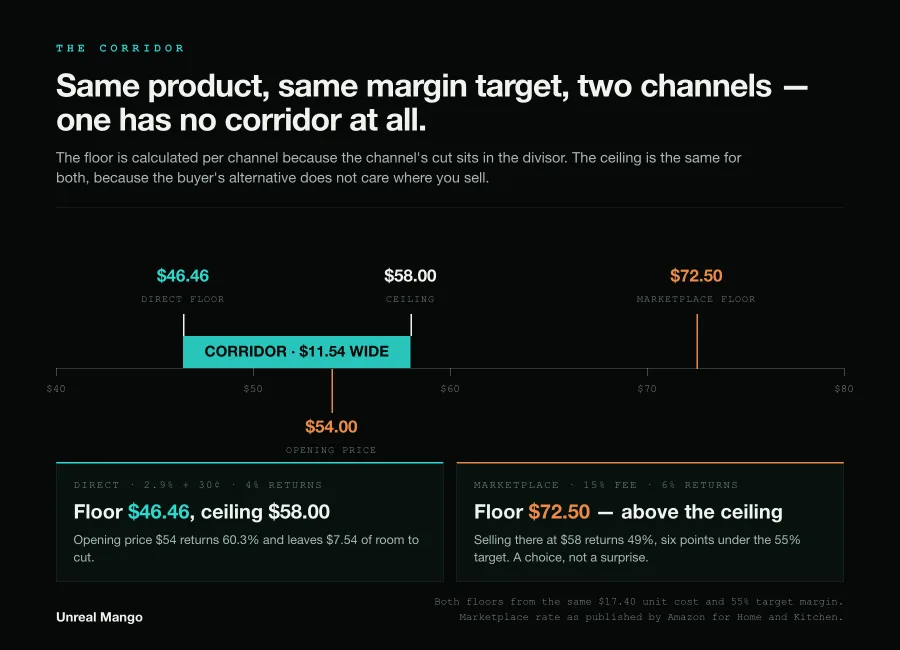
The marketplace row is the useful one. Its floor sits above its ceiling, which means there is no price on that channel that both clears 55% and gets bought. Selling there anyway at $58 returns 49% — six points under target, not a catastrophe, but a choice made with the number in front of you rather than a surprise discovered at the end of the quarter. The alternatives are all visible: accept 49% there, cut the cost base, or stay direct.
A corridor also tells you when to stop. If the floor comes out close to the ceiling, the product does not have a pricing problem, it has a cost problem or a differentiation problem, and no amount of choosing between $52 and $54 will fix it.
Choosing the opening price when the product has no sales history
Inside an $11.54 corridor there is no data to appeal to. A new product has no conversion rate, no elasticity and no cohort, so anyone claiming to derive the exact number is deriving it from nothing. What you can use is an asymmetry: cutting a published price is always available to you, and raising one on an existing list costs you goodwill with everybody who already bought.
So open above the midpoint. For this corridor that is $54 — $7.54 above the floor and $4.00 below the ceiling — which returns a 60.3% margin on the direct channel, comfortably above the 55% target, and leaves the entire lower half of the corridor in reserve.
Two adjustments to that default are worth making deliberately. Open nearer the floor if you genuinely need volume to learn something specific and can say what. Open nearer the ceiling if raising later will be structurally hard: annual contracts, a printed catalogue, or a stockist agreement that fixes your wholesale price for a season.
Rounding the final figure is the one place where price perception belongs in this procedure. Whether $54 should be published as $53.99 is a real question with a real evidence base, and it is a separate one from where the number came from; the effects worth relying on are sorted from the folklore in psychological pricing.
What should trigger a price review once the product is live
Not the calendar. “Revisit quarterly” is the standard advice and it is unfalsifiable — it tells you when to look, never what you are looking for.
Review the price when an input to the corridor moves, because the corridor is what the price was derived from. Four triggers cover almost everything: your unit cost changes by more than a few percent, usually because run size or materials moved; a channel changes its take rate or fee structure; your returns rate drifts away from the allowance you assumed; or the alternative you set the ceiling against is repriced or discontinued. Any of those, and you rerun two formulas and see whether the opening price is still inside the band.
That is maintenance, not measurement. Deliberately finding out how demand responds to price is a separate discipline with its own design requirements — price testing — and a live price on a new product is not the place to improvise it.
Turning one price into a price list: tiers, spacing and the wholesale line
Guides in this category stop at one number. A business needs a list, because the moment there are two customer types there are two prices, and if the second one is invented under pressure it will undercut the first.
| Line | Price | Per unit | Margin |
|---|---|---|---|
| Single unit, direct | $54.00 | $54.00 | 60.3% |
| Three-pack, direct | $145.00 | $48.33 | 56.9% |
| Wholesale, 24-unit minimum | $27.00 | $27.00 | 35.6% |
Each line is derived, not chosen. The three-pack discounts 10.5% per unit and still clears the floor: at $48.33 it sits $1.87 above the $46.46 floor, and spreading one $0.30 fee across three units buys $0.53 of that headroom. The wholesale line is set by the shelf: a stockist who doubles to reach the retail price needs the $54 shelf price divided by two, which is $27, and that price carries no channel fee and no returns allowance because returns become the stockist’s problem.
The wholesale margin looks alarming next to the others until you notice it is a different kind of margin. There is no fee, no returns cost, no per-order overhead, and the volume is committed in advance. Judging it against the direct target is a category error — but publishing a wholesale price that does not divide cleanly into your own retail price is not, and it is how a brand ends up competing with its own stockists.
Your maximum honest discount is 14%, and the three-pack already spends three-quarters of it
The discount grid is a part of the price list, not a separate improvisation, and its limit falls straight out of the corridor. The deepest markdown you can publish is the distance from your opening price to your floor:
($54.00 − $46.46) ÷ $54.00 = 13.96%
Which means the routine 20%-off promotion is not available on this product. At 20% the price is $43.20, below the floor, and every unit sold in that window misses the target margin. Anyone running that campaign is not discounting; they are funding sales out of margin they had already allocated elsewhere.
Note also that the three-pack has already spent most of that allowance. Its 10.5% per-unit discount leaves 3.5 percentage points of room before the floor. A price list is a budget, and the discount grid is the line item that quietly overspends.
What first customers should get instead of a launch discount
The instinct is a launch discount, and it is the one move that damages the list you just built. A discount teaches the first cohort — the people most likely to talk about the product — what it is worth, and every later sale at full price reads as a price rise to them.
Give value instead of taking price off. A fixed-value add-on costs you its unit cost rather than a percentage of every future sale: an item costing $4 to include reads as more generous than a $4 discount and leaves the published number intact. If a lower price is genuinely necessary to get the first orders, publish it as a founding price with a stated end date and a stated future price, so the increase is a scheduled event rather than a broken promise.
The same logic sets the boundary of this whole procedure. Pricing gives you a defensible number and a list that holds; it does not tell you how many people will buy at that number, which is a question of market sizing and demand, or which alternative the buyer will compare you against in the first place, which is a positioning decision. Where the ceiling sits is determined upstream of the arithmetic, in the marketing strategy that decides who the product is for. The corridor is a tool for making the price decision honestly; it is not a substitute for having a market.
11 / Reader questions
Frequently asked questions
01How do I calculate the selling price of my product?
Divide your total unit cost by one minus everything the sale gives away: your target margin, the channel's percentage cut and your returns allowance. A $17.40 unit sold direct at a 55% target margin, 2.9% + 30¢ card processing and a 4% returns allowance needs $46.46. The same unit on a marketplace charging 15%, with a 6% returns allowance, needs $72.50.
02How do I calculate the cost of a product?
Add the direct costs of one unit — materials, the labour minutes that go into it, packaging and inbound freight — then add a share of your fixed monthly costs divided by the units you actually make that month. Fixed cost per unit moves with volume, so the figure has to be recalculated whenever the run size changes.
03How to calculate the price of a product?
Calculate two bounds instead of one price: the lower bound comes from arithmetic you control — unit cost, target margin, channel fees and returns — and the upper bound comes from what the buyer would otherwise buy instead if you did not exist. Any number between the two is defensible; below the floor you miss your target margin, above the ceiling you lose the sale — and you can say which.
04What are the 5 C's of pricing?
Cost, Customers, Competition, Channels and Compatibility, the last meaning whether the price fits the rest of your positioning. Teaching lists disagree about the fifth C. It is a checklist of what to look at before pricing rather than a method, because none of the five produces a number on its own.
05What is the best way to price my products?
Cost-plus and value-based pricing are not rivals but opposite ends of one corridor: cost-plus gives the floor you cannot go below without missing your target margin on the unit, and the buyer's alternative gives the ceiling you cannot go above without losing the sale. Use both, then place the opening price between them.
06How do I price a product for retail?
Work backwards from the shelf: decide the retail price first, divide it by the markup your stockist applies — a doubling is the common case — and that is your wholesale price, which then has to clear a cost floor of its own. A $54 shelf price with a stockist doubling leaves $27 wholesale, which needs a unit cost well under it.