Published
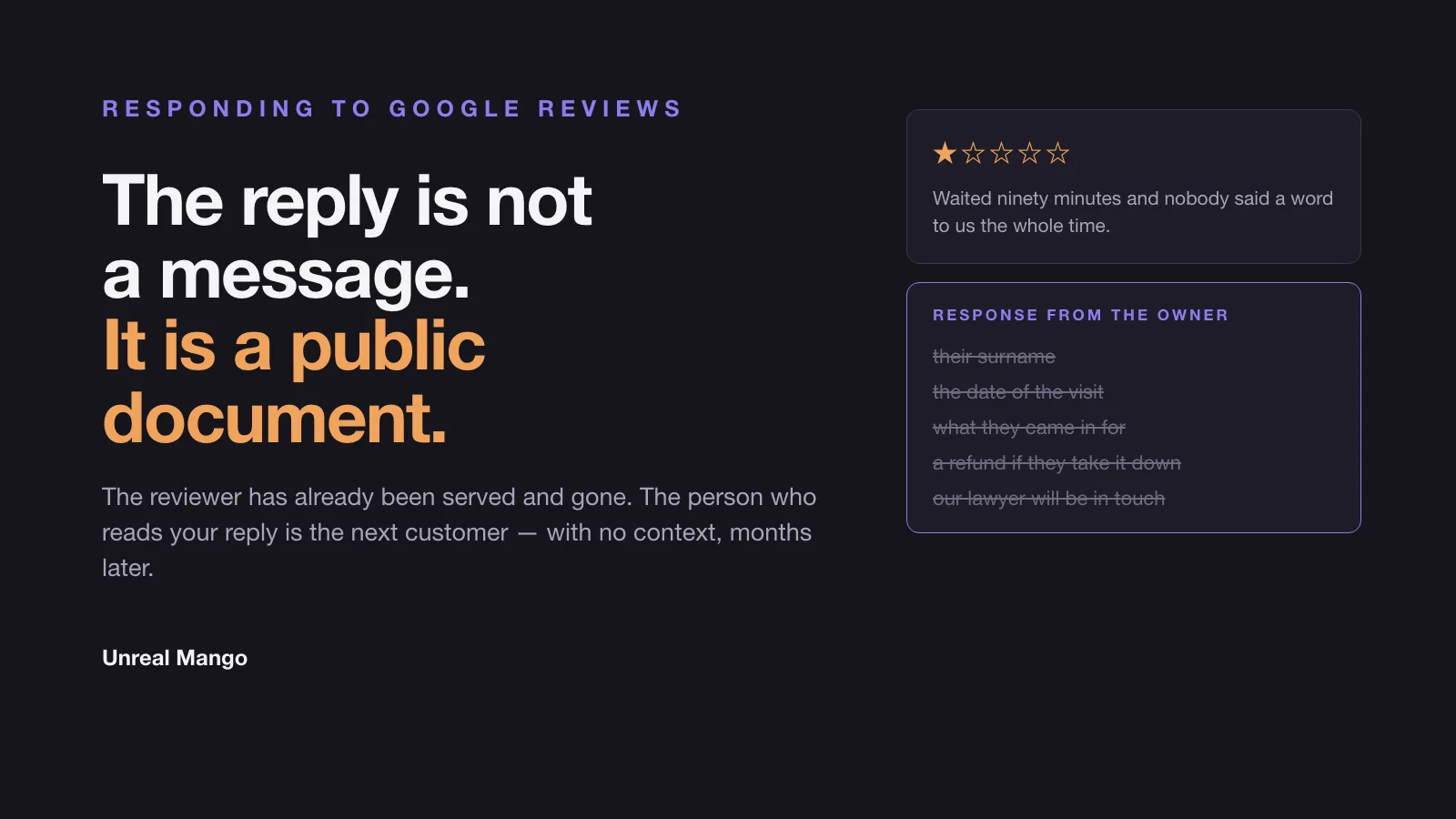
Open your Business Profile, select Read reviews, then Reply. That part takes ten seconds. What goes in the box is the hard part, because a reply is not a message to the reviewer. It is a public document, and the person who will actually read it is the next customer, comparing you to two competitors.
That framing decides everything below: what you may write, what US law forbids you to write, how fast it has to happen, and when the correct reply is none at all.
Your reply is read by the next customer, not by the reviewer
The reviewer has already been served, already formed their opinion, and already left. They may never come back to the page. The reader who matters is the one who arrives months later, sees a one-star review near the top of your profile, and reads your reply underneath it with no context at all — no knowledge of the job, the invoice, the argument at the counter, or who was right.
Consumers report expecting this. BrightLocal’s Local Consumer Review Survey, published 11 February 2026 on a panel of 1,002 US adults, found 89% expect business owners to respond to reviews and 42% say they are unlikely to use a business that never replies. BrightLocal does not disclose when the fieldwork ran, and this is stated preference, not observed behaviour — people routinely say a thing matters more than their clicks show.
The causal evidence is thinner and stranger than the advice built on top of it. Wang and Chaudhry, publishing in the Journal of Marketing Research in 2018, found that hotel management responses to negative reviews shifted subsequent reviewers’ opinion in a positive direction, while responses to positive reviews carried a negative externality — and that tailoring the response amplified whichever effect applied. Their reading of the positive-review case is that a manager quoting back the specific things a happy guest praised looks like a business using its own review section as advertising space.
Three practical consequences follow from writing for the later reader:
- Assume zero context. Your reply has to make sense to someone who has read one paragraph of a stranger’s complaint and nothing else.
- Everything you add is permanent and public. The reviewer can edit their review; you cannot edit their memory of yours, and screenshots outlive both.
- Only one party is under a rulebook. The reviewer can write almost anything. You are bound by Google’s content policy, by US consumer-protection law, and — in several industries — by rules that make the ordinary reply illegal.
What a Google review reply may not contain, under Google policy and US law
This is the part almost no guide covers, and it is where the money is. Owner replies are content on Google Maps, so they sit under the same prohibited-content policy as reviews. On top of that sit two US regimes that reach replies specifically.
Personal information about the reviewer
Google’s Maps user-generated content policy is direct: “Do not distribute or post personal information without consent. Personal information is defined as information that applies to a living identifiable person and disclosure could result in risk of harm if it is compromised or misused.” Its examples include a person’s full name, or last name, and their face in a photograph or video.
That sits awkwardly beside Google’s own reply advice, which tells you to “Address the reviewer by name.” The reconciliation is narrower than it looks and it is our reading, not Google’s wording: the display name the reviewer chose to publish is already public and using it is not a disclosure. Anything you know that they did not publish is. In practice the line falls between “Thanks, Marcus” and any of the following, all of which we have watched businesses type into the box:
| What owners write | Why it is a problem | What goes in the reply instead |
|---|---|---|
| The reviewer’s surname, when they posted under a first name or a handle | Publishing a last name they withheld is distributing personal information without consent | The display name only, or no name at all |
| “You came in on the 14th and we spent two hours on…” | Dates, durations and visit details identify the person and confirm the relationship | “We’ve found the visit and the manager has the file” |
| Order, invoice, account or booking numbers | Same disclosure, plus it hands a lookup key to anyone reading | Nothing — the reference goes in the email |
| “You never paid the balance” | A public accusation in a dispute, and an invitation to a defamation argument you now have in writing | “There’s a billing question here we should settle directly” |
| “Happy to refund you if you take this down” | Google prohibits incentives offered for the revision or removal of a negative review | Offer the resolution; say nothing about the review |
| “Our lawyer will be in touch” | The FTC’s rule on consumer reviews reaches unfounded legal threats used to suppress a review | Nothing publicly, ever |
The last two rows connect to a rulebook we have covered in full elsewhere: Google’s incentive ban and the FTC’s 16 CFR Part 465 are laid out rule by rule, with dates, in our guide to getting more Google reviews without getting them deleted. The short version for replies: an incentive tied to a review being revised or removed is a violation of Google’s policy on its face, and §465.7(a) of the FTC rule reaches “an unfounded or groundless legal threat, a physical threat, intimidation, or a public false accusation” used to get a review taken down.
The fact that the person was your customer at all
In healthcare, confirming the relationship is the disclosure. You do not have to name a diagnosis; saying “we’re sorry your appointment ran late” tells the world this person was a patient, and that is protected health information under the HIPAA Privacy Rule.
The Office for Civil Rights has enforced this against small practices at least four times — OCR publishes no index of review-response cases, so four is the findable count, not a certified total — and the pattern is identical every time: a bad review, an owner who wanted the record corrected, a reply that corrected it.
| Practice | Platform | Penalty | Announced |
|---|---|---|---|
| Elite Dental Associates (Dallas, TX) | Yelp | $10,000 settlement | 2 October 2019 |
| Dr. U. Phillip Igbinadolor, D.M.D. & Associates (NC) | $50,000 civil money penalty | 28 March 2022 | |
| New Vision Dental (CA) | Yelp | $23,000 settlement | 14 December 2022 |
| Manasa Health Center (Kendall Park, NJ) | $30,000 settlement | 5 June 2023 |
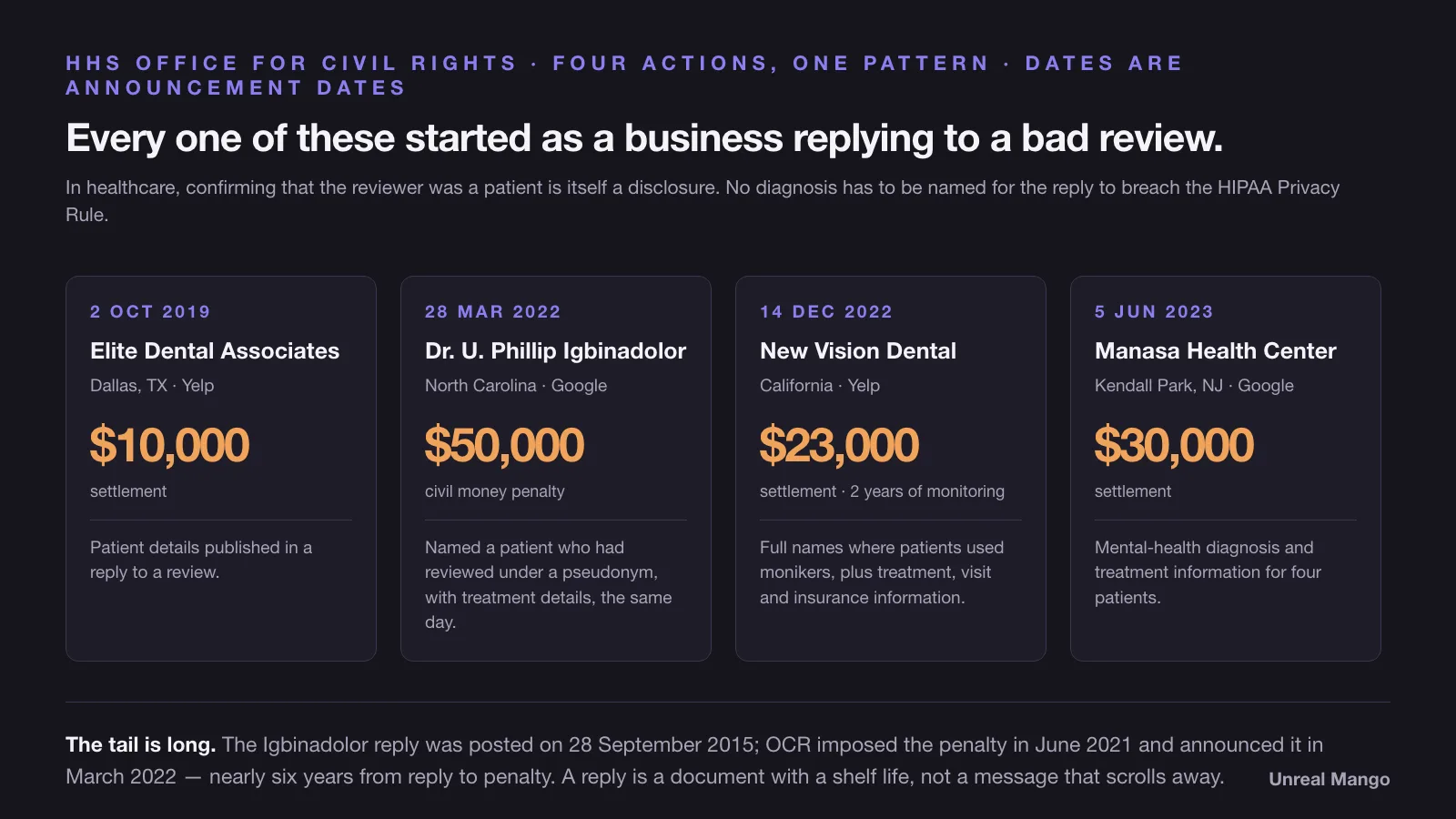
The details matter more than the amounts. Igbinadolor replied on the practice’s Google page to a review posted under a pseudonym and named the patient along with treatment details — on the same day the review appeared. New Vision Dental published patients’ full names where they had used monikers, together with treatment, visit and insurance information. Manasa Health Center disclosed mental-health diagnosis and treatment information for four patients across responses to negative Google reviews. OCR Director Melanie Fontes Rainer, announcing that one: “OCR continues to receive complaints about health care providers disclosing their patients’ protected health information on social media or on the internet in response to negative reviews. Simply put, this is not allowed.”
Two things are worth pulling out. First, the penalties are small relative to the corrective action plans that come with them — New Vision Dental took two years of OCR monitoring for a $23,000 settlement. Second, look at the clock on the Igbinadolor case: the reply went up on 28 September 2015, OCR proposed the penalty in October 2020, imposed it in June 2021 and announced it in March 2022. Nearly six years from the reply to the penalty. A reply is a liability with a very long tail, which is another reason to treat it as a document rather than a message. If reviews are part of how you acquire patients, the compliant reply is a fixed part of the intake process, not a judgement call made by whoever is angry that morning — the same logic that governs the rest of patient acquisition.
Professional-conduct rules outside healthcare
Lawyers have their own version, and it is stricter than most practitioners assume. ABA Formal Opinion 496, issued 13 January 2021, holds that “a negative online review, alone, does not meet the requirements of permissible disclosure in self-defense under Model Rule 1.6(b)(5).” An informal public complaint is not a “controversy between the lawyer and the client”, so the self-defence exception does not unlock. The opinion offers two responses a lawyer may safely post: “Please contact me by telephone so that we can discuss your concerns” and “Professional obligations do not allow me to respond as I would wish.”
The same shape applies wherever a confidential relationship is the service: therapy, addiction treatment, financial advice under an adviser’s confidentiality obligations, family law. If your reply is only persuasive because it reveals what the client came to you for, you cannot send it.
Google’s four rules for writing a reply, and the one number Google never published
Google publishes reply guidance in a section headed “Tips to write better review replies” on its Tips to get more reviews help page. Four bullets sit under “Make your replies positive & relevant”, quoted here as Google words them:
- “Be professional and polite: Keep your replies clear and helpful.”
- “Keep it short and simple: Customers value direct and honest responses.”
- “Make your replies count: Instead of sending the same ‘thank you’ to everyone…”
- “Be conversational, not promotional: Your reviewers are already customers, so avoid using your response to offer deals or promotions.”
Five more sit under “Give helpful responses to negative reviews”: protect privacy and avoid personal attacks, be honest and explain limitations, apologise when appropriate, personalise your reply, and respond in a timely manner. The privacy bullet is the one with teeth — “Never share a reviewer’s private information or engage in personal attacks. If a situation is complex, politely request that the reviewer contact you via phone or email to resolve the issue privately.”
Now the number that is not there. Every guide on this topic quotes a response window and attributes it to Google. Google’s help documentation contains no window. The timeliness bullet above is the whole of it: respond in a timely manner, no hours, no days, no target.
The familiar “24 to 72 hours” does exist on support.google.com, but not in the Help Center. It sits in a community guide inside the Google Business Profile Community — the forum section, carrying the forum’s own “do not share any private or confidential personal or business-related information in this public forum” notice, and carrying no author and no date — which advises: “To make the best impression, aim to respond within 24 to 72 hours.” Same domain, different kind of page, and no policy weight.
That distinction is not pedantry, because the same community guide also advises: “If the review mentions a specific employee, have that employee respond to the review and leave their name or initials at the end to give it a personal touch!” Follow that in a dental practice and you have just published the name of the staff member who treated an identifiable patient.
The Help Center is not blameless here either — its own “personalise your reply” bullet ends “A personal sign-off with your name or initials shows that their experience matters to you.” The difference is who signs. The Help page means whoever is answering; the community guide means the employee who served that customer, which in a clinic is the one person whose name must not appear. Two pieces of advice on one Google domain, one of them unusable in a regulated vertical — which is why it matters whether what you are following is Google’s policy, Google’s Help documentation, or an unbylined community guide in Google’s forum.
One mechanical rule that is Google’s: every reply is moderated before it publishes, usually within ten minutes but occasionally much longer. A reply that breaks policy does not go live for you to quietly fix later.
How fast to reply, and what the speed actually buys
Answer first: within a week satisfies 81% of consumers, and there is no published evidence that faster than that changes anything measurable.
BrightLocal’s February 2026 survey reports the ladder as 19% wanting a same-day reply, 32% wanting one by the following day, and 81% expecting to hear back within a week. BrightLocal does not state whether those windows nest, so read them as it reports them rather than adding them together. The movement is the interesting part: same-day expectation was 6% in the 2025 edition and next-day was 18%, so both roughly tripled and doubled in a single year. Stated expectations are drifting fast, which is a reason to watch the number rather than to build a night shift around it.
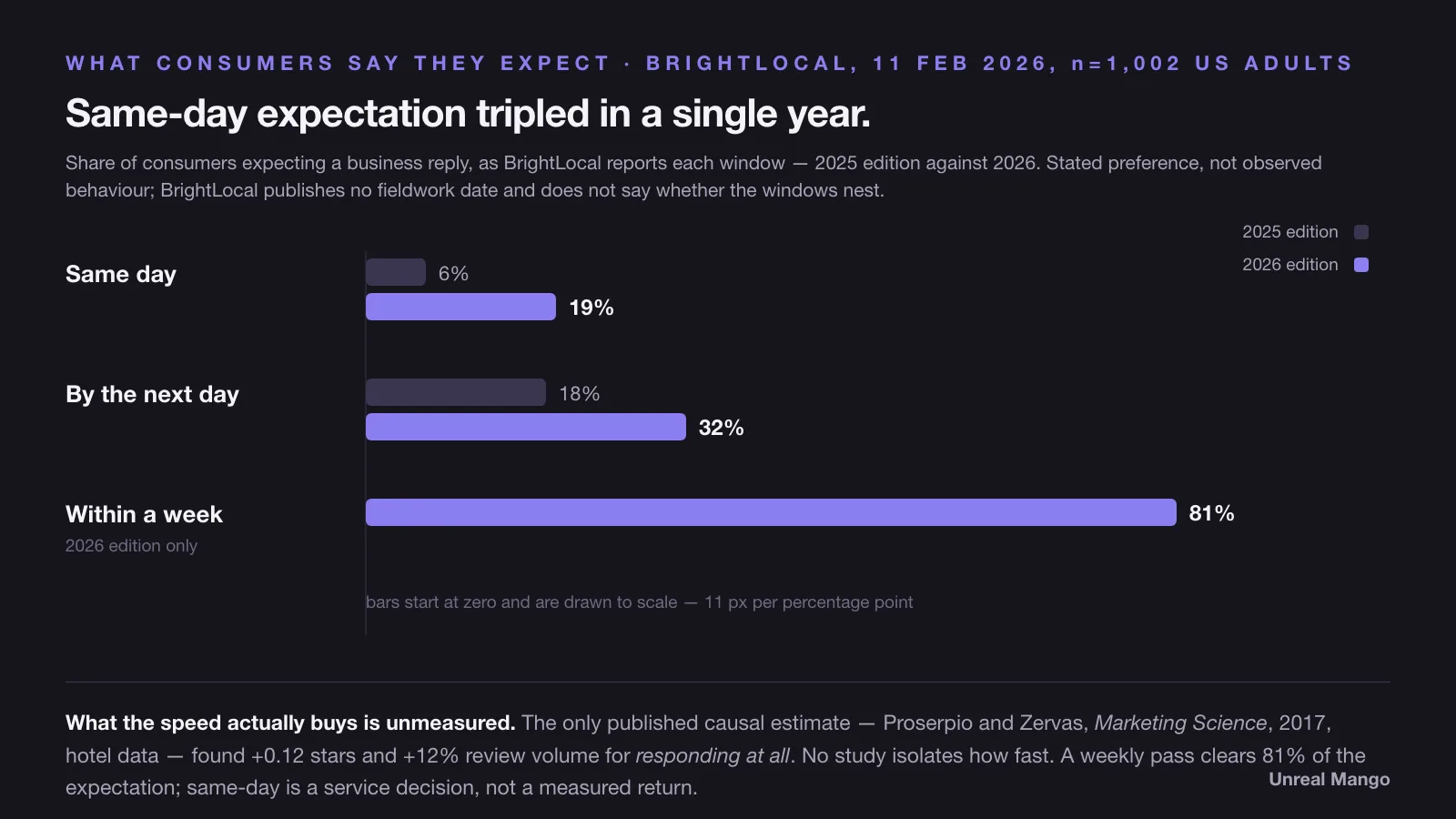
The only causal estimate anyone has published measures whether you reply, not how fast. Proserpio and Zervas, in Marketing Science in 2017, exploited variation in how often hotels responded across different review platforms and how likely consumers were to see those responses, and found a 0.12-star increase in ratings and a 12% increase in review volume for responding hotels. They also found negative reviews became fewer but longer — their reading is that unhappy guests become more hesitant to post an unsubstantiated complaint somewhere the owner will answer it.
Read the qualifiers before you quote it: hotels, TripAdvisor-era data, published in 2017, and the estimate is for adopting responses at all. Nobody has published a study isolating reply latency. So the honest operating rule is a weekly pass that clears everything, with same-day reserved for the case where speed genuinely changes the outcome — the customer is describing a problem that is still happening.
A reply to a bad review that does not read like a template
Templated replies are not neutral; BrightLocal’s 2026 survey found generic or templated replies actively put off half of consumers. The failure is structural. A template can only contain sentences that are true of every complaint, which means it cannot contain a single fact, and a reply with no facts in it reads as a form letter no matter how warm the adjectives are.
What makes a reply read as specific is one verifiable detail that only your business could have supplied — and, critically, a detail that is not private. Four slots, in this order:
- A fact only you could know, that costs nothing to publish. “The kitchen was down to one oven that Saturday.” “That part was on back-order for nine days.” Operational, not personal.
- The part of their account you are conceding. Named, not gestured at. “Ninety minutes is too long to wait without an update, and we didn’t give you one.”
- What changed, or the honest limit. Either a specific change, or a straight admission that this is what the service is. Google’s own bullet asks you to explain limitations; a reply that promises a fix you will not make is worse than one that says the wait is normal at that hour.
- One route off-platform. A named channel, once. Google’s guidance for complex situations is to move it to phone or email.
No slogan, no restatement of your values, no invitation to come back and try again — that last one reads as a sales pitch, and the “be conversational, not promotional” bullet exists precisely because owners keep writing it.
Same complaint, three replies:
The template. “Hi Marcus, thank you for your feedback. We’re sorry to hear your experience didn’t meet expectations. We value all our customers and strive to provide excellent service. Please reach out so we can make it right!”
Nothing in it is false and nothing in it is information. A reader learns that this business owns a word processor.
The specific reply. “Marcus — you’re right that ninety minutes with no update is too long, and that one’s on us. We had one oven out that Saturday and we should have told the room instead of hoping it would catch up. The wait is now capped: if a table passes forty minutes on a main, the manager comes over. If you’d rather sort out the bill, our number is on the profile.”
Sixty-nine words. One operational fact, one concession, one change, one route. No surname, no order number, no reason for the visit. Note where the details come from: the ninety-minute wait is Marcus’s own, repeated back, and repeating something the reviewer published is not a disclosure. “That Saturday” is the single detail the reply adds, and it is safe here only because a day of the week does not identify anyone in a restaurant with two hundred covers. In a four-chair clinic the same word would.
The reply that gets you fined. “Marcus, we’re sorry about your visit on 14 September. Dr. Weller spent forty minutes reviewing your treatment plan and explained the insurance situation clearly at the time.”
Every added detail was intended to make the business look reasonable. Together they confirm the relationship, place it on a date, name the clinician and disclose the subject matter — the exact combination that has cost four US practices between $10,000 and $50,000.
The tone the reply is written in is a brand asset like any other, and it is the one most businesses have never defined. If the replies on your profile sound like three different companies, that is worth catching in a brand audit rather than fixing one review at a time.
When not to respond to a Google review at all
The universal “reply to everything” advice has real exceptions, and treating them as edge cases is how businesses end up with a public argument on the first screen of their profile.
- The reviewer was never a customer, or the review is on the wrong profile. Arguing about it publicly ratifies it as a customer complaint in the eyes of every later reader. Removal runs on a different track — a report against a named policy, not a persuasive paragraph — and the reply box is not where that fight happens.
- The review is an extortion attempt. Answering publicly turns it into a negotiation the whole internet can watch, and the two obvious moves carry different risks. Offering money to make it go away is a straight Google policy violation. Threatening a lawsuit in the reply engages §465.7(a) only if the threat is unfounded or groundless — which is a judgement nobody should be making in a text box at midnight.
- You cannot confirm the relationship without consent. In healthcare and in law, the correct public reply is either the neutral single sentence — ABA 496’s “please contact me by telephone so that we can discuss your concerns” travels well outside law — or silence. It is not a shorter version of the reply you wanted to write.
- There is an active claim, insurance matter or dispute in progress. Anything you publish becomes an exhibit. Reply after it resolves, or not at all.
- You are angry. The only response-time rule with evidence behind it applies to you, not to the customer: nothing you write in the first hour after reading a one-star review will be the version you want permanently attached to your business.
There is a softer case too. Given the Wang and Chaudhry finding that responses to positive reviews carried a negative externality on subsequent ratings, the maximally tailored, enthusiastic reply to a five-star review is not free. One short, plain sentence of thanks is the safer form, and it also satisfies Google’s “be conversational, not promotional”.
Where the reply option is, and why it sometimes is not there
The mechanics, in Google’s own steps: go to your Business Profile, select Read reviews, select Reply next to the review you want to answer, enter your reply, and select Reply. To edit or delete one afterwards, open Read reviews, and under your own reply select Edit or Delete.
Three things about that flow that trip people up:
- Verification gates it. Google requires the business to be verified before you can reply at all. If the option is missing entirely, verification status, the account you are signed in with, or a duplicate listing are the first three things to check — not a bug in the review.
- Replies are single-level. A reviewer cannot post a response underneath your response; Google reviews are not threaded. Their only move is to edit or replace the original review, and Google documents no notification when they do. Whatever you write stands as the last word on that thread, indefinitely, which is the strongest argument for writing it for the later reader.
- Editing goes back through moderation. A corrected reply is a new reply as far as Google’s review queue is concerned.
Everything above assumes the reply is written by someone who knows the rules. In most owner-run businesses it is written by whoever is free, in whatever mood the morning left them, with no written line between a detail that helps and a detail that costs $30,000. That is survivable at four reviews a year and it is a liability at forty.
So the deliverable is not a better template. It is one page, agreed once: what may never appear in the box, who signs, which trigger sends the reply to legal or clinical review first, and what the weekly pass looks like. Writing that page down and wiring it into how the business already works is the part we take on inside marketing for small businesses.
Sources, and what each figure was measured on
- Reply mechanics, verification requirement, edit and delete path, and reply moderation timing: Google Business Profile Help, “Manage customer reviews.” The page carries no visible last-updated date.
- The four reply bullets and the five negative-review bullets: Google Business Profile Help, “Tips to get more reviews,” section “Tips to write better review replies.” No visible date.
- “Aim to respond within 24 to 72 hours” and the named-employee advice: a community guide in the Google Business Profile Community section of
support.google.com, carrying no author, no date and no Help Center status. - Personal information definition: Google Maps user-generated content policy, “Prohibited & restricted content.”
- Consumer expectations (89% expect a response, 42% unlikely to use a non-replier, 19% same-day, 32% next-day, 81% within a week, 50% put off by generic replies): BrightLocal Local Consumer Review Survey, published 11 February 2026, panel of 1,002 US adults. BrightLocal does not publish a fieldwork date. 2025 comparison figures (6% same-day, 18% next-day) are from the prior edition.
- 0.12-star and 12% review-volume effects: Davide Proserpio and Georgios Zervas, “Online Reputation Management: Estimating the Impact of Management Responses on Consumer Reviews,” Marketing Science, 2017. Hotel data; identification exploits variation in response rates across platforms and in consumer exposure to responses. Measures responding at all, not response speed.
- Positive- versus negative-review response asymmetry: Yang Wang and Alexander Chaudhry, “When and How Managers’ Responses to Online Reviews Affect Subsequent Reviews,” Journal of Marketing Research, 2018. Hotel data.
- HIPAA enforcement: HHS Office for Civil Rights actions against Elite Dental Associates (announced 2 October 2019), Dr. U. Phillip Igbinadolor, D.M.D. & Associates (penalty proposed October 2020, imposed June 2021, announced 28 March 2022), New Vision Dental (14 December 2022) and Manasa Health Center (5 June 2023). Dates in the table are announcement dates.
- Lawyer confidentiality: ABA Standing Committee on Ethics and Professional Responsibility, Formal Opinion 496, issued 13 January 2021.
- Incentives and legal threats: Google’s fake engagement and rating manipulation policies, and 16 CFR Part 465 §465.7(a). Both covered in full in our guide to getting more Google reviews.
08 / Reader questions
Frequently asked questions
01How do I respond to a Google review?
Go to your Business Profile, select Read reviews, select Reply next to the review, type your response and select Reply. Your business must be verified before the option appears. Google reviews every reply against its content policies before publishing it, which usually takes up to 10 minutes but can take up to 30 days.
02Why can't I reply to a Google review?
The most common reasons are that the profile is not verified, that you are signed in with a Google account that does not manage the profile, or that the review sits on a duplicate or suspended listing rather than the profile you are looking at. Google requires verification before the Reply option is available at all.
03Can a customer reply to a business's response on Google?
No. Google reviews are not threaded — a reviewer cannot post a reply underneath your reply. Their only route is to edit or replace their original review, and Google documents no notification when they do. That asymmetry is why the wording of your reply matters more than it looks: you get the last word, and you also carry the whole record.
04How fast should you respond to a Google review?
Within a week clears the expectation of 81% of consumers in BrightLocal's February 2026 survey. Same-day is expected by 19% and by the following day by 32%, both roughly triple and double their 2025 levels. No published causal study measures reply speed, so anything faster than a week is a service decision rather than a measured return.
05Should you respond to every Google review?
Respond to every negative review and to positive ones briefly. Two things complicate the universal advice: 42% of consumers in BrightLocal's 2026 survey say they are unlikely to use a business that never replies, but the peer-reviewed evidence on hotels found that responses to positive reviews had a negative effect on subsequent ratings. Reply to praise in one sentence, without selling.
06Can you offer a refund in a Google review reply?
Not as a trade for the review. Google's policy prohibits offering payment, discounts or free goods and services in exchange for posting a review or for the revision or removal of a negative one, so a public offer to compensate the reviewer if they take it down is a policy violation on its face. Resolve it privately and say nothing about the review's fate.
07Can you delete a reply to a Google review?
Yes. Go to your Business Profile, select Read reviews, and under your own reply select Edit or Delete. Editing goes back through the same moderation queue as a new reply. Deleting removes your reply only — the customer's review stays exactly where it was.