Published
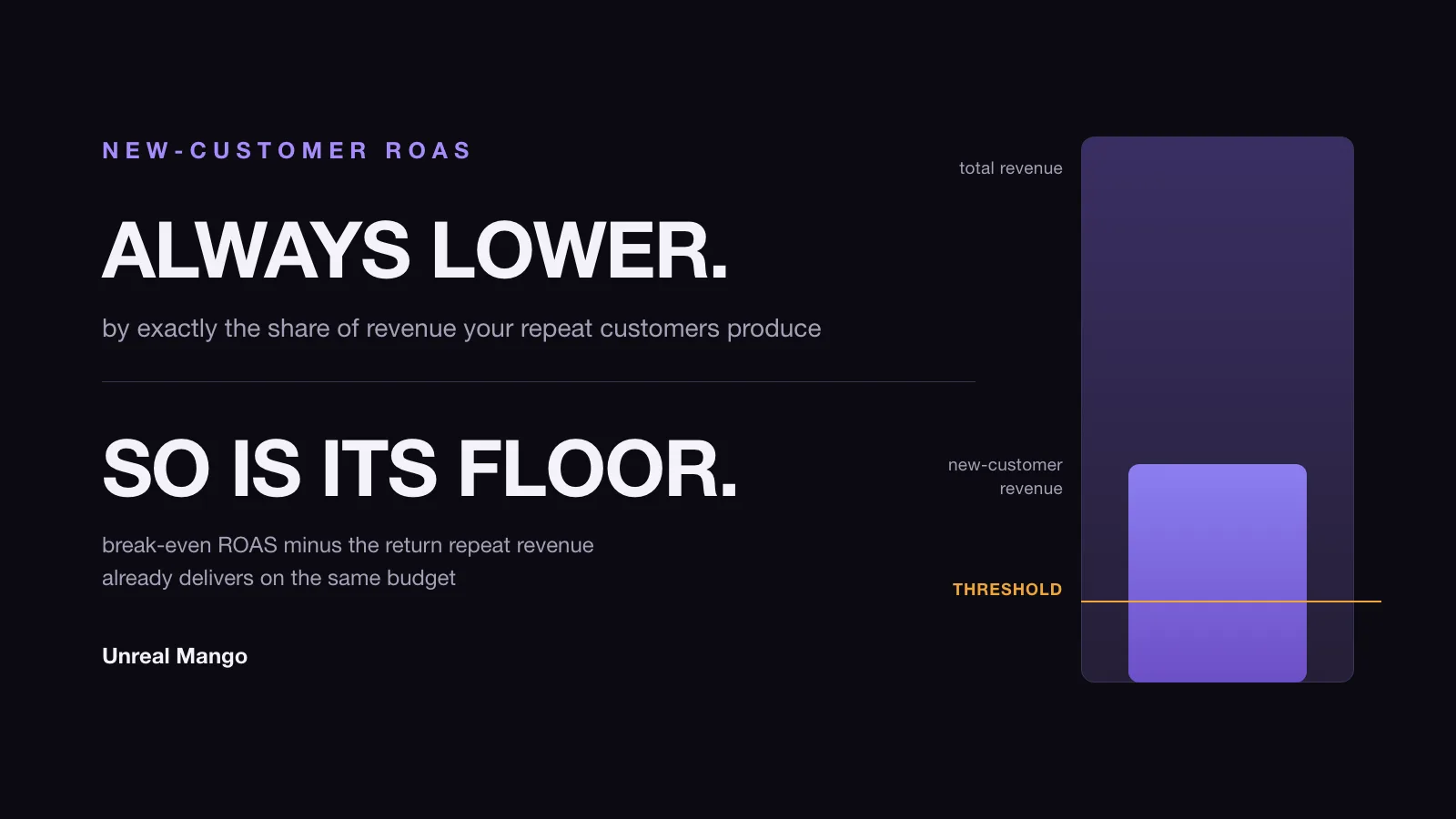
New-customer ROAS is revenue from first-time buyers divided by total ad spend. It is never higher than blended ROAS, and lower by exactly the share of revenue your repeat customers produce, and its break-even sits lower too — by exactly the return that repeat revenue already delivers on the same budget. Most of the confusion around the metric comes from comparing it against thresholds built for a different number.
How this was checked. In August 2026 we pulled the US organic results for “nc roas” and “new customer roas”, then read the primary documentation behind each claim rather than the articles quoting it: Triple Whale’s metric definition, Google Ads Help on the new customer acquisition goal, Meta’s guidance after the existing customer budget cap was withdrawn, and Shopify’s customer reports and profile-merge rules. The arithmetic in the threshold sections is our own, worked on stated inputs, and every input is named where it appears.
New-customer ROAS in one line, and the identity that gets you there without new software
The formula is new-customer revenue over total advertising spend. Triple Whale, whose dashboard put the NC ROAS abbreviation into circulation, writes it as new customer order revenue divided by blended ad spend, where blended ad spend is every advertising dollar plus any spend you have flagged manually.
The denominator is the part people get wrong. It is all your ad spend, not the portion you believe was aimed at new customers. That is deliberate: you cannot cleanly separate the budget that acquired a first-time buyer from the budget that reminded a past one, so the metric refuses to try and charges acquisition with the whole bill.
Which produces a relationship worth writing down, because it means you do not need a new tool to see the number:
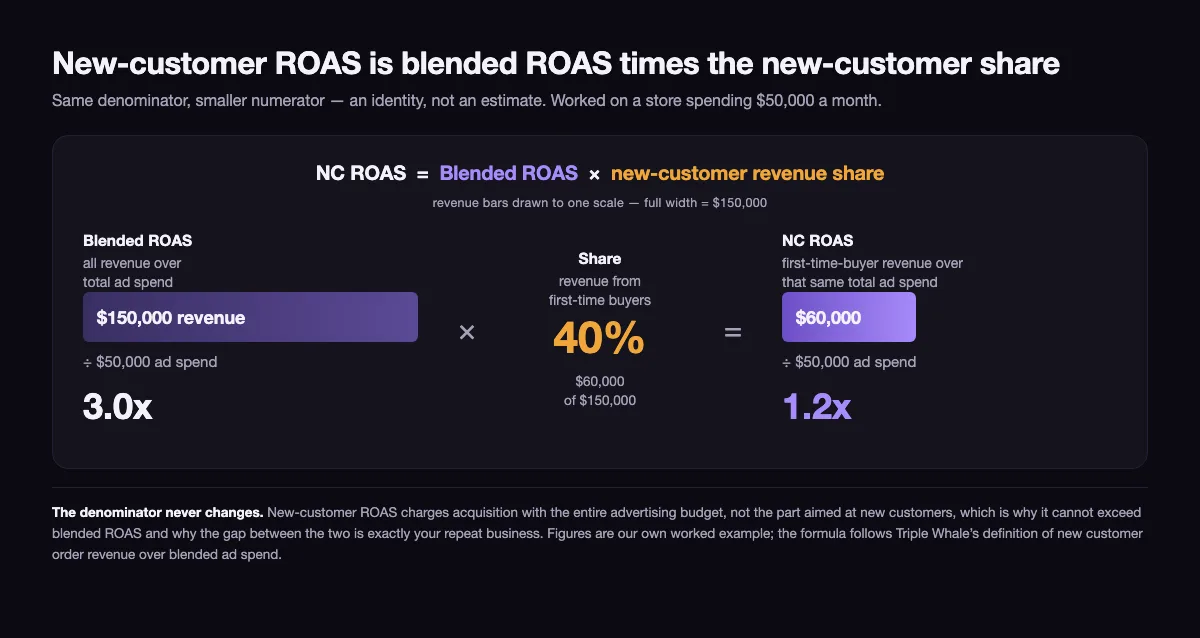
NC ROAS = Blended ROAS × new-customer revenue share
Both quantities on the right are already in front of you. Blended ROAS is total revenue over total ad spend. New-customer revenue share is the proportion of revenue that came from first-time buyers, which every ecommerce platform reports. Multiply them and you have NC ROAS exactly — it is an identity, not an approximation, because both figures carry the same denominator.
Take a store spending $50,000 a month and banking $150,000. Blended ROAS is 3.0x. If 40% of that revenue came from first-time buyers, new-customer revenue is $60,000 and NC ROAS is 1.2x. The same $50,000 sits under both.
Three consequences follow immediately.
- NC ROAS can never exceed blended ROAS. The share is at most one, so the product is never larger — and strictly smaller for any brand with repeat revenue at all. A dashboard showing otherwise has a definition problem.
- A falling NC ROAS with a flat blended ROAS is a mix shift, not a performance drop. The same advertising is producing the same total revenue, from a smaller proportion of new people.
- The gap between the two numbers is your repeat business, expressed as a discount. A brand with 80% new-customer revenue sees the two figures nearly converge; a subscription brand at 15% sees NC ROAS at a seventh of blended and should not be alarmed by the ratio alone.
What the platform number counts that new-customer ROAS refuses to
Ads Manager reports revenue the platform believes it influenced, over spend on that platform. Two things inflate it, and the new-customer filter removes only one of them.
The first is repeat purchase. A customer who bought in March, joined your retargeting pool, saw an ad in April and bought again is a conversion the platform will claim. That revenue is real, the ad’s contribution to it is usually marginal, and it is the single largest reason a reported ROAS looks healthy while the business is not growing. New-customer ROAS excludes this revenue by construction.
The second is credit for demand that already existed — branded search, and retargeting people already on their way to checkout. Restricting the numerator to first-time buyers does not remove this, it only narrows it: a first-time buyer who found you through a friend’s recommendation, searched your brand name and bought still lands in the new-customer numerator. A new-customer filter is a mix correction, not proof that the spend caused anything. That distinction is the whole subject of incrementality testing, and it is not settled by any ROAS variant.
What the filter does settle is direction of travel. If new-customer ROAS falls while blended ROAS holds, the account is quietly rotating its budget onto people who were already yours. That is the failure mode ordinary ROAS is structurally incapable of showing you, which is the case for tracking it at all. The broader question of what any of these numbers should be measured against — including why the conventional break-even formula understates the real one — is worked through separately.
Three systems, three answers about the same order
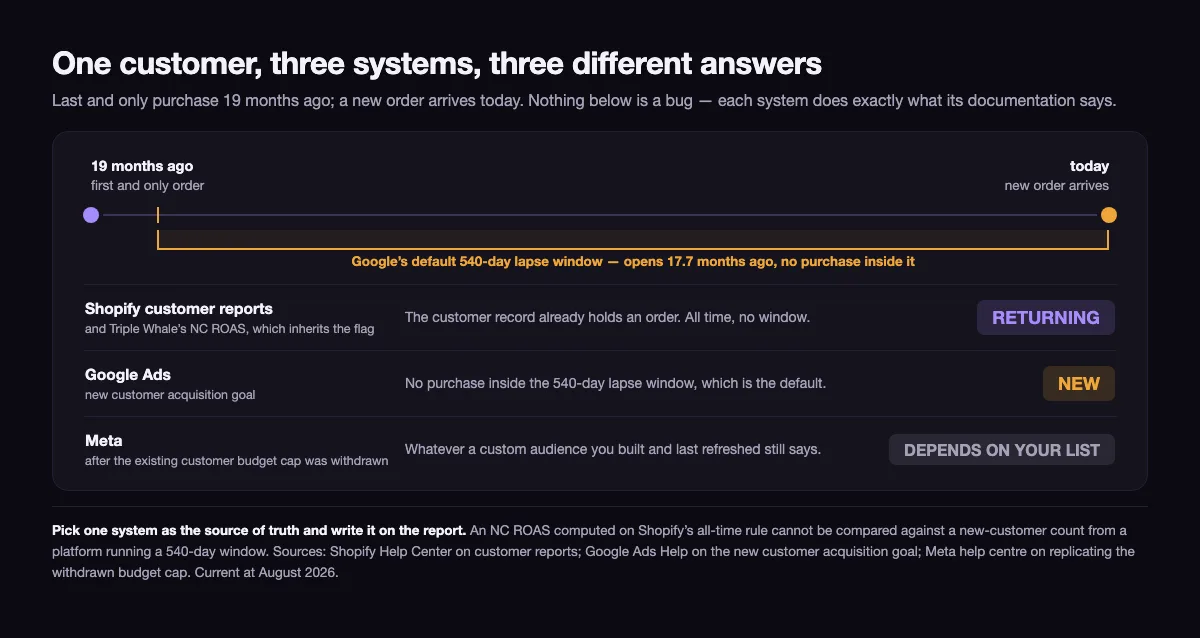
Before the number means anything, something has to decide who counts as new. Three systems do this in production and a fourth inherits its answer from one of them, and they do not agree — so the same December order can be new in one dashboard and repeat in another.
| System | Rule for “new” | Window | Who defines it |
|---|---|---|---|
| Shopify customer reports | The customer record has no earlier order | All time | Shopify |
| Google Ads, new customer acquisition goal | Has not purchased inside the lapse window | 540 days by default | You, or Google’s autodetection |
| Meta, after the budget cap was removed | Absent from a custom audience you uploaded | However you built that list | You, entirely |
| Triple Whale NC ROAS | The is_new_customer flag on the order | Inherited from the store | Shopify |
Shopify is the strictest and the simplest. Its documentation is one sentence: “A first-time customer is a customer who placed their first order with your store.” The classification travels with the customer record rather than with the report you are looking at — Shopify notes that customer report data “is based on the entire order history of the new customers in the report, not only the orders that were placed during the selected timeframe.” Someone who bought once in 2019 is not new in 2026, ever.
Google Ads is the most permissive, and the number is published. Its help documentation defines the target as a “new customer who hasn’t purchased within a given time period (540-day lapse window recommended and set at default, but not required).” Five hundred and forty days is roughly seventeen and three-quarter months. A customer who last bought nineteen months ago is a returning customer to Shopify and a new customer to Google Ads simultaneously, and both systems are behaving exactly as documented. Google offers three modes on top of that definition — New Customer Value mode, which bids higher for new customers than existing ones; High-value new customer mode, which bids higher again for the valuable ones; and New Customer Only mode, which bids for nobody else — and you can either let Google detect the status or report it yourself through the conversion tag, which Google’s own documentation says “would allow for better accuracy.”
Meta now has no built-in answer at all. The Existing customer budget cap, which let Advantage+ shopping advertisers limit the share of budget spent on people already in a custom audience, was withdrawn; Meta’s help centre states it “is no longer available.” The replacement is manual: run a sales campaign whose ad set excludes the custom audiences representing your existing customers, or split into two ad sets with separate spending limits. Either way, “existing customer” means whatever is in a list you built and last refreshed yourself — a definition with no window at all unless you impose one.
The practical instruction is short. Pick one system as the source of truth for the metric, note which one in the report itself, and never compare an NC ROAS computed on Shopify’s all-time rule against a new-customer count from a platform running a 540-day window. They are different questions wearing the same word.
Four places the new-customer filter is simply wrong
Even inside one system, the flag misfires in ways that always point the same direction — toward overstating NC ROAS.
Guest checkout with a different email. Shopify creates a customer profile when someone places an order, and “each profile can have only one email address.” A returning buyer who checks out as a guest with a work address instead of a personal one becomes a second profile, and that profile’s first order is a first order. Nothing in the data marks the two as the same human.
Duplicate profiles that cannot be merged. Shopify does let you merge duplicates, which is itself an admission that they occur. But merging is blocked outright if “either of the customer profiles has, or has ever had, a subscription contract,” and equally blocked for profiles with a vaulted credit card, store credit, an active B2B company link, or multipass login. For a subscription brand — precisely the business type most interested in new-customer economics — the duplicate is permanent. It will report as a new customer forever.
Multiple devices and a broken match. Where the platform rather than the store decides, identity depends on matching signals surviving the trip from browser to ad account. When the match fails, the safe default is to treat the person as unknown, and unknown reads as new. Improving the quality of that signal is what server-side event forwarding is for, and it narrows this failure without eliminating it.
Returns, which unwind the revenue but not the label. A first-time buyer who returns the order keeps the customer record, so their next purchase is a repeat one — while the returned revenue has already been counted in that month’s new-customer numerator. The order gave the money back. It did not give back the ad spend, and it did not give back its place in the ratio.
None of the four is a reason to distrust the metric. They are a reason to read it as a directional series measured the same way each month, rather than as a figure precise to two decimals that can be compared against someone else’s.
The new-customer ROAS threshold, and why it sits below your blended one
Here is the arithmetic that most discussion of this metric skips, and the reason “is 1.2x good?” cannot be answered from the number alone.
Start with the input. For a store on a 60% gross margin, with roughly twelve points of variable cost beyond cost of goods and the 19.3% online return rate the National Retail Federation reports, contribution after returns is 38.74% of revenue and break-even ROAS is 2.58x — the figure derived in full in what counts as a good ROAS. Use your own contribution rate if you have it; the structure below does not change.
Now ask what advertising actually has to cover. At break-even, the contribution from all revenue exactly covers all ad spend and no more. Write that out and divide through by spend:
contribution rate × (NC ROAS + repeat ROAS) = 1
where repeat ROAS is simply repeat revenue over the same total ad spend. Rearranged, that gives the threshold:
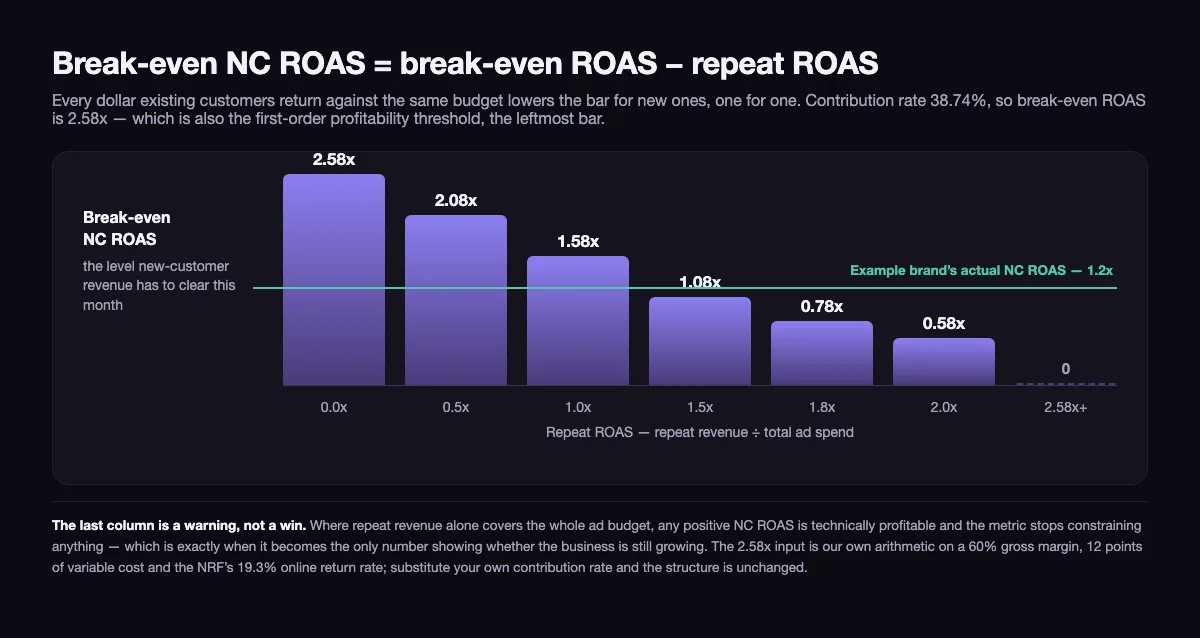
Break-even NC ROAS = break-even ROAS − repeat ROAS
Your new-customer target is your ordinary break-even, reduced by exactly the return your existing customers already deliver against the same budget. That is the whole reason it sits lower, and it is a subtraction rather than a vague allowance.
Back to the $50,000-a-month store. Revenue splits $60,000 new and $90,000 repeat, so repeat ROAS is 1.8x. Break-even NC ROAS is 2.58 − 1.8 = 0.78x. The actual 1.2x clears it, and the margin is real money: contribution of 38.74% on $150,000 is $58,110 against $50,000 of spend, leaving $8,110.
| Repeat ROAS (repeat revenue ÷ total ad spend) | Break-even NC ROAS at a 38.74% contribution rate |
|---|---|
| 0.0x | 2.58x |
| 0.5x | 2.08x |
| 1.0x | 1.58x |
| 1.5x | 1.08x |
| 1.8x | 0.78x |
| 2.0x | 0.58x |
| 2.58x or more | zero — advertising already pays for itself on repeat revenue alone |
Two warnings about that table.
The last row is not good news. If repeat revenue alone covers the ad budget, any new-customer ROAS above zero is technically profitable this month, and the metric stops constraining anything. That is the position of a brand harvesting its existing base, and it is precisely when NC ROAS becomes the only number telling you whether the business is still growing.
The row you are on is a snapshot, not a promise. Repeat ROAS this month comes from customers acquired in previous months, so a threshold calculated from it assumes the acquisition engine keeps running at the same rate. Cut acquisition and the repeat term decays behind you, raising the threshold at exactly the moment you have stopped clearing it.
First-order profitability is the other threshold, and it is much higher
The threshold above is the steady-state one: does advertising pay for itself this month, counting everything the business banked. There is a stricter test, and it is the one investors and cash-constrained founders actually care about.
First-order profitability asks whether the first purchase alone covers what it cost to acquire. On the same contribution rate, that means an NC ROAS at or above the full 2.58x — no repeat term, no subtraction. Upcounting, the only page in the US top ten to publish a range, reports that “most brands see NC ROAS somewhere between 0.5X and 2.5X.” Read against 2.58x, that observation says something blunt: on these cost assumptions, most brands do not make money on the first order and are relying on the second.
That is a legitimate way to run a business, and it is a fragile one. It works when repeat purchase is reliable and the gap between spending and recovering is short enough that the balance sheet can carry it. It fails when either assumption slips, and it fails quietly, because reported ROAS keeps looking the same throughout. If you are going to run below first-order break-even deliberately, the number to keep beside NC ROAS is the lifetime value of the customer you are buying — and the honest version of it, measured on cohorts you have actually observed rather than projected from a retention curve you like.
The two thresholds also disagree usefully. A brand clearing the steady-state threshold but far below first-order break-even is growing on borrowed time, and how long that borrowing runs before the customer pays it back is a separate number worth holding beside this one; a brand clearing both has room to raise spend until the first one binds. Knowing which of the two you are looking at is more useful than any benchmark.
Reading the number month to month without fooling yourself
Four habits make the metric useful and their absence makes it decorative.
Fix the definition and write it on the report. All-time Shopify rule or 540-day platform window, stated once, at the top. A series that silently changes definition mid-year is worse than no series.
Track the share, not only the ratio. New-customer revenue share is the term that connects your two ROAS figures, and it moves first. A share falling from 40% to 32% will drag NC ROAS down by a fifth before anything is visibly wrong with the advertising.
Recompute the threshold when costs move. The threshold is built from a contribution rate and a repeat return, and both drift. A change in return rate or shipping cost moves your break-even before it moves any number in an ad account — and what a click costs is the input everyone watches while the other two go unwatched.
Do not treat a filtered number as a proven one. New-customer ROAS corrects for mix. It does not establish that the campaign caused the purchase, and no amount of filtering will: that requires holding spend back somewhere and comparing total revenue, which is a different exercise with a different name. Treat NC ROAS as the best available observational read and keep the caveat attached.
If the question is which of these numbers your account should actually be managed against, and on which definition, that is the sort of thing our paid media team settles before touching a bid.
Every figure on this page, with its source and window
| Figure | Source | What it covers | Window |
|---|---|---|---|
| NC ROAS = new customer order revenue ÷ blended ad spend | Triple Whale metric documentation | Definition as implemented in the dashboard | current at August 2026 |
| 540-day lapse window, default and adjustable; three acquisition modes | Google Ads Help, new customer acquisition goal | Google’s own definition of a new customer | current at August 2026 |
| Existing customer budget cap “no longer available”; manual exclusion as replacement | Meta help centre, via Advantage+ campaign guidance | Meta’s new-versus-existing controls | current at August 2026 |
| First-time customer rule; report data uses entire order history | Shopify Help Center, customer reports | Shopify’s classification rule | current at August 2026 |
| One email per profile; merge blocked by subscription contracts and several other conditions | Shopify Help Center, managing customers | Duplicate-profile mechanics | current at August 2026 |
| “Most brands see NC ROAS somewhere between 0.5X and 2.5X” | Upcounting | Observed range, sample not published | not stated |
| 2.58x break-even, 38.74% post-returns contribution rate | Our arithmetic, on a 60% gross margin, 12 points of variable cost and the NRF’s 19.3% online return rate | Worked in full in our ROAS benchmarks piece | NRF figures, summer 2025 |
The identity, the threshold formula and every worked example are our own arithmetic on the inputs named above, not survey findings. Where a range is quoted from another publisher it is marked as an observation, because none of the sources we found publishes a sample size behind an NC ROAS benchmark.
09 / Reader questions
Frequently asked questions
01What is NC ROAS?
NC ROAS is new-customer return on ad spend: revenue from first-time buyers divided by total advertising spend. Triple Whale, which popularised the abbreviation, defines it as new customer order revenue over blended ad spend. It answers a question ordinary ROAS cannot — whether the money is buying customers or re-buying the ones you already had.
02What is the formula for new customer ROAS?
New-customer revenue divided by total ad spend. The denominator is all advertising spend, not the portion aimed at new customers, which is why the number looks low next to a platform figure. You can also get it without new software: blended ROAS multiplied by the share of revenue that came from first-time buyers gives exactly the same answer.
03Why is new customer ROAS lower than total ROAS?
Because it keeps the same denominator and shrinks the numerator. Blended ROAS counts all revenue over all ad spend; NC ROAS counts only first-time-buyer revenue over that same spend. The ratio between them is your new-customer revenue share, so a brand where 40% of revenue comes from new buyers has an NC ROAS exactly 40% of its blended one.
04Is a new customer ROAS below 1 bad?
Not by itself. Below 1 means the first orders from new customers did not return the whole advertising budget, which is normal for any brand whose repeat revenue also rides on that budget. Upcounting reports most brands land between 0.5x and 2.5x. The figure to compare against is your break-even minus your repeat return, not 1.
05What is a good new customer ROAS?
There is no market figure worth targeting, only your own threshold, which is your break-even ROAS minus the return your repeat revenue already produces on the same spend. For a 60% gross-margin store with a 1.8x repeat return, that threshold is 0.78x. The only published range we found is Upcounting's 0.5x to 2.5x, offered as an observation rather than a benchmark.
06How is a new customer actually identified?
It depends entirely on which system you ask, and the three in common use disagree. Shopify calls a customer first-time if the customer record has no earlier order, over all time. Google Ads calls one new if they have not purchased inside a lapse window, 540 days by default. Meta no longer decides at all: a customer counts as existing only if they sit in a custom audience you built and refreshed yourself.
07What is the difference between NC ROAS and blended ROAS?
The numerator, and nothing else. Blended ROAS divides total revenue by total ad spend; NC ROAS divides first-time-buyer revenue by that same total spend. Blended tells you whether advertising pays for itself this month, NC ROAS tells you whether it is buying growth. A brand can be comfortable on the first and shrinking on the second.