Published
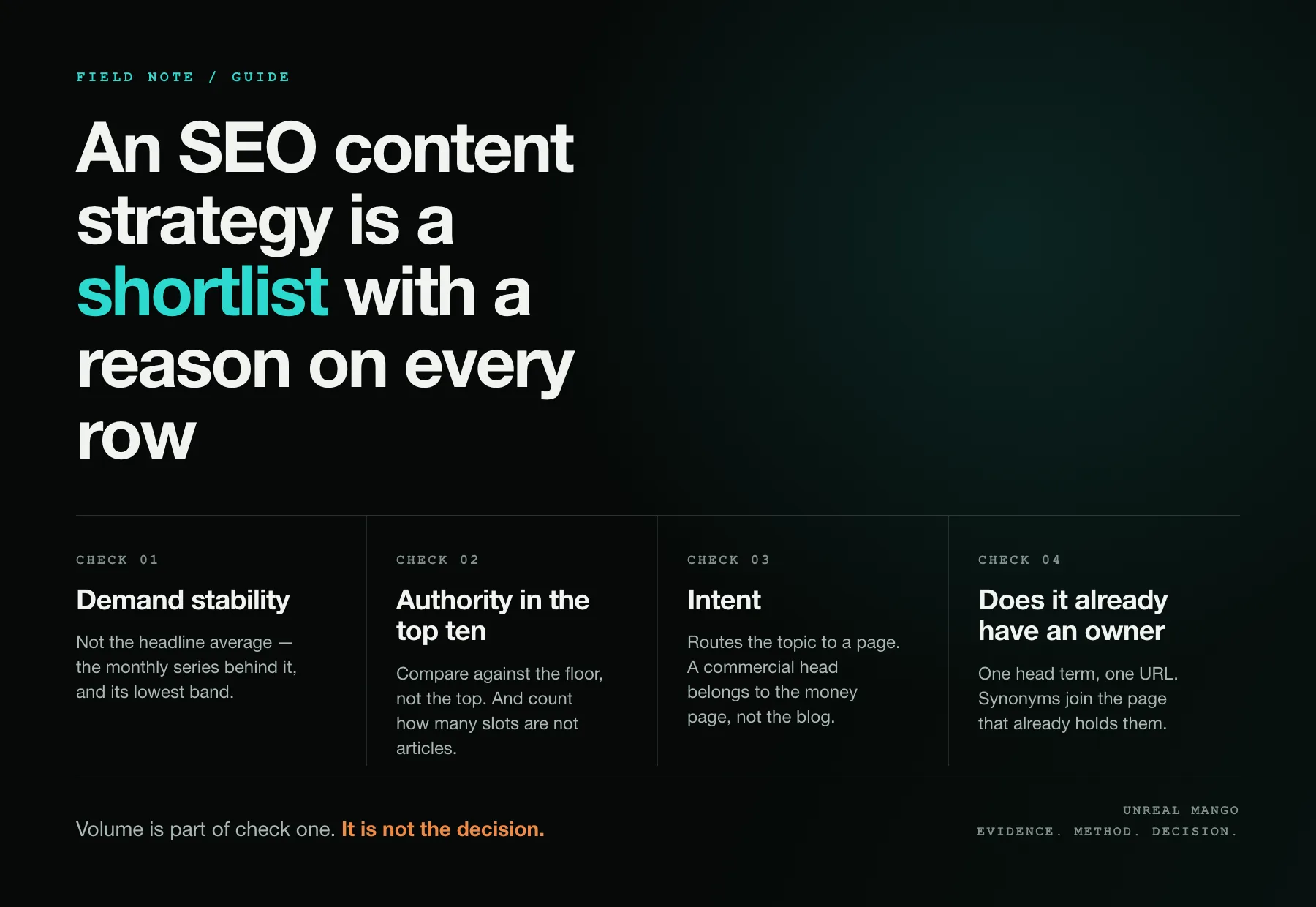
An SEO content strategy is the rule that decides which topics get written, in what order, and which get turned down. It is not the list of topics that comes out of it. Search volume alone does not decide: four measurable things do, and volume is only part of the first one.
Almost everything published under this phrase describes the same production line — research, write, optimise, measure. That line tells you how to make a page. It does not tell you which page, and it never tells you which one to refuse.
How this was checked. Everything Google served in the United States for “seo content strategy” on 23 August 2026 was recorded: nine organic results, one AI Overview, one People Also Ask block. All nine results were read. Alongside it, the twelve-month demand series for the term, its difficulty score, and a third-party authority score for every ranking domain were pulled and are quoted below with their sources. Every measured number below comes from that snapshot; the worked example in the next section is illustrative and is labelled as such.
Where SEO changes a content strategy, and where it does not
A content strategy settles a handful of things once so that individual pieces are not argued from scratch: who you publish for, what you promise them, which formats you commit to, and what you stop doing. Those decisions are not made by search data and cannot be. That work, and the test for whether your document actually makes them, is a content strategy’s own subject and is not repeated here.
An SEO content strategy takes those decisions as settled and adds exactly one input: measured demand. It answers a narrower question. Given the audience you already committed to, which of the things they are typing into a search box are worth a page of yours, in what order, and which are not?
That narrowing is the whole value. It also sets the boundary of what search data may decide. Demand can tell you that four hundred people a month ask a question. It cannot tell you whether answering it serves the audience you chose, and a strategy that lets volume override that is a keyword list with a job title.
The shortlist table: six columns that settle a topic before it is written
The output of the process is one table. Every candidate cluster is a row, and a row is only finished when all six cells are filled. A cluster with an empty cell is not ready to be written, whatever its volume.
| Cluster (head plus synonyms) | Intent | Page type | Money page it links to | Priority | Success, and by when |
|---|---|---|---|---|---|
| Commercial charger installation cost | Commercial | Guide with a price band | /services/installation/ | 1 — two page-one slots are held by directories, not articles | Top ten, and two enquiries that cite the page, by day 120 |
| Charging for apartment buildings | Commercial | Guide | /solutions/multifamily/ | 2 — page one is all competitor articles, but the floor is reachable | Top twenty and a measurable share of the cluster’s queries, by day 120 |
| Power draw of a fast charger | Informational | Explainer | /services/installation/ | 3 — real slot, longer walk to a purchase | Top ten; enquiries are not expected from this page |
| Installers in a named city | Local commercial | Not an article | The location page already owns it | Not queued | The location page gets the work, instead of a second page competing with it |
| Charging for fleet depots | Commercial | Guide | None — the segment page does not exist yet | Blocked | Nothing is written until there is somewhere to send the traffic |
| Best chargers of the year | Commercial listicle | Not an article | None | Dropped | Every slot in the top ten is held by a manufacturer or a review site |
That example is illustrative, drawn from a business that installs commercial vehicle charging. The volumes behind such a table are yours to measure; what carries over is the shape. Note what the last three rows do. One topic is handed to a page that already owns the term, one is blocked because the page it would send people to does not exist yet, and one is dropped outright. A table that can only produce rows is an inventory, and an inventory publishes everything eventually.
Four checks fill the first four columns: demand stability, the authority already sitting in the top ten, intent, and whether the topic already has an owner on your own site. Those decide whether a row survives at all. What decides its place in the queue is a separate rule, set out further down, and it uses only two of the four.
The reported monthly volume hides a 13.6x swing
Start with the number everyone starts with, and then look underneath it.
Google’s keyword planner reports 720 monthly searches for “seo content strategy”. The twelve monthly figures behind that number are 880, 1,000, 390, 140, 260, 320, 720, 1,900, 880, 1,600, 720 and 720. The median month is indeed 720. The highest month is 13.6 times the lowest. Four of the twelve months came in under 400.
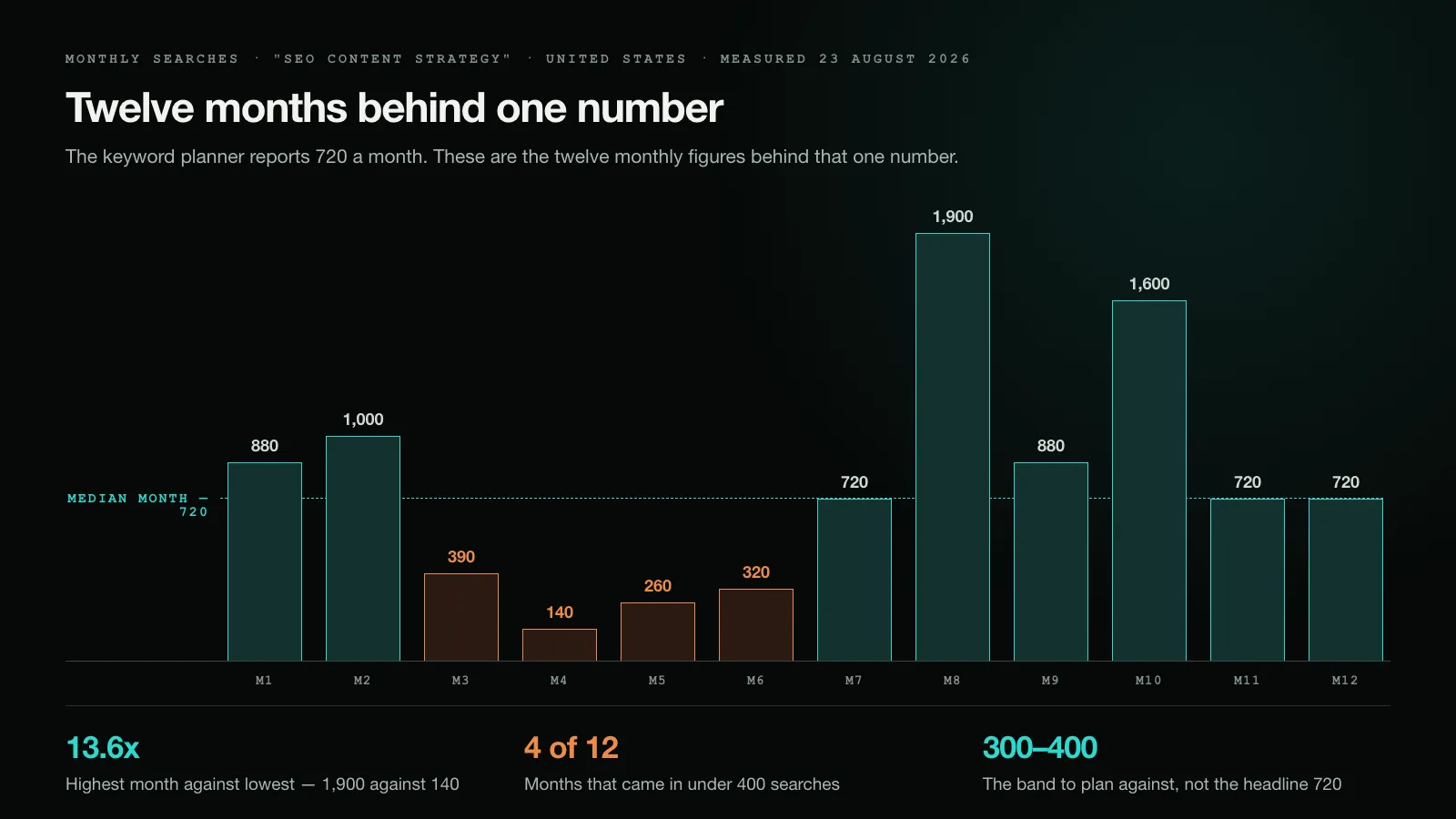
A plan built on 720 a month is a plan that will look broken for a third of the year. A plan built on 300 to 400 is a plan that survives the trough and gets a pleasant surprise at the peak. The rule that falls out of this is simple: plan against the lower band of the series, never against the headline number.
Two things produce a spread that wide. One is real seasonality. The other is a tool that has clustered several phrasings together and is reporting them as one number, which is a fact about the tool rather than about the market. They call for different responses, so it is worth working out which you have. Here the related searches point at the second: three of the eight Google shows alongside this query are general beginner questions about what SEO is, which is a much larger and less stable audience attached to a different question.
The disqualifier. If several differently worded versions of a term come back with identical volume, identical competition and an identical monthly series, the tool has merged meanings that are not the same. The number is inflated, and the page you write against it will rank for a slice of it at best.
Reading the top ten for whether there is a slot you can take
Difficulty scores compress a lot of judgement into one integer. This term scores 16 out of 100, which reads as easy. That number is worth roughly one minute of your attention. What the nine results are actually made of is worth twenty.
Two things are worth measuring on the page-one set. The first is authority: on a 0–1000 domain-strength index, the nine organic results for this term score from 282 at the floor to 937 at the top, with a median of 456. The 937 is a post on LinkedIn, which is a publishing platform rather than a competitor, and once it and Google’s own documentation are set aside the median of the seven topical domains is 429.
The second is composition, and it matters more. Three of the nine slots are not held by an article about the subject at all: one is Google’s own general SEO starter documentation, one is a post on LinkedIn, one is a lesson inside a vendor’s training academy. One more, five years old, is holding its position on domain strength rather than on anything it says.
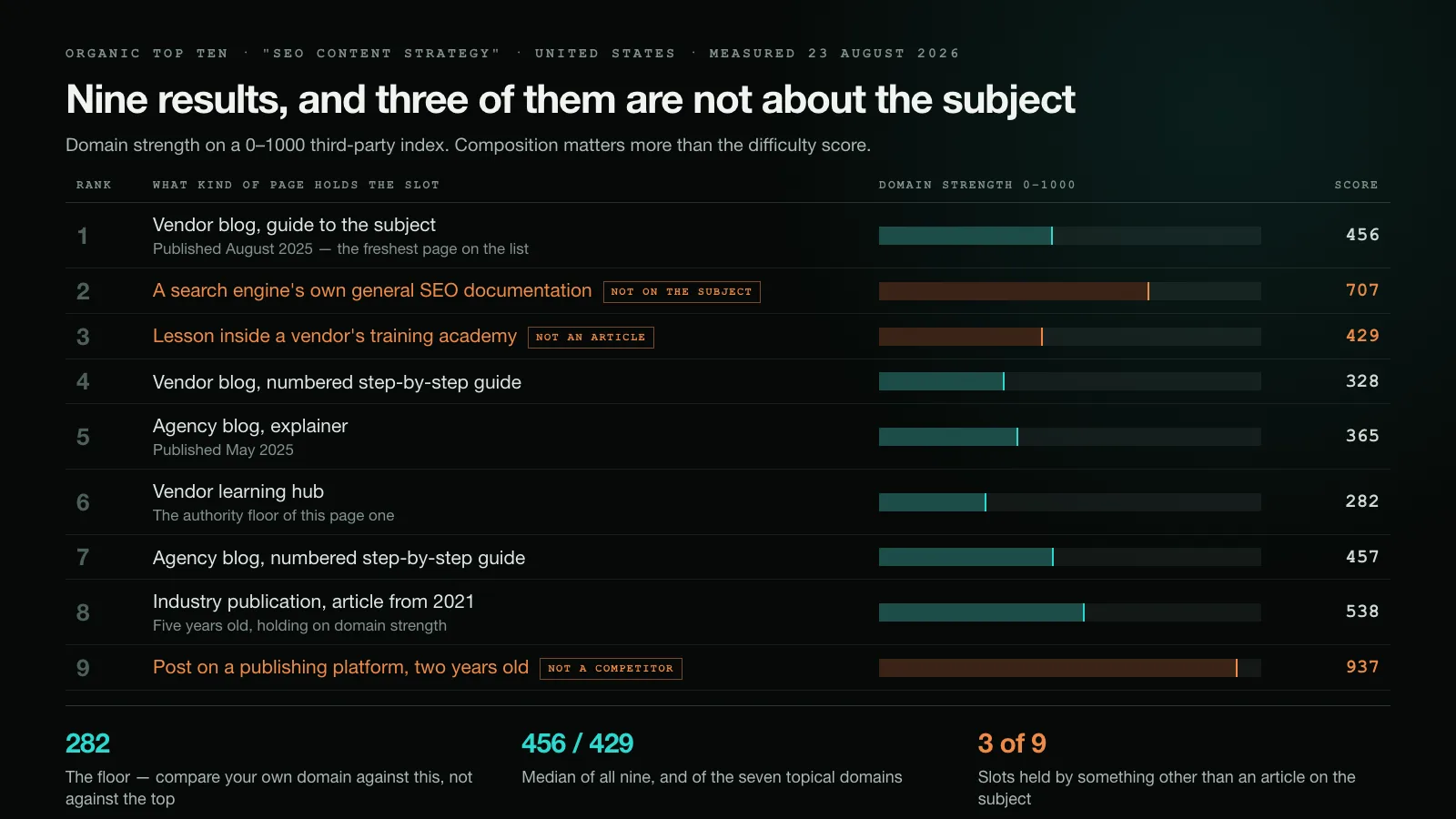
The check: compare your own domain’s score against the floor rather than against the top, and then read that comparison together with the composition instead of on its own. A floor above you, on a page one made entirely of competitors’ articles, means the slot does not exist yet and no amount of writing quality creates it. A floor above you on a page one where two or three slots are held by documentation, platform posts or gated lessons is a different situation: those slots are not being defended on authority, and a page that is actually about the subject can take one.
This page’s own record. Demand: median 720, band 140 to 1,900, planned against 300 to 400. Difficulty: 16. Authority: the page-one floor is 282, the median 456, and on the same index this domain sits below the floor rather than above it. Composition: three of the nine slots are not held by subject articles. Intent: commercial, at 0.79 on the classifier. Owner: none — no page here had been assigned this cluster. Verdict: write, first priority. Not because the authority check was passed, because it was not, but because an unconsolidated page one is the one case where the floor stops being a veto. That is a judgement rather than a calculation, and it is falsifiable: this page either reaches the top ten or it does not, and the row above is what it gets judged against.
Intent decides which page gets the topic, not whether you write it
Intent is usually taught as a label to attach after the fact. It is more useful as a routing rule, applied before anything is commissioned.
For this term the classifier returns commercial intent at 0.79, and the paid market agrees: advertisers pay $4.44 a click on average and bid up to $19.60 for the top of the page. People searching this are, in large part, deciding whether to hire someone. That does not make it a bad topic for an article. It makes it a topic that has to point somewhere.
The routing rule has three outcomes:
- Commercial head terms go to the money page. “Content marketing agency” is not a blog topic. It belongs to the service page, and an article that tries to rank for it competes with the page that actually converts.
- Commercial-leaning informational terms become articles with a named destination. This one is such a term. The article is allowed to exist because the head is a question, not a purchase, and it is required to link once to the page that sells the service.
- Purely informational terms are written when they support a cluster, and skipped when they do not. Traffic that cannot walk anywhere is a cost with a nice-looking chart attached.
The column in the shortlist table that catches the most mistakes is the fourth one, the money page. If you cannot name the page a topic sends people to, you have not found a weak spot in your content — you have found a missing page in your site.
One head term, one URL, and where the synonyms go
Phrasings that mean the same thing belong on one page. “Content strategy for seo”, “content strategy and seo” and “seo and content strategy” are the same question asked three ways, and they are all assigned to this URL. Splitting them across three pages would split the signal three ways and rank all three worse than one page would have ranked alone.
The test for whether a phrasing deserves its own page is intent, not wording. If the person typing the variant wants a different kind of answer — a template rather than an explanation, a price rather than a method — that is a second page. If they want the same answer in different words, it is the same page.
This is why the shortlist is kept as a permanent record rather than rebuilt each quarter. Once a cluster is assigned to a URL, the assignment is the thing that prevents a future writer, in good faith, from proposing a page that already exists under a different title. Auditing what you have already published, and deciding what to keep, merge or remove, is a separate exercise with its own thresholds; it is covered in our guide to conducting a content audit, and it runs after the assignment map exists, not instead of it.
Ordering the queue when you can publish ten pages a quarter
Most teams can publish far fewer pages than they have candidate topics. The ordering rule below is what the priority column in the shortlist encodes, and it deliberately does not sort by volume. Read it top down and stop at the first line that fits.
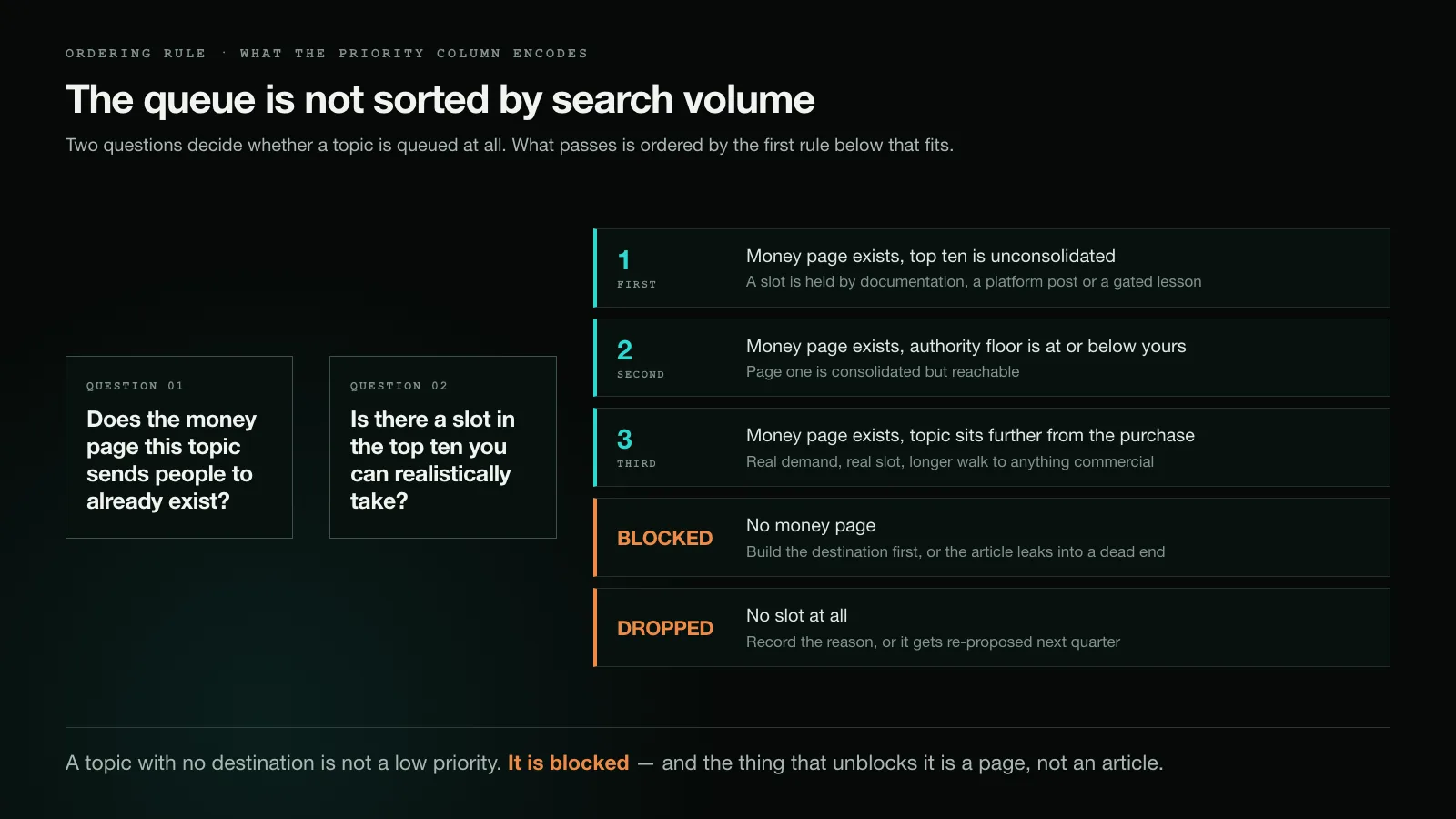
- The money page exists and the top ten is unconsolidated. Something that is not a competitor’s article — documentation, a platform post, a gated lesson — is holding a slot. These go first, every time. They are the cheapest positions on the board.
- The money page exists and the authority floor is at or below yours. Page one is consolidated but reachable. These are the workhorses of the quarter.
- The money page exists, a slot is reachable, but the topic sits further from the purchase. Real demand, real slot, longer walk to anything commercial. Worth writing, third in line.
- No money page. Blocked, not queued. Build the destination first or the article leaks its traffic into a dead end.
- No slot. Dropped, with the reason recorded, so that nobody proposes it again next quarter without new evidence.
Two disciplines make this hold. Record the reason for every drop, in the same table, permanently — a dropped topic with no recorded reason gets re-proposed roughly every second planning cycle. And leave the order alone once it is set. The gap between publishing a page and seeing where it settles is long, and how long is a question of its own; reshuffling the queue on week-three data destroys the only evidence you were going to get.
None of this ordering survives a site search engines struggle to crawl. If pages are not being indexed at all, the technical checks come before topic selection, not after it.
What the AI Overview on this query changes about the plan
On 23 August 2026 this query returned an AI Overview large enough to carry an embedded video, and no featured snippet — the classic snippet position has been absorbed. The Overview cited eight domains. Two of them do not appear anywhere in the organic top ten.
That last detail is the actionable one. Being cited in the Overview and ranking in the ten are not the same achievement, and they are not won the same way. Ranking is won on the usual mix of relevance and authority. Citation appears to favour pages that state a checkable thing plainly — a number with its source, a definition in one sentence, a named comparison — because that is the shape of text a summariser can lift without inventing anything.
Three adjustments follow, and all three are cheap:
- Answer in the first two sentences of every section, then expand. A section that builds to its conclusion has nothing liftable in the first screen.
- Attach a method to every number you publish. “Measured on this date, in this market, on this many results” turns a claim into something a summariser can carry with attribution attached.
- Expect the click-through on Overview queries to be lower, and account for it in the success column before you publish, not in the post-mortem. A position that used to be worth a certain traffic share is worth less on these queries, and the honest response is to change the expectation, not the reporting.
What does not follow is abandoning the topic. Commercial intent at 0.79 and a $19.60 top bid say the remaining clicks on this query are worth more per visit than most informational traffic, not less.
When the right decision is not to write the page
Four conditions each end a topic on their own. The first two are checked first because they end it outright; the last two more often change which phrasing you should be targeting instead.
Every slot is held by someone selling the thing. If page one is ten vendors and no informational result, Google has decided this query is a shopping query. An explainer will not be admitted, however good.
The authority floor is far above you and page one is consolidated. Both halves have to be true. A floor well above your domain is only a veto when every slot is held by a competitor’s article, because that is a page one being defended on authority. Meet that and you have found a links project, and writing another article is not it.
The volume is a clustering artefact. Identical figures across differently worded variants, or a monthly series that swings by an order of magnitude with no seasonal explanation, both mean the number in the cell is not the number you will get.
The term is ambiguous and the ambiguity is not yours. If an abbreviation in the head term makes the AI Overview answer about a different industry entirely, the demand belongs to that industry. Take the longer, unambiguous phrasing instead, and record the ambiguous one as checked and rejected so it is not rediscovered as an opportunity in six months.
Whether the whole programme paid for itself is a different calculation, made over a different time window, and it is not the one that decides which page to write next. Confusing the two produces quarters where a profitable programme is cancelled because one page underperformed.
Handing the shortlist to the people who make the pages
The shortlist is a decision, not an instruction. Three things carry it into production, and each one takes exactly one row from the table.
The dates and owners go into the content calendar, which turns priority order into who owes what and when. The requirements for a single page go into a content brief — the cluster, the assigned head term, the money page it must link to, and the success criterion, all copied straight across so the writer is never guessing which of six similar phrases the page is meant to own. What comes back gets measured against the success column that was written before the page existed, which is the only version of that criterion worth trusting.
If a company already has a working calendar and briefs, and pages that still do not rank, the missing layer is almost always this one: nothing decided which topics were worth making, so everything proposed was made. Selecting well is unglamorous, it happens in a spreadsheet, and it is the part of the work that determines the ceiling of everything downstream. It is also the part we run first on every engagement.
11 / Reader questions
Frequently asked questions
01What is an SEO content strategy?
An SEO content strategy is the rule that decides which topics get written, in what order, and which get turned down, based on measured search demand rather than on what the team feels like publishing. The output is a shortlist where every row carries the reason it is there.
02How is an SEO content strategy different from a content strategy?
A content strategy settles who you publish for, what you promise them and what you refuse to publish, across every channel. An SEO content strategy is narrower: it takes those standing decisions as given and adds one input, measured search demand, to decide which topics inside them get made first.
03What are the top 5 SEO strategies?
There is no agreed list of five, and the number is a packaging convention rather than a finding. The activities that reliably matter are picking topics against real demand, matching intent to page type, giving one URL one head term, making the site crawlable, and earning links. Ranking them into a top five is marketing, not method.
04What is the 80/20 rule in SEO?
It is a borrowed heuristic, not a rule with a defined threshold: most of a site's search traffic usually comes from a small share of its pages. It is useful as an argument for auditing what you already published before adding more, and useless as a target, because nothing in it tells you which pages will be the small share.
05Is SEO dead now with AI?
No, but the click is under pressure on queries where an AI Overview appears. On this article's own head term, measured in the United States on 23 August 2026, Google served an AI Overview large enough to carry an embedded video, and it cited eight domains, two of which do not appear in the organic top ten at all.
06What is an SEO content strategist?
An SEO content strategist decides what gets published against search demand: they run the keyword research, cluster it, assign one head term per URL, set the order of production and say which topics are not worth a page. Writing is usually not their job. Deciding what is written, and refusing the rest, is.
07Is there an SEO content strategy template?
The shortlist table in this article is the template, and it is six columns: cluster, intent, page type, the money page it links to, priority, and what counts as success by when. A template with more columns than that tends to record the work instead of deciding it.
08How many keywords should one page target?
One head term per URL, plus its synonyms. Phrasings that mean the same thing belong on the same page, because splitting them across two URLs splits the signal and both pages rank worse. A second page is justified when the intent behind the phrasing differs, not when the wording does.