Published
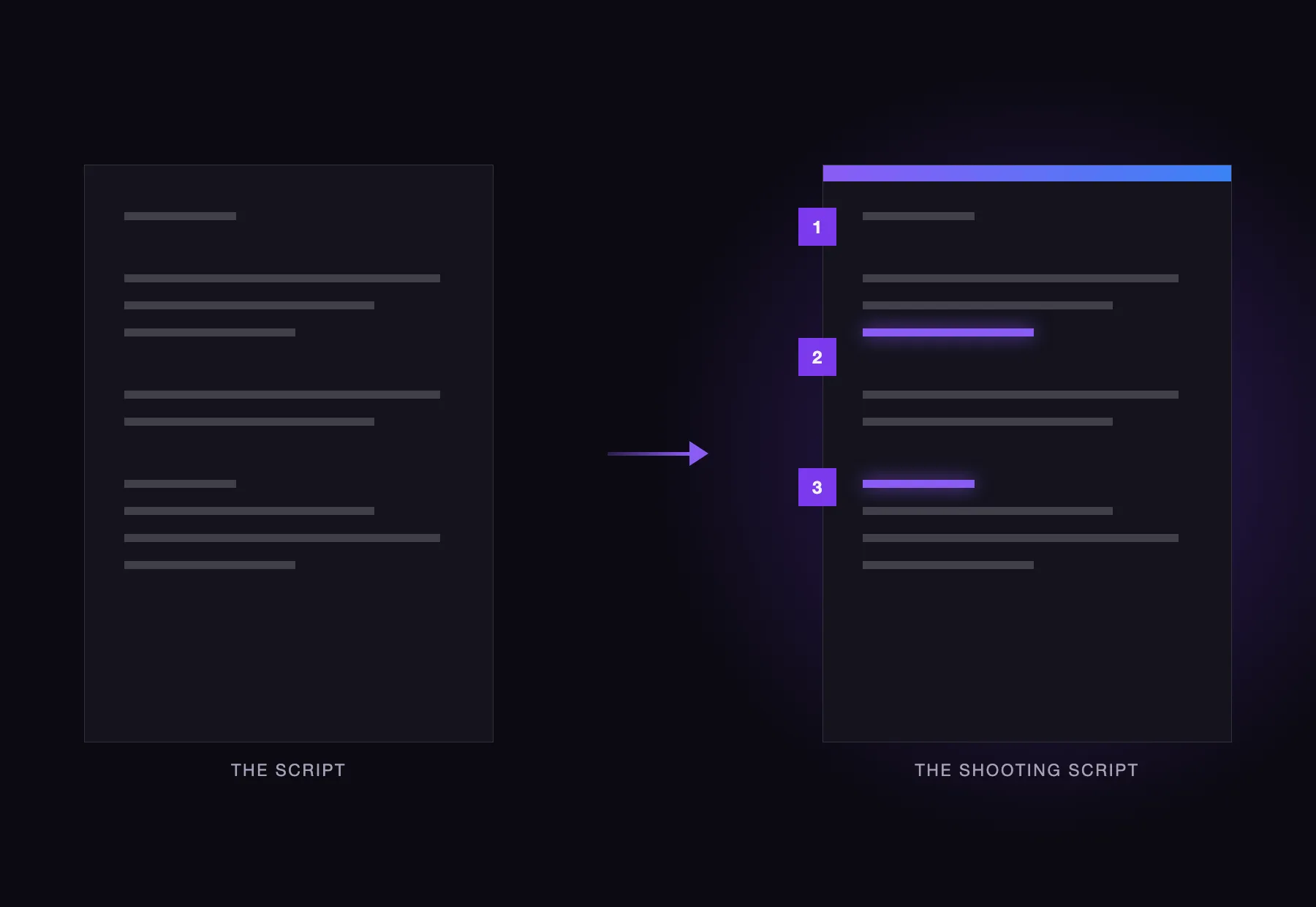
A shooting script is the version of a script marked up for production: scenes and shots numbered, camera and staging direction written in, and production notes attached, so that every department can plan from the same page. It is not a better script. It is the same story turned into a build order.
Almost everything written about the term describes a stage in the making of a narrative film. Under other names, it is also the single document that decides whether a commercial shoot day runs to plan — and the question most clients actually have is not what it contains, but whether their project needs one at all.
How this was checked. For this query in the United States on 23 August 2026, Google returned an AI Overview, an image pack sitting above every one of the organic results, and eight organic positions: Wikipedia, StudioBinder, a Reddit screenwriting thread, Adobe, a YouTube tutorial, a university library guide, WeVideo and Arc Studio. Between them the definition is stable — the script marked up for production, with numbered scenes and camera direction — though the Reddit thread is there precisely because no one standard is enforced. Seven of the eight frame it as a document of a feature film or a student assignment; the eighth is a library guide to finding published screenplays. None covers what the same document is called on commercial work, who on a crew reads which part of it, or when a project is small enough not to need one. Those are the sections below. The image pack, worth knowing before you download from it, is filled almost entirely with blank templates.
What a shooting script adds to a script that already reads well
A finished script answers two questions completely: what happens, and what is said. It answers a third only by implication — how any of it will actually be captured — and closing that third question is the whole job of the shooting script. The words themselves usually survive untouched. What arrives is a layer of production information written on top of them.
Four things get added, and roughly in this order.
Numbers. Every scene gets one, and on many productions every shot inside it does too. This is the least interesting part of the document to read and the most consequential part to everyone downstream, because the numbers are what every other piece of paper refers to. The schedule sorts by them. The budget attaches costs to them. The call sheet lists them. The continuity report indexes to them. The editor’s bins are named after them. Nothing else in the document works as a shared key — scene titles get reworded and page counts shift, but a number, once issued, stays attached to the same piece of story. The mechanics of numbering individual shots, and of laying a page out in the two-column video format, are a separate craft covered in our guide to writing a video script. What matters here is only what the numbering is for.
Camera and staging direction. A reading draft keeps this to a minimum on purpose, because directing from the page is considered bad manners in a document whose job is to be read for the story. The shooting script puts it back in, but selectively: where the choice commits somebody. A move that needs track laid, an insert that costs a second setup, an angle that decides which wall the lights go on. Direction that changes nothing operational still does not belong in it.
Production notes. Requirements pulled out of the action and restated as requirements. A practical effect. Two identical props, because one of them gets destroyed on the take. A location that permits until six and not past it. A performer under eighteen, with the hour limits that brings. These are frequently absent from the reading draft because they interrupt the read; they are mandatory here, because somebody has to buy them, book them or apply for them.
A lock. At some point the numbers are declared fixed, and from then on the document stops being edited in place. Changes are issued as replacement pages, printed on a fixed sequence of coloured stock so that anyone can tell across a room whether the pages in their hand are current. A scene inserted after the lock takes a letter rather than a number of its own, so that nothing already scheduled has to be renumbered. It looks like bureaucracy and it is: it exists because renumbering after the schedule is built silently invalidates every other document on the production.
Shooting script, spec script, screenplay: telling the three apart
Two of those are drafts and one is the general term for the thing itself. A screenplay is what all of this is — the scene headings, the indented dialogue, the courier — and a spec script and a shooting script are two states of the same screenplay rather than two rival kinds of file. That is why “shooting script vs screenplay” is a slightly malformed question. The real comparison is between the draft written to be chosen and the draft written to be built.
| Spec script | Shooting script | |
|---|---|---|
| Written to | Sell the story or win the job | Get the story built |
| Primary reader | Producer, financier, agent, competition reader | The crew: director, AD, camera, sound, editor |
| Scene numbers | Absent by convention | Present, and permanent once locked |
| Camera direction | Kept minimal on purpose | Written in wherever it commits a resource |
| Production notes | None | Attached to every line that needs buying |
| Edited by | The writer | The director and the production office, with the AD and department heads |
| Cost of one change | A rewrite | A reschedule |
The last row is the one that costs money. A change to a spec script costs an afternoon of somebody’s writing. The identical change to a locked shooting script moves a scene between days, which moves cast availability, which moves a location booking, which moves the crew call — and each of those has a price attached to it. This is the entire reason the two documents are kept distinct rather than one file being edited continuously from first draft to wrap.
A marked-up page, element by element
Most of the example pages circulating online are blank templates rather than working documents, which makes the term look like a formatting exercise. It is not. A page carries six kinds of information, and each one is there because a different person needs it.
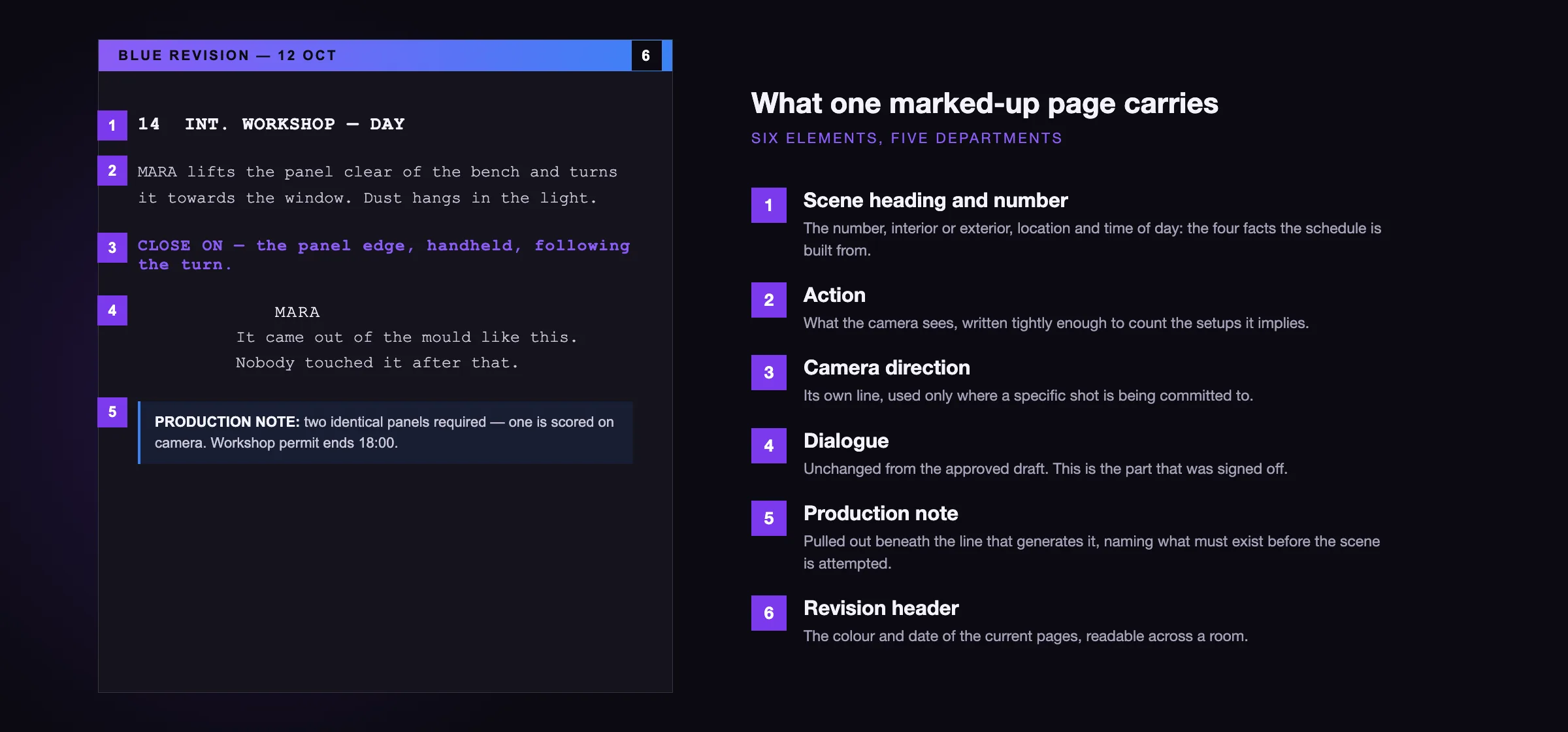
The scene heading carries the number, plus interior or exterior, the location and the time of day. Those four facts alone determine which day the scene can be shot on, so this single line is what the schedule is built from. The action describes what the camera sees, written tightly enough that a reader can count the setups it implies. Camera direction appears as its own line where a specific shot is being committed to rather than left to the day. The dialogue block is unchanged from the approved draft — this is the part that must not drift, because it is what was signed off. A production note is pulled out directly beneath the line that generates it, naming the thing that has to exist before the scene can be attempted. And the revision header states the colour and date of the current pages.
Six elements, one page, five departments reading it for different reasons. Which is the part that most explanations of the format leave out.
The same page read five ways, from director to editor
A shooting script is not read from top to bottom by anyone except the director. Everyone else scans it for their own layer and ignores the rest, which is precisely why the information has to be written down instead of explained in a meeting: five different extractions cannot survive as a conversation.
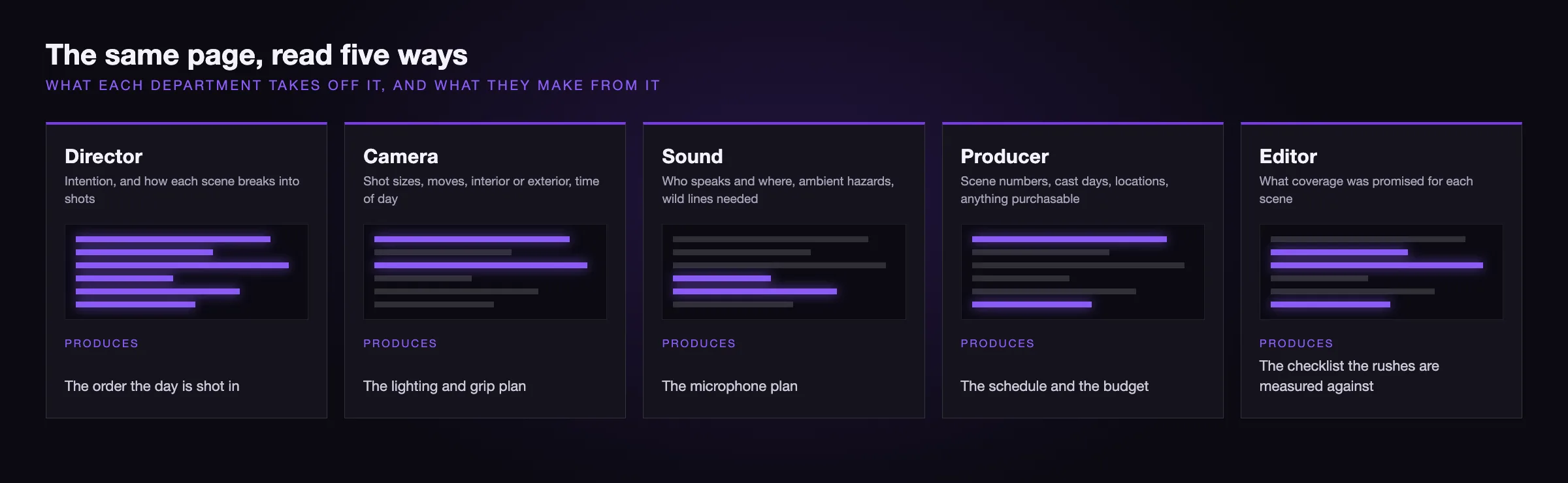
| Reader | Reads it for | Produces |
|---|---|---|
| Director | Intention, and how each scene breaks into shots | The order the day is shot in |
| Camera | Shot sizes, moves, interior or exterior, time of day | The lighting and grip plan |
| Sound | Who speaks and where, ambient hazards, wild lines needed | The microphone plan |
| Producer | Scene numbers, cast days, locations, anything purchasable — read with the first AD | The schedule and the budget |
| Editor | What coverage was promised for each scene | The checklist the rushes get measured against |
The fifth row is the one people forget, and it is the one that decides how the edit goes. An editor who has the shooting script knows what was supposed to exist. An editor without it can only work with what turned up on the cards, and has no way of telling a deliberate omission from a missing shot until it is far too late to ask for it.
When a shot list is enough, and when it stops being enough
A shooting script earns its place the moment more than one person has to make a decision without you in the room. Below that line it is overhead; above it, its absence is what the overruns are made of. The threshold is not a budget figure, and it is not a runtime — it is the number of independent decisions the day contains.
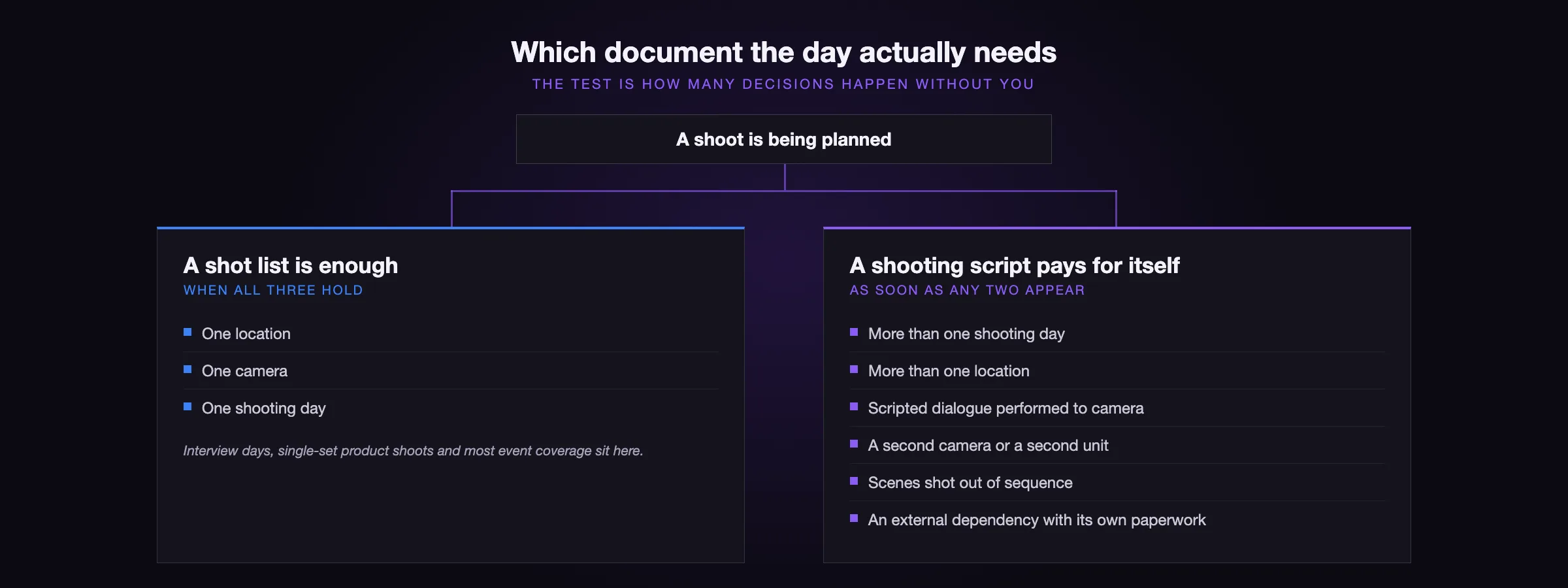
A shot list is enough when all three of these hold: one location, one camera, one shooting day. Interview days, single-set product shoots and most event coverage sit here comfortably. The list plus a running order is the whole plan, and writing a marked-up script for it would be paperwork nobody opens.
A shooting script starts paying for itself as soon as any two of these appear:
- More than one shooting day, so that something has to match across a gap.
- More than one location, so that scenes get grouped by place rather than by story order.
- Scripted dialogue performed to camera, so that what is said is a deliverable rather than a happy accident.
- A second camera or a second unit, working simultaneously and out of your sight.
- Scenes shot out of sequence, which is where continuity errors are manufactured.
- Any external dependency with its own paperwork — a drone, a permit, a stunt, an animal, a minor, a closed road.
Exactly one trigger on its own is the judgement call in the middle: a shot list with the running order and the dependencies written onto it usually still holds. Two is where it stops holding.
Two of six is a genuinely low bar, and most commercial jobs above a single day clear it without anyone noticing. That is the useful takeaway: the question is rarely “is this project big enough for a shooting script” but “which two of these are already true”.
What the day costs when nobody wrote one
The failures are not dramatic. Nothing collapses on set, and the shoot usually finishes on time. The cost appears afterwards, and it lands on four specific line items.
Coverage that only ever existed in one head. The director knew the cutaway they wanted and never wrote it down, the day ran long, and the shot was quietly dropped without anyone registering the decision. It surfaces in the edit as a cut that cannot be made. Patching it costs either a library purchase or a pickup day — and the general question of how much cutaway material a finished minute actually needs is worked through in our piece on B-roll.
Continuity discovered in the edit rather than on the day. Scenes shot out of order without numbered reference points produce mismatches — a cup on the wrong side, a jacket buttoned in the second half of a conversation — that are free to fix on set and expensive to fix afterwards. This is the failure a numbered document is most directly designed to prevent.
A requirement buried in a line of action. Somebody wrote that a character sets a document alight. Nobody extracted it as a note, so no duplicate prop was ordered and no fire safety cover was arranged. The scene stops, and standby crew hours accrue while it is resolved. The whole value of the production-note layer is that it moves these facts from prose into a list somebody can act on.
A schedule built from the wrong measurement. Days get estimated from page counts. Page counts stop being a good proxy the moment coverage is decided, because two pages of dialogue between two people is a very different day from half a page containing four setups. Without a marked-up script, the estimate is made against the reading draft and then quietly overrun on the day, which shows up as overtime rather than as a planning error.
None of these is caused by a missing document, strictly speaking. Each is caused by a decision that was made but never written down, which is the same thing from the point of view of everyone who was not there when it was made.
What the same document is called on commercial work
On a brand film, a case-study video or a product launch, nobody says “shooting script” out loud. The document still exists, under whatever name the producer happens to use — production script, running order, shot plan, setup list — and it does the same job with the contents rearranged around whatever the project actually has instead of scenes.
| Project shape | What the document actually is | What gets numbered |
|---|---|---|
| Scripted brand film with performers | Closest to the film case: a marked-up script with coverage decided | Scenes, then shots inside them |
| Interview-led case study | A setup list, a question order and a coverage plan for the cutaways | Setups, not scenes |
| Product or tabletop | A shot-by-shot script in which each shot is a lighting state | Shots only |
| Animated or motion piece | The script hands over to a board and a timed cut instead | Frames and sequences |
The interview case is the one that trips clients up. Because nobody is acting and nothing is scripted, it looks as though there is nothing to mark up — and then the day produces four hours of talking with no plan for what the editor will cut away to, no note of which questions have to be answered on camera versus in a caption, and no record of which setup a given answer was given in. The document that prevents that is a shooting script in everything but name.
The practical version of this is simply a request you can make. When you commission video production, ask to see the document the crew will work from before the shoot is booked, whatever it is called. If it exists, the numbers in it will match the numbers in the quote, and you can read across from one to the other. If it does not exist, you have found that out on the cheapest possible day.
If a shooting script has been set as coursework
The assignment is usually testing something narrower than it sounds. A tutor asking for a shooting script is almost never assessing formatting fidelity — they are looking for evidence that you have thought about coverage: that you know a scene is not one continuous view of events but a set of separate camera setups that have to be planned, shot and cut back together.
That produces a short and unglamorous checklist. Number the scenes. Write camera direction only where it changes what would otherwise be shot, and leave it out everywhere else — a page directing every glance reads as inexperience, not thoroughness. Attach production notes to anything that would have to be arranged in real life, including the things a student production could not actually afford, because noticing them is the point. And break at least one scene down into its individual setups, so the coverage thinking is visible rather than implied.
Two warnings, both from what the search results for this term actually contain. Downloading a blank template and filling the boxes produces a document that satisfies the format and demonstrates nothing, which is the most common way this assignment goes wrong. And reading published scripts — the route the university library guides are built for — is genuinely useful, but be aware that what is published is nearly always the production draft or a post-hoc transcript, not the annotated pages somebody carried around a set.
Where the shooting script sits between the approved script and the shoot
The chain is short, and each document in it answers a question the one before could not. The brief fixes what the piece is for. The script fixes the words and, through the word count, the running time. The shooting script fixes how those words will be captured — the coverage, the numbers, the requirements. From there the numbers feed the schedule and the call sheets, which are simply the shooting script re-sorted from story order into the order the days will actually happen in.
Where framing rather than timing is the contested question — animated work especially, but also any piece with a fixed slot length — a storyboard and then a timed cut of it sit alongside this, answering what each frame looks like and whether the sequence plays at real length. That is a different question from the one the shooting script answers, and it is covered separately in our guide to animatics. The two documents are complementary rather than alternatives: one specifies what is captured, the other specifies what it looks like.
The reason the order matters is that every stage inherits everything settled before it. A script rewritten after the shooting script is marked up invalidates the coverage. Coverage changed after the schedule is built invalidates the schedule. This is not a rule anyone invented — it is just what happens when five departments plan from the same numbers, which is the point of writing them down in the first place.
10 / Reader questions
Frequently asked questions
01What is the difference between a shooting script and a regular script?
A regular script fixes what happens and what is said; a shooting script fixes how it will be captured. It adds permanent scene and shot numbers, camera and staging direction, and production notes, so that scheduling, budgeting and every department on the crew can refer to the same numbered units.
02Who writes the shooting script?
In practice it is a two-handed job. The production office issues the locked, numbered draft every department works from; the director marks the coverage onto it — how each scene breaks into shots — with the first assistant director and the department heads. The writer's draft is the input. What changes at that point is not the writing but the decision about how it gets captured.
03What is the difference between a shooting script and a shot list?
A shot list is an inventory of setups; a shooting script keeps each of those setups attached to the dialogue, the action and the production requirements around it. On a job that has a shooting script, the list is derived from it. On a job small enough not to need one, the list plus a running order is the whole plan.
04Do you need a shooting script for a corporate or brand video?
Only when more than one person has to make a decision without you in the room. A single-camera, single-location, single-day shoot with no scripted performance runs perfectly well on a shot list and a question order. Once two of those conditions break at once — extra days plus extra locations, scripted dialogue plus a second camera — the marked-up document starts paying for itself.
05What does it mean when a script is locked?
Locking means the scene numbers stop moving. Once the schedule, the budget and the call sheets all refer to scenes by number, renumbering would invalidate every other document, so later changes are issued as replacement pages on coloured stock instead — the colour showing at a glance which revision someone is holding.
06Is a shooting script the same as a storyboard?
No, they answer different questions. The shooting script says what is captured, what is said and what each shot has to deliver; the storyboard says what each frame looks like. One is written and numbered, the other is drawn. On most jobs the shooting script comes first and the board is drawn from it.
07Where can I find real shooting scripts to read?
University film library guides are the usual route — the one ranking for this term points to a collection of more than a thousand full-text screenplays — and studios also publish scripts during awards season. Be aware that what gets published is normally the production draft, not the marked-up pages that were actually carried around the set.