
Published
The best social listening tool depends on which job you are buying: reputation monitoring, competitive intelligence, influencer discovery, crisis alerting or consumer research. Brand24, Mention and Determ handle the first at published prices. Brandwatch, Meltwater and Sprinklr handle the last at quote-only prices. No listening tool does influencer discovery well on its own.
Here is the number that shapes every one of those choices and appears in none of the comparison tables: X charges $0.005 per post read, and caps pay-per-usage accounts at 2 million post reads per monthly billing cycle (X API pricing documentation, checked 11 August 2026). Coverage is not a feature a vendor chooses. It is a bill a vendor pays, and it gets passed to you as a mention quota.
Every price and quota below comes from the vendor’s own public pricing page or documentation, checked on 11 August 2026. Prices in this category move — treat them as order of magnitude, not as a quote. We take no affiliate commission and no paid placement; nothing here is a sponsored slot.
Social listening tools compared by the job you are hiring them for
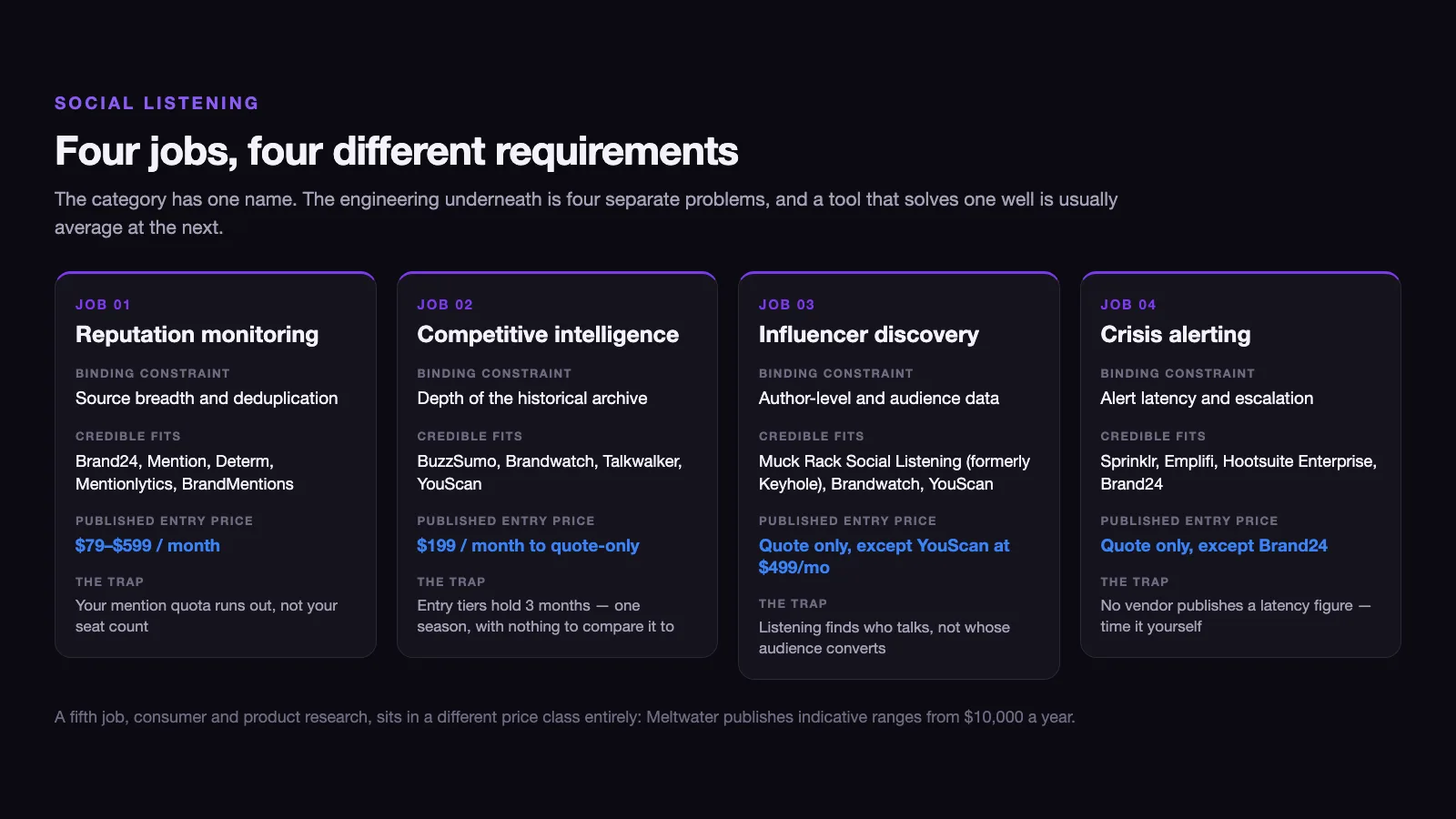
Five jobs live under the same category name, and they are not the same purchase. A tool that is excellent at one is usually mediocre at another, because the underlying requirement differs: coverage breadth, archive depth, author-level metadata, alert latency and sampling rigour are separate engineering problems.
| Job to be done | What the tool must be good at | Tools that credibly fit | Published entry price | The trap |
|---|---|---|---|---|
| Reputation monitoring | Broad source coverage, review sites, daily digest, dedupe | Brand24, Mention, Determ, Mentionlytics, BrandMentions | $79–$599/mo, published | What runs out is your mention quota, not your seat count |
| Competitive intelligence | Historical archive, share of voice, deep boolean queries | BuzzSumo, Brandwatch, Talkwalker, YouScan | $199/mo published to quote-only | Entry tiers see 3 months of history — too short for seasonality |
| Influencer discovery | Author-level data, audience makeup, past brand mentions | Muck Rack Social Listening (formerly Keyhole), Brandwatch, YouScan | Quote only, except YouScan at $499/mo | Listening finds who talks, not whose audience converts |
| Crisis alerting | Alert latency, escalation rules, routing to a human | Sprinklr, Emplifi, Hootsuite Enterprise, Brand24 | Quote only, except Brand24 | No vendor publishes alert latency; you have to time it yourself |
| Consumer and product research | Image recognition, theme discovery, defensible sampling | Brandwatch, Meltwater, Sprinklr, Synthesio | Meltwater publishes “from $10,000/year” | Priced like a research service, not like software |
The practical consequence: write down which single job justifies the spend before you open a comparison table. Buying the union of all five is how a $79 problem becomes a $25,000 contract.
What social listening covers, and where monitoring and scheduling stop
Three products are sold under overlapping names, and the boundary matters because it decides what you should be paying for.
Social monitoring is mention-by-mention and reactive. It surfaces individual posts so a human can reply. The output is an inbox.
Social listening is aggregate and analytical. It measures themes, share of voice and volume shifts so someone can make a decision. The output is a chart and a query.
Social media management is publishing, scheduling and approvals. Different product, different meter, out of scope here — a scheduler that also shows you mentions is not a listening tool, and it is priced as if it were something else entirely.
Dedicated listening vendors sell the middle one. Management suites sell all three under one login and unbundle listening as a paid add-on, which is exactly where the pricing confusion in this category comes from.
Reputation monitoring: catching mentions across social, review sites and forums
This is the job most buyers actually have, and the cheapest to satisfy. The requirement is breadth plus deduplication: you want the mention to reach you once, from wherever it appeared, with enough context to decide whether it needs an answer.
Two things separate a usable tool here from a noisy one. The first is whether review platforms sit inside the same coverage set as social networks. Talkwalker, for example, describes its coverage as “30+ social networks” and, separately, “300+ review sites” — two counts, listed apart, which is a hint that they are licensed and ingested as different data streams. Ask the vendor which review sources are in scope on your tier, not on their enterprise tier.
The second is what happens to the mention after it arrives. A tool that emails you every hit is a worse product than one that clusters 400 near-identical reposts into a single line. Ask to see a real spike in the trial, not a demo dataset.
Reputation monitoring is a subset of a broader exercise, not a replacement for it — the periodic brand audit is where you decide what “healthy” even looks like before a tool starts measuring it. And for the single loudest reputation surface most local businesses have, listening tools are the wrong instrument entirely: Google reviews need a process, not an alert.
Competitive intelligence: share of voice needs history, and history is tiered
Share of voice is a ratio measured over time, which makes archive depth the binding constraint. It is also the spec most quietly rationed by tier.
The published numbers, as of August 2026:
- BuzzSumo — 2 years of data on Content Creation ($199/mo), 3 years on PR & Comms ($299/mo), 5 years on Suite ($499/mo) and Enterprise ($999/mo).
- BrandMentions — 3 months on Starter, 6 months on Pro, 12 months on Expert, custom on Enterprise.
- Determ — up to 3 months on every paid tier, negotiable only on the custom plan.
- Mention — historical data is a separately purchased add-on, up to 2 years.
- Brandwatch — claims an archive of “1.4+ trillion posts from today back to 2008”, with no published price attached.
Read that list next to a real question. “Are we gaining ground on our two closest competitors?” needs at least twelve months, because anything shorter compares one season to another season and reports the difference as a trend. On a three-month tier you will produce a chart that is technically correct and directionally meaningless.
Note also that “competitors” in most B2B categories includes earned media, and earned media coverage is a different licensed source set again — the same distinction that makes a PR platform and a listening platform price differently. If the goal is share of coverage rather than share of chatter, the workflow starts with media pitching, and the monitoring tool is chosen to match it.
Influencer discovery: conversation data finds voices, follower counts find nothing
Listening tools are genuinely good at one half of this job and structurally bad at the other. They can tell you who is already talking about your category, in what tone, with what reach — that is a real advantage over browsing follower counts, because it surfaces people with topical authority instead of people with audience size.
What they cannot tell you is whether that audience converts. Listening data is post-level and public. Audience composition, historical brand-deal performance and fraud signals are the parts that decide the outcome, and they come from a different product class with different data licences.
The category is consolidating around exactly this gap. Keyhole, a long-standing name in influencer campaign tracking, is now Muck Rack Social Listening: its pricing page redirects to a Muck Rack demo request form (checked 11 August 2026), with no figure published.
If you use listening for discovery, use it as the top of a funnel and verify downstream. Measure the shortlist against real interaction data — the arithmetic of engagement rate will eliminate half of a list built on mention volume alone — and put the commercial terms on paper before any brief goes out, which is what an influencer contract is for.
Crisis alerting: the one job where latency is the whole product
Every vendor in this category claims fast alerting. Emplifi promises “round-the-clock spike alerts”; Hootsuite markets its Enterprise-only listening on speed of understanding. Not one of them publishes a latency figure — not a median, not a p95, not a definition of what “real-time” is measured against.
That absence is the finding. If the reason you are buying is that you want to know within minutes when something is going wrong, then the only number that matters is one you have to generate yourself during the trial, using the protocol below.
Two secondary specs decide whether the alert is useful once it fires. Escalation: can the alert route to a person on call, or does it land in a shared inbox at 2am? Threshold logic: does it trigger on absolute volume, which fires constantly for a large brand and never for a small one, or on deviation from that account’s own baseline? Deviation-based thresholds are the ones worth paying for, and they are the ones most often reserved for higher tiers.
Why listening prices scale with mentions and keywords, not with seats
This is the mechanic that surprises most first-time buyers, and it is visible directly on the pricing pages if you read the quota column instead of the price column.
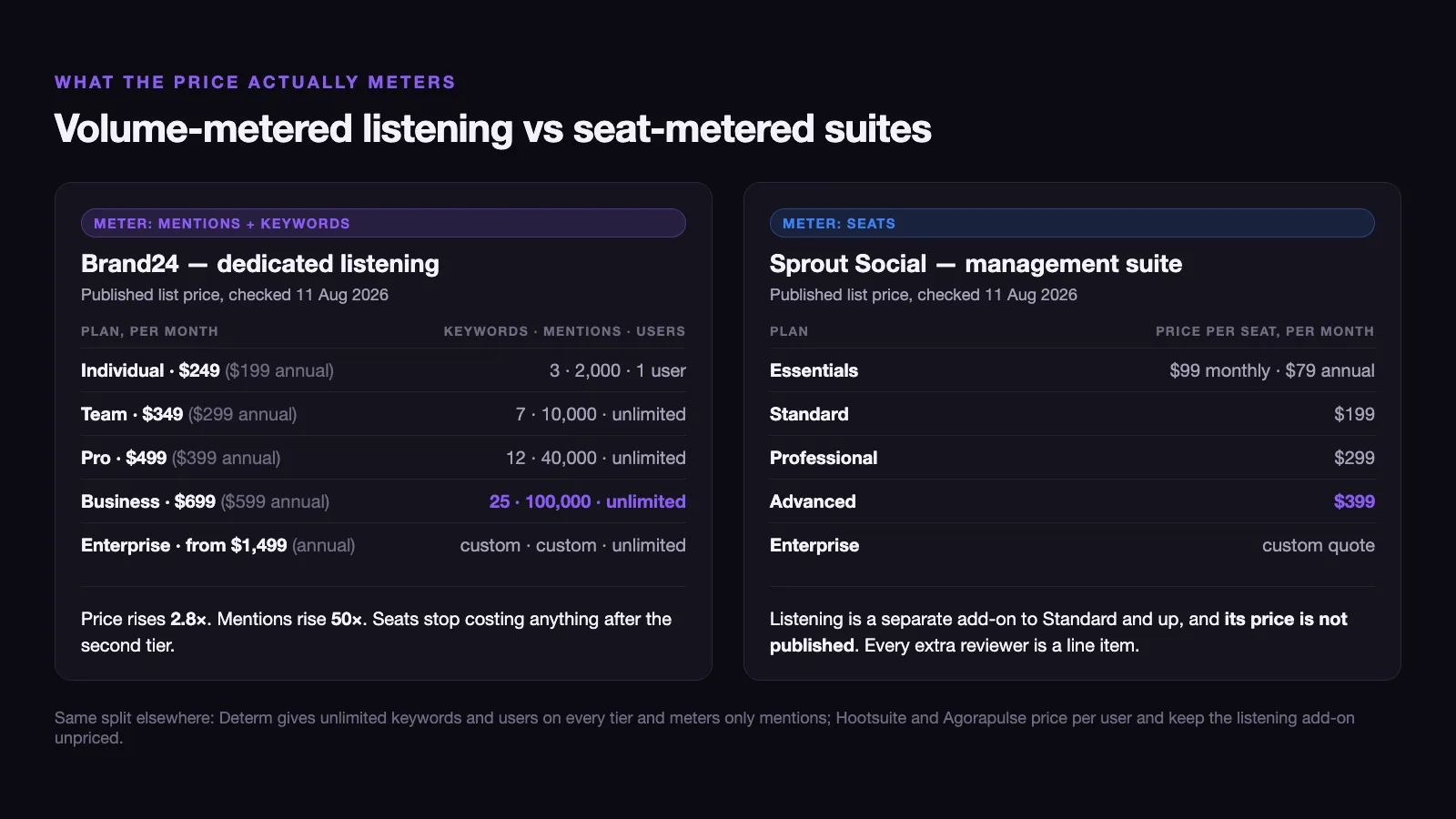
Brand24 publishes the cleanest example. Individual is $249/month, or $199 on annual billing: 3 keywords, 2,000 mentions per month, 1 user. Business is $699/month, or $599 annual: 25 keywords, 100,000 mentions per month, unlimited users. The price rises 2.8×, the seats go from one to unlimited, and the mention allowance rises 50×. Seats are not the meter. Volume is.
Determ makes it starker still: keywords are unlimited and users are unlimited on every paid tier, and the tiers differ only by mention allowance — 1,000, 5,000 and 10,000 per month at €99, €299 and €499 respectively. Mention now sells a single plan, Company, from $599/month on an annual contract, with 50,000 mentions and unlimited users. YouScan’s Starter 3 is $499/month billed annually for 3 topics, up to 15,000 mentions per month, unlimited users.
The honest exception, because it changes which tools suit an agency: management suites that bolt listening on price per seat instead. Sprout Social runs $99 per seat per month on monthly billing ($79 annual) up to $399 for Advanced, and states that Listening is an add-on to the Standard plan and up — with the add-on price not published. Hootsuite is $99, $199 and $399 per user per month on annual billing, with its full listening product available only to Enterprise customers, also unpriced. Agorapulse prices per user and sells Advanced Listening as a separately priced add-on, again without a public figure.
There is a consequence nobody puts in a sales deck: a brand with a common name pays more than a brand with a rare one for identical work. If your product shares a word with a video game, a film or a city, a meaningful share of your paid mention quota funds conversations that have nothing to do with you, and you buy a higher tier to compensate. Query precision is not housekeeping in this category — it is budget control.
At the top of the market the meter changes shape again. Meltwater publishes indicative ranges on its own blog — Starter from $10,000 per year, Pro from $25,000, Enterprise from $130,000 — while stating it does not use a fixed public price list. Brandwatch and Sprinklr publish no figures at all. At that level you are buying a research service with a software interface, and it should be evaluated against a research budget rather than a software one.
Source coverage is decided by platform API policy, not by your vendor
The gaps between tools on X, TikTok and Reddit are mostly not engineering differences. They are the downstream effect of what each platform sells, and to whom.
X moved to pay-per-usage pricing with no subscription tiers: $0.005 per post read, $0.010 per user lookup, capped at 2 million post reads per monthly billing cycle for pay-per-usage accounts, with anything larger requiring an enterprise agreement. At that rate, ingesting a million X posts in a month costs $5,000 in raw data before a single line of product is built. That is why mid-market tools ration X coverage rather than advertising it.
TikTok is the hard one. Its Research API is restricted to academic and not-for-profit institutions, and applicants must “be independent from commercial interests and be able to conduct research on a not-for-profit or non-commercial basis” — a commercial listening vendor is excluded by policy, not by capability. The separate Commercial Content API covers advertising and commercial content, and in its current phase includes data from EU countries only. Any tool promising broad organic TikTok listening should be asked, in writing, exactly where that data comes from.
Reddit publishes no public rate card at all. Its Data API documentation confirms that free and paid access both exist and that bulk export is significantly limited by default, with select developers who need broader access potentially charged fees. Widely circulated per-call prices for Reddit data do not trace back to a Reddit source, so treat any vendor’s Reddit coverage claim as unverifiable from the outside and test it directly.
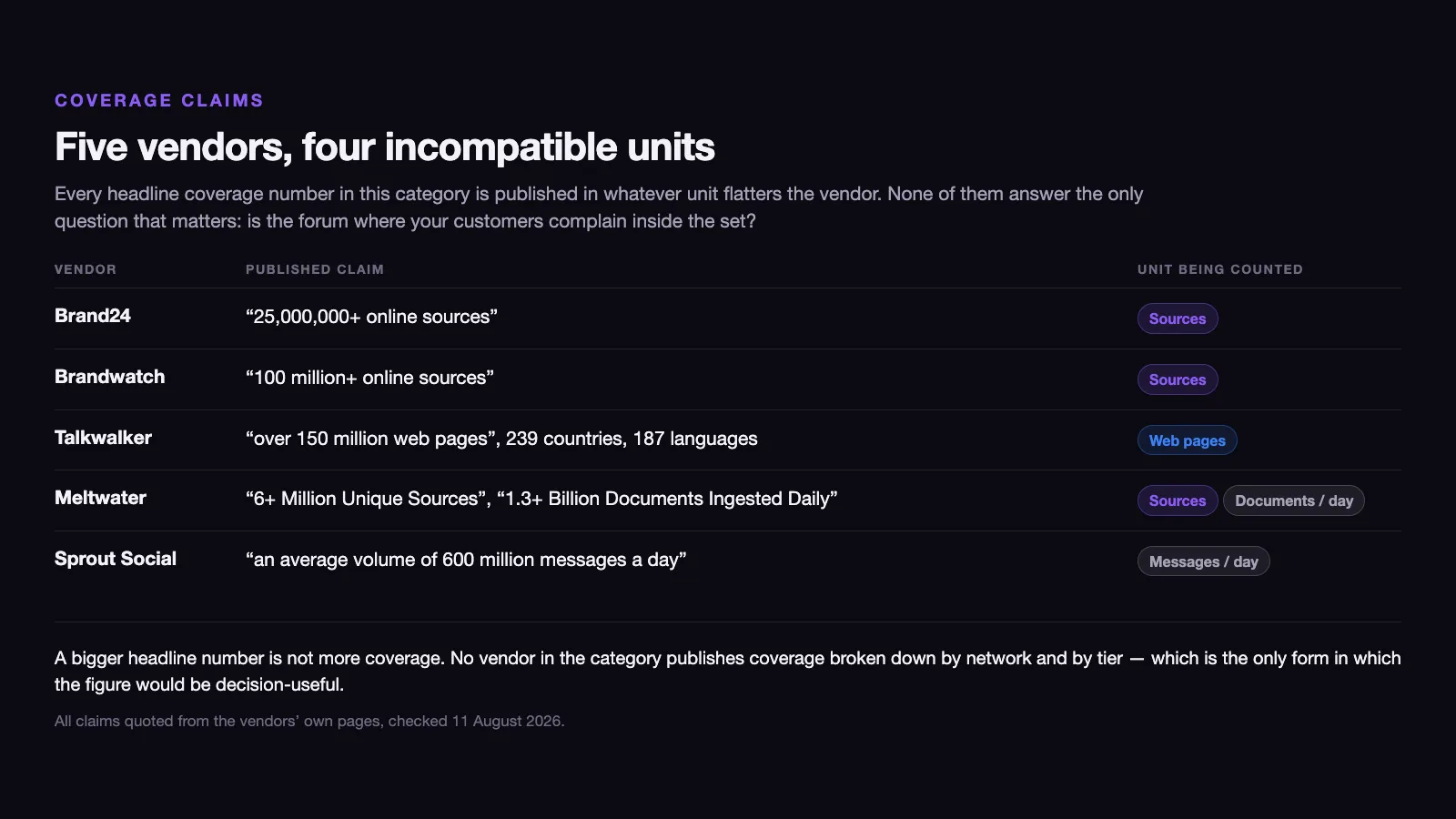
Vendor coverage claims themselves are not comparable, because the vendors are not counting the same unit — five headline claims resolve to four different units, and none of the three that use the word “sources” publishes a definition of what counts as one:
| Vendor | Published coverage claim | Unit being counted |
|---|---|---|
| Brand24 | “25,000,000+ online sources” | Sources |
| Brandwatch | “100 million+ online sources” | Sources |
| Talkwalker | “over 150 million web pages”, 239 countries, 187 languages | Web pages |
| Meltwater | “6+ Million Unique Sources”, “1.3+ Billion Documents Ingested Daily” | Sources and daily documents |
| Sprout Social | “an average volume of 600 million messages a day” | Daily messages |
Sources, web pages, documents per day and messages per day are four different things. A larger headline number tells you nothing about whether the specific forum where your customers complain is included. No vendor in the category publishes coverage broken down by network and by tier, which is the only form in which the number would be decision-useful.
What automated sentiment scoring still gets wrong
Sentiment is the feature that sells the demo and the one to trust least. Two recent peer-reviewed results are worth knowing before you build a dashboard on top of it.
On sarcasm, a study published in PLOS ONE on 14 November 2025, testing models against the SARC corpus of Reddit comments, reports a fine-tuned BERT model with multi-head attention at 0.917 accuracy and 0.917 F1, ahead of GPT-3 at 0.894, Llama-2 at 0.908 and Claude-2 at 0.877. The number that matters more sits earlier in the same paper: before fine-tuning, precision, recall and F1 ranged only from 0.50 to 0.60. On sarcastic text, an untuned model is close to a coin flip — and sarcasm is not an edge case in complaints about brands, it is the register.
On stability, research published in Frontiers in Artificial Intelligence on 11 August 2025 scored an identical finance headline 100 times with GPT-4o and got results spanning 0.40 to 0.80, with a mean of 0.67 — a spread wide enough to flip a sell, hold or buy call. In a separate case study in the same paper, scores at temperature 0.0 still ranged from 0.3 to 0.6, so turning the randomness knob down does not fix it. The same paper cites earlier work reporting accuracy fluctuations of up to 10% across repeated identical inference runs.
No vendor we checked publishes a sentiment accuracy figure — Talkwalker’s social listening product page, for one, carries no accuracy claim. That silence is consistent across the market, and it is informative.
The working rule that follows: use sentiment for direction of change, never for absolute level. “We are 40% negative” is a number with no defensible meaning. “We went from 12% negative to 40% negative in eleven hours” is a signal worth waking someone up for, because the measurement error is roughly constant and the delta survives it.
A seven-day trial protocol that beats any comparison table
Every tool in this category offers a trial or a demo. Most buyers spend it clicking through features, which is the part of a listening tool that is easiest to match and least likely to matter. Run this instead, on two tools in parallel:
- Write one boolean query and use it identically in both trials. Include your brand, two common misspellings, one product name and one exclusion term for whatever homonym pollutes your name.
- Run both trials across the same seven days. Do not stagger them — a single news cycle will otherwise explain the whole difference.
- Compare total mention counts at the end. If the two tools differ by more than 2×, you are looking at coverage, not accuracy. Neither is “wrong”; they are seeing different internets.
- Break the count down by network, and look specifically at X, TikTok, Reddit and YouTube. Those are the four where access is set by platform policy, so that is where the real gap between vendors lives.
- Hand-label 50 random mentions as positive, neutral or negative, then score each tool against your own labels. Use your real category vocabulary, not generic examples — sentiment models fail on domain jargon and on sarcasm, in that order.
- Seed one test mention from an account nobody follows, and time the alert. That interval is the entire product in the crisis job, and no vendor publishes it.
- Export the data before the trial ends. If you cannot pull raw mentions as CSV or through an API on the tier you can actually afford, you are renting a dashboard rather than owning a dataset.
This is our evaluation protocol, not an industry standard. It exists because published comparisons in this category measure feature checklists, and every serious vendor has every checkbox.
Where the 2026 Gartner Magic Quadrant fits, and where it does not
Gartner published its inaugural Magic Quadrant for Social Media Management and Listening on 6 July 2026, evaluating seven vendors. Six of those seven are identifiable from publicly available coverage of the report, which places Sprinklr and Emplifi as Leaders, Hootsuite and Sprout Social as Visionaries, and Brandwatch and Oktopost as Niche Players, with no vendor positioned in the Challengers quadrant. The category was renamed in the process: Gartner’s Peer Insights market is still titled “Social Monitoring and Analytics (Transitioning to Social Media Management and Listening)”.
Two things follow. First, the merger of “management” and “listening” into a single evaluated market is a signal about where enterprise buying is going — bundled, one platform, one contract.
Second, and more useful if you are not an enterprise: seven vendors is not the market. Brand24, Determ, Awario, Mentionlytics, YouScan, BuzzSumo, BrandMentions and Mention are not among the six publicly named, and for the reputation-monitoring job they are the practical shortlist for most companies. An MQ evaluates enterprise suites against enterprise criteria — global deployment, governance, breadth of adjacent modules. If none of those criteria describe your purchase, the quadrant is answering a question you did not ask.
The through-line across all five jobs is the same: decide what you are measuring and why, then buy the narrowest tool that measures it. Listening data is only worth its subscription if a decision changes when the number moves — which is a question about your social media programme, not about the software. Pick the job, run the seven-day protocol, and let the mention counts settle the argument.
12 / Reader questions
Frequently asked questions
01What are the best free social listening tools?
Free social listening tools give you alerts, not analysis. Talkwalker Alerts and Google Alerts will email you when a keyword appears, and native platform search covers one network at a time. None of them store history, dedupe results or score sentiment, so they answer "did someone mention us" but never "is this getting worse".
02How much do social listening tools cost?
Published list prices for dedicated listening tools run roughly $79 to $699 per month, with enterprise research platforms starting far higher. Brand24 lists $199 to $599 per month on annual billing; Meltwater's own blog gives indicative ranges from $10,000 per year. Brandwatch and Sprinklr publish no prices at all.
03What are the best social listening tools for agencies?
Agencies should filter on two things most comparisons ignore: unlimited seats and per-client separation of topics. Tools that meter on mention volume rather than users — Determ, Mention and YouScan on every tier, Brand24 from its second tier up — let you add an account manager without adding cost. Suites priced per seat make every extra reviewer a line item.
04Can ChatGPT do social listening?
No. ChatGPT cannot collect or monitor social conversations on its own, because it has no ingestion pipeline and no licensed access to platform data. It is useful downstream: paste in a spike's worth of mentions and it will summarise themes. The collection layer still has to be a listening platform.
05What is the difference between social listening and social monitoring?
Social monitoring is mention-by-mention and reactive: it surfaces individual posts so someone can reply. Social listening is aggregate and analytical: it measures themes, share of voice and volume shifts to inform a decision. Most vendors sell both under one login, which is why the terms blur in marketing copy.