Published
Donor stewardship is what an organisation owes a gift after it clears: acknowledgement, a report on what the money did, and contact that is not another ask. It runs on a calendar, not a checklist — from the receipt on day 0 to the second ask months later. Every step in between has a date and an artifact.
How this was checked. In August 2026 we read every page Google returned in the United States for “donor stewardship” and recorded one thing from each: whether it named a single interval. Eight of eight named none. Figures below come from IRS Publication 1771, a peer-reviewed field experiment published in Experimental Economics in 2025, a Cowles Foundation working paper on a natural field experiment with an Indian charity, the 2026 M+R Benchmarks (180-plus US nonprofit digital programmes, 2025 data), the Virtuous 2026 nonprofit benchmark report, the Association of Donor Relations Professionals, and two separate pieces of research from Cygnus Applied Research — Penelope Burk’s original Donor-Centered Fundraising study and the later, annual Burk Donor Survey. Where a number is our arithmetic on a stated assumption rather than a published figure, it says so.
The donor stewardship calendar, from the receipt to the second ask
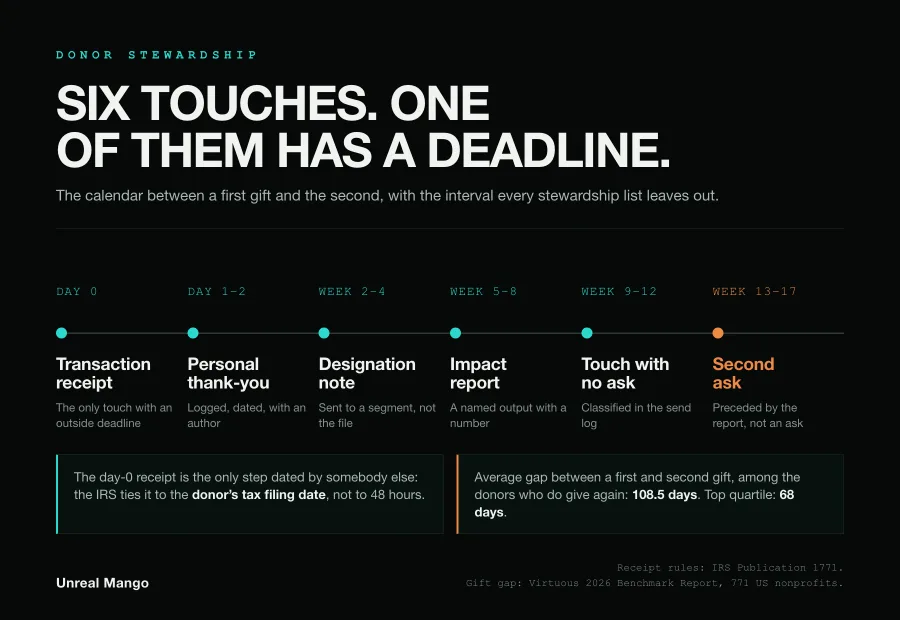
Six touches sit between a first gift and the moment it is reasonable to ask for a second. The right-hand column is the part missing from every stewardship list in circulation: what closes the task, so that it can be marked done by somebody other than the person who intended to do it.
| Touch | When | Channel | What closes it in the record |
|---|---|---|---|
| Transaction receipt | Day 0 | Automated, same channel as the gift | A receipt carrying the IRS-required fields; at $250 and above it is the contemporaneous written acknowledgment |
| Personal thank-you, no ask | Day 1–2 | Call, voicemail or signed letter | A dated activity record naming the person who made it |
| Designation note | Weeks 2–4 | Email or letter to that gift’s segment | A send record tied to a segment smaller than the whole file |
| Impact report | Weeks 5–8 | Email, letter or short report | A named output with a number attached, sent to that segment |
| Touch with no ask | Weeks 9–12 | Any | A message classified in the send log as carrying no request |
| Second ask | Weeks 13–17 | The channel that recruited them | An ask record whose preceding message in the log is the impact report |
Those intervals are not measured optima, and nobody publishes measured optima. They are bounded by three constraints that do have sources, and spaced in between by our own judgement. The first is legal, and it fixes a deadline rather than a date: the IRS ties the receipt to the donor’s tax filing, which is months out, so putting the receipt on day 0 is our call — on the same footing as the four-minute assumption further down. The day 1–2 slot for the personal thank-you is our call too; the section below explains why nobody else’s number is available to borrow. The second constraint is an ordering rule from donor research — the report on the last gift comes before the request for the next one. The third is the size of the whole window: our piece on donor retention benchmarks records the average gap between a first and second gift, among the donors who do come back at all, at 108.5 days in Virtuous’s 2026 panel, which is week 15 or 16, and at 68 days in the top quartile, which is week 10.
That third constraint is the one that squeezes everything else, and it is why the sequence above ends in week 17 rather than in month six. Five touches have to fit before the average second gift, and in a fast programme they have to fit before week 10 — which means the table compresses rather than shifts: designation note in week 2, impact report in weeks 3 to 5, the touch with no ask in weeks 6 to 8, the second ask in weeks 9 to 10. Anything scheduled later than that is not stewardship of the first gift any more; it is reactivation of a donor who has already stopped. Everything between the fixed points is spacing, and spacing is where a programme should be adjusted to its own cycle rather than to ours.
Day 0: the one stewardship touch with a legal deadline
The receipt is the only touch in the sequence with a specification written by somebody outside the organisation. IRS Publication 1771 sets the content: for a contribution of $250 or more, a written acknowledgment must carry the name of the organisation, the amount of a cash contribution or a description of a non-cash one, and either a statement that no goods or services were provided or a description and good-faith estimate of the value of anything that was.
It also sets a deadline, and the deadline is not 48 hours. To count as contemporaneous, the IRS says a donor must receive the acknowledgment on or before the earlier of the date the donor files their federal income tax return for the year of the contribution, or the due date of that return including extensions. That is months away, not days. The obligation is likewise softer than most guidance implies: the IRS puts the duty to obtain the acknowledgment on the donor, and says the charity “must assist a donor by providing a contemporaneous written statement”.
One neighbouring rule does carry a penalty. Where a payment over $75 is partly a contribution and partly payment for goods or services — a gala ticket, a benefit auction lot — the organisation must provide a written disclosure statement, and the penalty for failing to is $10 per contribution, capped at $5,000 per fundraising event or mailing.
So the widely repeated 48-hour rule is a service level, not a legal one, and we could not find a study behind it — the pages that repeat it do not cite one. That is not an argument for being slow. It is an argument for writing your own number down, publishing it internally, and then measuring the lag against it, because a service level nobody measures is indistinguishable from not having one.
Day 1 to 2: what the evidence for a personal thank-you actually says
The personal thank-you is the most-recommended act in fundraising and the one with the shakiest evidence base, which is worth knowing before an organisation builds a programme on it.
The famous numbers are stated preferences, and they come from the earlier of Penelope Burk’s two studies. Her original Donor-Centered Fundraising research reports that 95% of respondents would be very appreciative if a board member called within a few days of their gift just to say thank you, that 93% would definitely give again the next time they were asked, and that 84% would definitely or probably make a larger gift. Those are answers to a hypothetical. The nearest thing to a behavioural figure comes from her later, separate study, the annual Burk Donor Survey, and is also self-reported: 34% of respondents who received a thank-you call said their decision to give again was wholly or partly because of the call, and 21% of those who gave again said the call inspired them to give more generously.
Where a controlled test exists, it deflates the craft advice rather than the act. Adena, Huck and Neyse ran two preregistered field experiments with a German opera house, published in Experimental Economics in 2025, covering about 10,000 people between them — 8,800 letters in the first study, 1,132 past donors in the second. The second study set handwritten thank-you postcards against printed ones. Response rates came out at 19.3% for the handwritten card against 18.7% for the printed one, and average donations at 87 euros for the handwritten against 114 euros for the printed — the handwritten card losing on the size measure and winning on the response measure, with the authors reporting neither difference as statistically significant. Their first study found the same absence of effect for a “thank you in advance” line in an appeal letter.
The reasonable reading is not that thank-yous do not matter. It is that the measurable part of this touch is whether it happened, to whom, and how fast — not how it was lettered.
Weeks 2 to 4: naming what the gift was assigned to
The second requirement in Penelope Burk’s donor-centred framework is the one almost never scheduled: that every gift, whatever its size, is assigned to a programme, project or initiative narrower in scope than the mission as a whole. Burk’s requirement stops at the assignment. Telling the donor which programme it was, and treating that message as a dated touch of its own, is our operationalisation of the requirement rather than a finding of hers — flagged here for the same reason the four minutes further down are flagged.
This is a separate touch from the impact report, and separating them is what makes both of them closable. The designation note says where the money went. The impact report, later, says what it did — it has no section of its own in this piece because it is inseparable from what follows it, and it is dealt with in the section on weeks 13 to 17, where its artifact, a named output with a number attached, doubles as the check on the second ask. Collapsing the two produces the familiar failure where an organisation waits until it has results worth reporting, the wait runs past the second-gift window, and the donor hears nothing for a quarter.
The artifact here is a send record tied to a segment smaller than the file. If the note went to everyone, it did not name a designation, because a designation that applies to the whole mission is the mission. That is the check to run: open the send log, find the message, and look at whether the audience field contains a segment or the word “all”.
Weeks 9 to 12: the touch that does not ask, and what it is worth
This is the touch organisations skip, and it is the only one in the calendar with a randomised experiment anywhere near it. Read what follows as a bound on the ask rather than as proof that a first-time donor needs a silent touch: the experiment measured a different donor, one who gives every year.
Sudhir, Fong and Roy ran a natural field experiment with nearly 180,000 past donors of a leading Indian charity — 178,971 warm-list donors across four arms, testing a plain thank-you against thank-yous carrying a call to donate, a call to engage on Facebook, or both. Splitting the results by past giving behaviour reverses the headline. The call to donate decreased the average donation per mailer by 35% among recent and frequent donors — the paper’s loyal segment, defined as those who gave the previous year and in at least three of the previous five, 4% of that charity’s warm list — and increased it by 41% among donors who had done neither. Targeting the message at the non-loyal segment alone raised expected donations by 12.8% to 17.5% and donation rates by 23.3% to 27.2%. The two ends of that range are two different messages, not two estimates of one: 17.5% is a donation ask sent only to non-loyal donors, 12.8% an ask to engage on Facebook sent the same way.
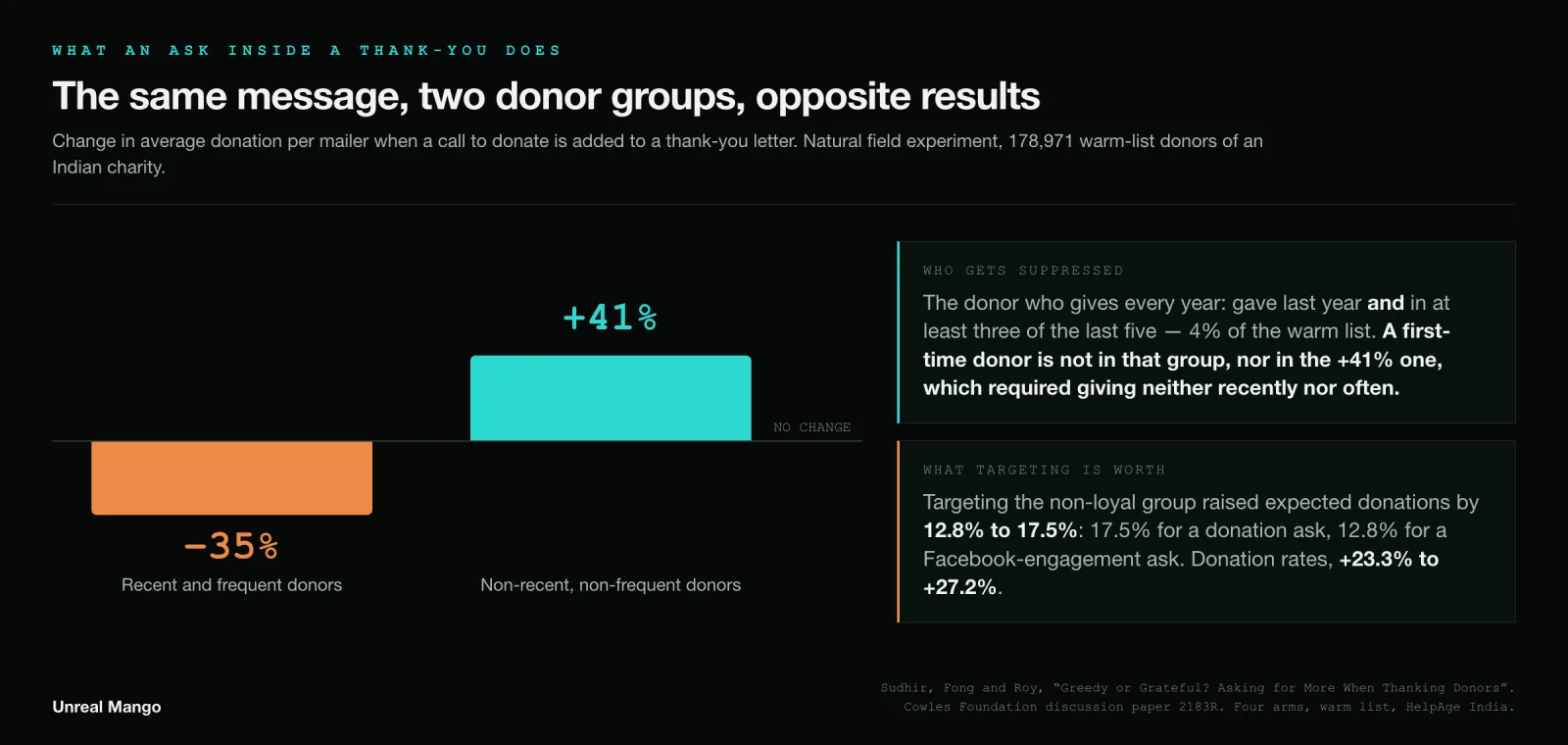
Read that as a scheduling instruction rather than a copywriting one — but read the segment definition before borrowing the number. The suppressed group is not simply donors who gave recently; it is that 4% who gave the previous year and in at least three of the previous five. A donor who has just made a first gift is recent but not frequent, so the 35% penalty is not measured on him — and neither is the 41% gain, which was measured on donors who had not given the previous year and had given at most twice. In the paper’s binary split he lands on the non-loyal side, where the ask raised giving, significantly so among donors the charity had recruited offline. So the no-ask touch in this slot rests on Burk’s ordering rule — report on the last gift before requesting the next — and not on Sudhir, Fong and Roy. Their control arm was itself a thank-you carrying no ask, which means the experiment compares an ask against no ask inside a touch; it never tested whether the extra touch should exist.
There is a baseline for how rare it is. The 2026 M+R Benchmarks report that a subscriber on a nonprofit email list received an average of 50 messages across 2025, of which 31 were fundraising appeals, 9 were newsletters and 2 carried an advocacy call to action, leaving roughly 8 classed as engagement or other. That is 19 non-fundraising messages a year, of which only 17 carry no request at all, because an advocacy call to action is still a request. Either number, spread thinly across a whole list, is not the same as one no-ask contact placed deliberately inside a specific donor’s first quarter.
Appreciation events belong in this slot rather than in a category of their own. A site visit, a briefing with the programme staff who actually spend the money, a volunteer day or a thank-you reception all qualify as the no-ask touch, on two conditions: the guest list is a defined cohort rather than the whole file, and attendance comes back into the record. Attach an ask to the evening and the experiment above says what it costs among the people most likely to be in the room.
Weeks 13 to 17: placing the second ask inside the window
The third of Burk’s donor requirements is explicitly an ordering rule: donors want a report, in measurable terms, on what was accomplished with the last gift before being asked for another. It is the only piece of the standard advice that specifies a sequence rather than a set, and it is what turns a list of good practices into a calendar.
Two constraints then fix the position of the second ask. It has to come after the impact report, because of the ordering rule. And it cannot come so late that it lands past the point where the second gift would normally already have been made — week 15 or 16 on the average gap quoted earlier, week 10 in the fastest quartile. An ask at month six is not wrong, but it is arriving after most of that window has closed, which makes it a reactivation rather than a first conversion. Weeks 13 to 17 is the last position that still straddles the average.
The check on this touch is the one line above it in the send log. If the message immediately preceding the second ask is itself an ask, the chain has broken regardless of how many touches were scheduled. If it is the impact report, the sequence held.
The cost side of that decision — what an acquired donor is worth, and what a channel costs to recruit them — sits in our piece on donor acquisition. Stewardship spends time; acquisition spends money, and they are priced in different units on purpose.
Donor stewardship is a duty to a gift; donor relations is the relationship
The two terms are used interchangeably in most of what ranks for either, and the professional body that owns the vocabulary does not use them that way.
The Association of Donor Relations Professionals defines donor relations as the comprehensive effort of a nonprofit seeking philanthropic support to ensure donors experience high-quality interactions that foster long-term engagement and investment. Underneath it sit four components: gift acceptance and management, acknowledgment, donor recognition, and reporting or stewardship. Those four are the “four pillars” the question about donor relations is usually asking after.
Stewardship is the fourth of them, and it has the narrower and older meaning: ADRP notes it was historically defined as the safeguarding of the assets of others, with the modern usage extending to the donor-facing work of showing impact and accountability. The practical difference is what each one attaches to. Donor relations attaches to a person and has no end. Stewardship attaches to a specific gift and can be completed — which is precisely why it can be scheduled and audited, and donor relations cannot.
Three places the stewardship chain breaks, and how each shows in the data
Every failure we see in this sequence is one of three, and each leaves a different fingerprint in the record.
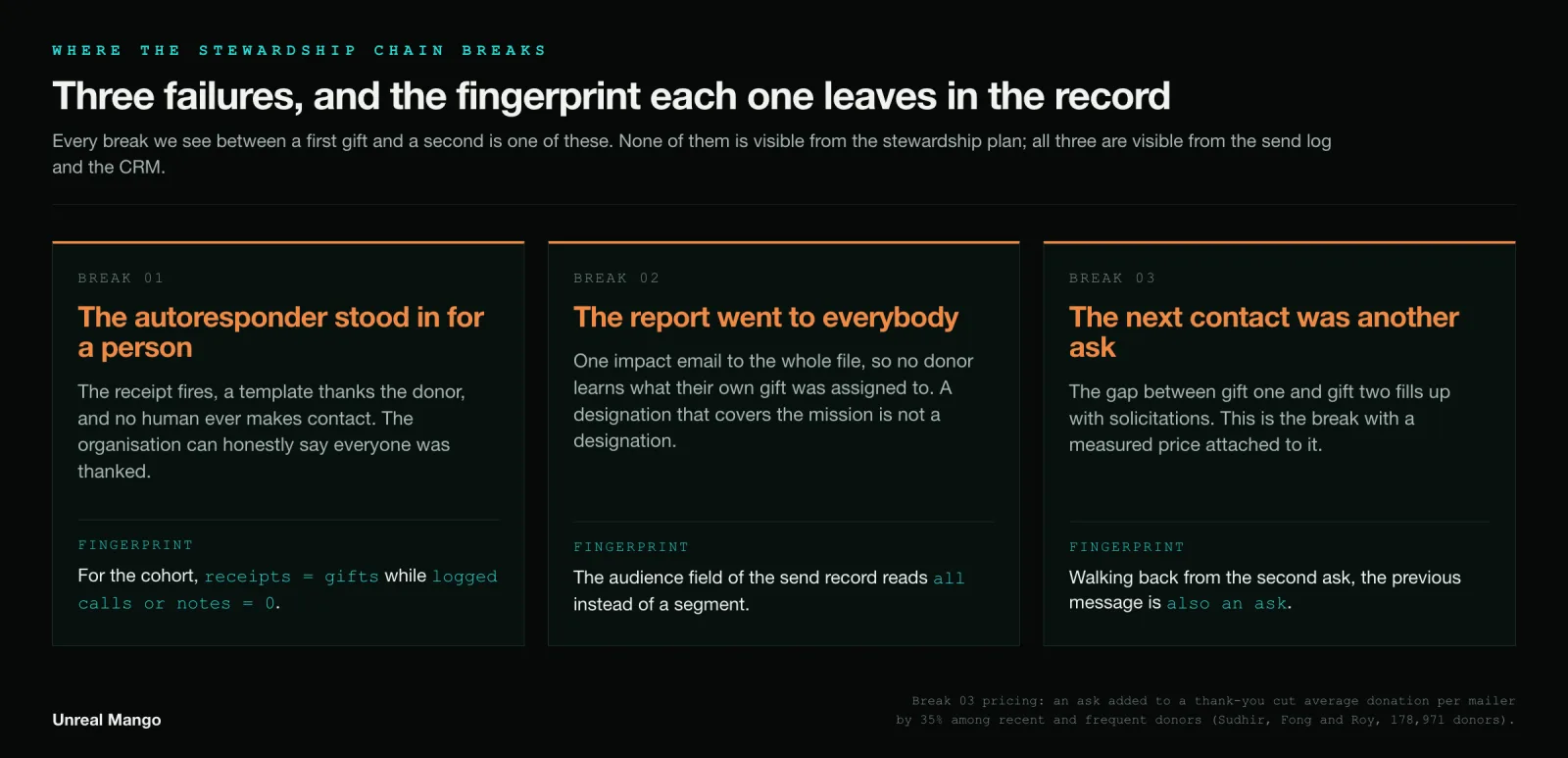
The autoresponder stood in for a person. The receipt fires, the donor is thanked by a template, and no human contact is ever made. The signature is arithmetic: for a given cohort, the number of receipts equals the number of gifts and the number of logged thank-you calls or signed notes is zero or close to it. This one hides well, because the organisation can honestly say every donor was thanked.
The report went to everyone. A single impact email goes to the whole file, so no donor learns what their own gift was assigned to. The signature is in the audience field of the send record: one message, no segment. Burk’s designation requirement cannot be satisfied by a mass send, because the smallest unit the message addresses is the mission.
The next contact was an ask. The gap between gift one and gift two gets filled with solicitations and nothing else. The signature is the sequence in the send log — walk backwards from the second ask and count how many consecutive messages carry a request. That 35% is what this break costs among established repeat donors — the ones who gave last year and in at least three of the last five. For a donor still between their first gift and their second, the experiment puts no price on it at all; the reason to avoid the break there is the ordering rule, not the number.
What a stewardship programme can measure, and what it cannot
Stewardship attracts unfalsifiable goals, which is part of why it loses budget arguments. Four things in the calendar above are genuinely countable:
- Coverage. The share of first-time donors in a cohort with a logged human touch inside the service level you set.
- Lag. The median number of days between the gift date and that record. A median, not a mean, because a handful of very late catch-ups will otherwise flatter the number.
- Sequence integrity. The share of donors whose second ask was preceded by an impact report rather than by another ask.
- Ask density. The share of messages a cohort received in its first quarter that carried no request at all, against the M+R baseline of 17 request-free messages in 50.
What cannot be measured is whether a donor felt seen, and no amount of survey work converts that into a number. The Burk figures are the closest anyone gets, and they are respondents attributing their own behaviour to a call after the fact — a different kind of evidence from the randomised experiments quoted earlier, and weaker. Say so internally rather than presenting stated appreciation as measured effect. A board paper that distinguishes the two is more persuasive than one that does not, because the first survives being checked.
Organisations running a Google Ad Grant have a parallel version of this discipline forced on them: the grant rules make conversion tracking mandatory, and most accounts fail it quietly. Stewardship has no external auditor demanding the equivalent, which is why the record-keeping has to be self-imposed.
What the calendar costs in staff hours before it stops scaling
The honest constraint on personal stewardship is time, and the number that matters is minutes per donor rather than money. The arithmetic below assumes four minutes for a personal touch end to end — deciding what to say, saying it, and logging it — which is our stated assumption, not a measured figure. Adjust the four and the shape holds.
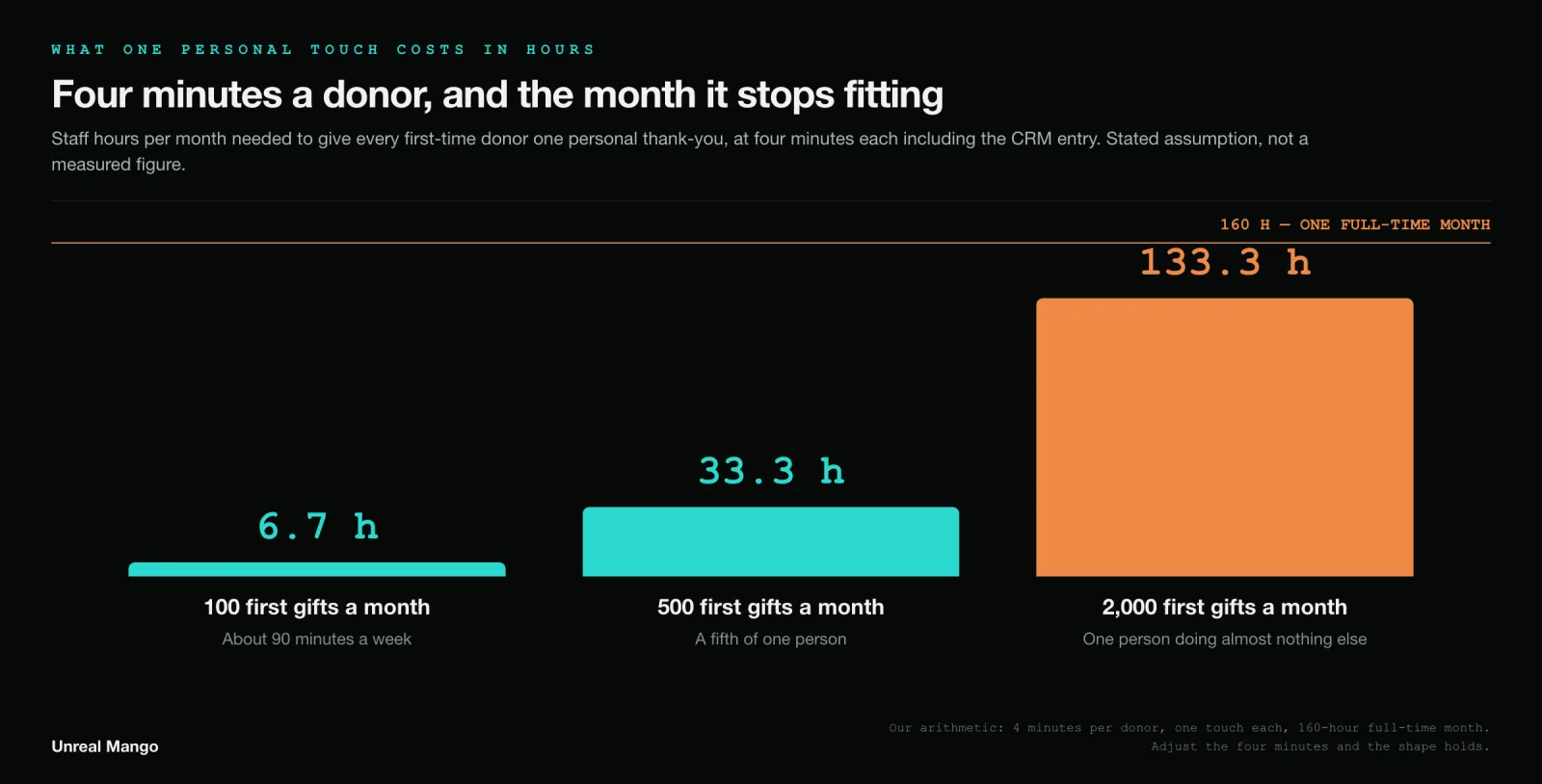
At 100 first gifts a month, four minutes each is 6.7 hours a month — about 90 minutes a week, or the better part of one working day once a month. At 500, it is 33.3 hours a month. At 2,000 it is 133.3 hours, which against a 160-hour full-time month means one person doing almost nothing else. The break is not gradual; it arrives the moment the number crosses whatever fraction of an FTE the organisation is willing to spend on it.
What goes in when the hours run out is not “a better template”. The evidence points somewhere specific: since the handwritten postcard did not outperform the printed one in the one preregistered test of it, the thing to preserve at scale is coverage and speed, and the thing to give up is craft on the artefact. Keep the human touch for the segment where a human can actually follow up, automate the receipt and the designation note, and spend the recovered hours on sequence integrity — making sure the report lands before the ask — which is the one part of the calendar the donor research states as a rule rather than as a suggestion.
That is the whole discipline: a fixed number of touches, each with a date, a channel, and something in the record that proves it happened. If you are building this into a fundraising programme and want the calendar mapped onto your own file and CRM, that is the kind of work our nonprofit and impact practice does.
11 / Reader questions
Frequently asked questions
01What does stewardship mean in nonprofits?
Stewardship is what an organisation owes a gift once it has been accepted: using the money as the donor intended, reporting on what it did, and staying in contact without immediately asking again. The Association of Donor Relations Professionals notes the word was defined historically as the safeguarding of the assets of others, and now also covers the donor-facing work of demonstrating impact and accountability.
02What are the four pillars of donor relations?
Gift acceptance and management, acknowledgment, donor recognition, and reporting or stewardship. That is the Association of Donor Relations Professionals' own breakdown, and it makes stewardship one component of donor relations rather than a synonym for it. ADRP defines donor relations as the comprehensive effort to ensure donors experience high-quality interactions that foster long-term engagement and investment.
03What are some examples of donor stewardship practices?
A receipt on the day the gift clears, a personal thank-you inside two days, a note naming what the gift was assigned to, a report carrying a number, and at least one contact that makes no request. Each of those is only a practice if it leaves a record behind it: a dated CRM entry with an author, a send log tied to a segment, a completed outcome field. A thanked donor with no record is an intention, not a task.
04How do you show appreciation to donors?
Promptly, personally, and without attaching a request — and the format matters less than most guidance claims. A preregistered field experiment run with a German opera house found handwritten thank-you postcards did no better than printed ones: 19.3% of recipients gave afterwards against 18.7%, a difference the authors report as not statistically significant. Speed and the absence of an ask are worth more than penmanship.
05What are some ideas for donor appreciation events?
Site visits, small-group briefings with the programme staff who spend the money, volunteer days and annual receptions are the standard set. Treat an event as one instance of the no-ask touch rather than a category of its own: it counts as stewardship only when the guest list is a defined cohort and attendance lands back in the record. An event with an ask attached is a solicitation with catering.
06Should a thank-you letter include another ask?
Not for donors who have given both recently and often. In a field experiment with nearly 180,000 past donors of an Indian charity, adding a donation ask to a thank-you mailing cut the average donation per mailer by 35% among donors who had given the previous year and in at least three of the previous five, while raising it by 41% among donors who had done neither. A first-time donor is in neither group. Sending targeted ask messages only to the non-loyal segment raised expected donations by 12.8% to 17.5%.