
Published
SEO takes three to six months to produce measurable results and six to twelve to compound — the answer most of the first result page gives, in variants running from two months to twelve. That number is a planning convention, not a measurement, and it merges four processes that run at different speeds. Only one of them is under anyone’s control.
What we measured. On 18 August 2026 we pulled the United States results for how long does seo take to work and read every answer on page one, then went to the primary sources behind them: Google’s own documentation on recrawling and on core updates, the dated rollout record on Google’s Search Status Dashboard, and the two largest public datasets on time-to-rank and on index retention. Every figure taken from a study or from Google’s own documentation carries its source and the year of the data behind it; the day-30, day-90 and day-180 checkpoints near the end are our own operating thresholds, not measurements. Two things about that result page are worth noting before the numbers: a Reddit thread outranks every professional answer on it, and Google adds a separate discussions-and-forums block below it. The published answers are not what searchers are being pointed at first.
Every published answer lands in the same band, and has since 2015
Eight sources answer this query on page one. Their ranges overlap heavily, which reads like consensus until two things surface. The spread across the eight actually runs from two months to twelve, and one of them — the AI Overview — is assembled from the other seven rather than answering independently. Then there are the dates.
| Source | Published or updated | The figure it gives |
|---|---|---|
| Google’s AI Overview for the query | Pulled 18 August 2026 | 3–6 months measurable, 6–12 months substantial |
| Search Engine Land | 6 May 2026 | 3–6 months, 6–12 in competitive industries |
| Vortex Web Innovate | 4 June 2026 | 3–4 months for small improvements, 6–12 for stable results |
| Shopify | 29 October 2025 | 3–6 months |
| Squarespace | 16 September 2025 | 4–12 months |
| SEO.com | Updated 31 July 2026 | 3–6 months, some sites 6–12 |
| Orbit Media | Updated 31 October 2024 | 2–3 months for low-competition keywords, 4–12 for significant success |
| Forbes | 7 February 2015 | 4–6 months |
Figures as they appear in each page’s snippet or opening answer, read on 18 August 2026.
The Forbes row is the one to sit with. It was published in February 2015, before mobile-first indexing, before the helpful content system, before AI Overviews occupied the top of this very result page — and it gives the same 4 to 6 months as the pages published this year. A number that survives eleven years of the thing it measures being rebuilt is not tracking that thing. It is a convention.
That does not make it wrong. It makes it useless for the question people actually have, which is never “what is the average” but “is mine on track”. For that you need to know which clock you are waiting on.
Clock one: getting crawled and indexed, in days to weeks
Nothing downstream exists until Google has fetched the page and decided to keep it. Google’s own wording on requesting a recrawl is unambiguous in both directions: “Crawling can take anywhere from a few days to a few weeks,” and “Requesting a crawl does not guarantee that inclusion in search results will happen instantly or even at all.”
This is the only clock with a same-day check. The URL Inspection tool in Search Console reports whether a specific URL is indexed and the date it was last crawled, and the Pages report groups everything that is not indexed by reason. A page sitting in “Discovered – currently not indexed” is not moving slowly; it is not moving.
The practical consequence is that the first month of any engagement is instrumentation. New pages have to be discovered, changed pages have to be refetched, and a site with crawl problems spends this month on access rather than on optimisation. Which of those you are in is answerable in an afternoon, not in a quarter.
Clock two: the re-evaluation, and the wait Google itself prescribes
This is the clock nobody measures, and it is the slowest one. Google’s guidance on core updates states the two speeds directly: “some changes can take effect in a few days, but it could take several months for our systems to learn and confirm that the site as a whole is now producing helpful, reliable, people-first content in the long term.” And when improvements do not register: “If it’s been a few months and you still haven’t seen any effect, that could mean waiting until the next core update.”
Google softens this by adding that “you don’t necessarily have to wait for a major core update to see the effect of your improvements.” Both statements are true, and together they describe a system where the fast path is not guaranteed and the slow path is a queue. The queue has a published length, because core updates are discrete, announced, dated events.
| Core update | Started | Completed | Rollout | Days until the next one began |
|---|---|---|---|---|
| March 2024 | 5 Mar 2024 | 19 Apr 2024 | 45 days | 118 |
| August 2024 | 15 Aug 2024 | 3 Sep 2024 | 19 days | 69 |
| November 2024 | 11 Nov 2024 | 5 Dec 2024 | 24 days | 7 |
| December 2024 | 12 Dec 2024 | 18 Dec 2024 | 6 days | 85 |
| March 2025 | 13 Mar 2025 | 27 Mar 2025 | 14 days | 95 |
| June 2025 | 30 Jun 2025 | 17 Jul 2025 | 17 days | 147 |
| December 2025 | 11 Dec 2025 | 29 Dec 2025 | 18 days | 88 |
| March 2026 | 27 Mar 2026 | 8 Apr 2026 | 12 days | 43 |
| May 2026 | 21 May 2026 | 2 Jun 2026 | 12 days | — |
Dates from Google’s Search Status Dashboard and Search Engine Land’s dated coverage of each rollout. Durations are calendar differences between the announced start and completion dates; gaps are calculated from the completion date of each update to the start date of the next. The May 2026 core update was the most recent confirmed core update when this was pulled on 18 August 2026.
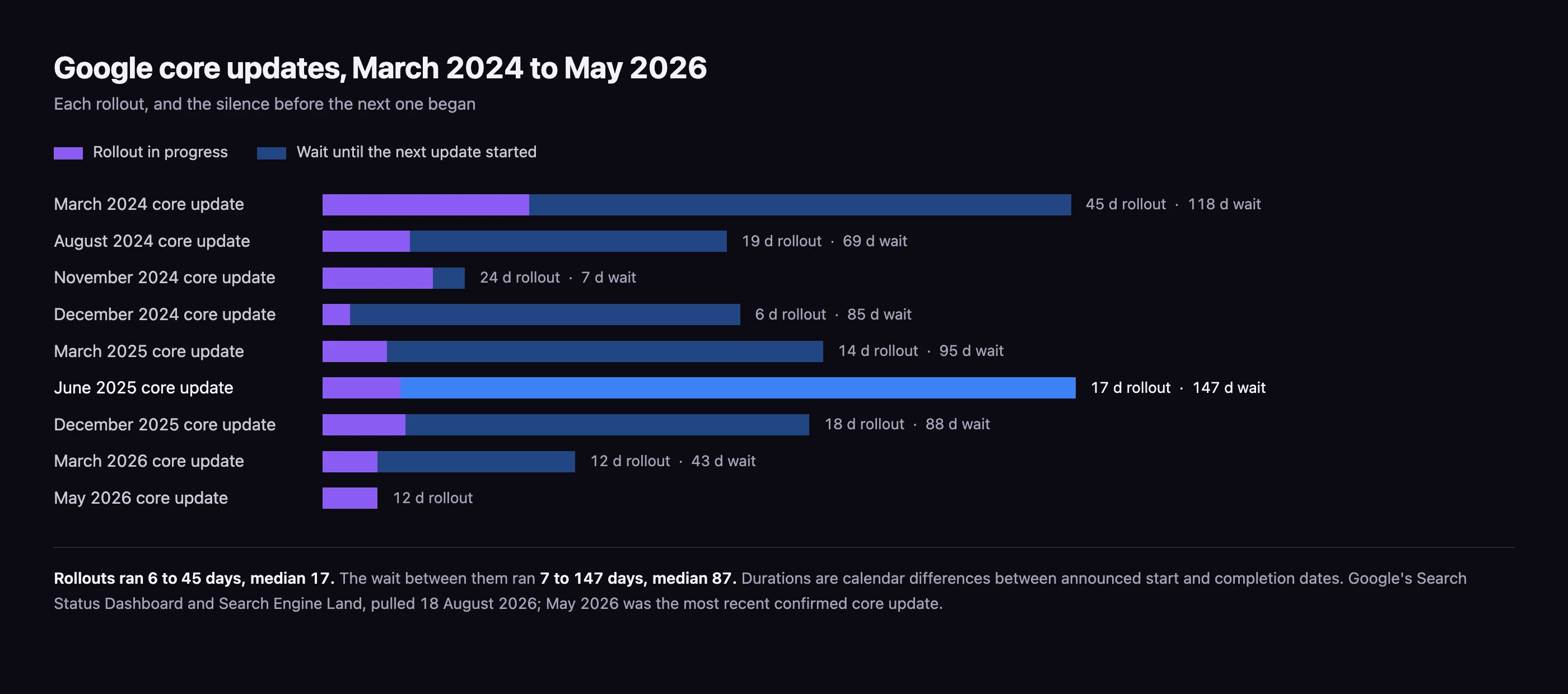
Three numbers come out of that table. Rollouts themselves ran 6 to 45 days, median 17. The silence between them ran 7 to 147 days, median 87 (86.5 exactly). And the two combine into the figure that matters: measuring each of the eight intervals from the end of one rollout to the end of the next one, the median is 100 days and the longest in the record is 165 days — work finished on 17 July 2025, the day the June update completed, would have waited for the December 2025 update to finish on 29 December before a core update could reassess it. Both figures are upper bounds on the wait, because they assume the work landed the day a rollout ended.
Now compare 100 days to the industry’s three-to-six-month consensus. It lands inside it, at the low end. The number everyone publishes as “how long SEO takes” is roughly the median wait for one clock out of four — before a single page has been written, crawled or ranked. We are not claiming the consensus was derived that way. We are pointing out that the most-quoted figure in this market is roughly the length of the queue, and the actual work is extra.
The fork that decides whether this clock applies to you at all is whether your problem is page-level or site-level. Fixing a title tag, an internal link or a thin section on one URL is the fast path. Changing what a site as a whole is judged to be — after a quality problem, a mass content clean-up, a domain migration — is the slow one, and Google’s own text says so.
Clock three: how long a page takes to reach the top ten
The largest public dataset on this is Ahrefs’ study of 2 million random keywords and 2 million pages tracked for a year. Its headline finding is not a timeline at all, it is a survival rate: only 5.7% of the newly published pages studied reached the top ten for at least one keyword within a year. For a high-volume keyword, 0.3%.
Among the pages that did make it, most took 61 to 182 days — two to six months, and this is the only place in this article where the consensus figure is matched by a measurement rather than repeated. It is not the source of that figure: Forbes was publishing four to six months two years before this study came out. The same study found the average top-ten page was over two years old, the average number-one page nearly three, and only 22% of top-ten pages had been created within the previous year.
One qualifier travels with all of it: that study was published in February 2017 and last updated in October 2021. We could not find a public dataset of comparable sample size published since. It predates AI Overviews, the helpful content system and the current shape of the result page, so read the direction rather than the decimals — the direction being that a page reaching the top ten inside a year is the exception, not the schedule.
This clock also explains why “how long does SEO take” has no single answer even inside one site. Ranking a page against three thin competitors and ranking one against eight established publishers are the same amount of writing and wildly different amounts of waiting.
Clock four: staying indexed, and the 130-day crawl floor
The three clocks above all point forwards. This one points backwards, and almost no timeline article includes it.
Indexing Insight monitored 1.4 million pages across 18 websites, reading each page’s “days since last crawl” from Google’s URL Inspection API, with the data pulled on 17 April 2025. The relationship between crawl recency and index status is close to a cliff:
| Days since Google last crawled the page | Share still indexed |
|---|---|
| Within the last 30 days | 97% |
| 100 to 130 days | Falls from 94% to 85% |
| 131 to 151 days | Falls from 32% to 0% |
| More than 151 days | None indexed in the sample |
Indexing Insight, 1.4 million pages across 18 sites, data pulled 17 April 2025. The study states the last row the other way round — as the not-indexed share climbing from 68% to 100% — and frames roughly 130 days as a strong indicator rather than a hard cut-off, since some pages survive beyond it.
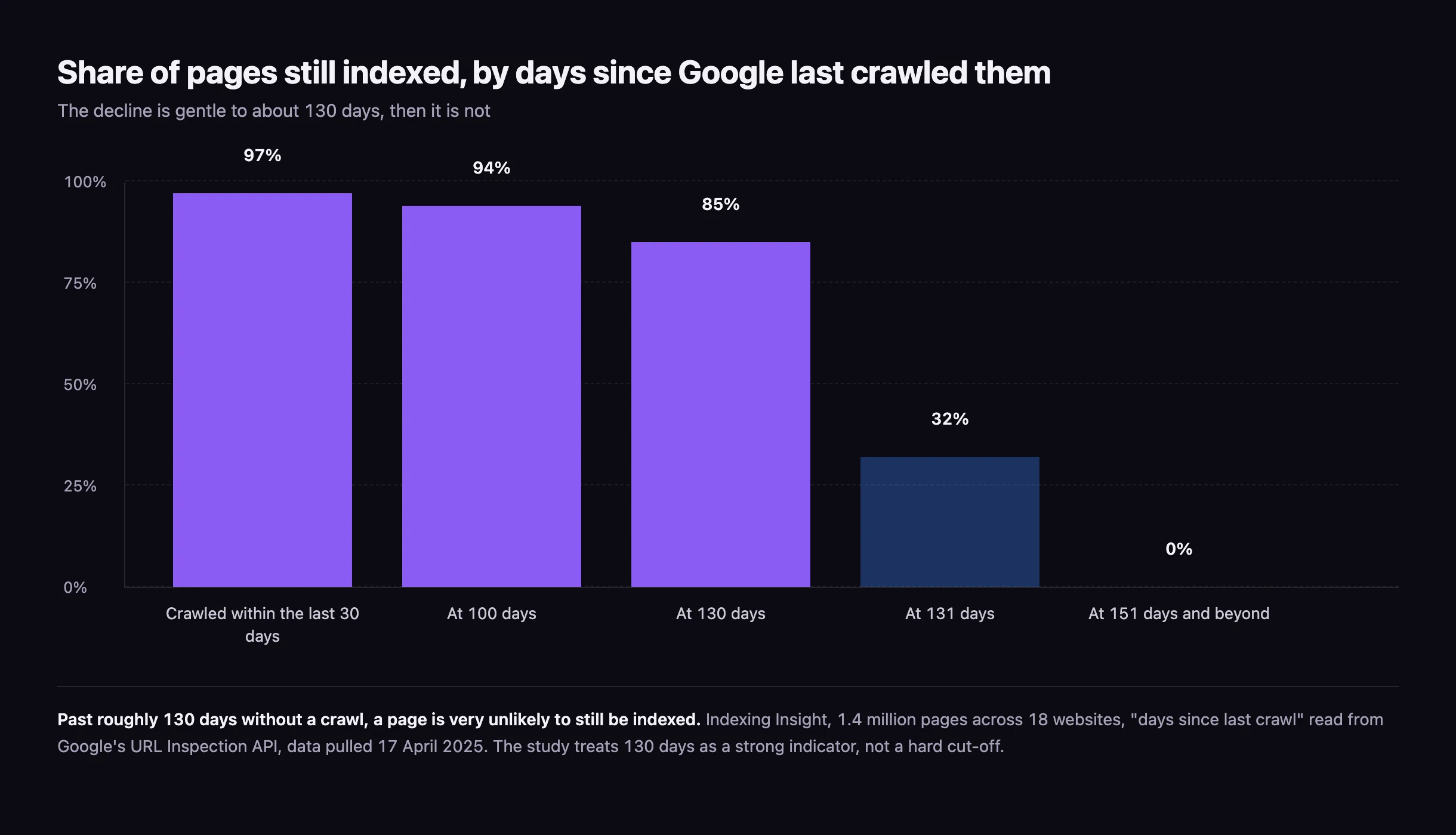
A page that stops being crawled stops being a result. That is why the honest answer to “how long does SEO take” is not a number with an end on it: reaching a position is one project, and being crawled often enough to keep it is a standing cost. A site that ranks well and then goes untouched for five months is not holding its ground, it is spending it.
It is also a diagnostic. If pages are dropping out of the index, the question is not what changed in the algorithm but when Googlebot last visited — and that is a date you can read.
Adding the clocks up, and finding which one you are actually waiting on
The four do not stack neatly into a single number, because they overlap and because not all of them apply to every change. What they do is set a floor: your timeline is the length of the slowest clock that applies to your problem.
| Clock | What has to happen | Where you check it | Measured length | Applies when |
|---|---|---|---|---|
| One — indexing | Google fetches the page and keeps it | URL Inspection, Pages report | Days to a few weeks (Google) | Always, and first |
| Two — re-evaluation | The change is judged, possibly at the next core update | Search Console positions after a dated rollout | 7–147 days of waiting, plus a 6–45 day rollout | Site-level quality changes |
| Three — ranking | The page displaces incumbents | Query and position data | 61–182 days for the 5.7% of new pages that make it inside a year | Every new or reworked page |
| Four — retention | The page keeps being crawled | Last crawl date | 97% indexed inside 30 days; near-total loss past ~151 | Continuously, forever |
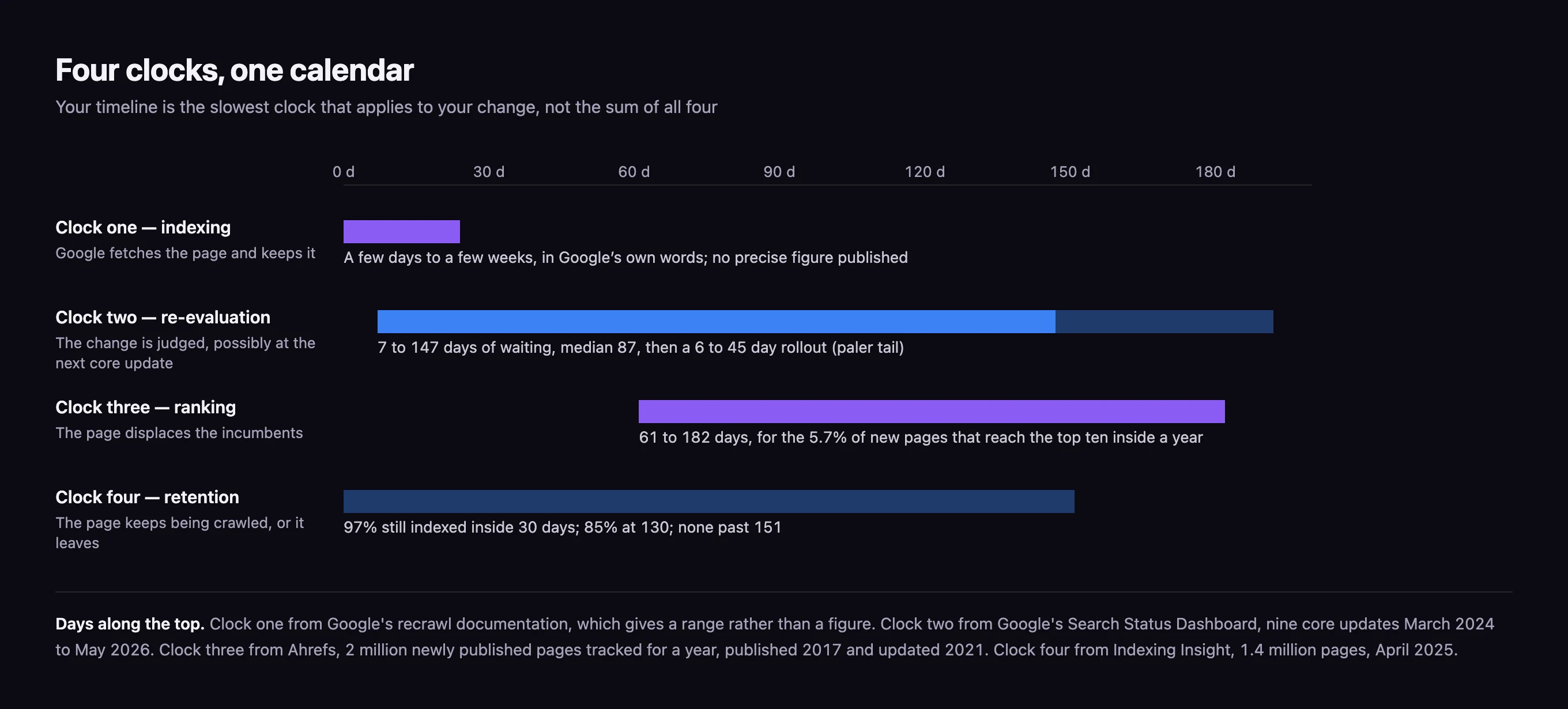
Read as a fork rather than a schedule, that table answers the question faster than a month-by-month plan does. A well-crawled site publishing a new page on an uncontested query is waiting on clocks one and three, and three months is a reasonable expectation. A site recovering from a site-wide quality problem is waiting on clock two, and the honest answer includes the possibility of several months of nothing followed by a step change during a rollout. Those two situations are given the same “3 to 6 months” by every source in the first table, and they are not the same engagement.
What has to be true at day 30, 90 and 180 to tell slow from broken
Waiting is only defensible if you know what should already have happened. Each phase has a leading indicator that moves before the thing you actually want, and if the leading indicator is flat the lagging one will be flat too. That is the moment to ask for an explanation — not month twelve.
| Checkpoint | What must be true | What it looks like when it is not working |
|---|---|---|
| Day 30 | Target URLs are indexed, with a last-crawl date inside the last few weeks | URLs still showing “Discovered – currently not indexed”, or a last-crawl date older than the engagement |
| Day 90 | Non-brand impressions exist and are rising, even with few clicks | Impressions flat, and the query list in Search Console is still only brand terms |
| Day 180 | The count of queries in positions 11–30 is growing | Nothing has entered the 11–30 band at all — a page that never reaches page two is not on its way to page one |
| Day 365 | Non-brand clicks and enquiries, against a written baseline | Growth exists but cannot be separated from seasonality or brand demand, because no baseline was recorded |
Two of those rows depend on something that has to happen before the work starts. The first is a written starting position — the minimum contents of one are in our SEO audit report template, and a programme without it cannot be evaluated later at any horizon. The second is agreement on which numbers count and in which reporting window; the attribution side of that argument is covered in how to choose a digital marketing agency, and it is much cheaper to settle in week one than in month nine.
If day 30 fails, the problem is access, not strategy, and it belongs in the first gates of a technical SEO audit checklist rather than in a content plan.
What actually changes the timeline, and what only looks like it does
Domain age does not. Google’s John Mueller has said so twice and bluntly — “No, domain age helps nothing”, and asked who benefits from the belief, “Primarily those who want to sell you aged domains.” What looks like an age advantage in practice is two other things that correlate with it: an established crawl history, so clock one is short, and an existing indexed footprint, so new pages inherit internal links instead of starting isolated. Buying an old domain buys neither.
Whether the change is page-level or site-level does. This is the single biggest fork in the whole calendar, because it decides whether clock two applies. It is also the question most proposals answer implicitly and never in writing.
The technical starting state does. A clean build needs configuration; a site with a decade of redirect debt needs development hours before optimisation begins, and those hours sit in front of clock one rather than inside clock three.
Competition in the query set does — the query set, not the industry. The same variables that move a quote inside its band move the calendar the same way: ranking one plumber in one city and one CRM nationally are the same words on a proposal and different orders of magnitude of work.
Content volume in scope does, and it is the one lever a buyer controls directly. Three pages a month and twelve pages a month reach the same position at different dates, because clock three runs per page and starts when that page is published.
What all of this means for the length of an engagement
Clutch’s verified client reviews put the typical SEO engagement at 12 months, and that is the right planning horizon — not because results take exactly a year, but because it is the first point at which a full set of the four clocks has had room to run and be measured against a baseline. The money attached to that horizon, and what a retainer buys inside it, is the subject of our SEO pricing guide; how that commitment compares with other agency billing models is in what marketing agencies charge. Whether the return justifies the commitment is a separate calculation with its own inputs, and we will publish it separately rather than fold a rough version of it in here.
What the four clocks change is not the length of the commitment but the evidence you are entitled to during it. Twelve months of patience with nothing to check at day 30, 90 and 180 is not a strategy, it is a subscription. Twelve months with those three checkpoints written down is a programme that can be stopped early on evidence — which is, in practice, the only protection a buyer has in a channel where the honest answer to “how long” starts with “which clock”.
We run SEO as a monthly retainer with those checkpoints written into the first month’s plan, because the owners do the work and cannot hide a slow quarter behind an account manager. The number of months matters less than whether anyone can tell you, on any given month, which of the four clocks you are currently waiting on — and what would have to appear in Search Console for that wait to be over.
10 / Reader questions
Frequently asked questions
01How long does SEO take to work?
Three to six months for measurable movement, six to twelve for compounding results — the answer most of the first result page gives. It is a reasonable planning figure and a poor diagnostic one, because it merges four separate processes that run at different speeds: getting crawled and indexed (days to weeks), being re-evaluated (Google's own fallback is waiting for the next core update, a wait that has run from 7 to 147 days since March 2024), reaching the top ten (61 to 182 days for the pages that manage it inside a year), and staying crawled well enough to remain indexed at all.
02How long does it take for SEO changes to show up in Google?
Google's own documentation gives two speeds. For a specific page, "crawling can take anywhere from a few days to a few weeks" after you request a recrawl, and requesting one "does not guarantee that inclusion in search results will happen instantly or even at all." For site-wide quality changes, Google says "some changes can take effect in a few days, but it could take several months for our systems to learn and confirm that the site as a whole is now producing helpful, reliable, people-first content in the long term."
03How long does SEO take for a new website?
Longer, but not because the domain is young. John Mueller of Google has stated flatly that "domain age helps nothing." What a new site actually lacks is a crawl history and an indexed footprint, so every clock starts from zero: pages have to be discovered before they can be indexed, indexed before they can rank, and ranked before any of it can be measured. Budget the first month for indexing alone and treat anything before month three as instrumentation, not results.
04Why does SEO take so long?
Because the slowest step is not the work, it is the re-evaluation. Google publishes that improvements may need to wait for a core update to register, and core updates are discrete events: nine of them between March 2024 and May 2026, each taking 6 to 45 days to roll out, with 7 to 147 days of silence in between. Work finished on 17 July 2025, the day the June 2025 update completed, would have waited for the December 2025 update to finish on 29 December — 165 days.
05How long does local SEO take?
Usually faster than national SEO, for a structural reason rather than an algorithmic one: the query set is smaller and thinner in competition, so fewer pages have to be built and fewer competing pages have to be displaced. The clocks are identical — indexing, re-evaluation, ranking, retention — but clock three is much shorter when the target is one city rather than one country. The Google Business Profile side moves on its own schedule and is not covered by these figures.
06How long does SEO take to work for a business?
Plan on twelve months of commitment and three checkpoints before it. Clutch's verified client reviews put the typical SEO engagement at 12 months, and that is the honest budgeting horizon. But you should not wait twelve months to learn whether it is working: by day 30 the target pages must be indexed, by day 90 non-brand impressions must exist, and by day 180 queries must be appearing in positions 11 to 30. A leading indicator that stays flat is a signal, not patience.
07How long does it take to rank on the first page of Google?
For most pages, longer than a year or never. Ahrefs tracked 2 million newly published pages for a year and found that only 5.7% reached the top ten for at least one keyword in that time, and only 0.3% did so for a high-volume keyword. Among the 5.7% that made it, most took 61 to 182 days. The average top-ten page in the same study was over two years old. That study was published in 2017 and last updated in 2021, so read the direction rather than the decimals.
08How do I know if SEO is slow or just not working?
Check the leading indicator for the phase you are in, not the revenue. Indexing is verifiable on day one from the URL Inspection tool, non-brand impressions appear in Search Console weeks before clicks do, and query counts in positions 11 to 30 move before positions 1 to 10 do. If the earlier indicator is flat, the later one will be too — no amount of additional waiting changes that, and it is the moment to ask for an explanation rather than month twelve.