Published
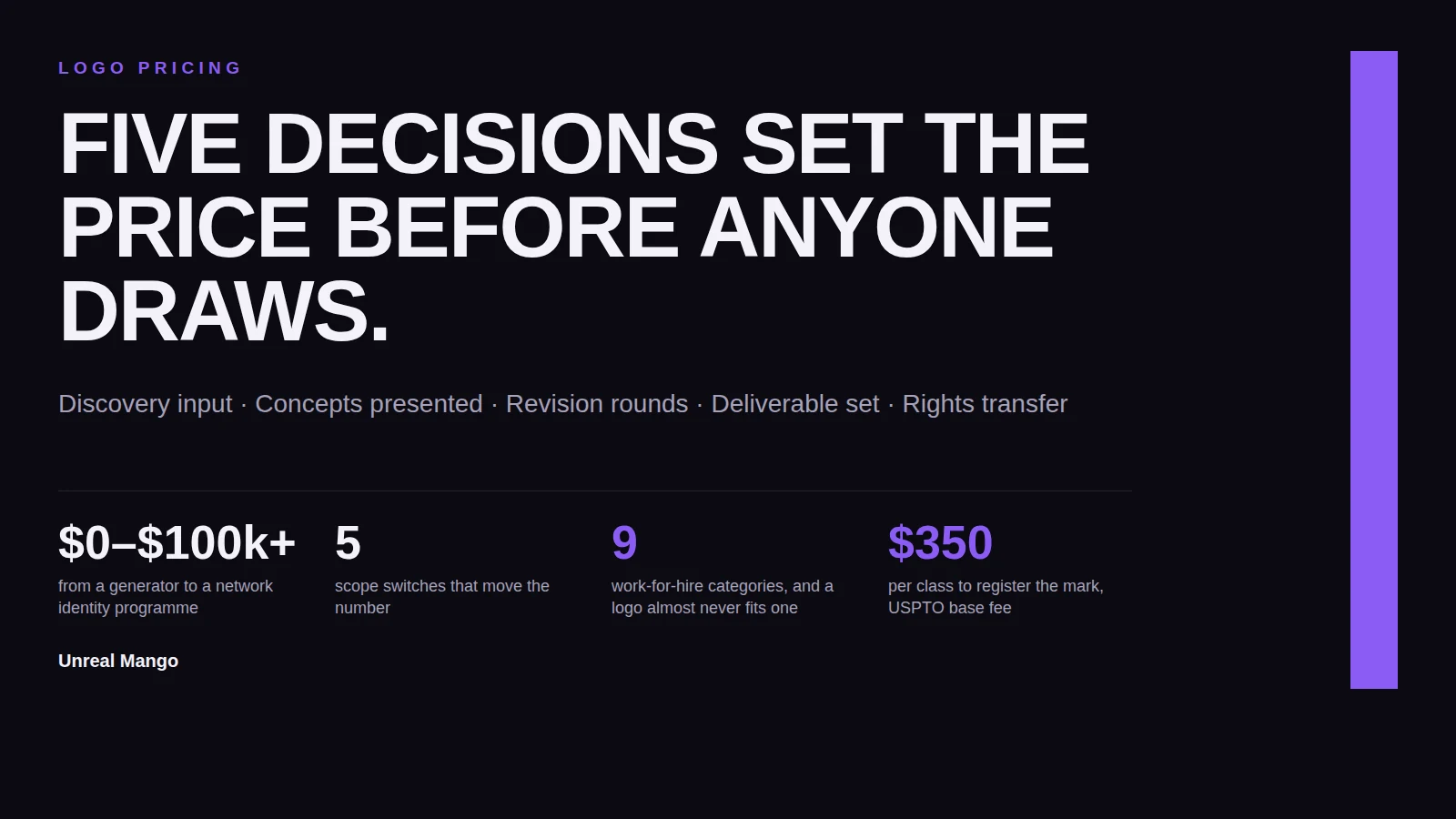
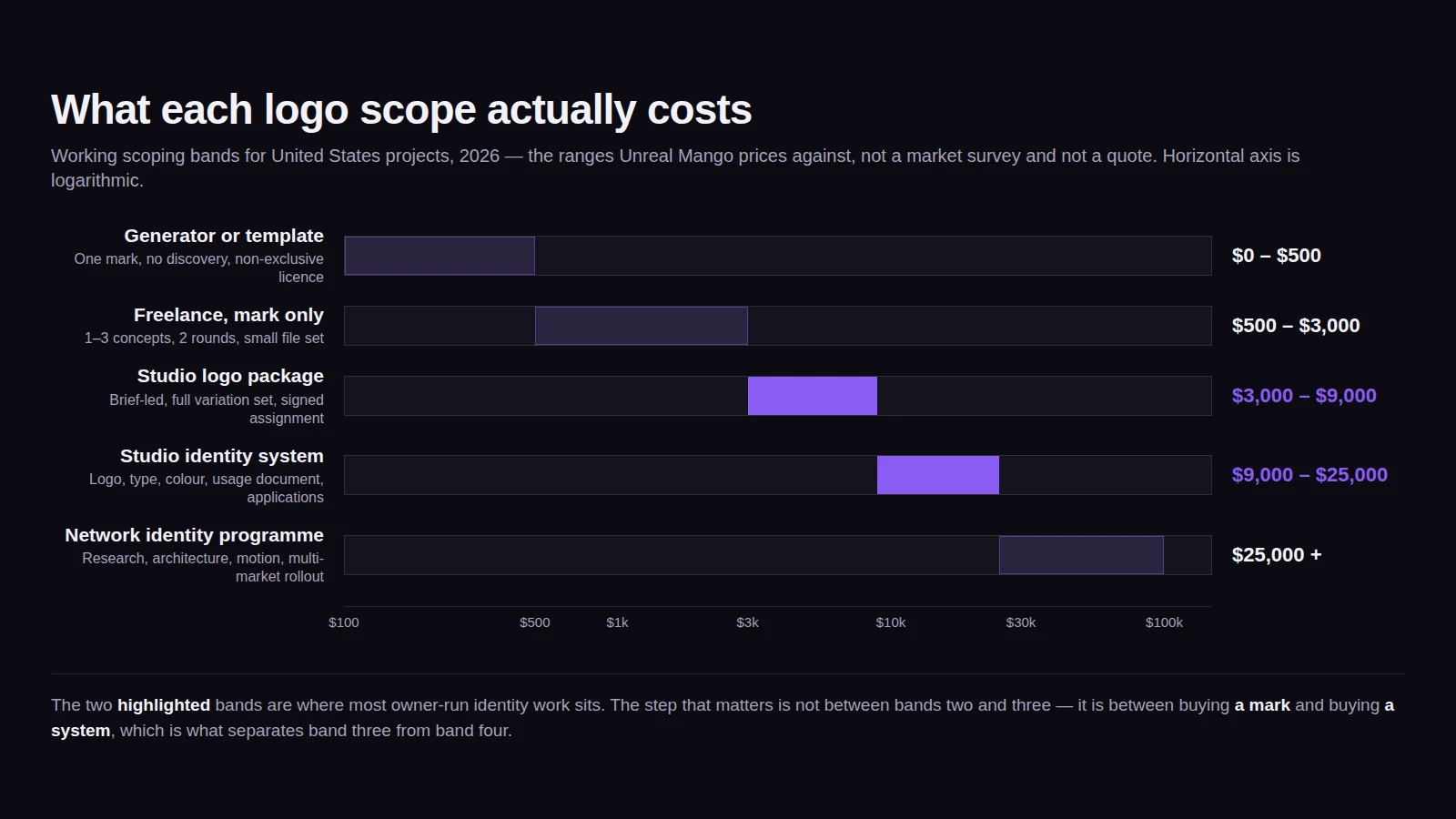
A logo design costs $0 to $500 from a generator, $500 to $3,000 from a freelancer, $3,000 to $9,000 from a studio for a full mark package, $9,000 to $25,000 once it comes with an identity system, and $25,000 upward from a network agency. The spread is not about drawing ability. Five scope decisions set the number before anyone opens a file.
How these figures were set. The bands on this page are the ranges we scope United States identity projects against in 2026. They are working bands, not a market survey and not a quote. Every figure that comes from somewhere else — a government fee schedule, a statute — is named and dated in the sentence that uses it, and the fee schedules were checked against the published sources on 18 August 2026.
The finding that surprises most buyers has nothing to do with the price. In the United States a logo commissioned from an outside designer almost never qualifies as a work made for hire, whatever the contract calls it. Copyright stays with the person who drew it until a signed assignment moves it. A cheap logo bought without one has not been bought at all. It has been borrowed.
What you are actually buying when you pay for a logo
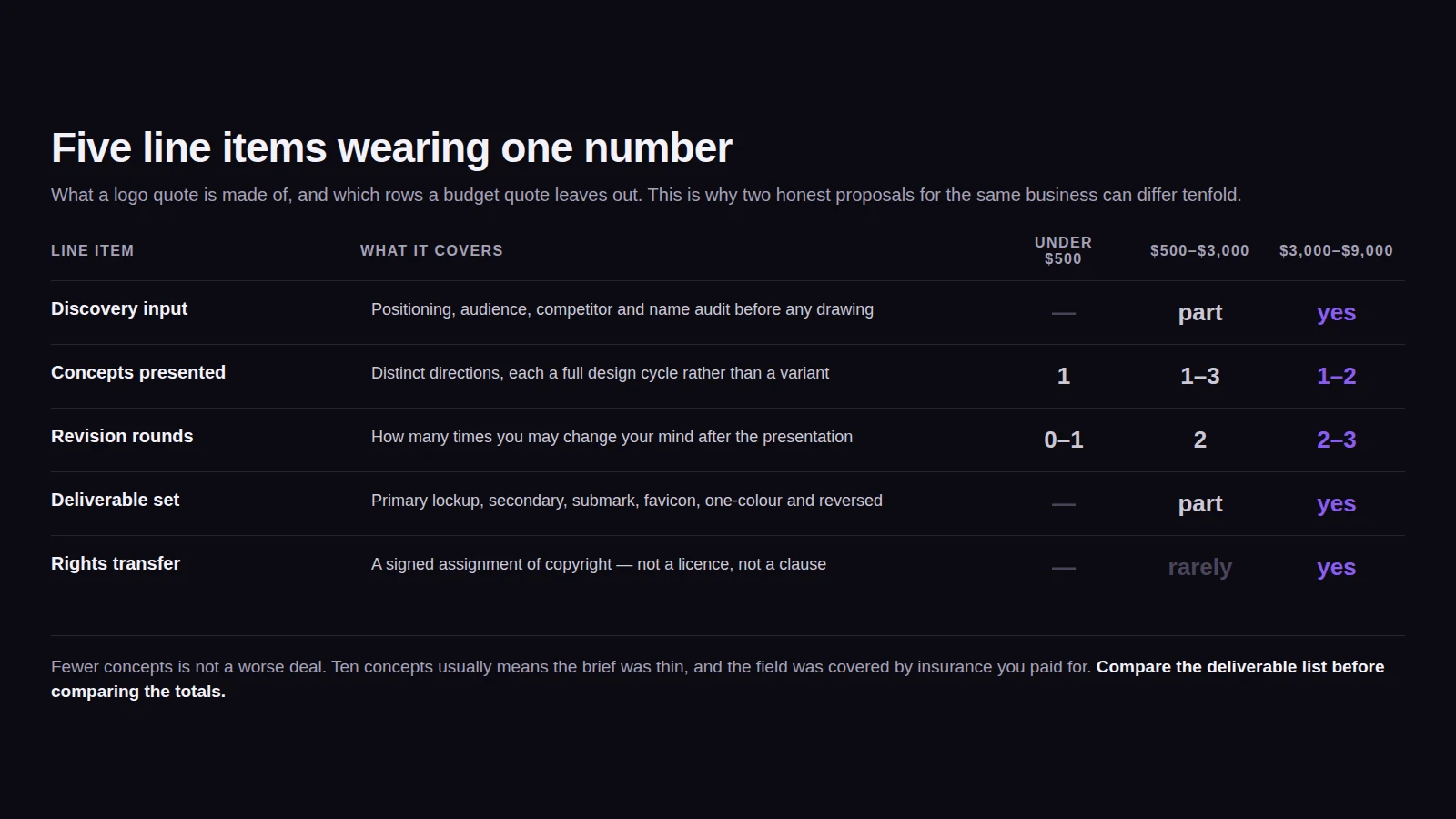
A logo quote is five line items wearing one number. Some designers itemise them, most do not, and the ones who do not are where the tenfold spreads come from.
| Line item | What it covers | Effect on the quote |
|---|---|---|
| Discovery input | Positioning, audience, competitor scan, name audit before any drawing | Largest single swing — adds days before a mark exists |
| Concepts presented | How many distinct directions you get to see | Each additional concept is a full design cycle, not a variant |
| Revision rounds | How many times you may change your mind after the presentation | Two included is standard; unlimited is priced in or clawed back later |
| Deliverable set | Primary lockup, secondary, submark, favicon, one-colour and reversed versions | Doubles from one file to a working set |
| Rights transfer | A signed assignment of copyright, not a licence | Often quoted separately, and often not quoted at all |
Read a quote against those five rows and most of the mystery goes. A $600 proposal and a $6,000 proposal for the same business are frequently both honest — the first prices concepts and nothing else, the second prices all five rows.
One row is worth spelling out because it is invisible until you need it. The deliverable set is not a stylistic preference: a logo that exists only as a raster file cannot be enlarged for a vehicle wrap or engraved onto a product, and the difference between a real vector master and a picture of one is not something you can see in a preview. That distinction has its own guide on file formats, and a quote that does not name the formats is not finished.
Concepts and revision rounds: the two numbers that move the quote
Concepts and rounds are the levers a designer actually pulls when a client asks for a lower price. Everything else on the list is close to fixed.
The counter-intuitive part: a high concept count is usually a symptom, not a bonus. Ten concepts means nobody knew what the answer was, so the studio bought insurance by covering the field. That insurance is billed to you, and it makes the decision harder rather than easier, because ten directions cannot be judged against each other by anything except taste. A designer who presents one route with reasoning attached is either very confident or working from a brief good enough to make confidence reasonable.
The way to buy fewer concepts without buying less quality is to spend the money upstream instead: a written brief that states the constraints, the audience and the applications the mark must survive. That is a separate discipline with its own rules and template, and in our scoping a decent brief reliably removes one concept round and one revision round from the same project.
Revision rounds behave differently. Two rounds is the market standard and is enough for a project with a decision-maker. Projects with a committee need three, and should be quoted at three from the start rather than discovering it at round four. “Unlimited revisions” is not generosity; it is a price that already contains the expected overrun, or a relationship that will end badly at revision nine.
Logo-only or a full identity: where the price actually steps up
The single largest step in logo pricing is not between a good designer and a better one. It is between buying a mark and buying a system.
A mark is one asset with its variations. An identity is the mark plus the typefaces, the colour specification, the layout rules and a document that tells anyone who touches the brand what is allowed. That document is why the step exists: writing down rules that survive being handed to a printer, a developer and a freelancer you have not hired yet takes longer than designing the mark itself. What actually goes into one, and how long real ones run, is covered in our teardown of published brand guidelines.
The decision rule is about headcount and channels, not budget. Buy the mark alone if one person makes every visual decision and the brand appears in three or four places. Buy the system the moment a second person starts producing material without asking, or the moment the brand has to appear in a channel nobody has seen yet. Below that threshold a guidelines document is a file nobody opens. Above it, its absence is what makes a brand look like four different companies.
Which kind of mark you are commissioning also moves the effort. A wordmark drawn from a modified typeface, a monogram and an illustrated mascot are not the same amount of work, and the choice is normally settled by the name and the sizes it must hold rather than by taste — the full set of options is laid out in our guide to the named types of logos.
The same brief quoted by a freelancer, a studio and a network agency
Three suppliers, one brief, three very different numbers. What changes is who does the thinking and how much of the price is structure.
| Supplier | Typical mark-only band | What the money is mostly buying | Where it goes wrong |
|---|---|---|---|
| Freelancer | $500–$3,000 | The designer’s own hands, on your project, most days | Availability. One person, one illness, one better-paying client |
| Owner-run studio | $3,000–$9,000 for a mark package, $9,000–$25,000 with a system | Two or three senior people, a written process, work that has survived production before | Capacity. A small studio takes fewer projects on purpose |
| Network agency | $25,000–$100,000+ for an identity programme | Research, naming, brand architecture, rollout across markets, and an account structure to run it | Distance. The people who pitched are rarely the people who draw |
None of those bands is a market survey; they are what we scope against. The honest version of the comparison is that you are not choosing a price tier, you are choosing who carries the risk of the decision. A freelancer transfers it to you, an agency absorbs it into process, and a studio sits between the two by keeping the person who made the promise on the file.
How that money is structured — retainer, project fee, percentage, hybrid — is a separate question from what a logo costs, and one we have already worked through in detail in what marketing agencies charge and how. A logo is almost always a project fee, which is the simplest case in that whole discussion.
Who owns a logo you paid for, and why “work made for hire” does not settle it
This is the part of logo pricing that no quote mentions and no comparison guide covers.
Under United States copyright law, a work made for hire is either something made by an employee inside the scope of their job, or a specially ordered work that satisfies two conditions at once: it falls into one of nine listed categories, and both parties sign a written agreement saying it is a work made for hire. The US Copyright Office lists those nine in its circular on works made for hire: a contribution to a collective work, part of a motion picture or audiovisual work, a translation, a supplementary work, a compilation, instructional text, a test, answer material for a test, and an atlas.
A logo commissioned from an independent designer is normally none of those things, so the first condition fails and the second cannot rescue it. The “work made for hire” clause pasted into a freelance contract does not, on its own, move the copyright. What moves it is a signed written assignment, and that is a separate sentence in a separate paragraph that many low-end contracts simply do not contain.
The practical consequences show up years later, not at handover:
- You cannot cleanly assign a logo you do not own when the business is sold or takes investment, and this is the point at which a diligence lawyer finds it.
- A designer who retains copyright can, in principle, license the same mark elsewhere. Reputable ones never do; the risk is that you have no document saying they cannot.
- Marketplace and generator logos are usually licensed rather than assigned, and the underlying elements are licensed to every other buyer on the platform at the same time.
Two things to ask for before the final payment, in writing: an assignment of all copyright in the delivered marks, and delivery of the editable source files rather than exports. They are different requests, and having one without the other still leaves you stuck.
This is a description of how commissioned design work is normally structured, not legal advice. A trademark attorney costs a fraction of a rebrand.
What it costs to register the mark, on top of designing it
Designing a logo and owning a trademark are two different purchases, and the second one has a published price list.
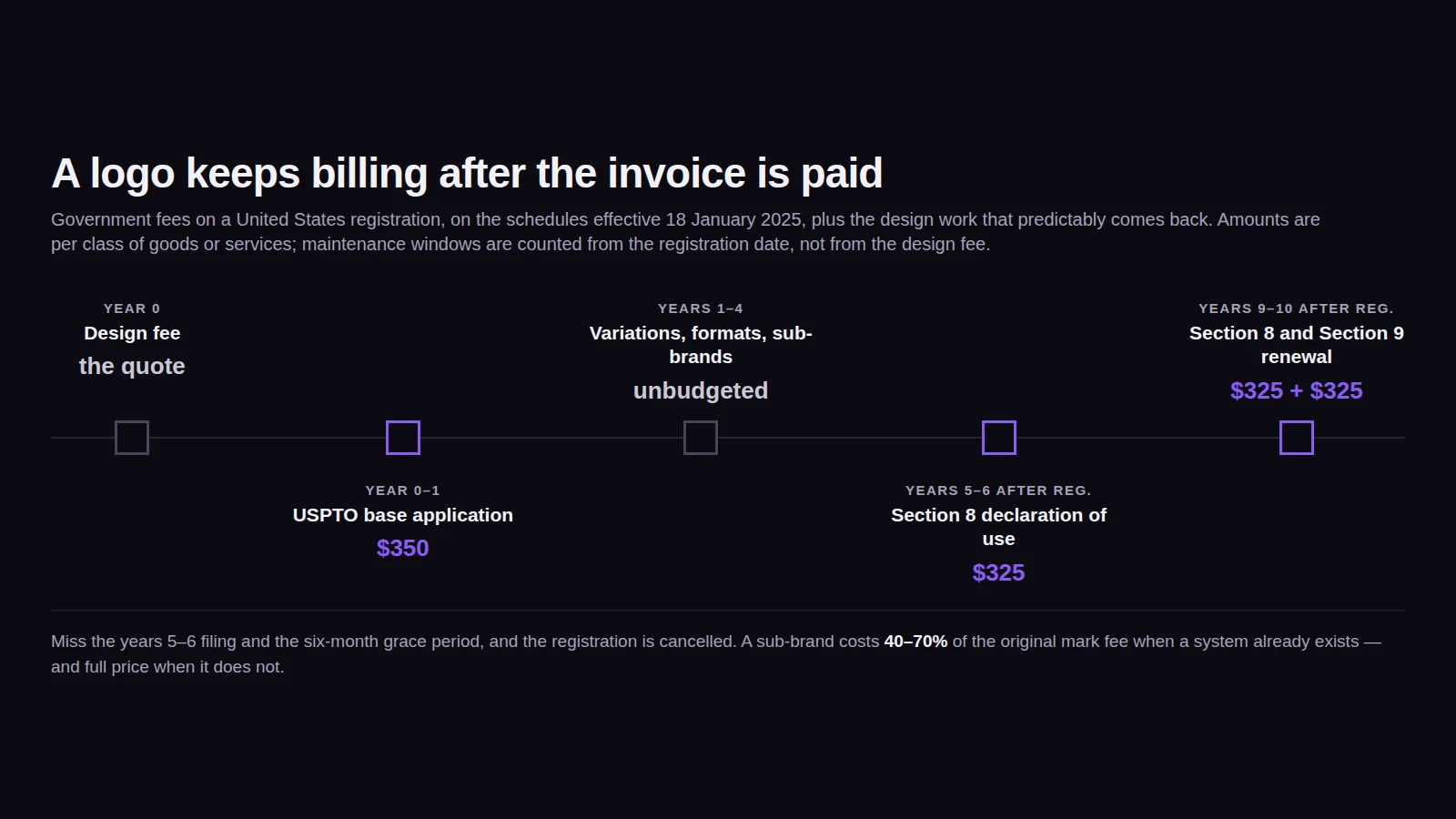
Under the USPTO fee schedule that took effect on 18 January 2025, a base trademark application costs $350 per class of goods or services. The old TEAS Plus and TEAS Standard tiers were replaced by that single base fee plus surcharges, and the surcharges are where an inexpensive filing turns expensive:
| USPTO fee | Amount | When it applies |
|---|---|---|
| Base application | $350 per class | Standard electronic filing using the pre-approved ID Manual wording |
| Custom identification | +$200 per class ($550 in total) | You write your own description of goods and services instead of picking pre-approved wording |
| Insufficient information | +$100 per class | Basic details such as applicant contact information or citizenship are missing |
| Long descriptions | +$200 | Each additional 1,000 characters of free-form description, per class |
| Section 8 declaration | $325 per class | Between the fifth and sixth year after registration |
| Section 9 renewal | $325 per class | Filed with a Section 8, between the ninth and tenth year, then every ten years |
Two classes, a custom description and an attorney turns a “$350 trademark” into four figures quickly. Registration is also optional in the sense that use creates some common-law rights, and not optional at all in the sense that without it you are relying on being first to court rather than first on a register.
Copyright registration is the cheaper cousin and covers the artwork rather than the commercial use of the name: on the schedule in force in August 2026, the US Copyright Office charges $45 for a single application by one author for one work not made for hire, and $65 for a standard application. The Office has proposed retiring the single application and raising the standard fee, so check both before filing. Neither replaces the assignment; a registration records a claim, it does not transfer one.
What a logo costs in its second year
Every guide on page one prices the first invoice. Almost none price the second year, which is where a good logo quietly costs more than a bad one and is still worth it.
Four things reliably come back:
- A variation nobody scoped. A vertical lockup for a sponsorship banner, a square crop for a marketplace profile, a one-colour version for embroidery. In our scoping each is a few hundred dollars if the original files are clean, and a small redraw if they are not.
- A channel that did not exist at brief time. An app icon, an animated version for video, a favicon that survives at 16 pixels. Motion in particular is a separate discipline with its own rate, not a variant of the logo fee.
- A sub-brand. A second product line, a service tier, a regional entity. When the system already exists this typically runs 40% to 70% of the original mark fee, because the constraints are already decided. When there is no system, it costs full price and drifts.
- Registry maintenance. The Section 8 declaration falls between the fifth and sixth year after registration — and registration itself lands a year or more after filing — so the first maintenance bill arrives long after everyone has stopped thinking about the logo. Missing it, plus the six-month grace period that carries its own per-class surcharge, cancels the registration.
The pattern is that a mark bought as a single asset generates recurring, unbudgeted small invoices, and a mark bought as a system absorbs the same requests inside rules that already exist. That is the actual argument for the more expensive scope, and it is an arithmetic one rather than an aesthetic one.
What moves your business into a higher bracket
Two businesses of the same size get different quotes for reasons that have nothing to do with revenue. Six factors move the bracket, roughly in order of how much they move it:
- Number of physical applications. Screen-only is the cheap case. Packaging, signage, vehicle livery, embroidery and engraving each impose a constraint the mark has to be tested against, and each test can force a redraw.
- Existing equity. A rebrand costs more than a first brand, because the work includes deciding what must be carried over and what may be discarded, and then defending that decision.
- Markets and scripts. A mark that must work in a second language, a second alphabet or a market with different colour associations is a different job.
- Regulatory or clearance risk. Crowded categories mean a trademark search before the design is approved, not after, and searches that come back dirty send the work back a stage.
- Multi-location or franchise structure. Anything that will be reproduced by people you do not employ needs rules, not just files.
- Adjacent work bought at the same time. A logo commissioned alongside a website is scoped differently from a logo alone, because the mark has to be designed against a layout that is still moving. If the site is the larger half of that project, our breakdown of website redesign budgets prices that side properly.
None of these is a reason to pay more for its own sake. They are the questions worth answering before you collect quotes, because each one you can rule out shortens the scope and lowers the number honestly.
What the cheap end leaves out
A logo under roughly $500 is not necessarily bad work. It is almost always incomplete work, and the omissions are consistent:
- Exclusivity. Template and generator marks license underlying elements to every other customer at once.
- Assignment. No signed transfer of copyright, which is the difference between an asset and a subscription.
- Small-size and single-colour testing. A mark that only ever existed at 1,200 pixels wide on a white background will fail the first time it is stitched, stamped or shown at 16 pixels.
- A variation set. One file is not a logo; it is one of the five or six you will need within a year.
The cheapest defensible path is to buy less scope, not lower quality: a mark only, one concept, two rounds, a full variation set and a signed assignment. That is a real project starting around $3,000, and it leaves nothing to redo later except growth. Buying the same mark at $800 without the last two items is not a saving of $2,200; it is a deferral, and the deferred half comes back at the worst possible moment.
Logo work is one discipline inside a wider field, and which one you actually need is not always the one you asked for — our map of the graphic design disciplines is the faster way to check. If what you are pricing is an identity rather than a picture, that is the work our branding practice is built around, and the scope conversation happens before the number, not after it.
10 / Reader questions
Frequently asked questions
01Is $500 too much for a logo design?
For a mark only, $500 is at the low end of the professional band rather than above it. At that price expect one to three concepts, two rounds of changes and a small file set, usually with rights handled loosely or not at all. It is too much only if what arrives is a stock symbol with your name typed next to it.
02What is a fair price for a logo design?
A fair price is one where the scope is written down. For a mark with a full variation set, two to three revision rounds and a signed transfer of copyright, $3,000 to $9,000 is a fair 2026 range in the United States. A mark on its own, with a partial file set and no assignment, sits at $500 to $3,000 and is also fair — for what it is.
03How much does a logo cost for a small business?
Most small businesses spend $500 to $3,000 on a mark alone and $3,000 to $9,000 for a full mark package with variations and a signed assignment. Once type, colour and a usage document come with it, the bracket starts at around $9,000. It also moves up with the applications the logo has to survive: packaging, vehicle livery, embroidery and app icons each add testing and redraws.
04Do I own the logo after I pay for it?
Not automatically. In the United States a logo commissioned from an outside designer is almost never a work made for hire, because it does not normally fall into any of the nine categories the Copyright Act lists for commissioned work. Copyright stays with the designer until a signed written assignment moves it. Ask for that assignment in writing before the final payment.
05Can I just use a free logo maker instead?
You can, and for a project that needs a placeholder it is a reasonable choice. What you usually cannot get from a generator is exclusivity: the underlying symbols are licensed to everyone else on the platform too, which makes the mark difficult to register and impossible to defend. Free is a launch tool, not an asset.
06How long does a logo design take?
Two to five weeks is typical for a mark with two concept rounds, and six to twelve weeks for a logo plus a core identity kit. Almost all of the variance sits on the client side: the calendar stalls between presentation and decision far more often than it stalls in the studio.
07Why do logo prices vary so much between quotes?
Because the quotes are not for the same thing. Two proposals for the same business can differ tenfold and both be honest, if one prices a single mark with no rights transfer and the other prices a mark, its variations, a usage document and a signed assignment. Compare the deliverable list before comparing the totals.