Published
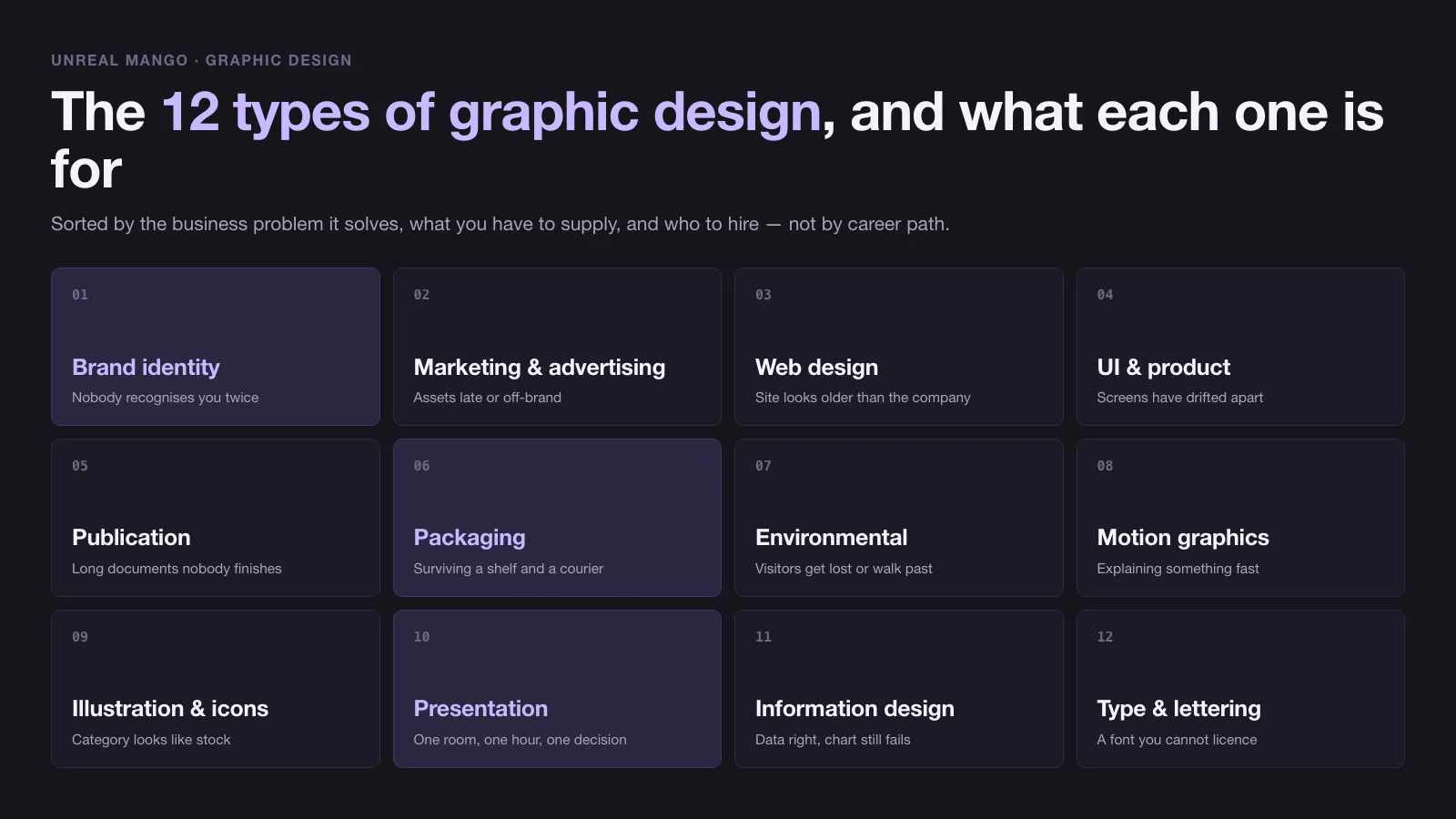
Graphic design splits into twelve working disciplines, and each one exists to solve a different business problem. Identity design fixes what your company looks like. Packaging design gets a product onto a shelf. Environmental design gets a visitor through a building. Which one you need is decided by what just happened in your business, not by what looks nicest.
Almost everything published under this heading is written for someone choosing a career. That is why the lists cluster around salaries, software and portfolios. This one is written for the person signing the purchase order: what each discipline is for, what you personally have to supply before it can start, roughly how long it takes, and which kind of specialist to go to.
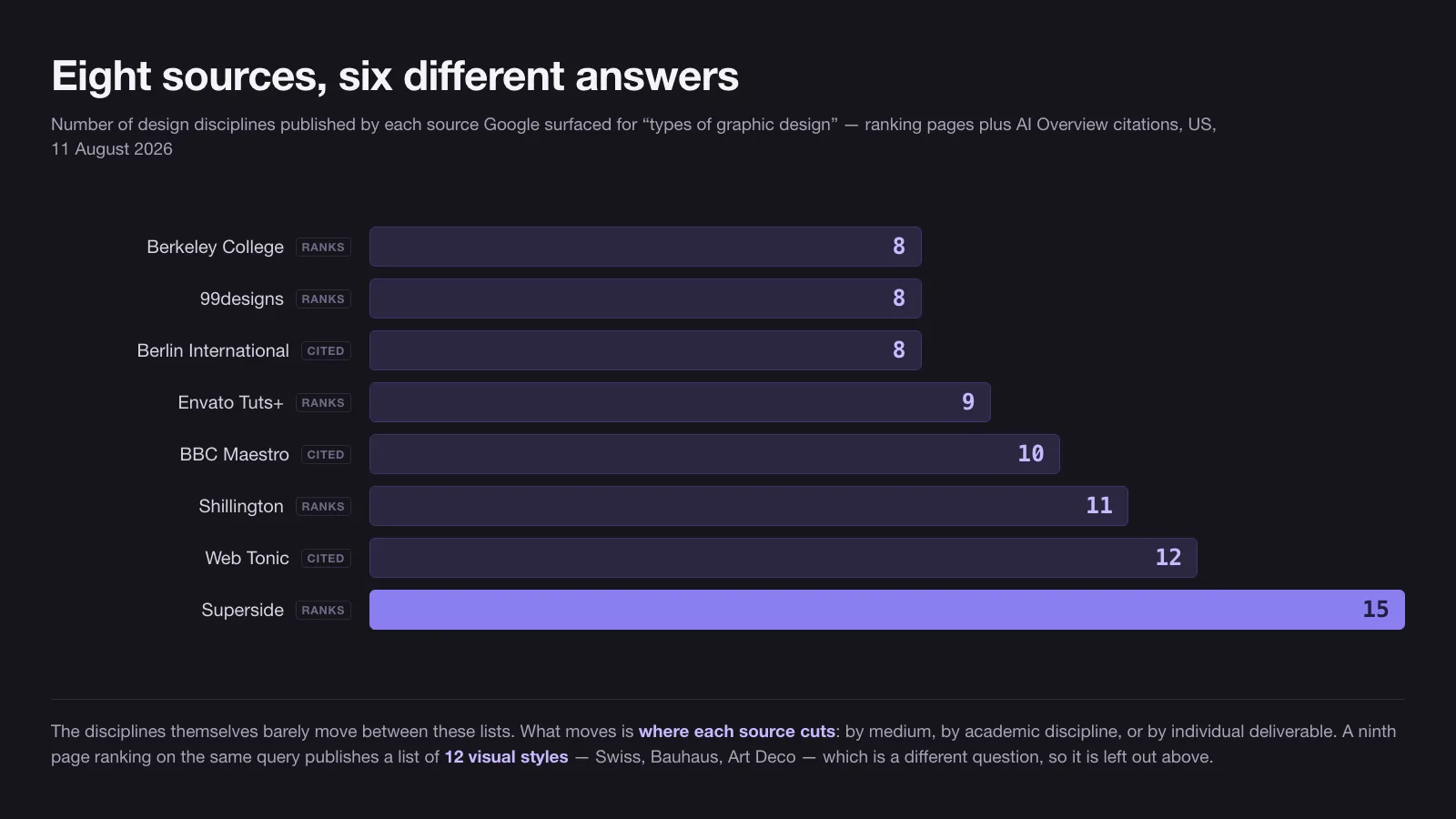
How this was checked. For this query in the United States on 11 August 2026, Google returned an AI Overview and a People Also Ask block above the listings. Of the nine listings that followed, three were education providers, one was a marketplace blog, one was a Reddit thread, one was a video and one covered visual styles rather than disciplines. Counting those listings together with the sources the AI Overview cites, eight publish a number of disciplines: 8, 8, 8, 9, 10, 11, 12 and 15. A ninth publishes a count of twelve visual styles, which is a different question and is left out of that tally. Not one of them explains what a buyer has to hand over before any of the work can start. That is the gap this article fills.
Three ways to cut the field, and the one that matters when you are the buyer
Six different totals across eight sources is not a disagreement about facts. It is a disagreement about where to cut.
Three cutting rules are in circulation, and each produces a different number:
- Cut by medium — print, screen, environment. Gives three or four types. Tidy, useless for briefing anyone.
- Cut by academic discipline — the version taught on design courses. Gives eight to eleven, and explains why education providers hold three of the nine listings here.
- Cut by deliverable — one type per thing you can order. Gives fifteen or more, and starts double-counting: a social ad and a billboard are the same discipline in two sizes.
This article cuts by who you have to hire and what you have to give them. Two disciplines are separate here if commissioning them means a different specialist, a different set of inputs from you, or a different production constraint. That produces twelve. The number is not the point; the routing is.
The 12 types of graphic design, and what each one is actually for
The table below is the whole article in one screen. Each discipline is then described underneath.
| # | Discipline | The problem it solves | What you supply | Typical turnaround | Who you hire |
|---|---|---|---|---|---|
| 1 | Brand identity | Nobody recognises you twice | Positioning, audience, competitor set, sign-off list | 3–8 weeks | Studio or senior freelancer |
| 2 | Marketing and advertising | Campaign assets are late or off-brand | The offer, final copy, channel specs, brand files | 2–10 working days per set | Freelancer, studio or in-house |
| 3 | Web design | The site looks older than the company | Sitemap, real copy, image assets, CMS constraints | 3–8 weeks | Studio with a developer |
| 4 | UI and product design | Screens have drifted apart as the product grew | User flows, technical limits, existing components | 4–12 weeks, then ongoing | In-house or product design studio |
| 5 | Publication and editorial | Long documents nobody finishes reading | Final approved text, image rights, page count and trim | 2–6 weeks | Editorial designer |
| 6 | Packaging | The product has to survive a shelf and a courier | Dieline, substrate, print method, regulatory copy | 3–8 weeks | Packaging specialist |
| 7 | Environmental and wayfinding | Visitors get lost or walk past you | Site drawings and measurements, materials, access rules | 4–12 weeks | Specialist with a fabricator |
| 8 | Motion graphics | Something complex needs explaining fast | Script or storyboard, brand files, audio, duration and ratio | 2–5 weeks per piece | Motion designer or animation studio |
| 9 | Illustration and iconography | Your category looks like everyone’s stock library | Subject list, style references, usage rights needed | 1–4 weeks | Illustrator, commissioned per set |
| 10 | Presentation design | A high-stakes room, one hour, one decision | The argument, the data, the delivery context | 3–10 working days | Presentation specialist |
| 11 | Information design | The data is right and the chart still fails | Clean dataset with its source, the single takeaway | 1–3 weeks | Information designer |
| 12 | Type design and lettering | Your wordmark is set in a font you cannot licence | Usage, language coverage, licensing scope | 2–4 weeks lettering; 3–9 months a typeface | Type designer |
About those turnarounds. They are our own scoping bands for a single deliverable at an agreed scope, measured from approved brief to first full draft. They are not a market survey, and they exclude your review time — which in practice is what actually decides the calendar. Two rounds of feedback that take a week each add a fortnight to every row in the table.
1. Brand identity design
Identity design decides what your company permanently looks like: the logo, the palette, the typefaces, and the rules that keep them consistent when other people use them. It is the discipline whose output nearly every other one on this list consumes, which is why commissioning it after everything else is expensive — the packaging, the deck and the site all get rebuilt when it lands.
The deliverable that matters is not the logo. It is the set of rules around it, because that is what survives the designer leaving; our count of what is actually inside twelve official brand guidelines documents shows what to insist on. If you are choosing between a wordmark, a monogram, a pictorial mark and the rest, that decision has its own guide: the types of logos and what each format costs you in flexibility.
2. Marketing and advertising design
In our own project mix this is the highest-volume discipline by a wide margin: social assets, display banners, email templates, landing page graphics, print collateral, event stands. The work is not intellectually the hardest, but it is the one that breaks first, because demand is continuous and the specs change under you.
The buyer-side failure here is almost never craft. It is supply: campaigns stall because the copy is not final, the offer changes mid-build, or nobody has the current logo files. A designer waiting on approved copy is the most common invisible line item in a marketing budget. If your ads are losing traction rather than looking wrong, the problem may not be design at all — the mechanics of creative wearing out are a media-buying issue with a media-buying fix.
3. Web design
Web design covers the layout, hierarchy and visual system of a marketing site: what a page type looks like, how it behaves at each breakpoint, and how a non-designer will fill it later without wrecking it. It is separated from UI design here for a practical reason — the constraint is a content management system and a marketing team, not an engineering roadmap.
What you supply decides the timeline more than the page count does. Real copy, real photography and a decided sitemap keep a marketing site at the bottom of the three-to-eight-week band above. Lorem ipsum plus “we’ll write it later” pushes it to the top of that band or past it, because every layout decision gets made twice.
4. UI and product design
UI design is the discipline for software: screens, states, components, and the design system that keeps the eightieth screen consistent with the first. Its output is not a set of pictures but a set of reusable parts, handed over in a format engineers can build from.
The trigger for buying it is almost always growth. A product built screen by screen accumulates six shades of grey, four button heights and three date pickers; at that point you are not commissioning a redesign, you are commissioning a system. This work is continuous by nature, which is why the turnaround band above ends in “then ongoing” — the initial engagement establishes the system, and the system needs an owner afterwards.
5. Publication and editorial design
Editorial design is the discipline of long documents: annual reports, whitepapers, books, magazines, catalogues, printed research. Its job is to make length survivable — grid, hierarchy, pacing, and the discipline that keeps page forty as readable as page four.
It is the discipline most often skipped, and the skip is visible: a fifty-page report laid out in a word processor gets opened, scrolled and closed. Editorial work cannot start until the text is genuinely final, because reflowing a laid-out document is not a small edit — it moves every page after the change.
6. Packaging design
Packaging is where graphic design meets manufacturing. The designer works to a dieline supplied by the printer, on a specific substrate, with a specific print method, and with copy that a regulator may control. Colour behaves differently on kraft board than on coated stock, and neither behaves like your screen.
This is the clearest case on the list for hiring a specialist rather than a generalist. The information the project needs from you is unusually technical — dieline, substrate, print method, barcode and any mandatory regulatory copy — and it comes from your printer, not from your marketing team. Getting it before design starts is the single biggest lever on the schedule.
7. Environmental and wayfinding design
Environmental design puts graphics into physical space: signage, wayfinding, exhibition stands, retail interiors, murals, office branding. Wayfinding is the subset with a measurable success test — can a first-time visitor get from the entrance to where they are going without asking anyone.
The constraints are architectural. Sign sizes follow sightlines and reading distances; materials follow weather, cleaning and fire rules; placement follows accessibility legislation that varies by country. You supply drawings and measurements, and the design is delivered alongside a fabricator, not instead of one.
8. Motion graphics design
Motion graphics is graphic design with time added: animated logos, explainer videos, title sequences, animated data, social video, interface animation. The discipline is the same — type, image, hierarchy — plus pacing, and pacing is what makes it a separate hire.
The economics are decided before anyone animates. A script and an approved storyboard cost a fraction of the animation they govern, which is why changing your mind at storyboard stage is cheap and changing it at animation stage is not; the working version of that checkpoint is the animatic. If you are weighing animation approaches for the piece itself, the trade-offs between 2D and 3D are set out separately.
9. Illustration and iconography
Illustration is commissioned artwork: editorial images, spot illustrations, character work, and icon sets built as a family rather than collected one at a time. It is the fastest way out of a category where every competitor is licensing from the same three stock libraries.
Two things decide the brief. The first is the usage rights you actually need — where the artwork will appear, for how long, and whether exclusivity matters — because that, not the drawing time, is what most illustration pricing turns on. The second is consistency: a set of twenty icons commissioned as a set costs less and looks better than twenty icons commissioned twenty times.
10. Presentation design
Presentation design is a distinct commissioning discipline for one reason: the deliverable is an argument, not a document. An investor deck, a sales pitch, a board update and a conference keynote each need a different structure, and the design work starts by fixing the narrative order — which slide earns the next slide.
Most of the value is created before anything is styled. A deck that is redesigned without restructuring looks better and performs the same. If you are assembling the raw material, our breakdown of what belongs in a pitch deck covers the slides investors expect and the order they expect them in.
11. Information design
Information design, also called data visualisation, turns data and process into something a reader can act on: charts, dashboards, infographics, diagrams, comparison tables, timelines. It overlaps with editorial and UI work, but it is a separate skill — choosing the right chart form and removing everything that is not carrying meaning.
The input requirement is stricter than in any other discipline on this list. You supply a clean dataset, its source, and the one thing the reader should conclude. Handing a designer a spreadsheet without a takeaway produces a decorated spreadsheet, which is the failure mode we see most often in this discipline.
12. Type design and lettering
Type design is the specialist end: custom lettering for a wordmark, a modified typeface, or a full commissioned family. Most companies never need it. The ones who do usually arrive through a licensing problem — the typeface in their identity is not licensed for the number of web visitors, applications or regions they now have.
The two jobs on this row are not the same size. Custom lettering is a fixed set of drawn characters for one use; a typeface is a working font file with a full character set, language coverage, spacing and kerning, which is why the band above runs to months rather than weeks.
Which discipline you need, by what just happened in your business
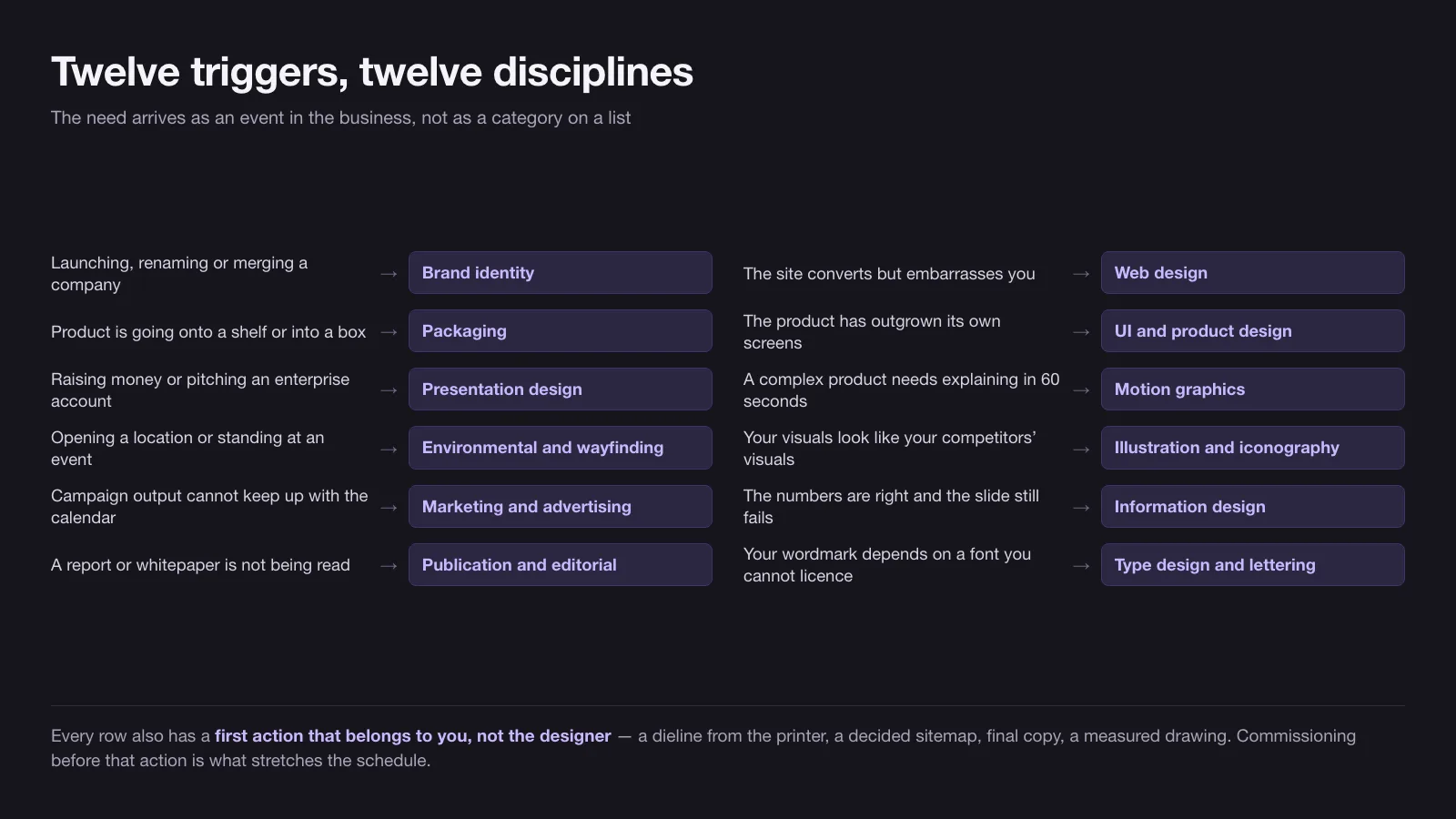
The list above is ordered by discipline. This one is ordered by trigger, which is how the need actually arrives.
| What just happened | Discipline to commission | Do this first |
|---|---|---|
| Launching, renaming or merging a company | Brand identity | Settle positioning before anyone draws |
| Product is going onto a shelf or into a box | Packaging | Get the dieline and print method from the printer |
| Raising money, or pitching an enterprise account | Presentation design | Fix the narrative order, then style |
| Opening a physical location or standing at an event | Environmental and wayfinding | Obtain drawings, measurements and access rules |
| Campaign output cannot keep up with the calendar | Marketing and advertising | Lock the offer and finalise the copy |
| A report or whitepaper is not being read | Publication and editorial | Freeze the text before layout starts |
| The site converts but embarrasses you | Web design | Decide the sitemap and write the real copy |
| The product has outgrown its own screens | UI and product design | Inventory the components you already have |
| A complex product needs explaining in 60 seconds | Motion graphics | Approve a script, then a storyboard |
| Your visuals look like your competitors’ visuals | Illustration and iconography | Define usage rights before commissioning |
| The numbers are right and the slide still fails | Information design | Write the takeaway in one sentence |
| Your wordmark depends on a font you cannot licence | Type design and lettering | Audit where the licence actually falls short |
Where two disciplines overlap, and which one owns the file
In our own projects, most of the budget that gets lost is lost in the seams, where two specialists each assume the other owns something. Five seams account for nearly all of it.
- Identity and marketing. Identity defines the rules; marketing applies them. The seam is the template. If nobody is contracted to build the campaign templates, identity ships a PDF of rules and marketing invents its own layouts within weeks.
- Web and UI. Web owns the marketing site, UI owns the product. The seam is the design system: two systems means the signed-up user crosses a visible border between the site they bought from and the product they bought.
- Packaging and illustration. The illustrator draws the artwork; the packaging designer places it into a dieline at production resolution and in the right colour space. Artwork commissioned without that conversation arrives in the wrong colour model and gets redrawn.
- Motion and UI. Motion owns the video; UI owns the interface animation. The seam is specification — a video handed to engineers is a reference, not an implementable spec, and interface motion needs durations and easing curves written down.
- Publication and information design. Editorial owns the pages; information design owns the charts. The seam is chart styling: a report with twelve charts in four different visual languages had two owners and no agreement between them.
The cheapest fix is contractual rather than creative. Name the owner of each shared artefact — templates, design system, artwork files, motion specs, chart styles — in the brief, before anyone starts.
A single product launch, split across four disciplines
Disciplines rarely arrive one at a time. A physical product going to market typically needs four of them, in a sequence where each one gates the next.
- Identity, or a confirmation that it holds. Everything downstream applies it. If the identity is being revised, the launch waits — or the packaging gets printed twice.
- Packaging. The longest lead time and the least forgiving, because printing is a physical commitment. It cannot start until the printer has supplied the dieline and the regulatory copy is approved.
- Motion and photography for the announcement. Both need the finished packaging design to exist, and motion needs its script approved before animation begins.
- Marketing and web assets. The fastest to produce and therefore the last to start, but they inherit every earlier decision, which is why they collapse when an earlier one is reopened.
Run in that order, the dependencies are one-directional. Run in reverse — assets first, packaging late — and each earlier decision invalidates work that has already been paid for. The sequencing, not the design quality, is what usually decides whether a launch date survives.
Who to hire for each type, and where the line falls
The twelve disciplines split cleanly into three commissioning patterns.
One generalist can cover marketing design, presentation design, basic web layout and light editorial work. These share a toolset and a set of conventions, and the constraints are commercial rather than technical. This is where a good freelancer or a small studio is genuinely equivalent to a large one.
A specialist is worth the premium for packaging, environmental design, motion and type design. Each carries production knowledge that is not transferable: dielines and substrate behaviour, fabrication tolerances and accessibility rules, animation timing, and font engineering. A generalist attempting these produces work that looks right and fails at production, and production failures are discovered at the most expensive possible moment.
Hire in-house or on retainer for UI and product design, and for high-volume marketing output. Both are continuous rather than project-shaped. A design system with no permanent owner drifts back into inconsistency, and a project-priced engagement gives nobody the mandate to maintain it.
For the disciplines where we do the work ourselves, the scope and the way projects are run are set out on our graphic design page.
Where AI changes the work, and where it does not
AI generation is now ordinary inside most of these disciplines. It is fast at the middle of the process: exploring layout variants, extending or replacing backgrounds, producing size variants of an approved concept, drafting icon options, cleaning up assets. Used there, it shortens the distance between a brief and something you can react to.
What it does not change is either end. It does not supply the inputs — a dieline, a fabrication tolerance, a measured sightline, ingredient copy a regulator will accept, or licence coverage for a typeface. And it does not make the judgement about whether the thing in front of you solves the business problem you started with. The disciplines in this list that carry a physical or legal constraint are the ones where that gap is widest, which is exactly why they are the ones still worth a specialist.
Treated as a tool inside the process, it is useful. Treated as a replacement for the brief, it produces work that is plausible at a glance and wrong at production.
What to settle before you commission any of the twelve
Four things decide the outcome more than the choice of designer does.
- The brief. Every discipline above starts with one, and the ones that go wrong nearly always went wrong here first. What a workable one contains — including the lines that pay for themselves — is covered in our guide to the design brief.
- The inputs, gathered before the start date. Column four of the table is not a formality. The most common cause of schedule slippage we see is a designer waiting for something only the client can provide.
- The file formats and the masters. Ask for editable source files and the correct master format for each deliverable at the point of commissioning, not after handover; which format belongs to which job is set out in our comparison of vector and raster files.
- The owner of each shared artefact. Templates, design system, artwork, motion specs, chart styles. Named in the brief, before the seams appear.
Get those four right and the choice between the twelve disciplines becomes what it should be: a routing decision, made once, based on what your business actually needs next.
09 / Reader questions
Frequently asked questions
01How many types of graphic design are there?
There is no fixed number. Across the eight sources Google surfaced for this query in the United States on 11 August 2026 — the ranking pages plus the sources its AI Overview cites — the published counts were 8, 8, 8, 9, 10, 11, 12 and 15: six different totals. The disciplines are real; the count is an editorial choice about how finely to split them.
02What are the 8 types of graphic design?
The most repeated eight-type split is visual identity, marketing and advertising, user interface, publication, packaging, motion graphics, environmental, and art and illustration. It is the version Google's AI Overview reproduces. It is a useful shorthand, but it folds web design into UI and leaves out presentation and information design.
03What are the 7 types of graphic design?
None of the pages ranking for this query on 11 August 2026 publishes a list of seven — the totals we found were 8, 9, 10, 11, 12 and 15. Seven-item lists do circulate, and they are usually the standard eight with two entries merged, typically illustration folded into publication or marketing.
04Which type of graphic design does a small business need first?
Brand identity, in almost every case. It is the discipline whose output nearly every other one consumes: marketing design, packaging, web design and presentation design all start by asking for your logo files, colours and type. Commissioning them first means paying to redo them later.
05Do I need a different designer for each type of graphic design?
No, but you need a different specialist for the disciplines with a physical or technical constraint. One generalist can cover marketing design, presentation design, basic web layout and light editorial work. Packaging, environmental design, motion and type design each carry production knowledge — dielines, fabrication tolerances, animation timing, hinting — that a generalist usually does not have.
06What is the difference between graphic design and visual identity design?
Visual identity design is one discipline inside graphic design. Graphic design is the whole field of arranging type, image and space to communicate; visual identity is the narrow part that defines a brand's permanent look — logo, palette, typefaces, rules — which every other discipline then applies.
07Can AI replace graphic designers?
Not for the disciplines that carry a physical or legal constraint. AI generation is now routine in the middle of the process — exploring layouts, extending backgrounds, producing variants. It does not supply a dieline, a fabrication tolerance, ingredient copy that a regulator will accept, or licence coverage for a typeface.