Published
Google removes a review through its content policy only when the review breaks a named clause. There is no clause for unfair, none for one star with no text, and none for an account you simply disagree with. A second, separate route exists for legal grounds — a court order, a defamation claim, an intellectual property claim — and it runs through Google’s legal removal form, not the report button. Everything else splits in two: find the clause and report it, or accept that the review is staying and dilute it. Both are procedures, and the second one has arithmetic.
What follows is the clause list, how to report against it, what the reporting tool tells you, and what a single one-star review actually costs in reviews you now have to earn.
What Google takes down, and what it will never take down
Google states the boundary on the reporting page itself: “Do not report a review just because you disagree with it or dislike it,” followed by “Negative reviews can highlight areas for improvement and aren’t always a sign of poor service.”
That sentence is the whole decision. A removal request is not an appeal about who was right. It is a claim that a specific piece of text matches a specific listed prohibition, evaluated as a classification job. Nobody at Google is going to compare your service record against the reviewer’s account.
Reviews that stay, no matter how you word the report:
- A true account of a bad experience.
- An opinion you disagree with — slow, overpriced, rude, not worth it.
- A one-star rating with no text. There is nothing to classify.
- An account that is wrong on the facts but plausible and about a real visit. The nearest clause reaches “false or misleading accounts of the description or quality of a good or service,” which is a high bar: Google has no access to your records.
- A review from a customer you refused to serve, or fired. Being an unwanted customer is not a policy violation.
Reviews that come down are the ones whose content — not whose conclusion — matches a prohibition. That list is longer than most owners realise, and shorter than they hope.
The 23 named prohibitions, and which ones a bad review actually falls under
Google’s prohibited and restricted content policy for Maps groups 23 named prohibitions into six families. Reading the whole list is worth ten minutes, because the categories are the vocabulary your report has to be written in — but most of them describe content a disgruntled customer never posts.
The tiering below is ours, not Google’s: it reflects which clauses a small business can realistically build a case on.
| Prohibition | Family | How often it is the live issue |
|---|---|---|
| Fake engagement | Fake & misleading | Often — the reviewer was never a customer |
| Off-topic | own family | Often — wrong branch, the courier, the business next door, or a personal rant |
| Personal information | Inappropriate | Often — names a staff member’s phone number, home address, or financial or medical details |
| Obscenity & profanity | Inappropriate | Often — profanity used to offend or to sharpen criticism; Google allows inoffensive uses of the same words |
| Harassment | Inappropriate | Often — sustained targeting of one named person |
| Impersonation | Fake & misleading | Sometimes — reviewer posing as someone else |
| Advertising & solicitation | own family | Sometimes — a rival plugging their own business |
| Repetitive content | Unclear & repetitive | Sometimes — the same review posted again and again |
| Hate speech | Inappropriate | Sometimes |
| Restricted content | Inappropriate | Sometimes — calls to action for restricted goods |
| Rating manipulation | Fake & misleading | Sometimes — including reviews left by former staff |
| Offensive content | Inappropriate | Sometimes — it covers “unsubstantiated allegations of unethical behavior or criminal wrongdoing” |
| Fake & misleading content & reviews | Fake & misleading | Umbrella clause — in practice reported as fake engagement |
| Misrepresentation | Fake & misleading | Rare — a “false or misleading account” of the service is hard to establish from outside |
| Misinformation | Fake & misleading | Rare |
| Unclear content | Unclear & repetitive | Rare |
| Defacement & mischief | own family | Rare |
| Sexually explicit, adult-themed, violence & gore, dangerous content, child safety, terrorist content | Inappropriate | Effectively never, in this context |
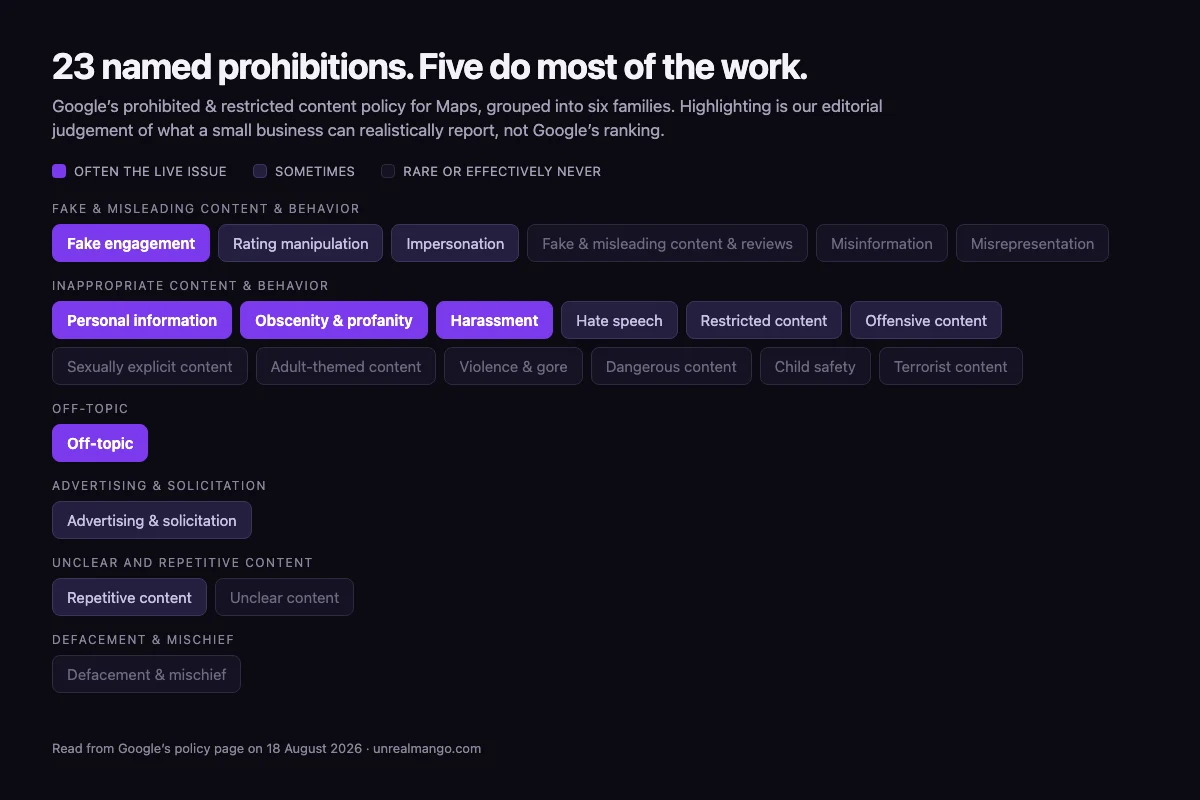
Note what is missing from all 23: unfair, damaging, disproportionate, malicious. Owners write reports in those words and the reports fail, because none of them is a category anyone at Google can select. Untrue is there, but narrowly — misrepresentation reaches a false account of the quality of a service, and offensive content reaches unsubstantiated allegations of unethical or criminal conduct. A review accusing you of fraud is not the same object as a review calling you slow, and only one of them has a clause.
Reviews left by current or former employees fall under rating manipulation’s conflict-of-interest wording, which is part of the same rulebook that governs how you may ask for reviews in the first place — that set is laid out in full, with the date each rule appeared, in our guide to getting more Google reviews without getting them deleted.
How to write a report Google can act on
Pick the clause first, then describe only the facts that establish it. Everything else — the transaction history, the tone of the complaint, the harm to your business — is noise in a classification decision and dilutes the one paragraph that matters.
One caveat on mechanics before the table. The initial report asks you to select a reason, not to write one: Google’s documented flow is a reason picker and a Submit button. The paragraph you draft is what goes into the free-text form at the one-time appeal stage, and what keeps your own record straight if the reviewer edits the text after you flag it. Picking the clause first still decides which button you press.
| What actually happened | Clause to report under | What the report has to establish |
|---|---|---|
| Reviewer was never a customer, or is a competitor | Fake engagement | That the contribution is not based on a real experience: no record on the stated date, no such service sold |
| Review describes another branch, a courier, or the shop next door | Off-topic | That the experience described is not of this location |
| Review names a staff member’s phone number, home address or medical details | Personal information | That third-party personal data is published without consent. Google separately allows naming a public-facing professional who trades under their own name |
| Review accuses you of fraud, theft or breaking the law, with nothing behind it | Offensive content | The specific allegation, quoted, and the absence of any basis for it |
| Slurs or profanity in the text | Obscenity & profanity, or hate speech | The words themselves; quote them |
| Sustained campaign against one named individual | Harassment | The pattern, with the other contributions listed |
| A rival promotes their own business inside your review | Advertising & solicitation | The promotional content in the review body |
| The same reviewer posts the same text repeatedly | Repetitive content | The duplicates, with links |
| Ex-employee grievance about pay or management | Rating manipulation, conflict of interest | The employment relationship and its dates |
| Customer’s account of the service is untrue but plausible, with no allegation of wrongdoing | None that will hold | — reply publicly instead |
| The review is unfair | None. This category does not exist | — |
Two practical rules. Google’s form takes one reason per report, so the real decision is which single clause you are betting on rather than how many you can list — pick the one you can evidence, not the one that feels worst. And quote the offending words verbatim in your own notes rather than characterising them, because the reviewer can edit the review after you flag it, and a quoted string survives the edit.
Two places to report, and the three statuses the tool returns
There are two surfaces, and they are not equivalent.
From the profile. Go to your Business Profile, select Read reviews, then next to the review select Report, choose the reason to flag it, and select Send report. Fast, and it gives you no visibility afterwards.
Reviews Management Tool. Go to the tool, confirm your email address or switch accounts, select your business, select Continue and then Report a new review for removal, select Report next to the review, choose the violation reason in the new tab, and submit. This is the route worth using, because it is the only one that reports status back.
Three statuses appear, in Google’s own wording:
- “Decision pending” — the review is flagged, but hasn’t been evaluated yet.
- “Report reviewed - no policy violation” — the review was evaluated, and no violation was found.
- “Escalated - check your email for updates” — the appeal has been escalated.
Two limits define what the tool can do for you. You may select up to 10 reviews in a single appeal submission, and each review gets one appeal opportunity — once. There is no second attempt and no way to buy one, which is why the first report should be written properly rather than sent in the first hour. Google’s published evaluation and appeal timings are set out in the companion piece linked above; treat any faster figure you see quoted as invented.
After a refusal: the one appeal, and what is left when it fails
“Report reviewed - no policy violation” is not the end. The Reviews Management Tool lists appeal-eligible reviews, and you may submit a one-time appeal on each. Use it only if you can add something the first report did not contain — the reviewer’s other contributions, the employment record, the dates that contradict the visit. Resubmitting the same argument spends the one appeal you get.
Escalation is not a separate, better outcome. Google’s page says a review that survives the appeal also ends up showing “Escalated - check your email for updates” — the email is the verdict, the status string is not. When the verdict goes against you, the review is part of your profile and the question changes from removal to management. Three things are worth doing in that order.
Reply, once, in public. The reply is the only piece of that exchange you control, and it is read by people who will never contact you. What to put in it — and what a reply must never contain — is its own discipline, covered in how to respond to Google reviews. One constraint belongs here: in a regulated vertical, confirming that the reviewer was a customer at all can be the violation. A dental or medical practice replying “we’re sorry your root canal was uncomfortable” has just published a treatment fact about a named person, which is a compliance problem before it is a marketing one — one of several reasons patient acquisition runs on different rules from ordinary local marketing.
Check whether Google is even the main surface. A one-star on Google is loud, but the same complaint is often sitting on two or three other properties that rank for your brand name. A brand audit tells you whether the review is the problem or a symptom of a wider one.
Then do the arithmetic, because burying is not a metaphor — it is a specific number of reviews.
The arithmetic of burying a one-star review
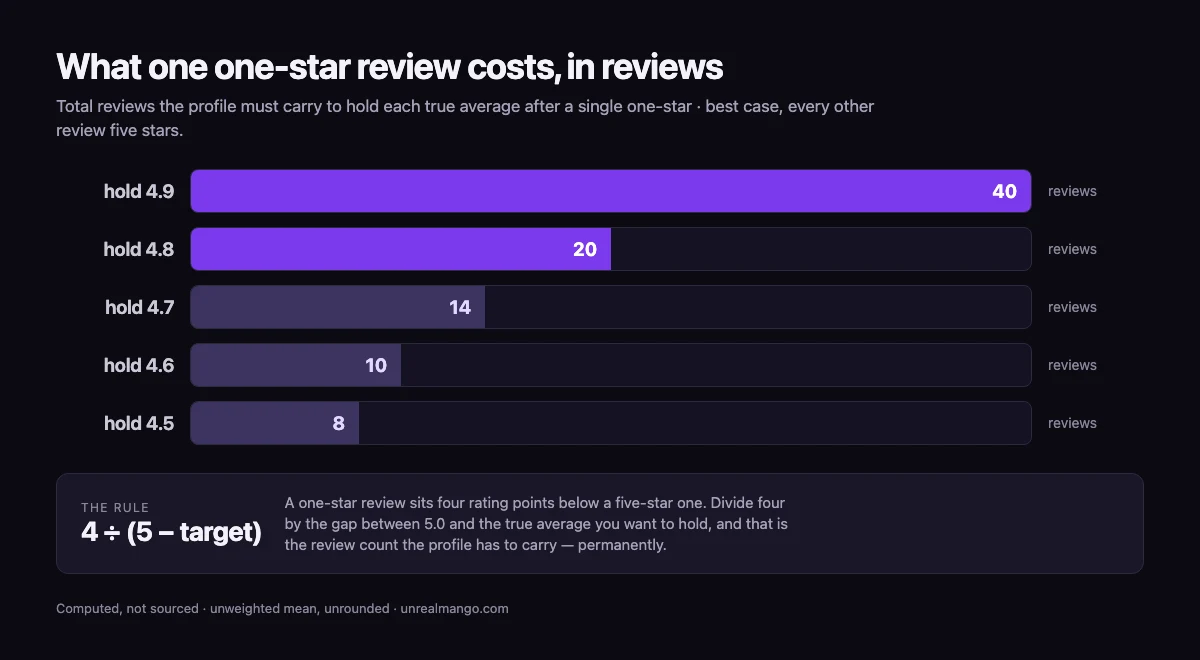
Your displayed rating is the mean of every review, shown to one decimal place. A one-star review is four rating points below a five-star one, and each new five-star review you add moves the mean by a shrinking amount. That produces a clean rule.
To hold a true average of T after a single one-star review, the profile needs at least 4 ÷ (5 − T) reviews in total — assuming every other review is five stars, which is the best case.
| True average you want the profile to hold | Total reviews needed, per one-star | Per two-star |
|---|---|---|
| 4.9 | 40 | 30 |
| 4.8 | 20 | 15 |
| 4.7 | 14 | 10 |
| 4.6 | 10 | 8 |
| 4.5 | 8 | 6 |
Swap the 4 for 3 and the same rule gives the two-star column; in general it is (5 − v) ÷ (5 − T), where v is the star value of the review you are diluting. The relationship is linear in the number of bad reviews, so two one-stars double it: 80 reviews to sit at 4.9. Three make it 120.
If your existing average is already below 5.0 — which it is — the number to add is N × (T − A) ÷ (5 − T), where N is your current review count, A your current average and T your target. A profile with 60 reviews averaging 4.7 that wants to display 4.8 needs 30 consecutive five-star reviews. Not thirty reviews. Thirty in a row, with no four-star among them, because a four-star review moves the average the wrong way against a 4.8 target.
Three things follow from the table, and they are the reason to run it before deciding anything.
Removal is worth real effort when a clause exists. At the 4.9 line, deleting one one-star review saves you the 39 five-star reviews the table says you would otherwise have to earn to carry it. Nothing else in local marketing has that exchange rate. That is the case for writing the report carefully rather than firing it off.
The curve is brutal at the top and forgiving at the bottom. A profile with 12 reviews sits at 4.67 after one one-star and needs roughly fifteen more five-star reviews to reach 4.9 — reachable if you are collecting reviews at all. A profile with 300 has already absorbed it and will never notice the next one either, which is the real argument for volume: it is defensive, not a ranking play.
The table targets the true mean, not the displayed one. Google publishes only that the score is the average of all published ratings; it does not document how that average is rounded to the single decimal place it shows. If it rounds rather than truncates, you cross a display threshold well before the table says — 27 reviews rather than 40 to show 4.9, 12 rather than 14 to show 4.7. Treat the table as the conservative version.
One thing the arithmetic does not tell you is whether any of it moves your position in local results. The published research on review counts and the local pack is correlational and category-specific, and it is set out with its caveats in the companion piece rather than repeated here.
Where the legal route helps, and where it backfires
Three legal facts are worth an owner’s time. The rest is a lawyer’s job.
You cannot contract your way out of reviews. The Consumer Review Fairness Act, 15 U.S.C. §45b, voids a form-contract provision that prohibits or restricts a customer’s ability to review you, imposes a penalty or fee for doing so, or transfers their intellectual property rights in the review content. The Act took effect on 14 December 2016; subsections (b) and (c), which void those clauses, applied 90 days after enactment, and the enforcement subsections (d) and (e) one year after enactment. The FTC and state attorneys general enforce it. The statute does preserve some ground: §45b(b)(2) leaves you free to enforce confidentiality duties imposed by law, to pursue a defamation claim, and to remove libelous, harassing, obscene, off-topic or clearly false content — but that last permission covers content on your own platform. It gives you nothing on Google’s.
A groundless legal threat aimed at a reviewer is itself a violation. The FTC’s 2024 rule on consumer reviews names unfounded legal threats used to suppress a review as prohibited conduct in its own right. So the standard move — a solicitor’s letter to a one-star reviewer hoping they fold — is the one action in this whole area that can turn a bad review into a regulatory problem. The provision and its wording are set out in the companion piece.
Defamation is a lawyer’s question, not ours. Whether a specific review crosses from opinion into a false statement of fact, whether that is actionable in your state, and whether pursuing it is worth the attention it draws — none of that is a marketing decision, and no article should give you an answer to it. Take the review, the dates and the evidence to a lawyer licensed where you operate.
What review removal services sell, and what they can deliver
Search for this topic and the first page is mostly Google’s own help pages, Reddit threads and YouTube, with a no-win-no-fee removal vendor near the bottom of it. Those firms do not publish rate cards; the model advertised is contingency, priced per outcome. We are not quoting a market rate, because there is no published one to quote.
What they can do is the work described above: identify the clause, write the report, use the tool, and appeal once. That is the same form, the same limits and the same single appeal available to you at no cost. A vendor’s genuine advantages are pattern recognition across many profiles and the discipline to write reports narrowly — neither of which is a mechanism you cannot use yourself.
What some of them do beyond that is worth knowing before you hire anyone. In January 2025 the Canadian local search firm Sterling Sky documented a case in which a reputation company got a critical forum thread deindexed from Google Search by filing a false copyright takedown, claiming the post had lifted material from a news article about the Haiti earthquake; Google approved it quickly enough to suggest no human read it, and the content later reappeared on its own without any appeal being filed. That route removes a page from search results, not a review from a profile — but it tells you what a supplier billing on outcomes will reach for. The tactic carries a specific exposure: a DMCA takedown notice requires a statement, made under penalty of perjury, that the sender is authorised to act for the copyright owner, and the statute creates liability for a knowing material misrepresentation. If a supplier gets a review taken down for you and will not say which policy clause it was reported under, that is the question to ask before the invoice.
The durable version of all of this is unglamorous. Have a clause-based report ready for the reviews that break the rules, a reply ready for the ones that do not, and enough review volume that a single one-star is arithmetic rather than an emergency. Building that third thing into how a business operates — rather than running it as a campaign after something goes wrong — is part of what we set up as marketing for small businesses.
Sources, and what each figure was measured on
- Policy categories and family structure: Google’s Prohibited & restricted content policy for Maps user-generated content, read 18 August 2026. 23 named prohibitions across six families. The tiering of which clauses realistically apply to a business owner’s report is our editorial judgement, not Google’s.
- Reporting steps, the Reviews Management Tool flow, the three status strings, the 10-review submission limit and the one-appeal-per-review rule: Google’s “Report inappropriate reviews on your Business Profile” help page. Status wording quoted verbatim; the page carries no visible publication date.
- “Do not report a review just because you disagree with it or dislike it” and the note on negative reviews: same page.
- Rating arithmetic: computed, not sourced. The requirement is N ≥ (5 − v) ÷ (5 − T) reviews in total to hold mean T after a single review of value v, and N × (T − A) ÷ (5 − T) additional five-star reviews to move an existing profile of N reviews from average A to target T. Assumes an unweighted mean and that all other reviews are five stars.
- Consumer Review Fairness Act: 15 U.S.C. §45b, statutory text; enacted 14 December 2016, with subsections (b) and (c) applying 90 days after enactment and (d) and (e) one year after enactment. Enforcement note from the FTC’s business guidance on the Act, dated February 2017.
- Separate legal removal route: Google’s legal removal request form, which accepts court orders, defamation and intellectual property claims for Maps content. It is not part of the 23-clause policy list.
- DMCA takedown abuse case: Joy Hawkins, Sterling Sky, published 20 January 2025 and updated 1 August 2026. One documented case, concerning a forum thread deindexed from Search rather than a review removed from a profile; no success rates published. Perjury and misrepresentation provisions: 17 U.S.C. §512(c)(3)(A)(vi) and §512(f).
- Composition of the first page of results, and the presence of a single contingency-billed removal vendor on it: live desktop SERP for “how to get rid of bad google reviews,” United States, English, captured 18 August 2026.
- Google’s published evaluation and appeal timings, annual enforcement volumes, profile-level restrictions and the rules governing how you may solicit reviews are covered in our companion article and are not restated here.
09 / Reader questions
Frequently asked questions
01Is it possible to get bad Google reviews removed?
Only if the review breaks a named clause in Google's content policy for Maps. Google's own instruction is not to report a review because you disagree with it or dislike it. A true account of a bad experience, an opinion, or a one-star rating with no text has no clause to cite and will stay.
02How much does it cost to get a negative Google review removed?
Reporting it yourself costs nothing and uses the same form the paid services use. Removal firms do not publish rate cards; the one vendor ranking on the first page of Google for this search advertises contingency, billed only on a successful removal. Any specific price you see quoted is that vendor's, not a market rate.
03Do Google reviews ever get removed?
Yes, in volume — Google publishes annual counts in the hundreds of millions, the bulk of it caught by its own detection rather than by owner reports. Reports succeed when the review matches a listed prohibition: fake engagement, off-topic content, personal information, obscenity, harassment. They fail when the only complaint is that the review is unfair.
04Can a business delete a Google review itself?
No. A business can report a review and reply to it, and that is the whole of its control. Only the person who wrote a review can delete it, and only Google can remove one. There is no owner-side delete button, and no plan or subscription that adds one.
05How do I remove an illegal or defamatory Google review?
Not through the report button. Google runs a separate legal removal route that accepts court orders, defamation claims and intellectual property claims for Maps content, and there is no illegal-content clause among the policy prohibitions for a report to match. Whether a review is defamatory is a question for a lawyer licensed where you operate.
06Can a business stop customers leaving bad reviews in its contract?
No. The Consumer Review Fairness Act, 15 U.S.C. §45b, makes a form-contract clause void if it restricts a customer's ability to review the business, penalises them for doing so, or takes ownership of their review content. The Federal Trade Commission and state attorneys general enforce it.