
Published
SEO ROI is (revenue attributed to organic search − cost of the programme) ÷ cost of the programme, expressed as a percentage. Every guide on the first page gives you that. None of them check what you put into it — and the same programme, honestly measured, returns 50%, 100% or 275% depending on two choices nobody writes down.
Those two choices are the subject of this piece. The formula is arithmetic. The inputs are judgement, and judgement is where the number is won or lost.
The SEO ROI formula, and why the formula is the easy part
Take a single year of organic work. Say the external invoices for it came to $36,000, internal hours and tooling added $12,000, and the gross profit on deals attributed to organic search was $72,000. These are arbitrary round figures chosen to make the arithmetic legible, not a quote and not a market rate.
| What you decide | Numerator | Denominator | Reported SEO ROI |
|---|---|---|---|
| Gross profit, full cost | $72,000 | $48,000 | 50% |
| Gross profit, invoices only | $72,000 | $36,000 | 100% |
| Revenue at a 40% margin, full cost | $180,000 | $48,000 | 275% |
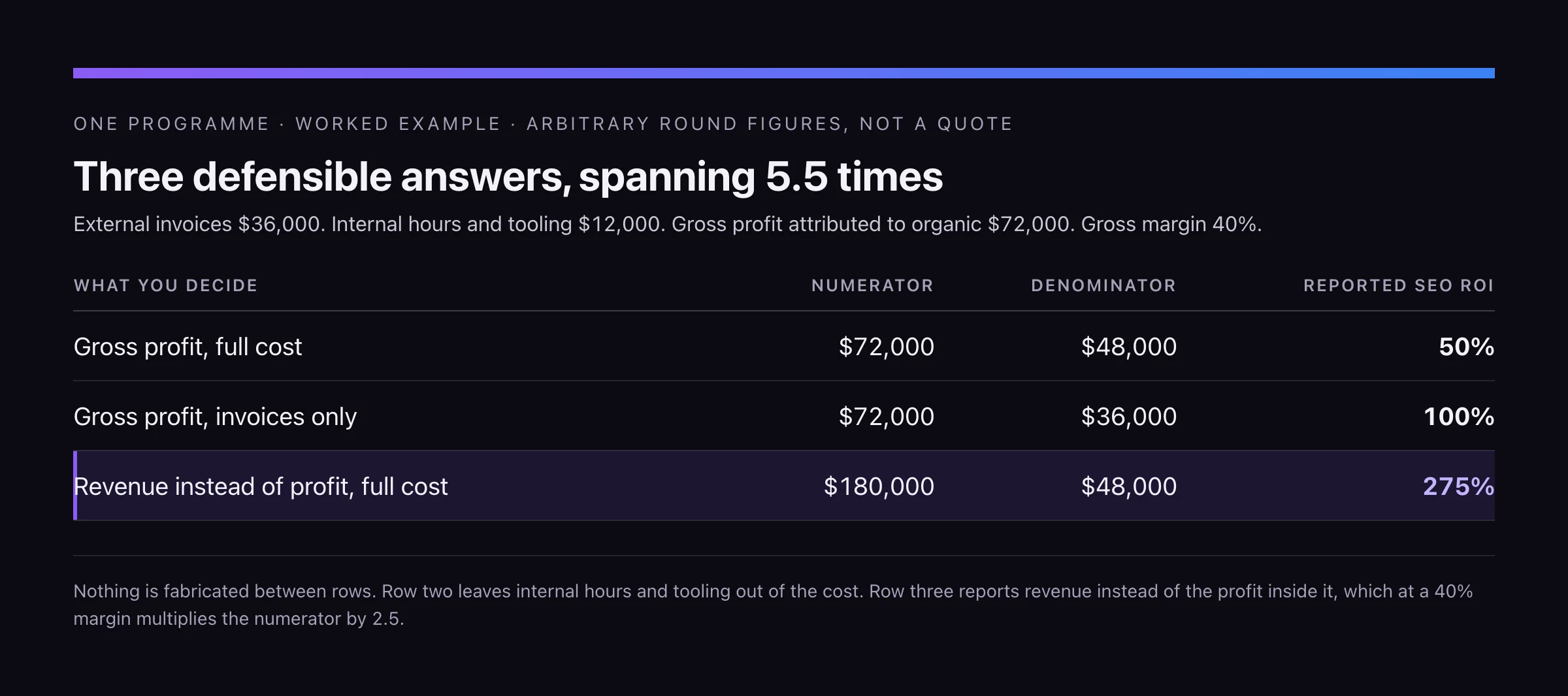
One programme, three defensible-sounding answers, spanning 5.5 times. Nothing was fabricated between rows. Row two simply left the internal hours and tooling out of the cost. Row three reported revenue instead of the profit inside it, which at a 40% gross margin multiplies the top of the fraction by 2.5.
This is why comparing your return against someone else’s published figure is meaningless unless they state which row they are in. Almost nobody does.
What belongs on the cost side, and what quietly gets left out
The cost side should contain everything you would not have spent if the programme did not exist. In practice it contains whatever arrived as an invoice, because that is the number sitting in the accounting export.
Three categories go missing, all of them real money:
- Internal hours. Someone briefs, reviews, approves and chases. Someone in development ships the technical fixes. Those hours have a cost even though nobody invoices for them, and on a small team they are frequently the largest single line.
- One-off builds. A migration, a template rebuild, a set of images, a fix to a checkout flow that was blocking indexing. These are capital-flavoured and get filed away from the marketing line, then never reappear in the ratio.
- Tools. Rank tracking, crawlers, analytics upgrades. Individually small, collectively not.
Leaving them out does not make your programme look slightly better. In the worked example above it doubled the reported return, from 50% to 100%, with no change in what was actually earned.
What the cost side should not contain is a debate about billing models. What a retainer buys, why two quotes for the same scope differ threefold and how an agency compares against a hire are a separate question with its own arithmetic, worked through in SEO pricing. That piece ends where this one starts: it budgets the horizon, and notes that the payback question cannot be answered with data until the horizon is spent. This is that answer.
Ad-equivalent traffic value: one keyword, a 44.8x spread
The most common way to fill the revenue side is also the weakest one. Ask a tool what your organic traffic is “worth” and it will price your clicks at what the equivalent paid clicks would cost in Google Ads. The number is large, it is easy to produce, and it is the first thing most agencies put in a report.
It has two problems. The second is fatal, but the first is easier to demonstrate.
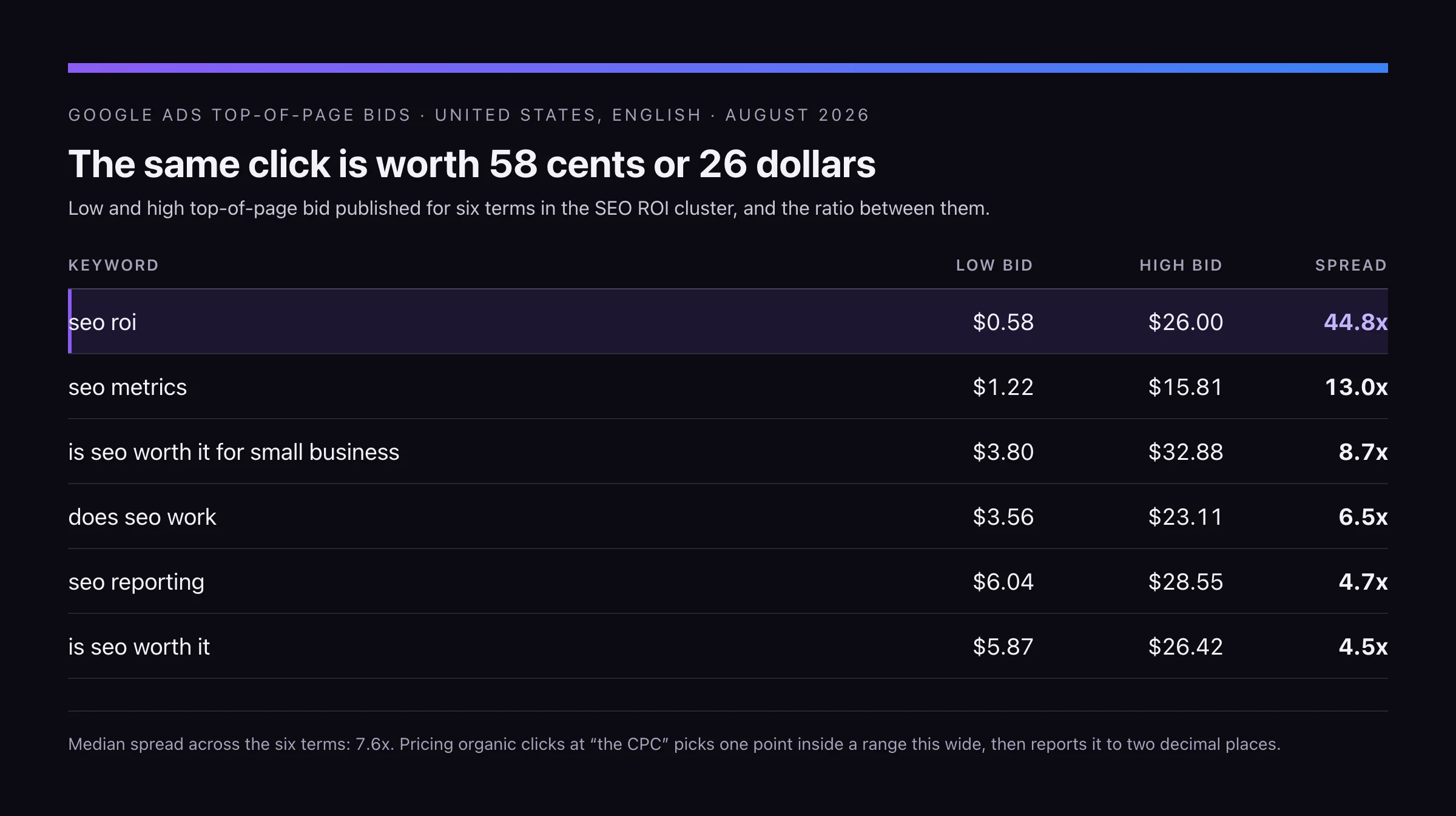
For most keywords Google Ads publishes a low and a high top-of-page bid — the range advertisers actually pay. Here is that range for six terms in this cluster, measured in the United States in English in August 2026:
| Keyword | Low top-of-page bid | High top-of-page bid | Spread |
|---|---|---|---|
| seo roi | $0.58 | $26.00 | 44.8x |
| seo metrics | $1.22 | $15.81 | 13.0x |
| is seo worth it for small business | $3.80 | $32.88 | 8.7x |
| does seo work | $3.56 | $23.11 | 6.5x |
| seo reporting | $6.04 | $28.55 | 4.7x |
| is seo worth it | $5.87 | $26.42 | 4.5x |
The median spread across the six is 7.6x. On the head term of this very article it is 44.8x: the same click is worth 58 cents or 26 dollars depending on which end of the published range a tool decides to use. Multiply your monthly organic clicks by “the CPC” and you have not measured anything. You have picked a point inside a range that is, in the worst case here, forty-four times wide, and then reported it to two decimal places.
The fatal problem is simpler. Ad-equivalent value assumes you would have bought that traffic. Most of it you would not have — not at the high end of the range, and often not at all, because a large share of organic clicks are branded searches from people already coming to you. Pricing those at auction rates values traffic you were never in the market for. If you do want the arithmetic of what paid clicks genuinely cost and what moves that figure, it is set out in how much Google Ads cost; it belongs in a paid budget, not in an organic return.
Use ad-equivalent value for one thing only: a rough opportunity comparison when deciding where a marginal budget goes. Never as the numerator of a return.
Seasonality: our own head term ranged 9.8x across twelve months
The second input problem is that organic traffic moves on its own, and the movement is much larger than most people assume.
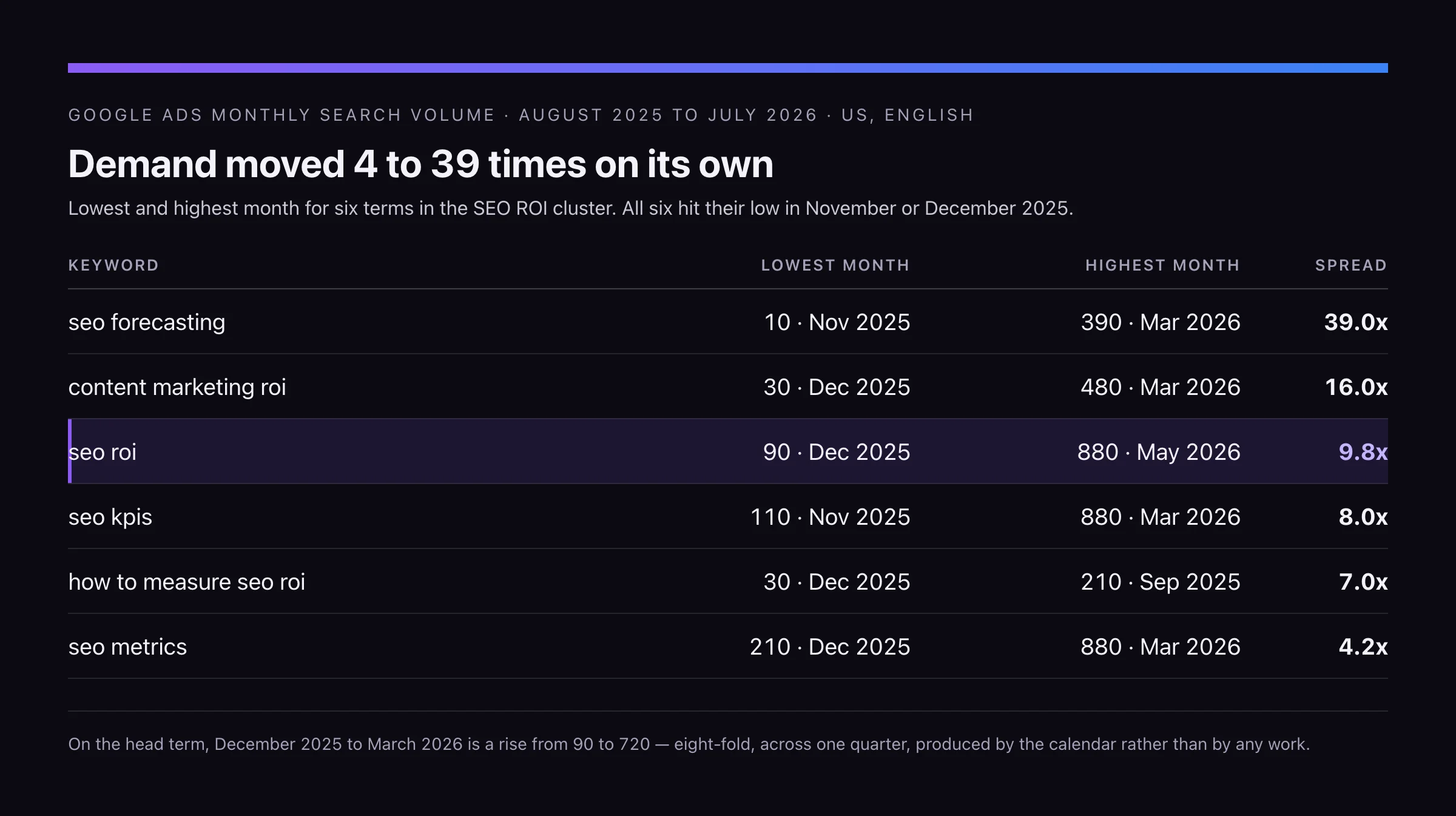
Here is the monthly search volume range for six terms in this cluster across the twelve-month window ending July 2026, same source and locale as above:
| Keyword | Lowest month | Highest month | Spread |
|---|---|---|---|
| seo forecasting | 10 (Nov 2025) | 390 (Mar 2026) | 39.0x |
| content marketing roi | 30 (Dec 2025) | 480 (Mar 2026) | 16.0x |
| seo roi | 90 (Dec 2025) | 880 (May 2026) | 9.8x |
| seo kpis | 110 (Nov 2025) | 880 (Mar 2026) | 8.0x |
| how to measure seo roi | 30 (Dec 2025) | 210 (Sep 2025) | 7.0x |
| seo metrics | 210 (Dec 2025) | 880 (Mar 2026) | 4.2x |
All six hit their twelve-month low in November or December 2025, though two of them tie that low with another month. Five of the six peak in March or May 2026.
Take the head term. Demand went from 90 searches in December 2025 to 720 in March 2026 — an eight-fold rise across one quarter, driven by nothing except the calendar returning to work. A report comparing Q1 against Q4 on this topic would show a spectacular gain produced by zero hours of effort. A report comparing Q4 against Q1 would show a collapse produced by the same zero hours.
Two rules follow, and they cost nothing to apply:
- Compare the same month year-on-year, never month against month. If you only have one year of data, say so and treat the first year’s return as provisional rather than reporting a quarterly change as performance.
- Rising organic traffic is not by itself evidence that the programme caused it. Correlation over a period when demand was rising anyway proves nothing about contribution, and separating the two takes a designed test rather than a dashboard. That is its own discipline — incrementality — and a paragraph here would not do it justice.
The lag does not just delay the answer, it breaks the fraction
Cost lands from month one. Revenue lands later. Divide one calendar year’s attributed revenue by one calendar year’s total cost and you have measured a mismatch, not a return.
The distortion runs in both directions and neither is obvious. Measure too early and a programme that ends up working reports a negative return, because the denominator is complete while the numerator is still filling. Measure a year later and the picture flips: the revenue arriving now was produced by work done and paid for in a period whose cost has already been counted somewhere else, so the current ratio flatters you.
The fix is to stop treating the year as one bucket:
- Tie cost to the month the work was done, not the month it was invoiced.
- Tie revenue to the page or cluster it arrived through, so a piece published in March is credited with what it earns in September.
- Report the programme as a set of cohorts that mature at different speeds, and state which cohorts are still immature.
This is more bookkeeping than a single ratio, and it is the difference between a number that survives a finance review and one that does not. How long the maturation actually takes is a separate question with its own evidence base, worked through in how long SEO takes to work — treat the lag here purely as a parameter that changes how you count, not as a forecast of when results arrive.
Why an SEO ROI calculator is built by the people selling SEO
Search for an SEO ROI calculator and the results page is almost entirely tools. In August 2026, seven of the eight organic results in the top ten for that term were calculator pages and the eighth was a blog post built around the same formula. All eight sat on the domain of a company that sells SEO services.
We are one of those companies. If we published a calculator it would have the same structural problem, which is why this section exists instead of a widget.
The problem is not dishonesty. It is that every calculator of this shape multiplies four numbers:
search volume × click-through rate at your target position × conversion rate × average order value
You supply the last two, which means you are already predicting the answer. The tool supplies the first two, and both are shakier than they look. Search volume, as the table above shows, is an annual average sitting on top of a range that can run 39-fold. The click-through rate curve is worse: it is derived from studies of a results page that increasingly does not exist.
On the three terms in this cluster checked in August 2026, an AI Overview appeared on all three, holding the top slot on two of them and sitting third on the calculator term, below two results. On “is seo worth it”, five of the eleven blocks above the related searches were SERP features rather than organic results — an AI Overview, a people-also-ask box, a discussions and forums panel, a video pack and a perspectives panel — and the first organic result was a Reddit thread. On “seo roi” itself, the fourth organic result was a YouTube video and the fifth a Reddit thread.
A calculator applying a position-three click-through rate to that layout is answering a question about a page that has changed shape underneath it. Treat the output as a hypothesis to test, never as a projection to budget against.
An average SEO ROI of 550% has no denominator you can check
Search the topic and you will meet figures like an average 550% return for SEO against 200% for search ads, or a sector table in which real estate returns over 1,389%. These circulate widely enough that clients bring them to calls.
Apply one test to any such figure before repeating it: what was in the denominator, over what window, measured on how many businesses? A return percentage without those three facts is not a measurement — it is a ratio of two undisclosed numbers. In every case we could trace, at least one of the three was missing.
This is not a claim that the underlying programmes did badly. It is a claim that the figure cannot be verified, which makes it useless as a benchmark for yours. Your own arithmetic, run on the eight lines below with the sources named, will tell you more than any published average, because you can audit every input in it.
How to measure SEO ROI in eight lines you can defend
Fix the window first — a full year, compared against the same months of the prior year. Then fill eight lines, and write the source next to each one.
| # | Line | Where it comes from | The common error |
|---|---|---|---|
| 1 | External invoices | Accounting export, filtered to the programme | Including work that was not organic search |
| 2 | Internal hours | Time on briefing, review, approvals, development | Omitted entirely, which in the example above cuts the denominator by a quarter and doubles the reported return |
| 3 | Tools and one-off builds | Subscriptions plus any migration or rebuild | Filed as capex and never returned to the ratio |
| 4 | Conversions from organic | Analytics, with the platform named in the report | Two platforms quoted side by side as if equivalent |
| 5 | Value per conversion | Closed-won value, not lead count | Counting leads and calling them revenue |
| 6 | Gross profit, not revenue | Finance, using your actual margin | Revenue on top, which multiplies the numerator by 2.5 and the reported return by 5.5 at a 40% margin |
| 7 | Branded and non-branded split | Search Console, queries split by brand terms | Branded demand credited to the programme |
| 8 | Seasonal and baseline adjustment | Same months, prior year | A quarter-on-quarter comparison read as performance |
Two of these deserve a note. Line 4 is where reports quietly fall apart, because different platforms count the same purchase differently and a report that does not name its source cannot be checked — the default attribution windows of the major platforms and a worked example of one purchase counted three ways are set out in how to choose a digital marketing agency. Line 5 is where lead-generation businesses lose the plot: a form fill is not revenue, and the conversion rate from one stage to the next is the whole argument, which is why the MQL and SQL distinction belongs in this calculation rather than in a separate report.
For line 5, if your business is subscription or repeat-purchase, the value of a customer is not the first invoice. Working out what a customer is actually worth over their life, and where that calculation leaks, is set out in the customer lifetime value formula — use the figure it produces here rather than the first-order value.
One more note on comparison. Return on ad spend and return on investment are not the same ratio and do not share a denominator, and organic and paid do not fail the same way: paid traffic stops the day spend stops, organic decays over months. Comparing the two percentages directly is the most common analytical error in this whole area. The honest comparison is not organic against paid but this year’s programme against what the same budget would have done elsewhere, on the same eight lines.
Is SEO worth it, answered with your own arithmetic
The published answer to this is always yes, which tells you something about who publishes it. The defensible answer is a short test, and it is arithmetic rather than opinion.
Three conditions have to hold at once:
- Demand exists. People search for what you sell, in the market you sell it in, in volumes that survive the seasonal range shown above.
- A plausible number of customers covers the year. Take the gross profit on one closed deal. Divide the annual programme cost by it. That is the number of customers the year has to produce before the return turns positive. If that count is implausible against your current volume, stop here — the answer is no, regardless of what any average says.
- The lag is survivable. Cost is immediate, revenue is not. If the business needs the return inside a quarter, this is the wrong channel and paid search is the right one.
If all three hold, the question stops being whether SEO is worth it and becomes how to measure whether yours is working, which is the eight lines above. If any one fails, no calculator output and no sector average changes the outcome.
That test is also how we scope SEO work before quoting it: if the second condition does not clear on a client’s own numbers, the honest recommendation is a different channel, not a smaller retainer.
Sources
- Search volume, competition, top-of-page bid ranges and twelve-month monthly series: Google Ads keyword data via DataForSEO, United States, English, retrieved August 2026. The twelve-month window runs August 2025 to July 2026.
- Search results page composition, feature counts and result ordering: live desktop Google results for “seo roi”, “seo roi calculator” and “is seo worth it”, United States, English, retrieved August 2026.
- Published return figures referenced in the section on averages were observed in the live results for “is seo worth it” in the same retrieval and are described rather than endorsed.
- The 50% / 100% / 275% worked example uses arbitrary round figures to isolate the effect of two accounting choices. It is not a quote, a benchmark or a market rate.
10 / Reader questions
Frequently asked questions
01How do you calculate ROI for SEO?
SEO ROI is (revenue attributed to organic search − cost of the programme) ÷ cost of the programme, expressed as a percentage. The formula is not the hard part. The same programme returns 50%, 100% or 275% depending on whether you put gross profit or revenue on top, and whether internal hours go into the cost below the line.
02What is the ROI of SEO?
There is no industry figure worth quoting, because a return percentage is only meaningful against a stated denominator and window. Published averages such as 550% or 1,389% by sector do not say what was counted as cost, what was counted as revenue, or over what period, which makes them unverifiable rather than merely optimistic.
03How do you measure SEO ROI?
Fix the window first, then fill eight lines: three cost lines (external invoices, internal hours, tools and one-off builds), three revenue lines (conversions with the platform named, value per closed deal rather than per lead, and gross profit rather than revenue), then the branded and non-branded split and a seasonal adjustment against the same months a year earlier. Every line needs a source you can point at.
04Is SEO worth it?
It is worth it when three conditions hold at once: people search for what you sell, the gross profit on a plausible number of customers covers the annual cost of the programme, and you can wait out a lag measured in quarters rather than weeks. If any one of them fails, the arithmetic fails with it, and no average return figure changes that.
05Is paying someone to do SEO worth it?
That depends on the value of one customer against the fully loaded cost of the programme, not on the provider's ROI claim. Work out the gross profit on one closed deal, divide the annual cost by that figure, and you get the number of customers the year has to produce to break even. If that count looks implausible against your current volume, the answer is no.
06Are SEO ROI calculators accurate?
They are arithmetic wrappers, not measurements. Every online SEO ROI calculator multiplies search volume by a click-through rate curve by a conversion rate by an order value, and you supply two of those four. All eight organic results in the top ten for the term in August 2026 belonged to companies selling SEO services, which is worth knowing before treating the output as neutral.
07How long before SEO shows a return?
Long enough that the calendar breaks the formula: cost lands from month one, revenue lands later, so a short window shows a negative return even for a programme that ends up working. The fix is to tie cost to the month the work was done and revenue to the page it landed on, rather than dividing one calendar total by another.
08Is SEO still worth it in 2026?
The question that matters is not whether organic search still exists but what a click from it is now worth to you. An AI Overview appeared on all three cluster terms checked in August 2026 and held the top slot on two of them, and on the 'is seo worth it' results page five of the eleven blocks above the related searches were SERP features rather than organic results, which changes the traffic assumption inside every projection.