
Published
CTV advertising is video advertising delivered to a television set that is connected to the internet — a smart TV, a streaming stick, a games console — and played inside a streaming app’s ad break. It is bought on impressions rather than airtime, and the published cost of entry runs from no minimum at all to $50,000, depending which door you use.
How this was checked. For this query in the United States on August 11, 2026, Google returned an AI Overview, a People Also Ask block and an organic page made up of Madhive, Amazon Ads, LiveRamp, Paramount Ads Manager, Spectrum Reach, AdRoll, Simpli.fi and two YouTube videos. Every one of those publishers sells connected TV inventory, sells the software used to buy it, or both. Not one of them is a disinterested party on price, and the only price figures on that first page come from companies quoting against their own rate cards. So the numbers below are taken from each platform’s own published documentation, dated, and the CPM claims are set side by side rather than averaged into a single fake benchmark.
CTV advertising is: a video impression bought on a television screen that receives its content over the internet.
- It is not a synonym for streaming ads. Streaming reaches phones, tablets and laptops too. The moment the screen is not a television, the household-level assumptions underneath a CTV plan stop holding.
- It is not a cheaper version of a television spot. Linear TV is bought in rating points and dayparts against a schedule. CTV is bought in impressions against an audience, and the two do not convert into each other cleanly.
- It is not a performance channel with a click at the end. Most placements are non-skippable and have no clickable surface at all, which is a measurement design decision before it is a budget one.
CTV advertising, OTT and linear television are three different purchases
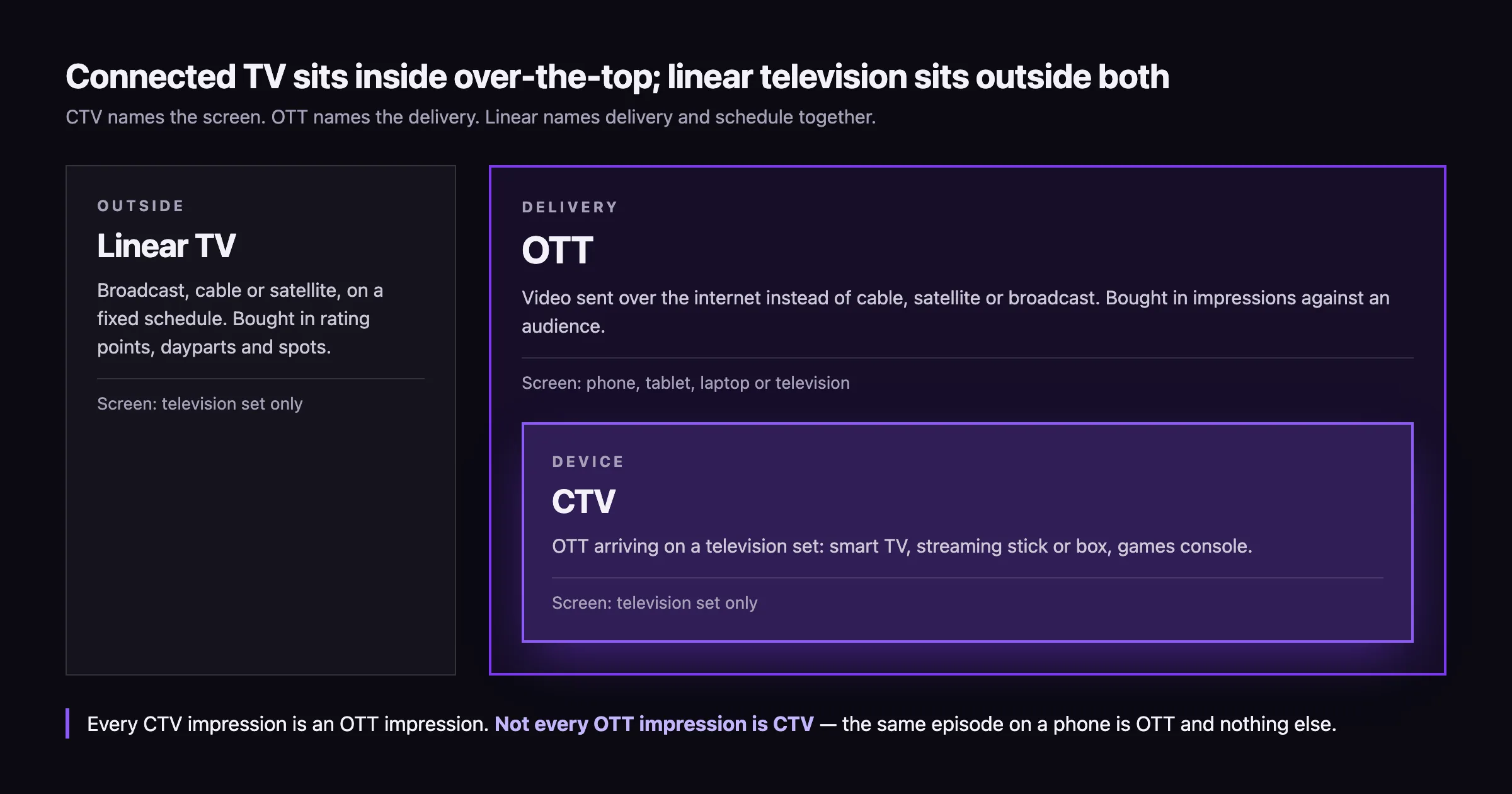
The three terms get used interchangeably in sales decks, and buying the wrong one is how a plan ends up with reach it cannot use. They answer different questions: OTT answers how the video arrives, CTV answers what screen it arrives on, linear answers both, the old way.
| CTV | OTT | Linear television | |
|---|---|---|---|
| What the term names | the device | the delivery method | delivery and schedule together |
| Screen | television set only | any screen | television set only |
| Reaches the viewer via | smart TV OS, streaming stick or box, games console | any internet connection | broadcast, cable or satellite |
| Bought in | impressions, against an audience | impressions, against an audience | rating points, dayparts, spots |
| Typical skip behaviour | non-skippable | varies by publisher | not applicable |
| Household inference | strong: one screen, one home | weak: a phone is one person, anywhere | strong, but panel-estimated |
The containment matters more than the definitions. Every CTV impression is an OTT impression; not every OTT impression is CTV. The same Netflix episode watched on a living-room television is CTV and OTT at once; watched on a commuter train it is OTT and nothing else. That is why a line item labelled “OTT” with no device targeting can quietly spend a television budget on phone screens, and why the household-level targeting a CTV plan is sold on evaporates on the part of the buy you were not looking at.
Against linear, the difference that actually changes the media plan is the unit. A linear schedule commits to time — a slot, a daypart, a programme — and gets whatever audience shows up. A CTV buy commits to impressions against an audience definition and gets whatever time slots deliver them. Neither is better; they fail differently. Linear underdelivers when viewing shifts; CTV underdelivers when the audience definition is too narrow for the inventory available, which shows up as a campaign that simply will not spend its budget.
Every published CTV price is quoted by a company that sells the inventory
This is the part worth reading before any planning number gets written down. The widely repeated “industry average” CPM for connected TV has no independent source behind it that survives a click through.
| Who publishes the figure | The figure | What it is sourced to |
|---|---|---|
| Paramount Ads Manager, insights page, 2026 | entry-level CTV “$25–$65 CPM,” premium placements “$40–$60” | “industry benchmarks” — no study, sample or year named |
| Paramount Ads Manager, same page, FAQ | “competitive” 2026 rates of “between $20 and $40 for standard inventory” | no source named |
| Paramount Ads Manager, same page | its own campaigns “start at $7 CPM,” an “80%+” saving against the average above | its own rate card, quoted against its own unsourced benchmark |
| Paramount Ads Manager, same page | Paramount+ video completion rate “about 96%” | “Paramount Internal, USA, 2024” — a 2024 in-house figure on a 2026 page |
| Vibe help centre, updated April 2, 2026 | “typical CPMs for a CTV campaign range between $15 and $30” | no source named |
| Roku Ads Manager help centre, March 2, 2026 | “dynamic CPM,” with a maximum bid the advertiser sets | no rate published |
| Disney Campaign Manager FAQ | none | no rate published |
| Amazon Ads streaming TV page | billed “on a CPM basis” | no rate published |
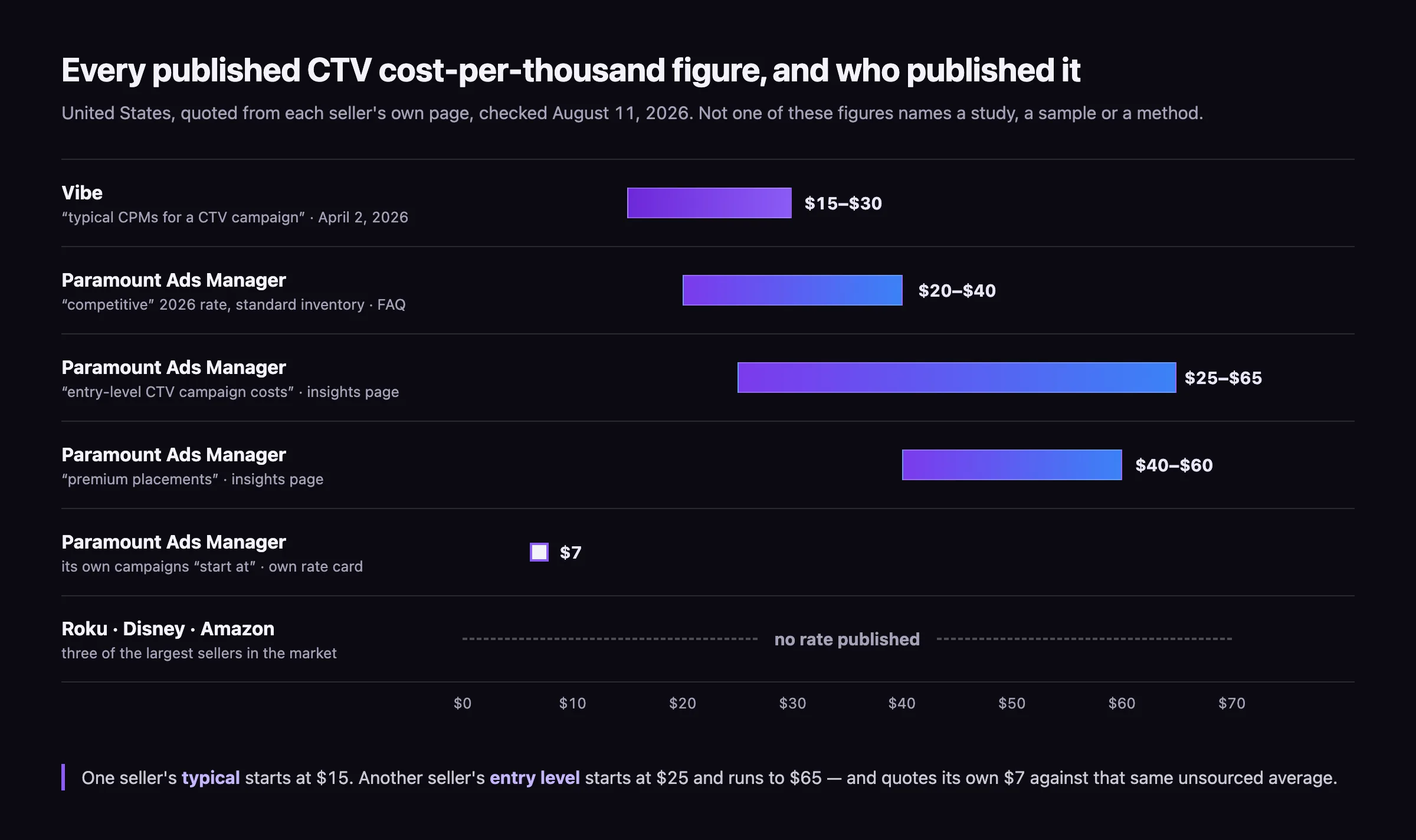
Read the Vibe row against the Paramount entry-level row. One seller’s typical starts at $15; the other seller’s entry level starts at $25 and runs to $65. The floor of one range sits 40% below the floor of the other, and the ceiling of the wider range is more than four times the floor of the narrower one. Both are describing the same market in the same year.
Three of the largest sellers in the list — Roku, Disney and Amazon — publish no rate at all, which is the more honest position, because on an auction the price is an outcome rather than a rate card. Roku’s own documentation says as much: you set a maximum bid and pay a dynamic CPM as delivery happens.
The practical consequence for a plan is narrow and worth stating plainly: treat the first flight as price discovery, not as a campaign with a forecast. Any CPM you write into a spreadsheet before you have run inventory in your own targeting is a borrowed number from a seller with a reason to shape it. This is the CTV-specific version of a wider problem with quoted ad prices, and the general arithmetic of what an ad account actually charges you is worked through separately for search.
One number that does carry a named method: the 2026 IAB Digital Video Ad Spend & Strategy Report: Part One, published May 5, 2026 with Advertiser Perceptions and Guideline, forecasts US digital video ad spend above $80 billion in 2026, growing 11% year on year and expected to pass 60% of total television and video ad spend for the first time. The same release breaks that growth down, and the breakdown cuts against the usual pitch: social video is growing at 13%, connected TV at 11%. CTV is large and growing; it is not the fastest-growing thing in digital video, whatever the deck says. The survey behind that split is n=360 United States decision-makers on digital video spend, fielded between February 20 and March 13, 2026. That is a real sample and a small one, so treat the two-point gap as directional rather than as a measurement.
Six routes into connected TV inventory, and the minimum each one publishes
The entry price is not one number, because there is no single market. Six distinct routes exist, and they differ by two orders of magnitude at the door.
| Route | Published entry minimum | What you are actually buying | Source, as published |
|---|---|---|---|
| Google Ads, with TV screens in device targeting | none stated | connected TV inventory served through Demand Gen and Performance Max campaigns, plus YouTube Select reservation | Google Ads Help, QR codes for Connected TV |
| Amazon Ads sponsored streaming TV | “no minimum spend requirement,” billed CPM | Prime Video, Twitch, Thursday Night Football, Fire TV Channels and broadcaster apps | Amazon Ads streaming TV ads product page |
| A streamer’s own self-serve desk | $500 per campaign at Roku Ads Manager; $500 per campaign at Disney Campaign Manager; no minimum published at Paramount Ads Manager | that publisher’s inventory only, with its own targeting menu | Roku Ads Manager help centre, March 2, 2026; Disney Campaign Manager FAQ |
| An independent self-serve CTV platform | no minimum campaign budget at Vibe; first invoice triggers at $100 of accumulated spend | aggregated inventory across many publishers, resold | Vibe help centre, updated April 2, 2026 |
| A full programmatic DSP | $10,000 recommended campaign minimum for Amazon DSP self-service | inventory across publishers and exchanges, with your own audience data | Amazon Ads streaming TV ads product page |
| Managed or direct sales | $50,000 campaign minimum for Amazon DSP managed service | negotiated placements, guaranteed delivery, publisher support | Amazon Ads streaming TV ads product page |
One gap in that table is worth naming rather than quietly filling: Netflix and the cable-adjacent resellers publish neither a minimum nor a rate. Both quote on request, and no public figure for either was findable on August 11, 2026. An article that presents a number there is inventing it.
Four things follow from the table that a definitional article will not tell you.
The $500 desks are single-publisher. Roku’s minimum buys Roku; Disney’s buys Hulu and Disney+. That is not a drawback for a first test — it is the cleanest possible experiment, because there is exactly one supply source to blame if it fails. It becomes a drawback the moment you want frequency control across the whole household, since two desks running separately cannot cap each other.
“No minimum” is not free. Google Ads and Amazon’s sponsored route publish no floor, but an auction with no floor still needs enough volume to leave the learning phase and to produce a readable result. The absence of a stated minimum moves the constraint from the platform to your statistics.
Roku’s floor comes with real constraints, published. Its help centre states campaigns publish from $500, video assets must run 6 to 92 seconds, ads are non-skippable, the platform serves the US only, and it supports ads in English only. Those are the sort of eligibility facts that decide whether a route is usable before price ever matters.
The jump from $500 to $10,000 is a jump in what you control, not in quality. A self-serve desk gives you the publisher’s targeting menu. A DSP gives you your own audience data, cross-publisher frequency and log-level delivery. If none of those three things is in your plan, the DSP tier is buying you a bill.
Who actually sells the impression: device makers, streamers and the desks between them
Connected TV supply reaches a buyer through four kinds of seller, and knowing which one you are dealing with explains most of what a rate card will and will not include.
Device and operating-system owners — Roku, Amazon with Fire TV, plus the smart TV platforms from Samsung, LG and Vizio — control the home screen itself and the free ad-supported channels running on it. They can sell inventory nobody else can: the menu, the screensaver, the channel guide. They also see which apps a household opens, which is the targeting signal a pure publisher does not have.
Streaming services with ad tiers — Netflix, Disney+ and Hulu, Paramount+, Peacock, Max — sell inside their own programming. This is the premium end, the closest analogue to a traditional television spot, and the one where “who else is in the break” is most controlled.
Owners of free ad-supported channel bundles — The Roku Channel, Tubi, Pluto TV and their equivalents inside the same devices — are the volume end of the market: continuous linear-style programming, lower CPMs, less control over what your ad sits next to.
Demand-side platforms — The Trade Desk, Madhive, Simpli.fi, and LiveRamp on the identity side — do not own the inventory they sell. They aggregate it, apply your data to it, and take a cut that none of them publishes, which is one reason the same impression can carry different prices depending which door you walked through.
Two sellers sit across that line and are worth naming as hybrids rather than filed under one heading. Amazon DSP buys across exchanges and owns Prime Video, Twitch and Fire TV. Spectrum Reach resells programmatically while also selling Charter’s own operator inventory. When a hybrid quotes you a price, you cannot tell from the quote alone whether you are paying a take rate or buying at source.
None of the four will tell you where their route is the wrong one, which is the whole argument for deciding the route before taking a meeting.
The formats, and the six the IAB Tech Lab standardised in July 2026
The bulk of connected TV money still goes to in-stream video: pre-roll before the content, mid-roll inside an ad break, post-roll after. Fifteen and thirty seconds are the commonly transacted lengths. Where a placement is skippable, mid-roll tends to hold a viewer better than pre-roll; most connected TV placements are not skippable, which flattens that difference far enough that it should not drive a plan. Roku’s own specification allows 6 to 92 seconds, which is wider than most buyers use.
Everything that is not in-stream was, until recently, described by each publisher in its own vocabulary — which meant a “pause ad” on one rate card and a “pause ad” on another were not necessarily the same line item, and neither could be bought programmatically without a bespoke integration. The IAB Tech Lab closed that gap: its CTV Ad Portfolio standard reached final version on July 22, 2026, after two public comment periods, and defines six formats explicitly.
| Standardised format | Where it appears |
|---|---|
| Pause Ad | when the viewer pauses the content with the remote |
| Screensaver Ad | initiated by the operating system or app when playback is idle |
| Menu Ad | inside the television or streaming platform’s own interface |
| In Scene Insertion Ad | branded elements placed within the content itself |
| Overlay Ads | non-linear, over playing content, in lower-third or bottom-right placements |
| Squeeze Back Ads | programme content is resized to free screen space for an ad |
The standard also covers signalling: changes to the AdCOM, VAST and Native Ads specifications so these formats can be described consistently across the programmatic pipes. For a buyer, that is the part that matters. It is the difference between a format existing on a publisher’s sales sheet and a format you can actually target, cap and report on alongside the rest of a plan.
Creative behaviour differs from social in one way worth flagging before anyone reuses a social cut: connected TV plays through the television’s own speakers by default. The captions-first, mute-safe discipline a social feed demands is the wrong instinct here — though no seller publishes an audible-rate figure for connected TV, so treat that as a property of the device rather than as a measured number. A 16:9 landscape master is the starting point rather than an afterthought — the geometry problem of cutting one master across placements is worked through for video generally.
Measurement when the placement has no click
A non-skippable full-screen ad on a television has no cursor, and in most placements no clickable surface. That is a deliberate property of the format, and it breaks the reporting habits a search or social buyer arrives with. Run a CTV flight and look at a last-click report, and the channel will show approximately zero — not because it did nothing, but because the report cannot see it by construction.
What exists instead falls into three groups.
Delivery metrics. Impressions served, quartile completion at 25, 50, 75 and 100 percent, video completion rate, and cost per completed view. Amazon’s CTV guide names video completion rate and cost per completed view as one example of how programmatic connected TV gets priced — not as an industry standard, and not on the same page as the product documentation everything else here is quoted from. These are honest measures of whether the ad played; they say nothing about whether it worked.
Lift metrics. Brand lift studies compare an exposed group against a control on awareness and intent. Conversion lift and geographic holdout tests do the same on sales. These are the only measurements that establish causation, and they require designing the holdout before the flight starts, not after the results disappoint.
Attribution proxies. Household-level matching by IP address, and automatic content recognition data from the television itself, connect an exposed home to later activity on other devices. They are useful and they are inferences: a household is not a person, and shared IP addresses in flats and offices blur the edge.
There is one genuine click surface, and it is narrow. Google Ads automatically generates QR codes on Demand Gen and Performance Max campaigns that target connected TV, and they are available on YouTube Select and Reservation buys too, provided device targeting includes TV screens — and its documentation is explicit that these are not available on YouTube TV or Google TV inventory. Amazon offers interactivity that lets a viewer respond with the remote or scan with a phone. Useful, but a QR scan is a fraction of the response a spot generates, so it is a signal rather than an accounting of the channel.
Because the response happens off-platform, server-side conversion capture stops being a nice-to-have and becomes the thing that lets a CTV flight appear in your own data at all; the mechanics of sending conversions from your server rather than the browser are set out for Meta’s implementation, and the same architecture applies here. Frequency is the other thing that needs a plan up front, since a household that sees the same 30 seconds nine times in an evening is being actively annoyed — the published evidence on where creative wear-out actually starts is collected separately.
What a first connected TV flight needs before it is worth booking
Four things, and a budget floor that is arithmetic rather than opinion.
A 16:9 landscape master with usable audio. Not a repurposed vertical cut, not a mute-safe social edit.
One route chosen deliberately. A single-publisher desk at $500 is the cleanest first experiment because it has one supply source and one variable. Split a first test across three routes and you will not be able to attribute the outcome to any of them.
A measurement design that exists before the flight. Either a holdout — geographic or audience — or an agreement in advance that this flight buys reach and will be judged on delivery and completion only. Deciding after the fact is how CTV gets declared a failure by a report that was never able to see it.
A frequency plan across every route you are running. Two desks bought separately cannot cap each other, which is the strongest practical argument for consolidating supply once a test works.
Then the floor. At a $500 platform minimum and a $25 CPM, a flight delivers about 20,000 impressions. At $15 that is roughly 33,000, and at $65 it is under 7,700. Divide by a frequency of three and the $500 buy reaches somewhere between 2,500 and 11,100 households, depending entirely on a CPM you cannot know in advance. That range is the honest answer to whether $500 is enough: it is enough to prove that delivery, creative and targeting function. It is not enough to prove the channel sells anything, and any test designed to answer the second question with the first question’s budget will return noise.
Deciding where connected TV sits against the rest of a mix — and whether a household-reach channel earns a slot at all this quarter — is the kind of allocation question our paid media team works through with a client before a single asset gets cut.
08 / Reader questions
Frequently asked questions
01What does CTV stand for in advertising?
CTV stands for connected TV: a television set that reaches the internet on its own, through a smart TV operating system, a streaming stick or box, or a games console. In advertising the term always needs the qualifier, because the bare three letters belong mostly to a Canadian broadcaster and, in medicine, to clinical target volume.
02What are examples of CTV advertising?
A 30-second spot inside a Hulu episode, a non-skippable pre-roll on a Roku channel, an ad break in Prime Video, a pause ad that appears when a viewer stops a Peacock stream, and a YouTube ad served to the television app rather than the phone. All five are bought on impressions, not airtime.
03Is Netflix considered CTV?
Yes, when it is watched on a television. Netflix's ad-supported tier sells inventory that is CTV whenever the stream is playing on a connected television set, and OTT-but-not-CTV when the same subscriber watches on a phone. CTV describes the screen, not the service.
04How much does a CTV ad cost?
Nobody publishes a defensible industry figure. The two sellers that do quote ranges disagree: Paramount Ads Manager put entry-level CTV at $25 to $65 CPM in 2026 without naming a source, and Vibe's help centre put typical CTV at $15 to $30 in April 2026. Roku, Disney and Amazon publish no rate at all.
05How does CTV advertising work?
You supply a video file and a targeting brief, a platform matches it to streaming inventory, and the ad plays inside an ad break on a television screen. Delivery is counted in impressions and billed on a cost per thousand basis. Most placements are non-skippable, and most have no click to record.
06What is the difference between CTV and OTT advertising?
OTT names the delivery — video sent over the internet instead of cable, satellite or broadcast. CTV names the device — a television set doing the receiving. Every CTV impression is an OTT impression; an OTT impression on a phone is not CTV. Buyers care because household targeting and living-room viewing conditions only hold on the TV screen.
07Is CTV advertising worth it for a small budget?
It buys reach, not immediate response, so the honest floor is the price of a real test rather than a token one. At a $500 platform minimum and a $25 CPM you get about 20,000 impressions, which at three exposures a household is roughly 6,700 homes. That proves delivery works; it does not prove the channel sells.