Published
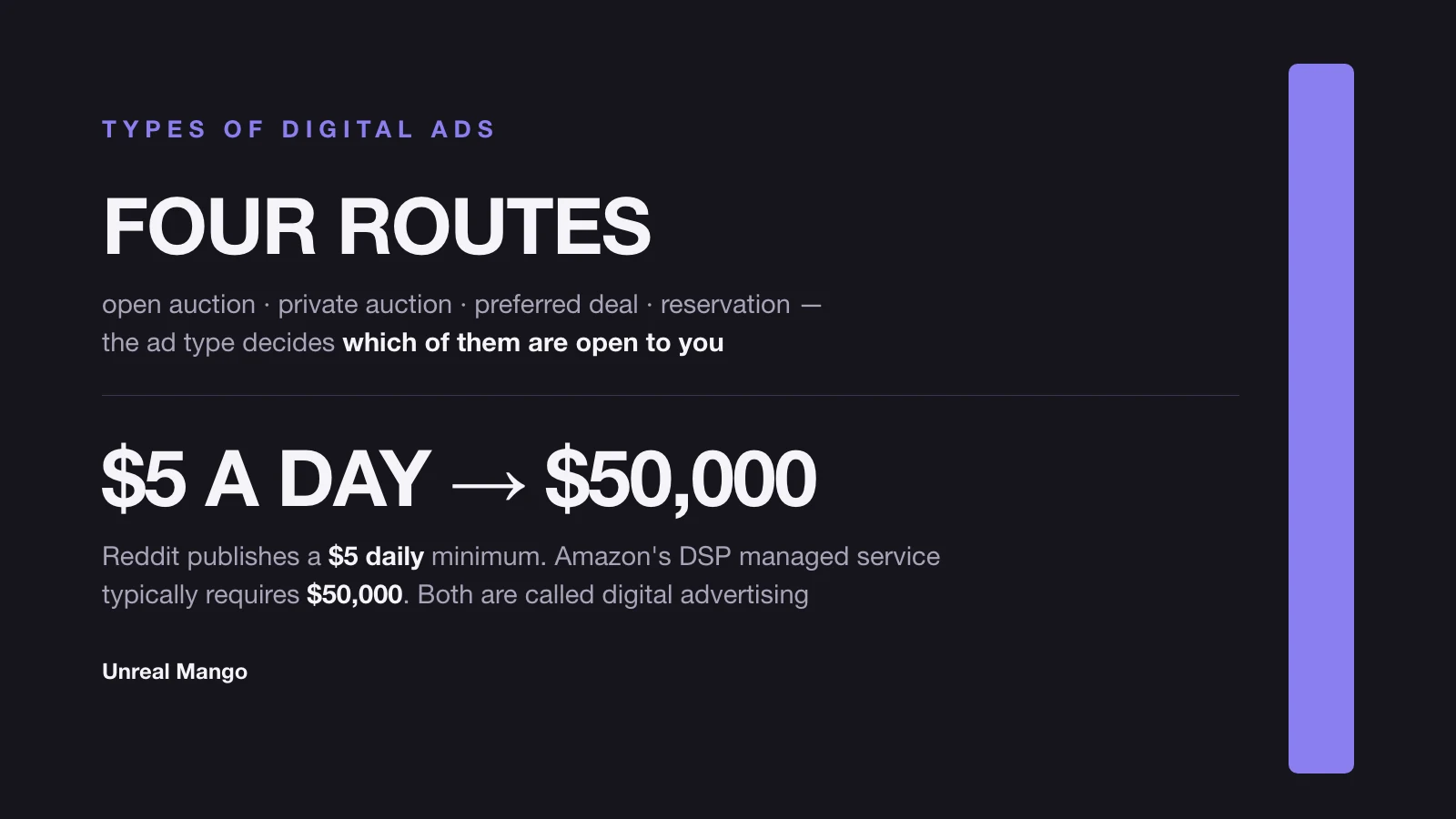
Digital ads split into thirteen families: search, shopping, display, rich media, native, social, online video, connected TV, streaming audio, podcast, in-app, retail media and digital out-of-home. What separates them in practice is not what they look like. It is the route the inventory is sold through, and the event that triggers the charge.
That second half is the part the ranking lists leave out. They name the formats and describe what each one looks like on a screen. None of them prints, for each format, whether the inventory is auctioned or reserved, what has to happen before money moves, and what the platform publishes as a floor to get started. That is what this guide is.
How this was checked. Every billing unit, threshold and minimum below comes from the platform’s own documentation or from a standards body — Google Ads and Ad Manager Help, Meta’s Marketing API reference, LinkedIn’s developer documentation on Microsoft Learn, TikTok Ads Manager Help, Amazon Ads, Spotify Ad Studio, Reddit and Snapchat’s advertising help centres, IAB Tech Lab specifications and the Media Rating Council’s measurement guidelines. Where a widely repeated number has no primary source, it is named as such rather than repeated. Several of the platforms in this guide — Meta, LinkedIn and Reddit among them — block automated access to their help centres, so where it exists their figures come from developer documentation instead, which is the authoritative equivalent and carries a date.
What makes something a digital ad, and where the lists go wrong
There is one test, and it is not about channels. A digital ad is an impression somebody else owns and sells you. If there is no inventory owner and no transaction, it is not advertising, however digital it is.
That test removes a surprising amount of what currently ranks for this term. One of the pages in the top ten for types of digital ads opens its list with search engine optimisation, and includes content marketing and email marketing further down it. Nobody sells you an impression of your own SEO. Nobody auctions a slot in your own newsletter. Those are marketing disciplines that happen to be digital, and putting them in a list of ad formats is what makes the list useless the moment you try to buy something from it.
The families that pass the test are the ones in this guide. Everything else — SEO, owned email, organic social, affiliate revenue share, PR — is digital marketing, and belongs on a different list.
Format, placement and buying model are three separate questions
Most format lists collapse three axes into one column, which is why the same list can contain “video,” “Facebook” and “retargeting” as if they were peers.
The format is the creative unit: a responsive text ad, a 1:1 image, a six-second video, a carousel, a playable demo, an audio spot.
The placement is the surface: a search results page, a social feed, a story, a mid-roll break, the home screen of a smart TV, a screen in a lift lobby.
The buying model is how the inventory changed hands: an open auction, a private auction, a fixed-price deal, or a reservation negotiated with a salesperson.
A single format runs across many placements. A single placement accepts several formats. And the same format can be bought through two different routes on the same platform on the same day — a YouTube in-stream ad is available in a self-serve auction and as a reserved buy, at different prices, with different guarantees. Keeping the three apart is the difference between a list you can read and a list you can act on.
The five routes an impression can be bought through
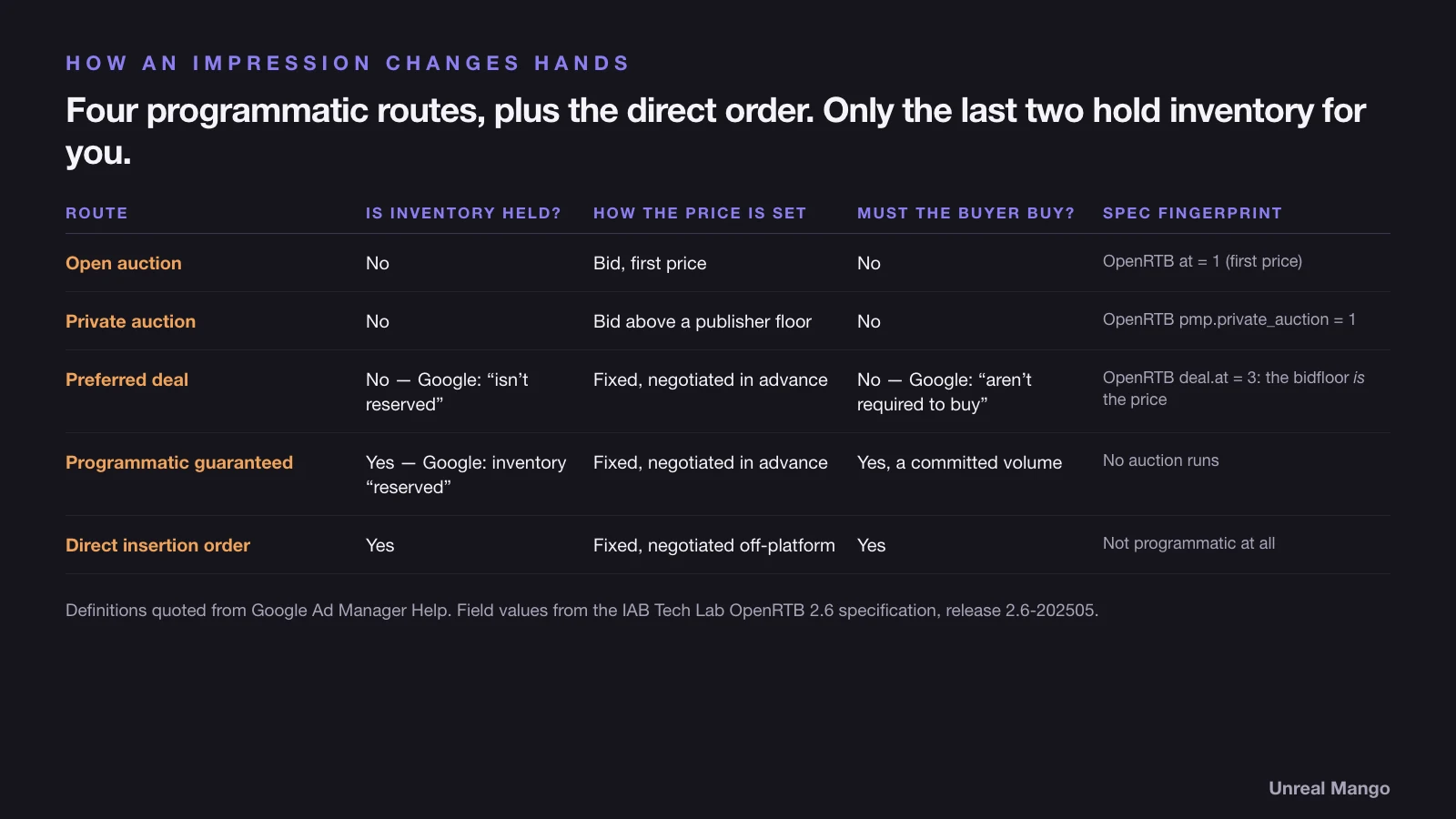
Google Ad Manager, which sits between a very large share of the world’s publishers and their demand, names four programmatic transaction types. The fifth route, the direct insertion order, is negotiated off-platform entirely. Google’s own definitions are worth quoting, because the industry’s informal vocabulary is much looser than the documentation.
Open auction: everyone bids, nothing is promised
Google defines Open Auction transactions as “auction-based transactions for inventory available to all buyers.” No inventory is held, no price is agreed in advance, and no buyer is obliged to buy anything. This is where most display, most social and most video inventory clears.
The auction underneath it is a first-price auction. Google announced the move to a unified first-price auction for Ad Manager in March 2019 and began the full rollout to all partners in September 2019. In OpenRTB — the IAB Tech Lab specification that carries the bid request, currently version 2.6 with the most recent release published in May 2025 — the auction type field at takes the value 1 for first price and 2 for second price plus.
Private auction: the same auction with a guest list and a floor
Private Auction transactions are, in Google’s words, “auction-based transactions with specific buyer(s) that are allowlisted by company.” The price is still bid, not fixed; the publisher sets a minimum CPM that buyers must clear to be eligible. Inventory is not reserved.
Preferred deal: a fixed price and a right of first refusal
Preferred Deal transactions are “fixed-price, pre-auction transactions that the publisher negotiates with specific buyer(s).” Two things follow, and Google states both explicitly: “The inventory negotiated isn’t reserved for the buyer,” and “Buyers aren’t required to buy the inventory.” If the buyer passes or fails to bid above the agreed price, the impression falls through to the private auction or the open auction.
This is the route with the cleanest technical fingerprint. In OpenRTB, the deal object carries its own optional at override, and it defines a third value that does not exist at request level: 3, meaning “the value passed in bidfloor is the agreed upon deal price.” The spec is saying there is no auction here — the floor is the price.
Programmatic guaranteed and the direct insertion order: inventory that is actually held
Programmatic Guaranteed transactions are “fixed-price transactions with a pre-committed set of inventory that is negotiated with a single buyer.” Google’s comparison page is blunt about the difference from a preferred deal: the inventory is reserved for that buyer.
The non-programmatic version of the same promise is the direct insertion order, which Ad Manager calls a traditional transaction and defines by where the negotiation happens: “Terms are negotiated and finalized outside of Ad Manager, say via email, spreadsheets, or PDFs.” Ad Manager then splits reserved line items into two shapes. A Sponsorship line item serves “based upon a defined percentage of impressions and a start and end time” — a share-of-voice buy. A Standard line item serves “based upon a defined impression goal and start and end time” — a volume buy. Both are guaranteed; the difference is how the promise is expressed.
Some formats are only available this way. The YouTube Masthead, the unit at the top of the YouTube home feed, is a reserved buy sold on a cost-per-thousand-impressions basis or a cost-per-hour basis. The CPM version can be reserved through a Google representative, as a YouTube programmatic-guaranteed instant deal, or in Google Ads. The cost-per-hour version, which buys “100% Share-of-Voice (SOV) of eligible impressions” during the hours reserved, is sold only through a Google representative. YouTube Select lineups are likewise gated behind reservation, sold at a fixed CPM under what Google Ads labels premier reach.
What the billing unit actually charges you for
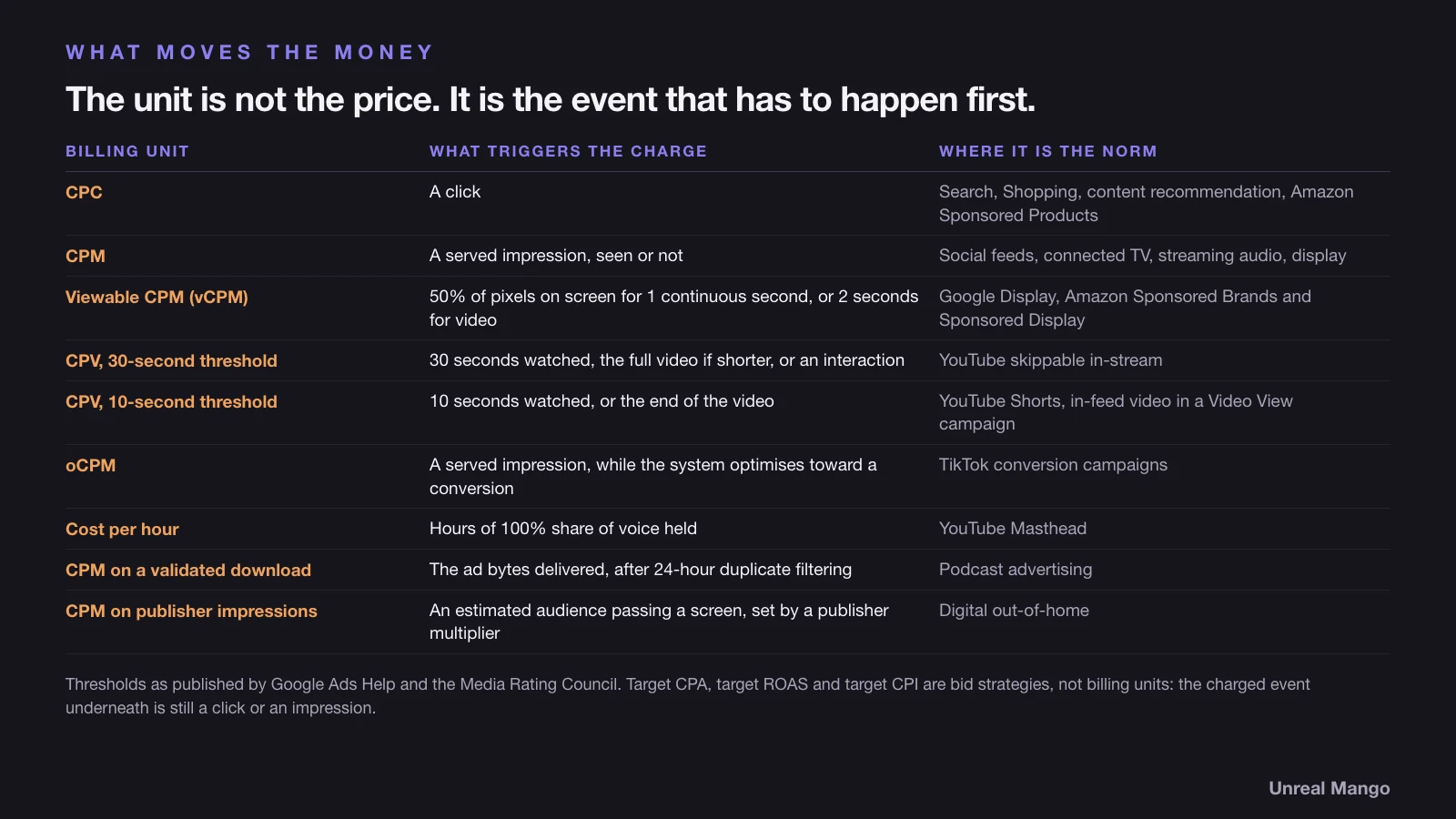
The unit is not the price. The unit is the event that has to happen before money moves, and formats differ far more in that event than in their creative dimensions.
CPC, CPM and viewable CPM
Cost per click charges on the click. Google’s own description of what you pay is worth reading closely: “You only pay what’s minimally required to clear the Ad Rank thresholds and beat the Ad Rank of the competitor immediately below you.” That is a generalised second-price mechanism, though Google never uses the phrase on its help pages, and because Ad Rank folds in quality it is not a textbook second-price auction either.
Cost per thousand impressions charges on delivery, whether or not anyone could see the ad. Viewable CPM charges only on impressions that cleared a viewability threshold, which Google states as 50% of the ad’s pixels on screen for at least one continuous second for display, or two continuous seconds for video. Those thresholds are not Google’s invention: they come from the Media Rating Council’s Viewable Ad Impression Measurement Guidelines (Desktop), whose current version 2.0 dates to August 2015, and which add an exception most people have never heard of — for large display ads of 242,500 pixels or more, the threshold drops to 30% of pixels for one continuous second.
Two honest caveats. Google itself notes that under vCPM bidding “a small portion of served impressions might be charged,” so it is not an absolute viewable-only guarantee. And the viewability standard has not been revised in a decade; the MRC’s live work has moved on to attention measurement, whose guidelines it published with the IAB in November 2025, and to auction transparency standards published in January 2026.
Cost per view, and the two different views
“Cost per view” means two different things on the same platform, and the difference is not small.
On YouTube skippable in-stream ads, Google charges when a viewer watches 30 seconds of the video, or the entire duration of the video if it is shorter than 30 seconds, or interacts with the ad — whichever comes first. On Shorts, and on in-feed video bought through a Video View campaign, the threshold is ten seconds, or the end of the video, whichever comes first.
There is a second complication. Skippable in-stream is no longer cost-per-view by default. The same format also runs on Target CPM, Target CPA and Maximize conversions bidding, and with those, in Google’s words, “you pay based on impressions.” The evergreen line that you only pay on YouTube after thirty seconds is now wrong for most conversion campaigns. Non-skippable in-stream and bumper ads use Target CPM outright, so they are impression-billed with no view threshold at all.
Target CPA, target ROAS and target CPI are not billing units
This is where platform vocabulary actively misleads. Target CPA, target ROAS and target CPI are bid strategies: instructions to the optimiser about the outcome you want it to aim at. The charged unit underneath is still a click or an impression.
Google’s own definition of cost per install shows the seam. It opens with “you pay for each app installation on a user device,” then immediately describes the bid as “the average amount you’d like to spend each time someone clicks on the ‘Install’ button on your ad.” Google does not publish the underlying charged unit for App campaigns. Treat CPI as a target you set, not a guarantee you buy.
TikTok’s oCPM is the same trap with a clearer name: optimised CPM charges per impression while the system optimises toward a conversion. Buyers routinely read it as conversion-based billing. It is not.
Performance Max, now the dominant Google campaign type, is the case where the unit is not a unit at all. Google documents its billing per channel: “Billing follows the same structure, with costs depending on ad placement, like CPM for YouTube Instream, clicks for Search, Shopping, and Discover, among others.” So one PMax campaign charges by the click on some inventory and by the impression on other inventory, and the reporting will not decompose a single campaign’s spend by channel for you. Worth knowing before you put half a budget through it.
Search ads
The text ad on a search results page, triggered by a query. Bought in an open auction, billed per click, and the only major format where the user has told you what they want before they see you.
Google’s Search campaigns bill on the click and nothing else; viewable CPM is explicitly unavailable on Search-only campaigns. Microsoft Advertising states the same model in one line: “You only pay when someone clicks your ad.” Neither platform publishes a minimum spend, which makes search the cheapest place to find out whether demand for a thing exists at all.
What varies wildly is the price of that click, and it varies by industry rather than by anything you control. If you are building a media plan rather than a format shortlist, the arithmetic of click price, conversion rate and cost per lead is a separate exercise, and we have set it out in the guide to what Google Ads actually cost.
Shopping ads, and the Performance Max problem
A product image, a price and a merchant name, served against a commercial query from a product feed rather than from keywords. Shopping campaigns are auction-bought and charged per click, like Search.
Performance Max is the complication. It absorbs Shopping inventory along with Search, Display, YouTube, Discover and Maps, and as set out below it bills per channel rather than in one unit — clicks on Search, Shopping and Discover, CPM on YouTube in-stream. Practically, that means a Shopping-style buy you can attribute to a click and a PMax buy that mixes clicks with impressions are sitting in the same account, and the reporting will not separate them for you.
Display ads, and what the IAB actually specifies now
The banner: a static or animated image unit on somebody else’s site or app. Bought in every route there is — open auction, private auction, preferred deal, programmatic guaranteed and direct — and billed on CPC, CPM, viewable CPM or target CPM depending on how you set the campaign up.
The specification most people cite for display is out of date, and the correction is useful. The IAB’s current display standard is the New Standard Ad Unit Portfolio, version 1.1, published July 2017, and it explicitly “replaces all the previous creative display guidelines for mobile and desktop — including the Universal Ad Package (UAP), rich media units, and other ad units’ related guidance.” Its primary specification is not pixel sizes at all: it defines flexible units by aspect ratio — horizontal families running from 2:1 to 10:1, vertical families from 1:2 to 1:4, and full-page ratios such as 9:16 and 16:9 — with file-weight bands running from 50 kB to 350 kB on initial load and from 100 kB to 700 kB on subload, depending on the size band.
The familiar sizes — 300×250, 728×90, 300×600, 320×50, 970×250, 160×600 — do still appear in that document, but under the heading Transition Fixed Size Ad Units, presented as legacy equivalents of the flexible units. Nine years on, no version 2.0 has been published, which tells you something about where standards effort has moved.
The portfolio also carries the LEAN principles the IAB introduced in October 2015: Light, Encrypted, Ad choice supported, Non-invasive. LEAN is a principle set rather than a certifiable technical standard, and there is no compliance programme behind it.
Rich media and interstitials
Rich media is display that does something — expands, plays, responds to input. The IAB folded it into the general portfolio in 2017 on the grounds that “All ads are now LEAN ads so no need for separate Rich Media ad units,” which is why you will no longer find a separate rich media spec sheet.
The interstitial is the full-screen unit that appears between two pieces of content: between levels in a game, between articles, between screens in an app. It is impression-billed, it is the highest-CPM display format in most inventory, and it is the format most likely to be described as intrusive by the same audience that clicks it. Search demand for interstitial ads runs around 2,400 a month in the US, higher than for banner ads, which is a reasonable proxy for where mobile inventory has actually moved.
Native ads and sponsored content
Native is the format that matches the form and function of the surface it sits on: a story-shaped unit in a feed, a recommendation module under an article, a piece of branded content published on a publisher’s own site.
Three native types, not six
Nearly every article on native advertising still lists six types, and that list is seven years out of date. The IAB Native Advertising Playbook 2.0, published May 2019, says so directly: “The original Playbook featured six core, distinct, native ad types. IAB Native Advertising Playbook 2.0 now features three core native ad types.” The three that survived are:
- In-Feed / In-Content Native Advertising
- Content Recommendation Ads
- Branded / Native Content
Dropped in 2.0: paid search, promoted listings, in-ad with native elements, and the “custom / can’t be contained” catch-all. Paid search in particular is now classified as its own thing rather than a native format, which is the correct call and the one most lists have not caught up with.
The disclosure rules that decide whether native is legal
Native is the one format family where the regulator has published operating instructions. The FTC’s Native Advertising: A Guide for Businesses and its companion enforcement policy statement, both December 2015, set out what a disclosure has to do rather than what it has to say.
Placement: the disclosure belongs near the ad’s focal point, “in front of or above the headline” rather than to the right of or below it, and it has to survive republication when the unit appears on another platform. Prominence: large enough and high-contrast enough to read easily, and in video, on screen “long enough for ordinary consumers to notice, read, and understand.” Wording: “Ad,” “Advertisement,” “Paid Advertisement” and “Sponsored Advertising Content” are all acceptable; the FTC specifically calls out “Promoted” and “Promoted Stories” as ambiguous, which is awkward given how many platforms still use exactly that label. And a logo on its own is not a disclosure.
Regulated categories tighten this further, and in healthcare the platform’s own policy layer usually bites before the FTC’s does — the rules on running medical advertising on Facebook are a worked example of a vertical where the format is available and the targeting is not.
Social ads
The feed unit: an image, video, carousel or collection served in a social platform’s main content stream, plus the story, messaging and in-feed video variants around it. Auction-bought, self-serve, and the family with the widest gap between what buyers assume they are billed for and what they are billed for.
Meta bills on impressions, whatever the objective says
Meta’s Marketing API documents eleven billing events, of which the two that matter are IMPRESSIONS and LINK_CLICKS. Link-click billing is compatible with exactly one optimisation goal: link clicks. Every other goal, including post engagement, conversions, lead generation and app installs, is compatible only with impression billing.
The practical consequence is worth stating plainly: every conversion-optimised campaign on Meta is impression-billed. The cost-per-result figure in the interface is a division, not a billing model. Creative dimensions across Meta’s feed and story placements are a separate question with its own answer sheet, linked at the end of this guide.
LinkedIn bills on impressions, clicks and views, and nothing else
LinkedIn’s developer documentation, last updated March 2026, lists exactly three cost types: CPM, CPC and CPV. Objectives map onto them — brand awareness is CPM only, website visits and conversions allow CPM or CPC, video views allow CPM or CPV.
Message and Conversation Ads sit inside that same three-unit list, and there is no fourth. “Cost per send” is not a LinkedIn billing unit. It is a label in Campaign Manager and a figure agencies quote; the underlying charge is CPM where an impression is a delivered message. The full LinkedIn format taxonomy — which unit does what, and which ones capture a lead without a landing page — has its own guide in LinkedIn advertising types; the pixel-level specifications are linked at the end of this guide.
TikTok publishes four units and a real floor
TikTok Ads Manager documents CPC, CPM, oCPM and CPV, plus a Cost Cap strategy that “keeps your average cost per result at or below the amount you specify.” It also publishes the strictest entry requirement of the major self-serve platforms: a campaign daily budget above $50 and an ad group daily budget above $20, with lifetime budgets calculated as days × $20 at ad group level. That documentation carries a July 2026 update stamp, which makes it the freshest published minimum in this guide.
Online video ads
Video splits by where the ad sits relative to the content, and each position bills differently.
In-stream runs inside a video player, before, during or after the content. Skippable in-stream bills on CPV at the thirty-second threshold, or on impressions under Target CPM, Target CPA or Maximize conversions. Non-skippable in-stream and bumper ads bill on Target CPM.
In-feed video sits in a browsing surface rather than a player and bills on the click, or on a ten-second autoplay watch in a Video View campaign.
Outstream places a video unit inside non-video content — an article, a feed — and is bought as display inventory.
Connected TV is in-stream video delivered to a television. It has no click by definition, which changes what can be measured rather than how it is bought; IAB Tech Lab released a dedicated CTV Ad Portfolio for public comment in December 2025, naming six screen-native formats — pause, menu, screensaver, in-scene, squeezebacks and overlays — that have no desktop equivalent.
The technical layer under all of this is VAST, the IAB Tech Lab Video Ad Serving Template, currently version 4.3 published December 2022, with a CTV addendum added in July 2024. VPAID, the old interactive wrapper, is deprecated in the spec’s own words and has been split in two: OMID, the Open Measurement Interface Definition, took over verification, and SIMID took over interactivity. If a vendor is still quoting VPAID support as a feature in 2026, that is a signal about the vendor.
Aspect ratio decisions across video placements — and the difference between what a platform accepts and what it renders well — are a separate exercise, linked at the end of this guide.
Streaming audio ads
The audio spot inserted into a music or radio stream, usually with a companion display banner. Spotify’s self-serve Ad Studio reports on CPM and defines it plainly: “Cost per 1000 impressions. Updates hourly based on the budget and impressions delivered so far.”
One exception is worth knowing because almost nobody reports it: Spotify’s Australian help centre states that in that market “you only pay for completed listens, not total impressions.” So “streaming audio is always CPM” is not true even within a single platform.
Spotify publishes a minimum budget of 250.00 in local currency to launch an Ad Studio campaign. The same figure appears elsewhere in Spotify’s documentation as a billing threshold, so confirm which applies in your market before treating it as a hard floor.
Podcast ads, priced against a download
Podcast advertising is sold on CPM, but the impression is a download, not a listen, and the definition is unusually specific. The governing standard is the IAB Tech Lab Podcast Measurement Technical Guidelines, version 2.2, May 2024, with version 2.3 released for public comment in July 2026.
Under those guidelines a download is a unique episode request that results in an episode being delivered, requiring at minimum the header information plus enough content to be playable for one minute. Duplicate requests are filtered in a 24-hour window keyed on IP address plus user agent — the guidelines’ own example is that ten requests for the same episode from six user agents behind one IP address inside 24 hours count as six downloads. For dynamically inserted ads, an ad counts as delivered only when 100% of the ad content was downloaded.
None of that measures whether anyone heard the ad. It measures whether the bytes arrived. That is the honest ceiling on podcast attribution, and it is a standards-body limitation rather than a vendor one.
In-app ads: interstitial, rewarded and playable
Mobile app inventory carries three formats that barely exist elsewhere.
Rewarded video trades an ad view for in-app currency or a continue. Google’s AdMob documentation describes the mechanics in detail — server-side verification of “each completed rewarded ad view,” and a rewarded interstitial countdown of “any duration between 5 and 30 seconds depending on the creative” — but publishes no billing unit for the format. What AdMob does document is that “the AdMob auction that sets an ad’s eCPM is run on a per-impression basis,” fed by both CPC and CPM bids. There is no documented cost-per-completed-view product at AdMob, despite how often rewarded video is described that way.
Playable ads are an interactive demo of the app being advertised. Here too, there is no separate billing model: a playable is a creative type served into the same auction. Unity’s advertiser documentation prices user acquisition on CPI bids, cost-per-event bids and ROAS targets, with delivery governed by eCPM, which it defines as a function of the campaign’s conversion rate and its CPI bid.
In-app interstitials behave as described above: full-screen, impression-billed, high CPM.
Retail media ads
Ads sold by a retailer against its own shopper data, on its own properties (on-site) or on third-party inventory it brokers (off-site). This is the fastest-growing family on the list and the one most likely to be missing from a list written before 2023.
Amazon’s units show the range of billing models inside one retailer. Sponsored Products is cost per click: “You bid the maximum amount that you’re willing to pay when a shopper clicks an ad for your products.” Sponsored Display offers a choice of CPC or viewable CPM. Sponsored Brands offers three models: CPC, viewable CPM, and a reserved share-of-voice product sold at “fixed, upfront pricing” for the top-of-search placement. Amazon’s own wording is that “there’s no minimum spend for CPC or vCPM campaigns” while “reserve share of voice requires a minimum spend commitment” that it does not publish. Its DSP managed service “typically requires a minimum spend of $50,000 USD,” which is the widest documented entry gap of any platform in this guide.
The measurement side has a standard now: the IAB and MRC published joint Retail Media Measurement Guidelines in January 2024, anchoring impression counting to the standard begin-to-render rule, inheriting the MRC viewability thresholds rather than inventing retail-specific ones, and requiring attribution windows of 3, 7, 14, 28 or 30 days to be empirically supported and disclosed before the campaign runs. IAB followed with in-store retail media definitions in December 2024.
For scale: the IAB/PwC Internet Advertising Revenue Report for full-year 2025, published April 2026, puts US commerce media revenue — the category that contains retail media — at $63.4 billion, up 18.0% year on year, inside a total US internet advertising market of $294.6 billion.
Digital out-of-home
Programmatically bought screens in physical space: transit, retail, roadside, lift lobbies, gyms. It is the format where the word “impression” means something different from everywhere else on this list, and the difference is documented rather than hidden.
Google’s DV360 states it plainly: DOOH publishers “measure impressions by using an impression multiplier which uses a publisher-provided estimate for the number of viewers for each ad.” Two separate metrics are tracked — served impressions, “the number of times an ad was shown on a screen,” and publisher impressions, “the publisher’s estimated number of viewers per digital out of home ad” — and “the cost per thousand impressions is calculated using the publisher impressions.” Google’s own worked example: five served impressions at an estimated 500 viewers each gives 2,500 publisher impressions, so $25 of spend is a $10 publisher CPM.
In the US, the audience figures behind those multipliers usually trace back to Geopath, which defines an OOH impression as the number of people passing a display “likely to notice the ad” over a 12-, 18- or 24-hour window depending on illumination. The IAB published a DOOH Measurement Guide in July 2025; its full text sits behind a free account wall, so treat specific thresholds attributed to it with care unless you have pulled the document yourself.
The honest summary: a DOOH CPM and a display CPM are not the same currency, and comparing them without adjusting for the multiplier will make DOOH look cheaper than it is.
Retargeting is a targeting method, not a format
Retargeting appears on almost every list of digital ad types, including the AI Overview currently sitting above the organic results for this term. It does not belong there.
A retargeted ad is a display banner, a social feed unit, a video pre-roll or a sponsored product tile. It is bought through the same routes and billed in the same units as any other instance of that format. What is different is the audience definition — people who have already interacted with you — and that is a targeting decision made inside the campaign, not a format you select.
The same objection applies to “programmatic,” which describes how inventory is transacted rather than what the creative is, and to “mobile advertising,” which describes a device. Keeping these off the format axis is what makes a list usable.
The billing unit decides where a format can sit in a funnel
Formats do not have a natural funnel position. Billing units do, and the format inherits it.
An impression-billed format charges you whether or not anything happened, which makes it structurally an awareness or reach buy — you are paying for delivery and hoping for attention. A click-billed format charges only on a demonstrated action, which makes it structurally a consideration or acquisition buy. A view-billed format sits between them, and its position depends entirely on which threshold applies: a thirty-second view is a considered watch, a ten-second autoplay is barely more than an impression.
That is why the same creative behaves differently on two platforms. A fifteen-second video on YouTube skippable in-stream under CPV bidding is a mid-funnel buy. The identical file in a Meta feed, impression-billed because the objective is conversions, is priced as reach and delivered as reach, and the cost-per-result in the interface is arithmetic performed after the fact.
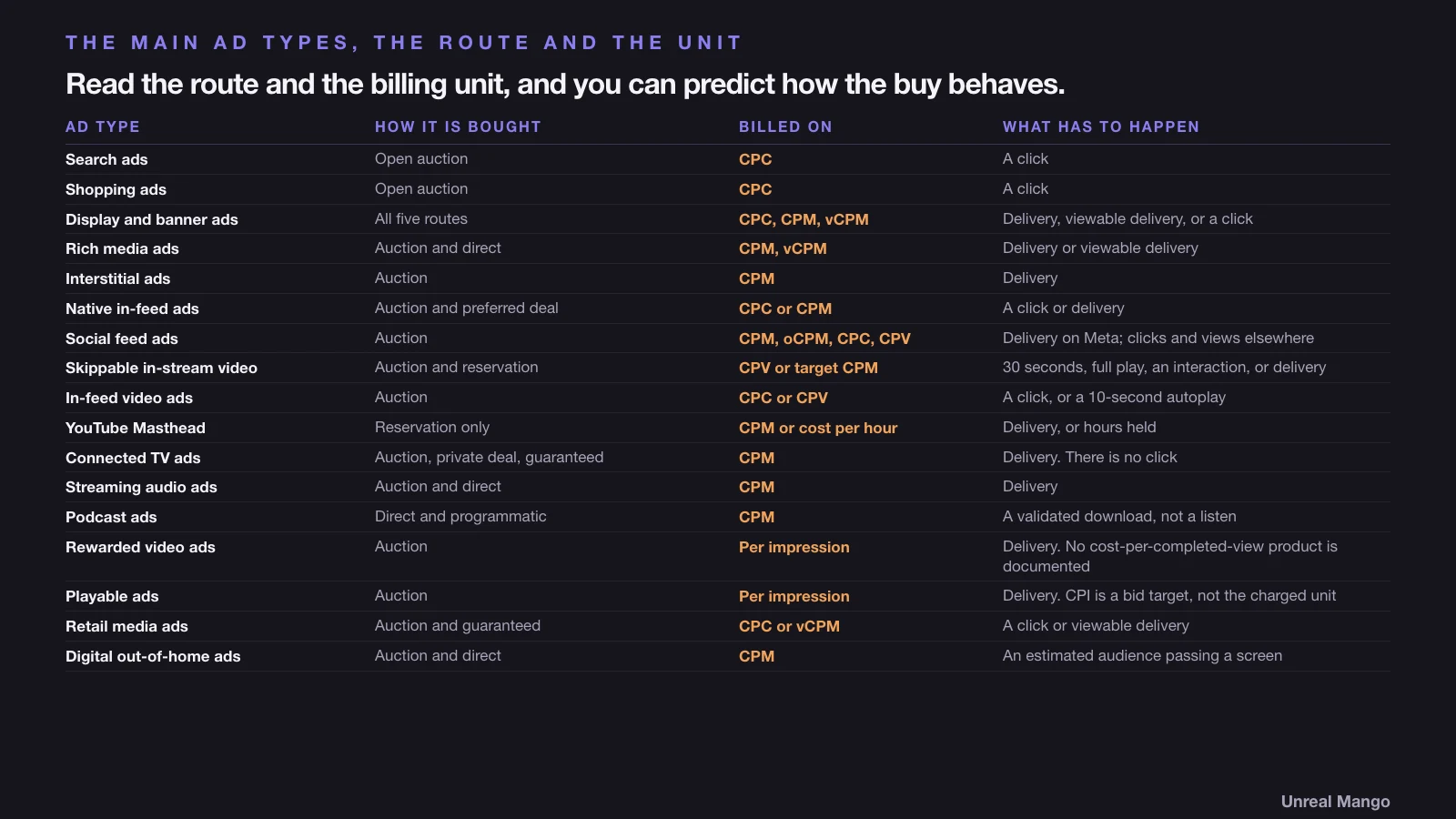
The practical rule: read the billing unit before you read the format name, and you will predict how the buy behaves.
One table: every ad type, how it is bought, and what triggers the charge
| Ad type | How it is bought | Billed on | What has to happen |
|---|---|---|---|
| Search ads | Open auction | CPC | A click |
| Shopping ads | Open auction | CPC | A click |
| Performance Max | Open auction | Mixed by channel | Clicks on Search, Shopping and Discover; CPM on YouTube in-stream |
| Display and banner ads | All five routes | CPC, CPM, vCPM, tCPM | Delivery, viewable delivery, or a click |
| Rich media ads | Auction and direct | CPM, vCPM | Delivery or viewable delivery |
| Interstitial ads | Auction | CPM | Delivery |
| Native in-feed ads | Auction and preferred deal | CPC or CPM | A click or delivery |
| Content recommendation ads | Auction | CPC | A click |
| Branded content | Direct insertion order | Flat fee | A published piece |
| Social feed ads, Meta | Auction | CPM | Delivery |
| Social feed ads, LinkedIn | Auction | CPM or CPC | Delivery or a click |
| Social feed ads, TikTok | Auction | CPM, oCPM, CPC, CPV | Delivery, a click or a view |
| Skippable in-stream video | Auction and reservation | CPV or tCPM | 30 seconds, full play, an interaction, or delivery |
| Non-skippable and bumper video | Auction and reservation | tCPM | Delivery |
| In-feed video ads | Auction | CPC or CPV | A click, or a 10-second autoplay watch |
| YouTube Masthead | Reservation only | CPM or cost per hour | Delivery, or hours held |
| Connected TV ads | Auction, private deal and guaranteed | CPM | Delivery |
| Streaming audio ads | Auction and direct | CPM | Delivery |
| Podcast ads | Direct and programmatic | CPM | A validated download |
| Rewarded video ads | Auction | Per impression | Delivery |
| Playable ads | Auction | Per impression | Delivery; CPI is a bid target, not the charged unit |
| Retail media, on-site | Auction | CPC or vCPM | A click or viewable delivery |
| Retail media, off-site | Auction and guaranteed | CPM | Delivery |
| Digital out-of-home ads | Auction and direct | CPM on publisher impressions | An estimated audience passing a screen |
What each platform publishes as a minimum to start
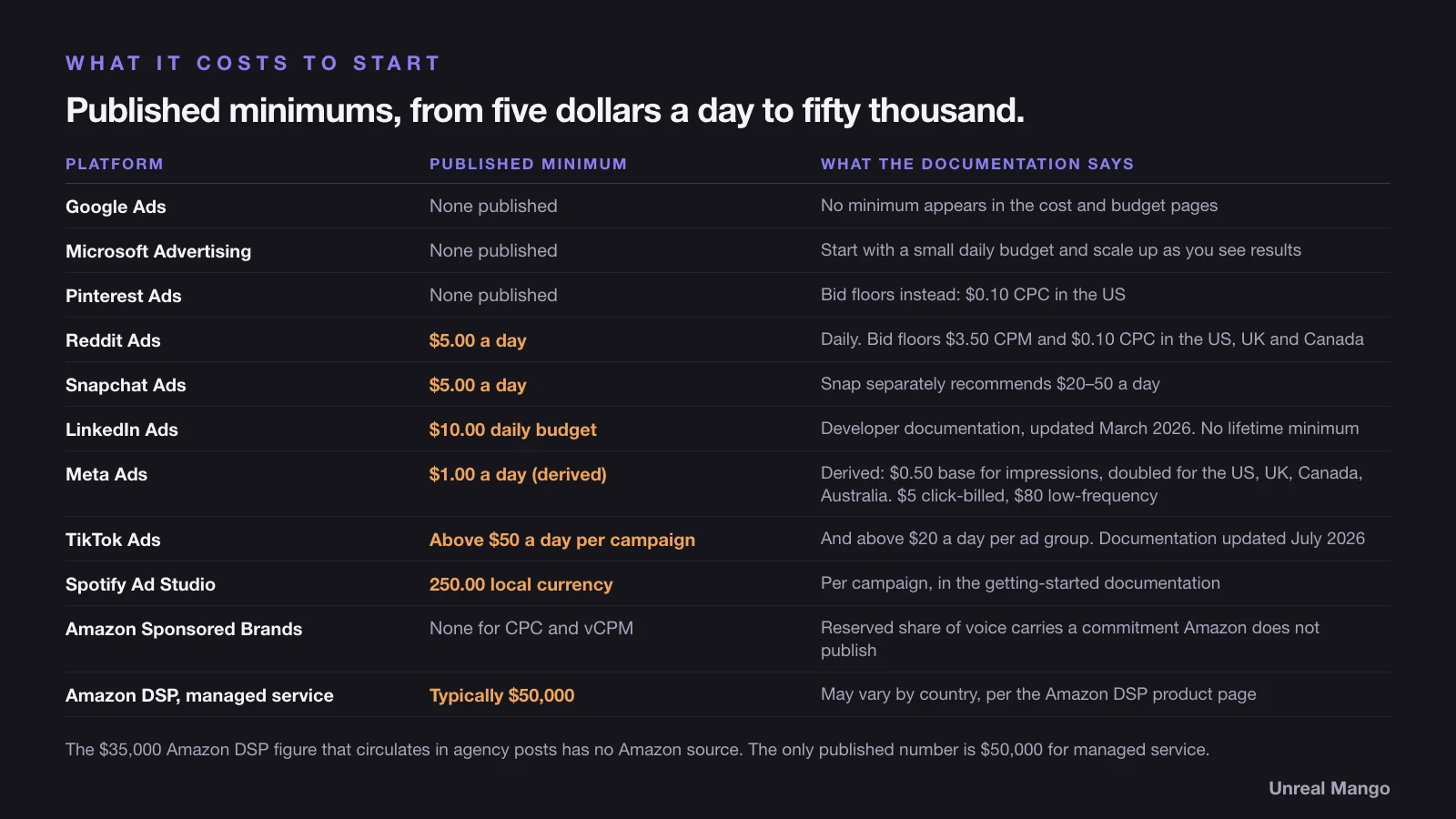
The distance between the cheapest and the most expensive entry point is the single most useful number in this guide, and it is rarely printed in one place.
| Platform | Published minimum | Where it is documented |
|---|---|---|
| Google Ads | None published | No minimum appears in Google’s cost and budget documentation |
| Microsoft Advertising | None published | New advertiser FAQs describe scaling from a small budget, with no floor |
| Pinterest Ads | None published | Budget articles document no figures; bid floors are published instead, $0.10 CPC in the US |
| Reddit Ads | $5.00 a day | Reddit’s advertising help centre, alongside bid floors of $3.50 CPM and $0.10 CPC in the US, UK and Canada. A separate lifetime minimum applies |
| Snapchat Ads | $5.00 a day | Snapchat’s pricing page, which separately recommends $20–50 a day |
| LinkedIn Ads | $10.00 daily budget | LinkedIn’s developer documentation, last updated March 2026. No lifetime minimum is documented |
| Meta Ads | $1.00 a day, impression-billed ad sets in the US, UK, Canada and Australia | Derived: the Marketing API sets $0.50 for impressions, $2.50 for clicks and $40 for low-frequency actions, doubled for the US, UK, Canada and Australia |
| TikTok Ads | Above $50 a day per campaign, above $20 per ad group | TikTok Ads Manager budget documentation, updated July 2026 |
| Spotify Ad Studio | 250.00 in local currency | Ad Studio getting-started documentation |
| Amazon Sponsored Brands | None for CPC and vCPM | Amazon publishes no minimum for CPC or viewable CPM campaigns; its reserved share-of-voice product carries a commitment it does not publish |
| Amazon DSP, managed service | Typically $50,000 | Amazon DSP product page; the minimum may vary by country |
Two of these are widely misquoted. Meta’s “$1 a day” is a derived figure, not a published one, and it applies only to impression-billed ad sets in a handful of countries; click-billed ad sets floor at $5 and low-frequency-event ad sets at $80. And the $35,000 Amazon DSP minimum that circulates in agency posts has no Amazon source; the only figure Amazon publishes is $50,000 for managed service.
Three questions that pick the ad type for you
Is there existing demand you can intercept, or do you have to create it? If people are already searching for the thing, search and shopping formats reach them at the moment of intent and bill only when they act. If nobody is searching, every click-billed format will underdeliver, and you are in impression-billed territory whether you like it or not.
Can you tolerate paying for delivery rather than for outcomes? This is a cash question, not a strategy question. Impression-billed formats — most social, all connected TV, most audio, all out-of-home, all rewarded video — take money at a rate set by delivery, not by results. Click-billed formats push the delivery risk back onto the platform. Budgets that cannot absorb a month of learning belong on the click-billed side of that line.
Do you need the inventory to be there on a specific date? Almost nothing in an open auction can be promised. If a launch depends on a specific placement on a specific day, you are in reservation territory — programmatic guaranteed or a direct insertion order — and that means a salesperson, a negotiated CPM, and an entry cost that is not published anywhere.
Most of the errors we find in inherited accounts are the second question answered by accident. A brand runs impression-billed social because that is what was set up, expects it to behave like search, and reads the resulting cost per lead as a performance problem rather than a billing-model mismatch. If that is uncomfortably familiar, it is the kind of thing our paid media work starts by unpicking.
Where the pixel sizes live
Deliberately absent from this guide: a single table of ad dimensions. Choosing an ad type and specifying the creative are different jobs done at different times, and specifications change often enough that a summary table inside a taxonomy article is stale within a quarter.
Each platform’s current dimensions, ratios, file weights, character limits and safe zones are maintained separately — Facebook ad sizes for the Meta placements, Instagram story dimensions for the vertical surface, LinkedIn ads dimensions for the B2B formats, TikTok ad specs for short-form video, and YouTube video aspect ratio for everything that plays in a player.
Pick the ad type here. Get the numbers there.
23 / Reader questions
Frequently asked questions
01What are the 7 types of online advertising?
Search, display, social, online video, native, audio and in-app advertising are the seven most lists settle on. Retail media, digital out-of-home and connected TV are the three that belong on a modern list and are usually missing. The count is arbitrary; what is not arbitrary is that each family is bought through a different route and billed in a different unit.
02What are some examples of digital ads?
A text ad above Google results, a banner on a news site, a sponsored post in an Instagram feed, a skippable ad before a YouTube video, a host-read spot in a podcast, a sponsored product tile on Amazon, a full-screen interstitial between mobile game levels, and a screen in a shopping centre selling programmatically. Each of those is a different format, sold a different way.
03What is the difference between digital advertising and digital marketing?
Digital advertising is the part you buy an impression of. Digital marketing is the whole discipline, including work you cannot buy an impression of at all — SEO, email to your own list, organic social, content. Several of the lists ranking for this term include SEO and email as types of digital advertising. They are not, on the only test that matters: there is no inventory owner selling you a slot.
04What is the difference between an ad format and an ad placement?
The format is the creative unit — a text ad, a six-second video, a carousel. The placement is the surface it appears on — a search results page, a feed, a mid-roll break. One format runs across many placements, and one placement accepts several formats. Confusing the two is why so many format lists mix Facebook, video and retargeting into one column.
05How much does it cost to start running digital ads?
Between nothing and $50,000, depending entirely on the platform. Reddit and Snapchat publish $5 a day. LinkedIn publishes a $10 daily minimum. TikTok requires more than $50 a day at campaign level and more than $20 at ad group level. Google and Microsoft publish no minimum at all. Amazon's DSP managed service typically requires $50,000.
06Are retargeting ads a type of digital ad?
No. Retargeting is a targeting method, not a format. A retargeted ad is still a display banner, a social feed ad, a video pre-roll or a sponsored product tile, bought through the same routes and billed in the same units as any other. Lists that put retargeting alongside display and video are mixing two different classification axes.
07Which type of digital ad is cheapest to test on a small budget?
Search ads on Google or Microsoft, because neither publishes a minimum spend and the auction charges per click rather than per impression. On the social side, Reddit and Snapchat both publish a $5 daily floor. The formats with real entry costs are the reserved ones — a YouTube Masthead or an Amazon DSP managed buy — because those are negotiated, not self-served.
08What does CPM actually mean, and how is it different from vCPM?
CPM is the cost of a thousand served impressions. Viewable CPM, or vCPM, is the cost of a thousand impressions that met a viewability threshold — for display, at least 50% of the ad's pixels on screen for at least one continuous second. The gap between the two numbers is the share of your served impressions that nobody could have seen.